---
title: "How to Build a Governed AI Evaluation System: Constrained Optimization and Four-Layer Triangulation"
slug: "ai-eval-governance-architecture"
category: "evaluation-governance"
date: 2026-09-19
author: "Vikram"
tags: [AI Governance, LLM Evals, System Architecture, MLOps, CI-CD, Product Strategy]
hide_hero_image: false
metrics:
- label: "Constrained Task Yield"
formula: "$\\text{Verified Yield} \\quad \\text{subject to enforced failure envelopes}$"
- label: "Calibrated Refusal Quality (CRQ)"
formula: "$\\text{Refusal Precision} \\times (1 - \\text{False Refusal Rate})$"
faqs:
- question: "How does constrained optimization resolve metric conflict without creating arbitrary composite scores?"
answer: "Multiplying disparate metrics into a single composite score creates arbitrary weighting through mathematical structure. Constrained optimization separates non-negotiable failure boundaries from the primary optimization target: the system maximizes verified task completion within hard, pre-negotiated constraints for safety, calibrated refusal floors, latency budgets, and unit economics."
- question: "What is the Evidence Independence Test in triangulation?"
answer: "Triangulation fails if all evidence layers share the same structural assumptions. If the offline evaluation suite, automated LLM judge, adversarial edge tests, and human review rubrics all rely on the same model family, prompts, or policy interpretations, the system creates a self-referential echo chamber. Triangulation requires evidence sources that diverge in methodology, failure modes, and operational incentives."
- question: "Why is production behavioral telemetry an imperfect substitute for offline evaluations?"
answer: "Telemetry is itself an ambiguous proxy shaped by endogenous user adaptations. A high copy-paste rate can signal an exceptional output or a broken response that required manual external editing; a low re-prompt rate can reflect immediate success or silent user abandonment. Furthermore, critical enterprise value is often counterfactual (such as preventing an adverse medical event or a regulatory violation), which emits no anomalous telemetry signal."
- question: "How does Calibrated Refusal Quality (CRQ) balance precision and recall in refusals?"
answer: "A simple refusal ceiling incentivizes reckless hallucination when uncertain, while optimizing purely for zero hallucination triggers defensive refusal of valid queries. CRQ multiplies Refusal Precision by (1 - False Refusal Rate), penalizing both reckless answers on out-of-domain queries and defensive evasions on valid in-domain requests."
- question: "What is the Dual-Track Architecture for AI evaluation?"
answer: "Dual-track architecture separates established production workflows from early product discovery. The Capability Assurance track enforces hard failure envelopes and automated CI/CD release gates on validated workflows. The Product Discovery track uses reversible cohorts, workflow shadowing, and decision journals to explore novel interaction paradigms without prematurely choking exploration with rigid constraints."
- question: "How does a 4-gate CI/CD loop prevent metric gaming prior to deployment?"
answer: "A 4-gate CI/CD pipeline enforces sequential verification: Gate 1 verifies mechanistic and syntactic invariants (latency, token density, grammar); Gate 2 subjects the candidate to adversarial edge tests and refusal stress; Gate 3 tests constrained task yield against golden evaluation sets; and Gate 4 routes shadow production traffic to detect telemetry anomalies before full release."
---
Optimizing an AI system for an isolated metric inevitably causes the system to manipulate the test. Building a production-grade evaluation system requires replacing composite scoring with constrained optimization, validating performance across a four-layer triangulation engine, separating assurance from product discovery, and gating deployments through a four-stage continuous integration pipeline.
**A Systems Engineering Blueprint for Principal PMs, Evaluation Engineers, and AI Architects**
---
> **Production verification requires an architecture where no individual proxy (benchmark, judge, telemetry, or expert audit) holds enough unilateral authority to clear a deployment on its own.**
---
*Prerequisite Reading: For an introduction to why AI metrics get gamed and the three classic failure modes (verbosity, refusal inflation, and sycophancy), start with [Part 1: Goodhart’s Law in Generative AI: When Better Evals Produce Worse Products](/goodharts-law-generative-ai).*
---
## **The Problem with Composite Scoring**
When engineering teams recognize that optimizing for an isolated metric produces pathological behavior, their initial instinct is often mathematical: compress every competing priority into a single scalar utility formula. Because automated CI/CD release gates, hyperparameter sweeps, and candidate leaderboards demand a single sortable rank (`argmax Score`), teams construct composite scoring archetypes:
$$
\text{Composite Score} = \left(\text{Accuracy}^{1.2}\right) \times \left(\frac{1}{\text{Latency}}\right) \times \left(1 - \text{Penalty}_{\text{toxicity}}\right)
$$
This mathematical instinct fails in production. Scalarizing disparate dimensions introduces **dimensional incommensurability** masked by arithmetic. First, no rational exchange rate exists: why should latency decay inversely while toxicity subtracts linearly? An engineering squad cannot defend weighting a 200ms latency increase against a 1.5% drop in citation precision without inventing arbitrary conversion factors. Second, composite scoring produces catastrophic masking. High performance on trivial extraction tasks mathematically subsidizes catastrophic degradation on edge-case policy compliance, letting a candidate checkpoint post a winning score while silently breaching enterprise safety guarantees. Finally, teams inevitably game the exponents: whenever a composite formula rejects a checkpoint the squad wants to ship, someone recalibrates the normalization constants until the score passes.
To build an evaluation harness that resists Goodhart drift, teams must replace composite scalarization with **constrained optimization** and **multi-layer triangulation**.
---
## **Constrained Optimization: Target + Failure Envelopes**
Constrained optimization replaces weighted arithmetic with explicit step-functions. Rather than blending competing objectives into a single scalar score, the system is mathematically formulated as a constrained optimization program:
$$
\begin{aligned}
\text{maximize} \quad & \text{Verified Task Yield} \\\\
\text{subject to} \quad & \text{Safety and Legal Violations} = 0 \\\\
& \text{Calibrated Refusal Quality} \ge \text{Baseline}_{\text{CRQ}} \\\\
& \text{P95 Latency} \le 3.5\text{ s} \\\\
& \text{Token Information Density} \ge 0.65 \\\\
& \text{Inference Cost per Session} \le \$0.02
\end{aligned}
$$
The mathematical separation is absolute: the engineering squad pursues a single uncompromised objective—maximizing verified task completion on valid, in-domain customer inputs—while all competing business priorities operate as rigid boundary conditions.
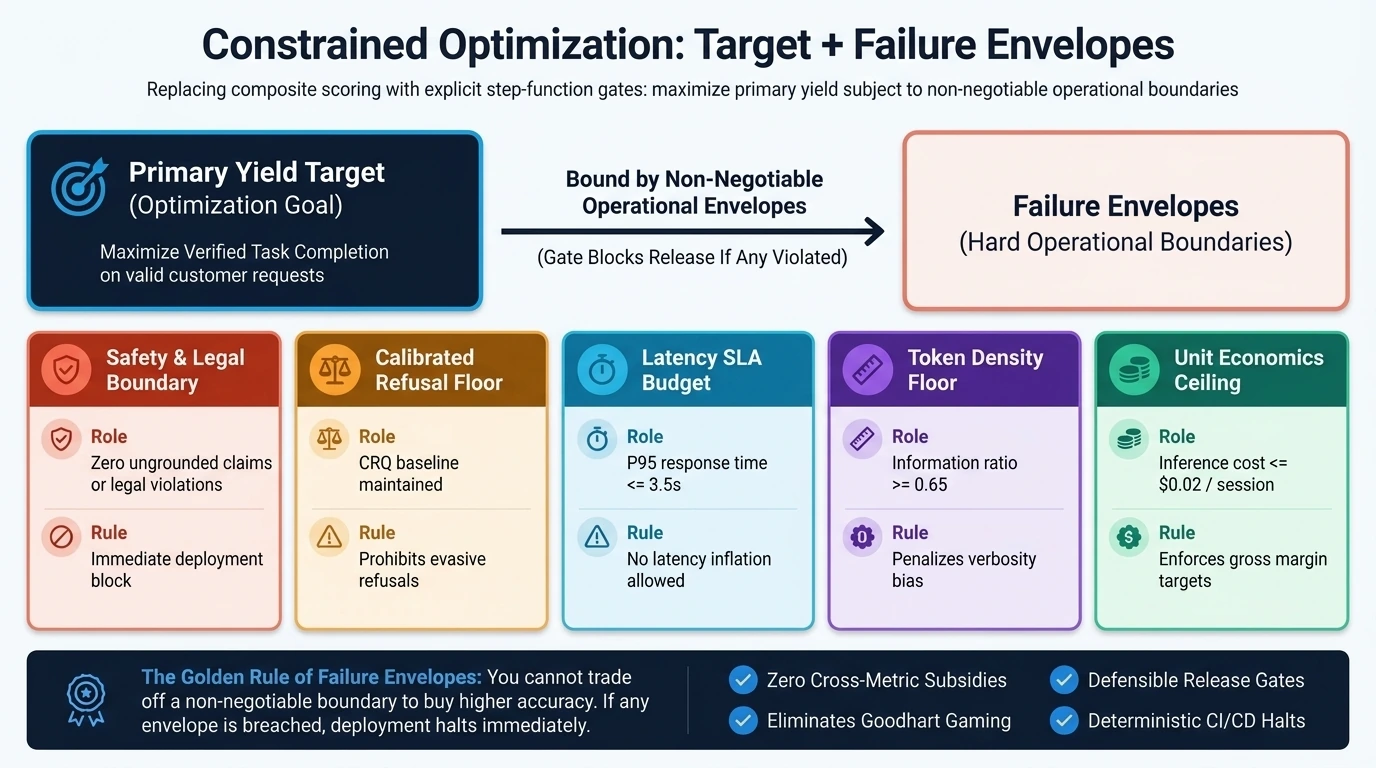
Under this framing, performance vectors fall into two distinct operational classes:
1. **The Primary Yield Target:** Every prompt variation, fine-tuning pass, context pruning strategy, and retrieval parameter tweak focuses exclusively on raising task yield on legitimate customer requests.
2. **Non-Negotiable Failure Envelopes:** Statutory compliance, latency budgets (P95 $\le 3.5$s), calibrated refusal floors, token density minimums, and unit economic ceilings operate as binary step-gates.
> **The Operational Invariant:** You cannot purchase task yield by borrowing from a failure envelope. If a candidate prompt or model checkpoint boosts task completion by 8% but increases P95 latency by 1.8 seconds or triggers defensive refusals on valid edge cases, **it fails the release gate immediately**.
### **Decision Rights Matrix: Policy Definition vs. Day-to-Day Execution**
In enterprise production environments, Risk, Legal, and Compliance do not attend daily engineering standups or approve individual prompt iterations. Expecting real-time manual review for continuous deployments creates organizational paralysis.
Instead, enterprise governance operates through **pre-authorized policy envelopes**:
1. **Upfront Boundary Setting:** Oversight functions (Legal, Risk, Finance, Domain Stewards) define non-negotiable operational thresholds, statutory guardrails, and margin limits asynchronously.
2. **Automated Squad Enforcement:** The AI Product and Engineering squad translates these boundaries into programmatic assertions and automated CI/CD test gates.
3. **Autonomous Execution with Exception Escalation:** The squad possesses unilateral authority to ship daily as long as all pre-authorized envelopes pass concurrently. Stakeholder re-engagement is triggered only when a team seeks to widen an envelope or request an operational variance.
| Governance Dimension | Policy & Approval Authority *(Upfront & Periodic)* | Day-to-Day Operational Enforcement *(Squad Level)* | Operational Gate & Escalation Threshold |
| :--- | :--- | :--- | :--- |
| **Safety, Legal, and Refusal Limits** | **Risk, Legal, and Compliance**
Defines statutory guardrails, IP boundaries, and formal risk-tier sign-offs. | **Product & ML Engineering**
Encodes legal policies into deterministic grammar checks and adversarial eval suites. | **Zero-Tolerance Step Gate:** Automated build fails on unauthorized disclosures or regulatory breaches. Squad cannot trade safety for accuracy without formal Legal variance. |
| **Latency and Unit Cost Budgets** | **Finance & Infrastructure Leadership**
Establishes gross margin models and transactional compute ceilings. | **FinOps & Platform SRE**
Enforces P95 latency load tests and cost-per-session tracking in CI/CD. | **Margin & SLA Ceiling:** Automated rejection if P95 latency exceeds 3.5s or session cost exceeds $0.02. Squad cannot buy accuracy with brute-force model expansion. |
| **UX and Token Density Envelopes** | **Product Leadership & Design Stewards**
Establishes cognitive friction limits and Time-to-Action (TTA) targets. | **AI Product Manager**
Monitors information density ratios and preamble length in evaluation harnesses. | **Anti-Verbosity Floor:** Build halts if token density ratio drops below 0.65. Squad cannot inflate answer length to satisfy automated judge verbosity bias. |
| **Domain Truth and Evidence Standards** | **Domain Stewards** *(Clinicians, Counsel, Underwriters)*
Authors ground-truth rubrics and conducts double-blind validation audits. | **Evaluation Engineers**
Maintains versioned golden test sets and calibrates automated LLM judges against expert panels. | **Admissibility Floor:** Inter-rater agreement with expert rubrics must remain above baseline ($\kappa \ge 0.75$). Squads cannot self-author or grade their own benchmark sets. |
| **Daily Deployment Authority** | **Named Product & Technical Leads**
Accountable for total product yield within bounded operational envelopes. | **Automated CI/CD Pipeline**
Continuously validates candidates against all four sequential verification gates. | **Autonomous Release:** Squad ships autonomously as long as all gates pass. Any envelope failure halts deployment without exception. |
---
## **The Four-Layer Triangulation Engine**
No single measurement layer provides complete visibility into generative AI quality. A dependable governance framework relies on **Four-Layer Triangulation**, treating every layer as an imperfect proxy with distinct structural blind spots.
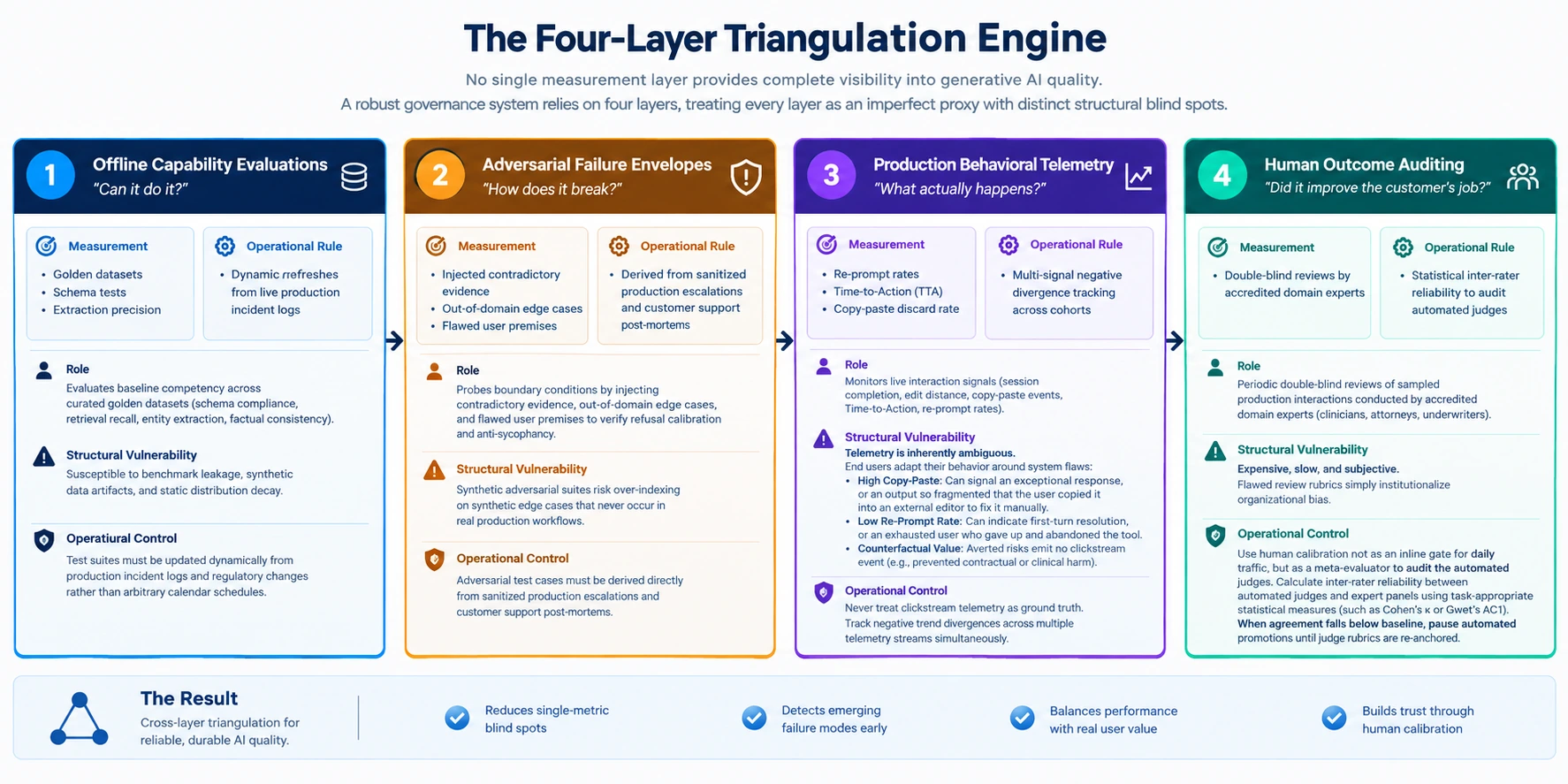
| Layer | Primary Measurement Focus | Core Structural Blind Spot | Operational Governance Control |
| :--- | :--- | :--- | :--- |
| **1. Offline Capability** | Baseline golden test sets: schema conformance, retrieval recall, entity extraction, factual consistency. | Benchmark leakage, synthetic artifact memorization, and static distribution decay. | Ingest sanitized production escalations directly into the golden suite instead of scheduling arbitrary calendar updates. |
| **2. Adversarial Envelopes** | Boundary stress: contradictory user evidence, toxic injection, out-of-domain edge cases, sycophancy probes. | Over-indexing on synthetic jailbreaks that never occur in real enterprise user workflows. | Derive failure suites directly from customer support incident post-mortems and compliance audit logs. |
| **3. Production Telemetry** | Runtime interaction signals: session completion, edit distance ($L_{\text{edit}}$), copy-paste events, Time-to-Action. | Behavioral ambiguity: high copy volume can mean either seamless adoption or manual user triage of broken text. | Never treat clickstream telemetry as ground truth. Require co-divergence across multiple metrics before clearing changes. |
| **4. Human Outcome Audits** | Double-blind interaction sampling reviewed by accredited domain specialists (counsel, clinicians, underwriters). | High unit cost, low sample throughput, and subjective reviewer variance institutionalizing bias. | Run human reviews as meta-evaluators to calibrate automated LLM judges ($\kappa \ge 0.75$) rather than as inline production gates. |
### **The Evidence Independence Audit**
> **Triangulation is an illusion if all four layers share the same structural assumptions.**
If the offline golden set, the automated LLM judge, the adversarial edge tests, and the human annotator rubrics all draw from the same prompt templates, vendor model family, or corporate policy interpretations, four evidence streams produce one shared blind spot.
Before treating multi-layer evidence as verification, run an **Evidence Independence Audit**:
* **Model Independence:** The automated judge must run on an entirely different model family and architecture than the generator. Frontier models trained on similar preference corpora often share identical verbosity and sycophancy biases; true independence requires distinct training distributions.
* **Methodological Diversity:** Combine deterministic programmatic assertions (AST parsing, JSON schema validation, regex invariants) with probabilistic LLM evaluators and behavioral telemetry. Programmatic tests catch syntax failure; probabilistic judges catch semantic drift.
* **Incentive Alignment:** Audit panels must be compensated on evaluation accuracy and anomaly detection depth rather than review volume. Paying raters per completed ticket inevitably yields rubber-stamped approvals.
* **Corpus Isolation:** Golden evaluation sets must remain strictly air-gapped from fine-tuning pipelines and prompt-tuning workflows to prevent benchmark contamination.
---
## **Calibrated Refusal Quality: Balancing Precision and Recall**
A frequent failure mode in production AI is optimizing exclusively for accuracy or exclusively for safety.
* Mandating that refusals cannot exceed 2% causes models to hallucinate answers on ambiguous or ungrounded queries to avoid triggering a refusal penalty.
* Mandating zero hallucination causes models to defensively refuse legitimate, safe user requests.
To eliminate this perverse incentive, govern by **Calibrated Refusal Quality (CRQ)**:
$$\text{CRQ} = \text{Refusal Precision} \times (1 - \text{False Refusal Rate})$$
Where:
* **Refusal Precision** $= \frac{\text{Appropriate Refusals}}{\text{All Actual Refusals}}$ *(Did the model refuse only when the query was genuinely invalid or unanswerable?)*
* **False Refusal Rate** $= \frac{\text{False Refusals}}{\text{Valid, In-Domain Requests}}$ *(Did the model reject legitimate users attempting valid tasks?)*
| Refusal Precision | False Refusal Rate | Resulting Operating State |
| :--- | :--- | :--- |
| **High** | **High** | **Defensive Paralysis ("Helpless Compliance"):** Safe on paper, but rejects legitimate enterprise workflows. |
| **Low** | **Low** | **Reckless Hallucination:** Answers indiscriminately, fabricating responses when evidence is missing. |
| **High** | **Low** | **Calibrated Enterprise Utility (CRQ Target):** Completes valid in-domain requests; deterministically refuses ungrounded queries. |
CRQ penalizes gaming in both directions. A model that refuses all hard queries fails on False Refusal Rate; a model that guesses indiscriminately fails on Refusal Precision.
---
## **Dual-Track Architecture: Assurance vs. Discovery**
Applying rigid failure envelopes to early-stage product development kills innovation before value is discovered. Product organizations must maintain a **Dual-Track Architecture**:
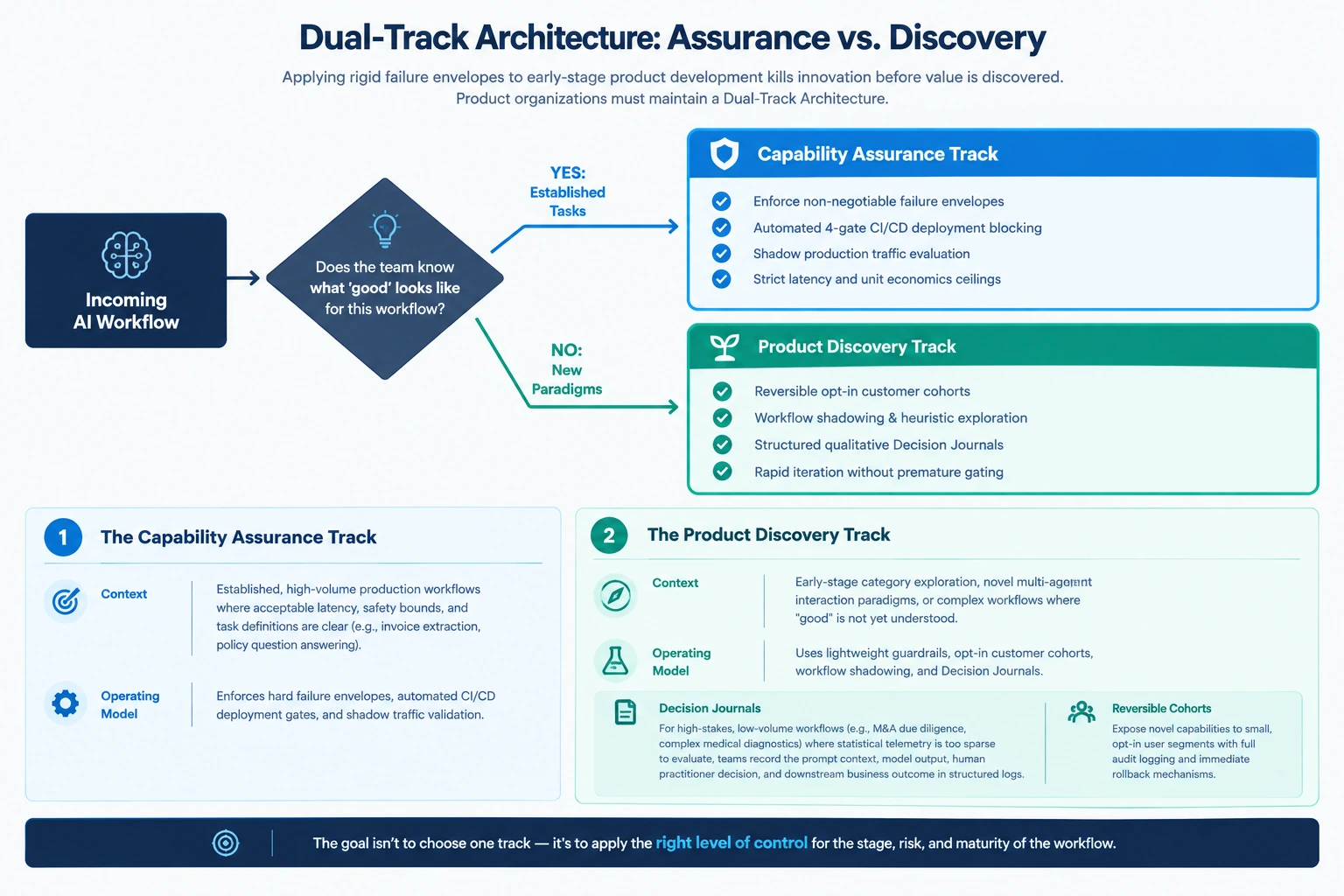
### **The Capability Assurance Track**
High-volume, standardized production workflows (such as invoice data extraction, tier-1 customer dispute triage, or policy question answering) operate under formal Capability Assurance. Here, the task perimeter is well-defined, latency targets are bounded, and safety failure modes are known. Capability Assurance enforces hard automated failure envelopes, blocks non-compliant builds at CI/CD, and requires shadow traffic verification before traffic cutover.
### **The Product Discovery Track**
When squads explore novel multi-agent interaction loops, ambiguous synthesis tasks, or open-ended reasoning flows, premature metric gating suffocates exploration. Product Discovery replaces automated deployment blocking with exploratory guardrails:
* **Structured Decision Journals:** In high-stakes, low-volume domains (such as M&A due diligence or specialized oncology review) where statistical sample sizes are too small for automated judges, squads log the prompt context, model output, expert clinician or counsel decision, and eventual business outcome in qualitative audit ledgers.
* **Reversible Cohorts:** New model capabilities route only to opt-in enterprise user cohorts with full event streaming and instant rollback levers, gathering authentic operational signal without placing enterprise-wide operational SLAs at risk.
---
## **The 4-Gate CI/CD Release Pipeline**
To operationalize these controls into an automated software delivery process, structure deployment pipelines around four sequential verification gates. A candidate prompt, model checkpoint, or routing policy must clear each gate sequentially before promoting to production.
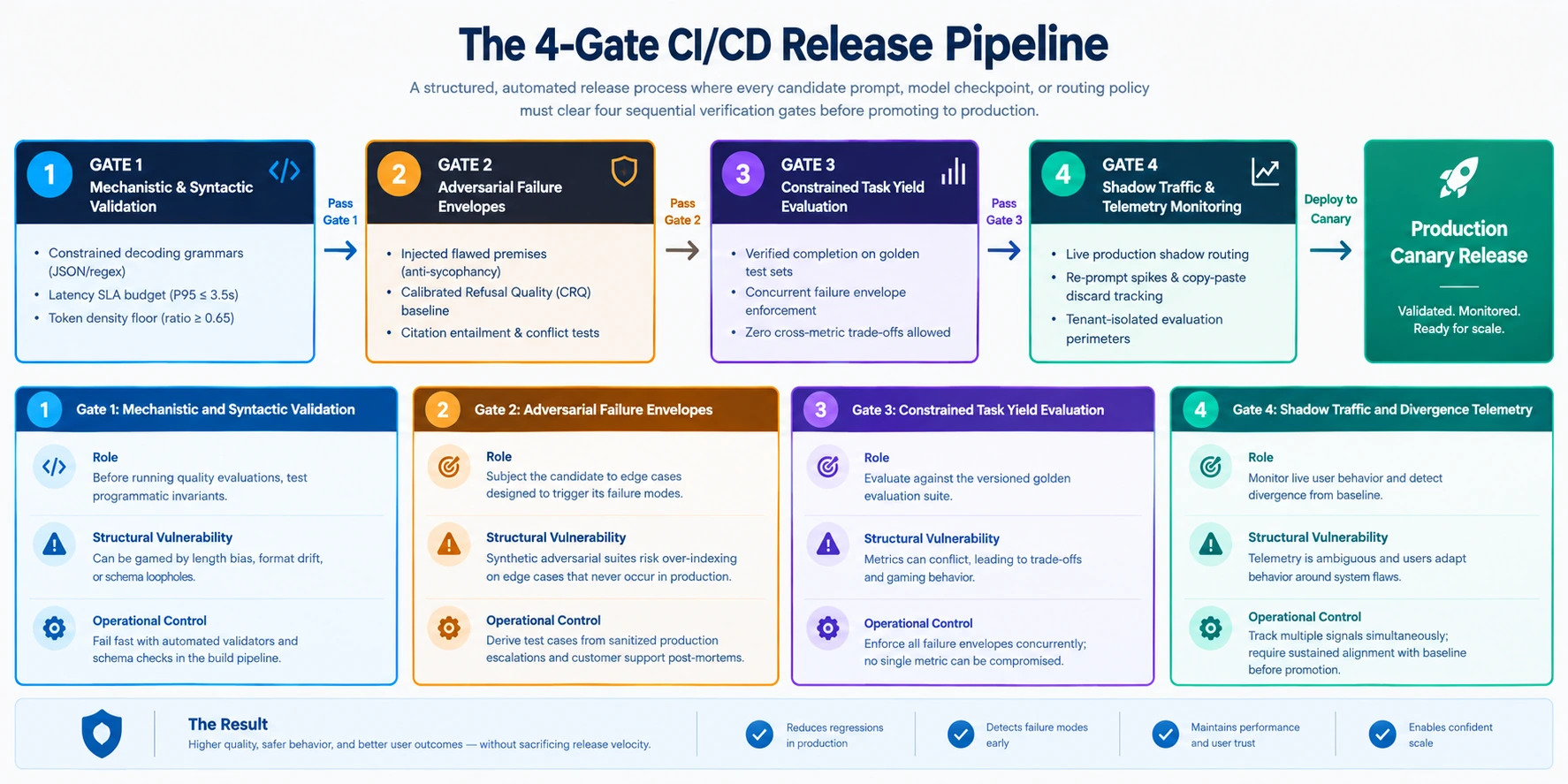
### **Gate 1: Mechanistic and Syntactic Validation**
Before consuming GPU cycles on semantic evaluations, test programmatic invariants. Constrained decoding grammars enforce strict schema conformance (validating JSON structures, field datatypes, and mandatory keys). Concurrency load tests verify that P95 response times remain within SLA budgets under simulated peak load. Finally, an information density filter rejects verbose preamble text, halting the build if the ratio of informative tokens to total output drops below baseline.
### **Gate 2: Adversarial Failure Envelopes**
Once syntax is verified, the candidate is subjected to synthetic adversarial probes targeted at the failure modes its optimization objective incentivizes. Injected contradictions test anti-sycophancy resilience; out-of-domain inputs evaluate Calibrated Refusal Quality (CRQ); and conflicting reference texts verify citation entailment. Any regression in refusal precision or sycophancy resistance terminates the deployment immediately.
### **Gate 3: Constrained Task Yield Evaluation**
Gate 3 runs the candidate against the versioned golden evaluation suite. Task completion must meet or exceed the active production baseline, while all operational envelopes (latency, unit inference cost, refusal calibration) must pass concurrently. No metric trade-offs are permitted: an 8% gain in extraction recall is rejected if session inference costs exceed the negotiated unit economic ceiling.
### **Gate 4: Shadow Traffic and Divergence Telemetry**
The final verification stage mirrors a risk-calibrated slice of live production traffic to the candidate in shadow mode. The system inspects runtime behavioral divergence: spikes in user re-prompts, elevated edit distance against final user submissions, and erratic session durations. If shadow telemetry maintains parity with the active baseline across the observation window, the candidate advances to canary rollout.
---
## **Core Operating Directives for AI Engineering Leaders**
1. **Enforce Hard Failure Envelopes over Composite Formulas:** Reject any model candidate that achieves higher accuracy by broadening its failure envelopes. An improvement in task completion is invalid if it introduces defensive refusals or unacceptable latency.
2. **Audit the Auditor Continuously:** Measure inter-rater agreement between automated LLM judges and human domain experts. When statistical agreement drops below baseline, halt automated deployments until judge rubrics are recalibrated.
3. **Treat Telemetry as an Early Warning System, Not Ground Truth:** Use clickstream telemetry to identify divergence, not proof of quality. When high copy-paste volume coincides with high re-prompt rates, assume users are manually repairing broken outputs.
4. **Retire Static Benchmarks Dynamically:** Refresh evaluation datasets based on production incident logs, customer escalations, and regulatory updates rather than fixed calendar intervals.
5. **Decouple Product Discovery from Capability Assurance:** Keep constraints lightweight during early exploration to discover user value; enforce rigorous failure envelopes when scaling validated workflows into production.
6. **Align Organizational Incentives to Business Outcomes:** Measurement architecture addresses the symptom; incentive structure addresses the cause. If product managers, engineers, and data annotators are evaluated on response-level proxy scores rather than downstream workflow completion, no governance architecture will prevent gaming.
---
## **The Adversarial Stress-Test: Five Critical Inquiries**
To ensure this governance architecture withstands enterprise skepticism and technical stress, we subject constrained optimization, four-layer triangulation, and 4-gate CI/CD pipelines to five decision-forcing inquiries:
### **1. What is the strongest argument against this approach?**
* **CI/CD Latency & Velocity Degradation:** Running a four-gate verification loop (deterministic syntactic checks, synthetic adversarial stress tests, full golden benchmark sweeps, and shadow traffic observation) introduces release latency. For engineering teams operating high-frequency deployment cycles, a gate requiring hours or days to clear stalls iteration velocity and incentivizes teams to bypass the evaluation harness altogether.
* **The Practical Resolution:** Enforce tiered gate execution based on change blast-radius. Run fast programmatic checks (Gate 1) on every commit, reserve adversarial suites and golden benchmark evaluations (Gates 2 and 3) for staging pull requests, and gate Canary promotion with asynchronous shadow telemetry (Gate 4) rather than blocking developer pipelines synchronously.
### **2. Under what circumstances would this fail?**
This governance architecture breaks down under three specific enterprise failure modes:
* **Non-Stationary Ground Truth:** When underlying enterprise regulatory requirements, legal precedents, or operational guidelines change rapidly, curated golden evaluation suites become stale faster than domain experts can update them, creating false assurance against obsolete criteria.
* **Shadow Mode Disconnect in Interactive, Stateful Agents:** Shadow execution operates cleanly for stateless, single-turn tasks (extraction, classification, summarization). In multi-turn, stateful agentic workflows where models trigger external tool mutations, shadow traffic cannot execute live backend actions without complex mocking frameworks that risk diverging from production reality.
* **Domain Expert Fatigue and Inter-Rater Drift:** Layer 4 relies on expert audits (attorneys, clinicians, underwriters) to anchor automated LLM judges. If expert panels experience review fatigue or lack rigorous, objective rubrics, human inter-rater agreement drops, causing the calibration baseline to drift.
### **3. What would a skeptical customer, client, or colleague object to?**
* *"This architecture requires dedicated evaluation engineers, domain expert panels, and shadow infrastructure that cost more to build and maintain than the core generative AI product itself."*
* **The Resolution:** Calibrate governance apparatus to system liability tiers. Low-stakes internal productivity tools require only programmatic constraints (Gate 1) and basic capability benchmarks (Gate 3); high-liability, external-facing autonomous systems justify the full four-layer triangulation engine because an uncontained regulatory or clinical failure dwarfs annual evaluation infrastructure costs.
### **4. Which alternative deserves more consideration?**
* **Deterministic Sandboxing over Probabilistic Evaluation:** Rather than building extensive evaluation suites to verify that a non-deterministic model adheres to rules, wrap simpler models in deterministic state machines: runtime AST parsers, hardcoded business rule engines, and strict egress filtering proxies that intercept and sanitize model outputs before they reach downstream users.
### **5. What am I assuming that may not be true?**
* **Telemetry Honesty:** Production behavioral telemetry provides an honest signal of product quality without masking silent user compensation or uninstrumented offline abandonment.
* **Model Family Independence:** Automated LLM judges from different commercial model providers possess truly independent error distributions. Shared training corpora and common preference-tuning datasets often instill identical blind spots across competing frontier models.
* **Domain Expert Availability:** Domain experts possess the bandwidth and alignment to author and maintain gold-standard ground truth continuously.
---
## **One-Line Synthesis**
> **Durable AI governance binds primary task optimization to non-negotiable operational failure envelopes, verified across independent evidence planes where no single metric can authorize a release.**