Capability vs. Reliability: Why the AI Products That Win Are Boring
Every enterprise software team knows how this plays out. You target an expensive, high-friction workflow. You prototype a tool against a curated batch of sample files, and the demo looks like magic. It extracts fields cleanly, catches subtle nuances, and leadership greenlights an enterprise pilot.
Six months later, the deployment is quietly deprioritized. Sometimes it dies because the model collapsed under the messy reality of production traffic. Just as often, it dies because it worked reliably on a task that didn't move the needle—it sat in an isolated browser tab, failed to integrate with the system of record, or created review overhead that cost more than the manual labor it was supposed to replace.
The enterprise AI graveyard is populated with both products that could not deliver consistent behavior at the tail and products that delivered consistent behavior on tasks nobody needed automated.
This bifurcation is documented across industry postmortems. The RAND Corporation's 2024 root-cause analysis found that over 80% of enterprise AI projects fail—more than double the rate of conventional software—driven either by models collapsing on messy production inputs or by initiatives launched without a clear business problem. MIT Sloan and BCG found that 7 out of 10 companies report negligible business impact from their AI investments, while Gartner projects that at least 30% of generative AI projects will be abandoned post-proof-of-concept.
Getting a model to stop hallucinating is only half the battle. The products that survive win because they solve the practical balance sheet of deployment, not just the accuracy score.
What Reliability Actually Means
Reliability is not a single number. In enterprise software, it is a bundle of distinct operational promises:
- Getting the right answer (Task correctness): Does the output accurately reflect domain facts for the specific task?
- Knowing when to say "I don't know" (Calibration and refusal): When the model is uncertain, does it flag its doubt explicitly, or does it invent a plausible answer with high confidence?
- Handling ugly inputs (Robustness): Does performance hold up when someone uploads a poorly formatted document, asks a question in casual shorthand, or tries to trick the prompt?
- Speed under load (Availability and latency): Does the system consistently meet its response-time targets during peak hours, or does it crawl when traffic spikes?
- Recovering from failure (Recoverability): When something breaks, does the system fail loudly and cleanly at the boundary, or does it silently corrupt downstream workflows?
- An audit trail (Auditability): Can you prove to an auditor six months later why the system made a specific decision, what data it relied on, and which policy version ran?
A product can satisfy several of these promises and still fail where it counts. An extraction pipeline that outputs valid, beautifully structured JSON containing the wrong vendor name is reliable at formatting, but useless at the actual job. Before arguing over accuracy percentages, teams have to agree on which of these dimensions matter for their specific workflow, and how high the bar needs to be before granting the system more autonomy.
The Demo-to-Production Chasm
A demo is staged to succeed. The documents are clean, the questions are polite, the edge cases are scrubbed, and everyone in the room wants to be impressed.
Production is the exact opposite. It is messy spreadsheets, angry customers, weird edge cases, server lag, and normal organizational entropy.
The Demo-to-Production Chasm is the distance between how an AI behaves during that sunny sales call and how it behaves under live fire. If a tool has a very narrow job, this gap is manageable because there are only so many ways users can break it. But for open-ended assistants and autonomous agents, the gap can be fatal. The model is exposed to thousands of bizarre inputs that never appeared in the sales pitch.
A demo samples a cherry-picked region of the input distribution. A procurement compliance audit samples the pathological tail. These are not the same test.
Three structural forces break between the demo and real life:
Real users are messy. Demos run on clean documents and polite questions hand-picked by the sales team. Real users do things like paste in scanned 40-page PDFs full of weird formatting, ask questions in broken English, or hammer the same prompt six times because the first five answers annoyed them. A model with a 3% error rate in a demo can easily hit a 20%+ error rate in production, simply because everyday employees don't behave like curated benchmark datasets.
The plumbing starts to creak. In a demo, the model runs in a quiet sandbox against a small sample database. In production, every query has to hit live search indexes under heavy traffic, navigate permissions, and pass through safety filters that add lag. A system that felt snappy in a slide deck suddenly times out, loses context, or pulls stale data when real load hits.
Auditors hunt for failures, not successes. A sales team wants to see what the tool can do on its best day. Enterprise risk and procurement teams want to know what happens on its worst day. If a query is ambiguous, does the model admit it doesn't know, or does it hallucinate financial data and legal terms? In regulated industries, 90% average accuracy doesn't matter if the remaining 10% creates a compliance disaster. Auditors get paid to find the cracks, not applaud the demo.
The PM's Enterprise Pilot Decision Matrix: Demos vs. Deployable Reality
When evaluating a new feature or enterprise pilot proposal in a product roadmap review, use this decision matrix to separate sales demo enthusiasm from deployable operational reality:
| Operational Dimension | What Looks Flawless in the Sales Demo | What Quietly Kills the Pilot in Month Three | The Hard Question the PM Must Answer |
|---|---|---|---|
| Input Cleanliness | Clean text files and polite, grammatically perfect prompts. | Rotated smartphone scans, messy multi-tab spreadsheets, and slang. | "What is our error rate when customer inputs deviate from our golden benchmark fixtures?" |
| Human Review Drag | Evaluator clicks "Approve" on a 1-paragraph summary in 2 seconds. | Double-checking a 60-page contract takes 15 minutes of an attorney's time. | "Does checking the AI's homework take more time than having an associate draft it from scratch?" |
| Refusal Discipline | Assistant politely declines obvious trick or policy questions. | Assistant refuses 25% of valid customer requests, overwhelming human queues. | "What does a 20% false refusal rate cost us in human support escalations and customer churn?" |
| Plumbing & Systems of Record | Runs isolated in a browser tab against a mock SQLite sandbox. | Must read/write across legacy on-prem SAP/Oracle instances with role permissions. | "How much will change management and API integration cost compared to the software license?" |
| Rollback & Blast Radius | Agent executes a single mock API call cleanly on a stage. | Agent enters an autonomous retry loop and fires 50 duplicate transactions into prod. | "Can an operator kill the execution loop and reverse all database mutations with one click?" |
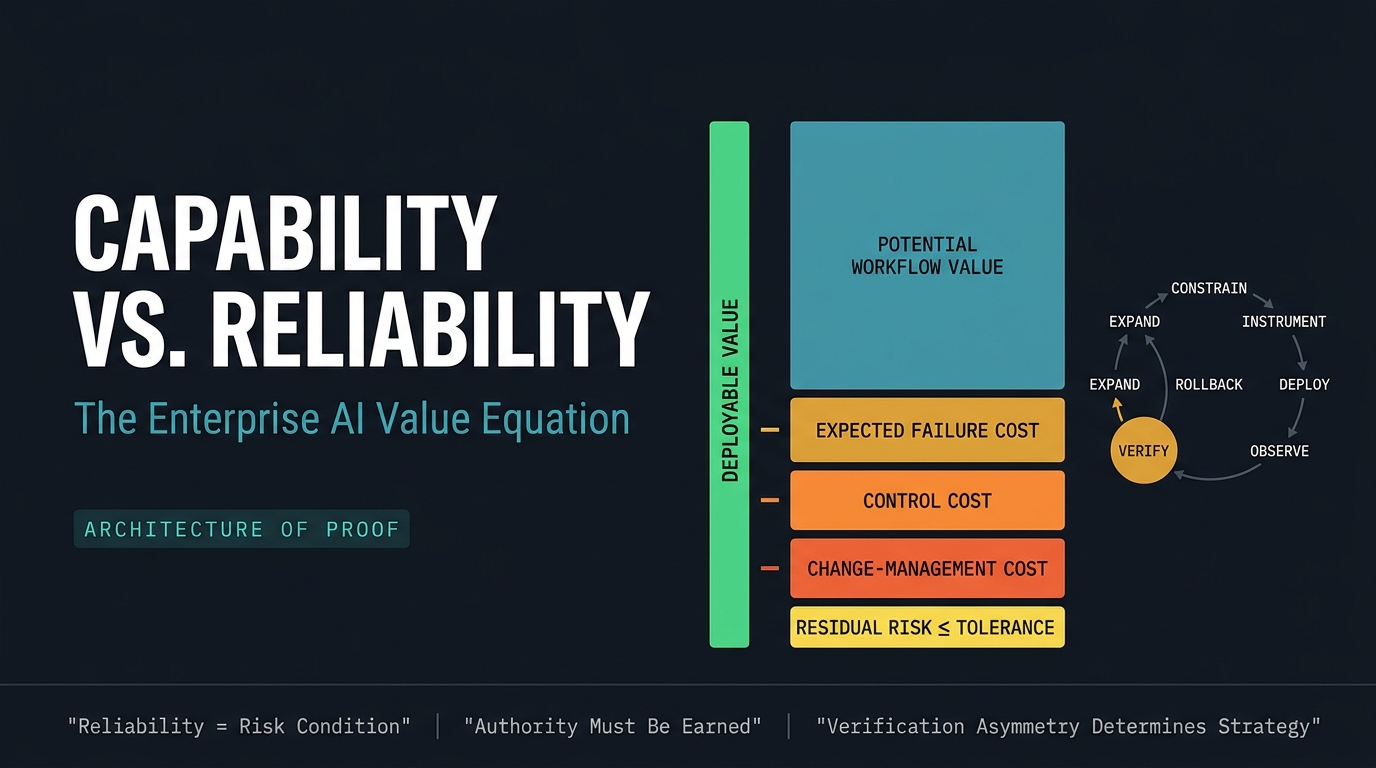
The Deployable Value Equation
The real question for an enterprise buyer is never just "is this model reliable?" The question is: "after paying for all the safety guardrails, staff retraining, and error cleanups, does this tool actually save us money without getting us sued?"
$$ \begin{aligned} \text{Deployable Value} = &\ \text{Potential Workflow Value} \\ &- \text{Expected Failure Cost} \\ &- \text{Control Cost} \\ &- \text{Change-Management Cost} \end{aligned} $$
$$\text{subject to: } \text{Residual Risk} \le \text{Risk Tolerance}$$
Here is what those terms mean in production:
- Potential Workflow Value: The gross hours or dollars the system could save if it operated in a frictionless vacuum.
- Expected Failure Cost: What you pay when the model gets things wrong: customer churn, compliance fines, and engineering incident triage.
- Control Cost: What you spend to keep the system in line: schema validation, safety filters, human reviewers, and audit logging infrastructure.
- Change-Management Cost: What it costs to get people to actually use it: retraining staff, updating operational playbooks, and building API integrations into legacy systems. This is usually the largest bill, and the one teams underestimate most.
What quietly breaks this equation is verification asymmetry—how hard it is for a human to check the AI's homework.
When verification is cheap (code compiles or crashes; a rough draft looks good or silly), imperfect AI tools thrive. Users catch mistakes with zero friction. But when verification is expensive (verifying an indemnification clause across a 60-page contract; checking an insurance claim against medical charts), the cost of double-checking eats up all the time the AI saved. If a senior lawyer has to re-read the original contract to trust the extraction, you haven't automated anything—you've just added a review step.
This explains why component reliability does not equal workflow value. An extraction tool that scores 99% accuracy creates zero deployable value if its outputs land in an isolated browser tab, require manual copy-pasting across three legacy databases, or accelerate a 30-second draft while leaving a three-week legal approval bottleneck untouched. A component that handles 60% of cases inside a workflow that still consumes the same total human-hours hasn't created business value; it has just created an accurate component.
The risk constraint is a hard gate, not a slider. If a deployment looks profitable on paper but violates the company's risk tolerance for confident errors in a regulated workflow, procurement kills it immediately. On the flip side, a system that passes every risk check with zero errors but generates negative net value will get abandoned just as fast. It is perfectly safe, but commercially useless.
The stakeholder table below maps the equation's terms to the evaluation concerns of each buyer:
| Stakeholder | Primary concern | Maps to |
|---|---|---|
| Business sponsor | Workflow coverage & net ROI | Potential Workflow Value & Deployable Value |
| Users | Speed & daily utility (minimal review drag) | Potential Workflow Value (net of verification friction) |
| CFO | Total cost of ownership & cash payback | Control Cost + Change-Management Cost |
| Compliance / Legal | Regulatory exposure & auditability | Residual Risk ≤ Risk Tolerance (Hard Gate) |
| IT Security | Attack surface & data perimeter | Control Cost + Residual Risk |
| Procurement | Contractual defensibility & vendor SLAs | Expected Failure Cost + Residual Risk |
The business sponsor and users push for the gross upside. Compliance, legal, and procurement enforce the risk constraint. IT and the CFO tally the deductions. The negotiation between these six parties is where deployment scope, authority level, and the required control architecture actually get set.
To make the equation concrete, consider a stylized contract-review assistant that handles 70% of incoming contracts autonomously, with the remaining 30% requiring attorney review:
| Term | Item | Amount |
|---|---|---|
| Potential Workflow Value | Avoided associate hours (annualized) | +800K |
| Expected Failure Cost | Remediation, misfiled exceptions, one projected regulatory inquiry | −120K |
| Control Cost | Schema validation, audit infrastructure, sampling QA | −95K |
| Change-Management Cost | Workflow redesign, attorney retraining, integration engineering | −210K |
| = Deployable Value | 375K | |
| Residual Risk | Within tolerance if error rate holds at target | ✓ |
That 375K figure—not the 800K gross value the demo suggested, and not zero because the system is not 100% reliable—is the correct number to defend in the business case.
Why Are Reliability and Narrowness Not the Same Thing?
When an AI product struggles with errors, the default engineering reaction is to make it narrower: shrink the scope, restrict the questions, and lock down inputs until the error rate drops.
Narrowing is one way to get consistency. It isn't the only way, and doing it blindly can kill your product. If you make a tool so narrow that it only handles 10% of an employee's day, they will simply stop opening it. Meanwhile, a competitor who figures out how to handle a wider scope with better guardrails will capture the entire workflow.
Reliability is about how predictably a system behaves on the inputs it accepts. Narrowness is just one architectural strategy to get there. You can build reliable products with broad scope by adding four practical controls:
JSON schemas with strict validation gates. Make the model return structured JSON and validate it against a strict schema before any downstream database sees it. If the JSON is invalid, reject and log it immediately. Keep in mind: valid JSON only proves the structure is right, not that the facts inside are true. A model can return a perfectly formatted JSON payload that names the wrong vendor. Schemas turn silent parsing crashes into observable events, but you still need business-rule checks to confirm the content is correct.
Deterministic front doors. Put a fast, simple classifier at the front door to intercept out-of-scope requests before they ever reach the generative model. Don't let an open-ended LLM guess whether a question belongs in a benefits portal. But test the router separately: an overcautious router rejects legitimate user requests, while an undercautious router lets garbage reach the model.
Explicit refusal examples in the prompt. Don't just show the model what a good answer looks like; show it what to reject. Include concrete negative examples in your prompt instructions and provide a dedicated refusal_reason field in the output schema so the model signals uncertainty cleanly instead of guessing.
Treating human review as a measured cost, not magic. Putting a "human in the loop" doesn't automatically fix risk. In real production environments, human reviewers get tired, skim outputs under deadline pressure, and succumb to automation bias. If your human reviewers approve 99% of outputs without reading them, they aren't providing oversight; they are adding an expensive latency tax. The test is whether the human-plus-AI workflow produces better outcomes than the old manual baseline, at a cost that still justifies the software.
Earned Authority: The PM Framework
In traditional engineering, you don't grant a new system full production privileges on day one. You give it access gradually as it proves it won't break things. SRE teams use error budgets; DevOps teams use canary releases.
Enterprise AI requires the exact same discipline: Earned Authority. A system shouldn't be allowed to execute payments, update clinical charts, or email customers just because its demo looked smooth. It should earn autonomy step-by-step as production telemetry proves it can handle the risk without costing more to supervise than it saves.
Capability creates potential operational value. Reliability is the risk condition for deploying it. Workflow economics determine whether deploying it is worthwhile. Authority expands when all three align.
The product lifecycle that follows from this:
graph LR
    C["Constrain\nInitial scope + controls"] --> I["Instrument\nTelemetry + audit logging"]
    I --> D["Deploy\nProduction with human review"]
    D --> O["Observe\nError distribution by cohort\n+ workflow economics"]
    O --> V["Verify\nFour-condition expansion gate"]
    V -- "All conditions met" --> E["Expand\nScope, autonomy, or authority"]
    V -- "Any condition fails" --> R["Roll back or remediate\nShrink scope or add control"]
    E --> O
    R --> C

    style V fill:#fff8e1,stroke:#ffa000,stroke-width:2px
    style E fill:#e8f5e9,stroke:#388e3c,stroke-width:2px
    style R fill:#ffebee,stroke:#d32f2f,stroke-width:2px
The Verify gate requires four practical conditions simultaneously:
$$ \text{Expand authority if} \begin{cases} \text{Residual risk} \leq \text{Risk tolerance} \\ \text{Net workflow value} > 0 \\ \text{Verification cost} \leq \text{Value captured at expanded scope} \\ \text{Accountability and rollback are viable} \end{cases} $$
Each condition can block expansion on its own: - A tool that passes every safety check but loses money at broader scale stays constrained. - A tool where verifying outputs at scale costs more than the manual labor saved stays constrained. - And a system without a fast, reliable rollback switch should never be expanded, regardless of its accuracy metrics.
The most common failure here is executive impatience. Teams agree to these gates during planning, but face commercial pressure to unlock autonomous features before the production data supports it. The fix is operational discipline: treat scope expansion like a formal deployment release, complete with clear metric thresholds, named owners, and automatic rollback triggers if error rates spike.
Remember two hard rules: a model update and an input distribution shift both reset the gate. Production mileage accumulated on one model does not transfer to a newer, flashier release. If you swap models or expand to a new customer segment, re-run the entire evaluation gate from scratch.
The Refusal Cost Equation
Telling a model to say "I don't know" sounds like the safest possible advice. But refusals are not free.
When a customer support assistant refuses 25% of incoming tickets and kicks them to human agents, you haven't automated support—you've built an expensive triage queue. If the cost of handling those false refusals exceeds the value generated by the 75% it resolved, the deployment is in the red.
The optimization target is the total expected cost of failure:
$$ \begin{aligned} \text{Total Failure Cost} = &\ \underbrace{\text{Cost}(\text{Confident Errors})}_{\text{Blast Damage + Remediation}} \\ &+ \underbrace{\text{Cost}(\text{False Refusals})}_{\text{Human Review + Lost Velocity}} \end{aligned} $$
The goal of reliability engineering is not to drive refusal rates as high as possible. It is to find the minimum of this total cost:
- Confident Error Cost: What you spend on incident triage, customer remediation, and liability when the model hallucinates or takes the wrong action.
- False Refusal Cost: What you spend on human review queues, operational latency, and lost user trust when the model needlessly rejects valid requests.
Set an explicit ceiling for your refusal rate based on human team capacity. If your system approaches that ceiling, investigate whether the model is genuinely confused (requiring better context and training data) or if your front-door router is simply miscalibrated. Watch user behavior closely: when users hit refusals, they often don't escalate to humans; they abandon the tool, rephrase the prompt until the safety check breaks, or silently copy-paste unverified text.
A confident error and a false refusal are both failures within the total cost framework. The optimization problem is minimizing total expected failure cost across both failure modes, not minimizing one at the expense of the other.
Compounding Errors in Autonomous Agents
The capability-reliability gap hits its extreme in autonomous multi-step agents.
When you chain together multiple model calls, database searches, API triggers, and conditional logic, errors compound quickly. If each individual step is 95% reliable on its own, a five-step chain has barely a 77% chance of finishing cleanly. In production, errors are rarely independent: a bad document retrieval in step one poisons every reasoning step and API call that follows.
This is why long, ungated agent loops fail in enterprise settings. When an agent runs unsupervised for ten minutes and commits an action directly into production, fixing the downstream wreckage takes hours.
graph LR
    subgraph Gated ["Short pipeline with validation gates"]
        direction LR
        S1["Step 1"] --> SV1["Gate"] --> S2["Step 2"]
        SV1 -- "Fail" --> SR["Halt + log"]
        S2 --> SV2["Gate"]
        SV2 -- "Pass" --> SC["Commit"]
        SV2 -- "Fail" --> SR
    end

    subgraph Ungated ["Long agentic loop, no intermediate gates"]
        direction LR
        A1["Step 1"] --> A2["Step 2"] --> A3["Step 3"] --> A4["Step 4"] --> A5["Step 5"]
        A5 --> AR["Commit\n(errors propagate silently)"]
    end

    style SV1 fill:#e8f4f8,stroke:#0288d1,stroke-width:2px
    style SV2 fill:#e8f4f8,stroke:#0288d1,stroke-width:2px
    style SR fill:#ffebee,stroke:#d32f2f,stroke-width:2px
    style SC fill:#e8f5e9,stroke:#388e3c,stroke-width:2px
    style AR fill:#ffebee,stroke:#d32f2f,stroke-width:2px
The diagram makes the architectural point clear: - The ungated loop accumulates small errors silently across steps and dumps them into production as a single catastrophic commit. - The gated pipeline places deterministic checks at every step boundary. If step two produces invalid data, the system halts, logs the failure, and alerts human operators before corrupting downstream databases.
The Adversarial Stress-Test: Five Critical Inquiries
1. What is the strongest argument against this approach?
The winning product isn't always the one with the lowest error rate. It is the one that delivers the highest risk-adjusted value for the least organizational friction.
A reliable system can easily be commercially useless. In many knowledge-work settings, the real baseline isn't "AI versus flawless human work"—it is overwhelmed staff, backlogs, inconsistent judgment, and delayed decisions. A tool that is somewhat imperfect can still be a massive upgrade over the current operational reality, and buyers will happily choose it over a hyper-reliable tool that only handles 5% of their cases. This is why coding assistants and draft generators won on raw capability despite mediocre reliability: developers can test code instantly. The reliability-first framework matters most where checking outputs is painfully expensive and mistakes cause serious damage.
There is also a strategic risk: the engineering guardrails you build today—regex checks, few-shot prompt sets, and rigid JSON wrappers—might become technical debt as frontier models improve. A competitor might skip your scaffolding entirely, drop in a next-generation model, and move faster. Earned authority treats model updates as a reason to re-test the gate, but it doesn't guarantee your custom plumbing remains a durable moat.
2. Under what circumstances would this fail?
Earned authority works smoothly when you can measure ground truth quickly and attribute results directly to the AI. It starts to creak when:
- Correctness is subjective: In corporate strategy, executive briefing, or policy interpretation, experts routinely disagree on what "correct" means. You can't set a clean error threshold when human reviewers disagree 30% of the time.
- Outcomes take months to surface: In fraud detection, credit underwriting, or clinical diagnoses, you often don't find out if the AI made a mistake until months later. A near-term error gate won't catch these lagging failures.
- Users game the system: Once a tool goes live, employees change how they work. If the bot is overly conservative, users will simply rephrase questions or copy answers without reviewing them, skewing your telemetry.
When these conditions apply, expansion decisions have to rely on wider confidence intervals and conservative rollbacks rather than clean real-time thresholds.
3. What would a skeptical customer, client, or colleague object to?
A business sponsor doesn't care about your F1 score. They will ask: "Does this actually save our team time, or does handling the exceptions wipe out the gains? Why should I buy a narrow, restricted tool when I could deploy an open copilot that handles everything with human review?" You need a financial model that shows net hours saved and a 90-day milestone, not a benchmark chart.
A legal or compliance officer will remind you that audit logs and JSON schemas are just basic hygiene. Legal defensibility requires clear data ownership, documented retention policies, incident escalation plans, and proof that your safety controls were actually running when a disputed decision was made. Logging an error doesn't protect the company if nobody acted on it.
4. Which alternative deserves more consideration?
Risk-tiered workflow automation deserves serious consideration as an alternative to the narrow-first approach.
Instead of restricting the entire product to a tiny set of inputs, tier the workflow by consequence: - Low-stakes, reversible tasks: Give the AI broad scope with minimal oversight (drafting an internal memo, summarizing public notes). - Medium-stakes tasks: Automate broadly, but sample outputs for QA and post-hoc human review. - High-stakes, irreversible tasks: Require pre-action validation and keep authority narrow, regardless of how capable the model feels.
This separates the scope question from the authority question. A product can be broad on low-consequence work while remaining locked down on critical tasks.
5. What am I assuming that may not be true?
- That reliability is the primary failure mode: In most failed enterprise pilots, bad change management and lack of workflow integration kill adoption long before hallucinations do.
- That refusal counts reflect clean safety: High refusal rates often mask shadow workarounds where frustrated employees bypass the tool or paste unverified text off-platform.
- That human oversight is a steady-state safeguard: High volume and fatigue inevitably turn human checkpoints into rubber stamps over time.
- That reliability engineering is a durable moat: Guardrails and schemas quickly become commoditized table stakes; defensibility comes from proprietary domain eval sets and deep system-of-record integrations.
One-Line Synthesis
Enterprise AI earns the right to broader authority when residual risk is within tolerance, net workflow value is positive, verification cost is covered by value captured, and rollback is viable—reliability is the risk condition, not the complete business case.
Frequently Asked Questions
Does reliability always beat capability in enterprise AI?
No. Reliability is one necessary condition for deployment, not the sole determinant of enterprise value. A reliable system can still be commercially irrelevant if it does not reduce meaningful workflow effort, integrate into the system of record, or improve cycle time. The complete value question requires workflow coverage, integration fit, adoption, and economic viability alongside reliability.
What is the Demo-to-Production Chasm?
The gap between what an AI system demonstrates under curated conditions and what it delivers against real production traffic: messy inputs, adversarial edge cases, off-topic queries, multi-tenant load, and the full distribution of user intent rather than the representative sample shown during a sales cycle.
What does reliability mean in this framework?
Reliability is not one metric. It includes task correctness, calibration and refusal behavior, robustness to input variation, operational availability and latency, recoverability after failure, and auditability. A system can be reliable in one dimension and unsafe in another. The relevant reliability vector depends on what the workflow requires.
What is Earned Authority in AI product development?
The principle that an AI system should receive expanded operational authority—broader scope, less human review, higher-stakes actions—only when residual risk is within tolerance, net workflow value is positive, verification cost is covered by value captured, and rollback is viable. Reliability evidence is necessary but not sufficient for authority expansion.
What architectural controls increase reliability without mandating narrowness?
Structured output schemas with JSON validation gates (which establish structural admissibility, not semantic correctness), deterministic ingress routing for confirmed out-of-scope queries, few-shot task bounding with explicit refusal signals, and graduated authority expansion gated on both reliability evidence and positive workflow economics.
Subscribe to the Architecture of Proof Dispatch
Rigorous, decision-forcing systems engineering and AI governance monographs for technical leaders. Delivered periodically, zero spam.