AI Product Management as Governance Design
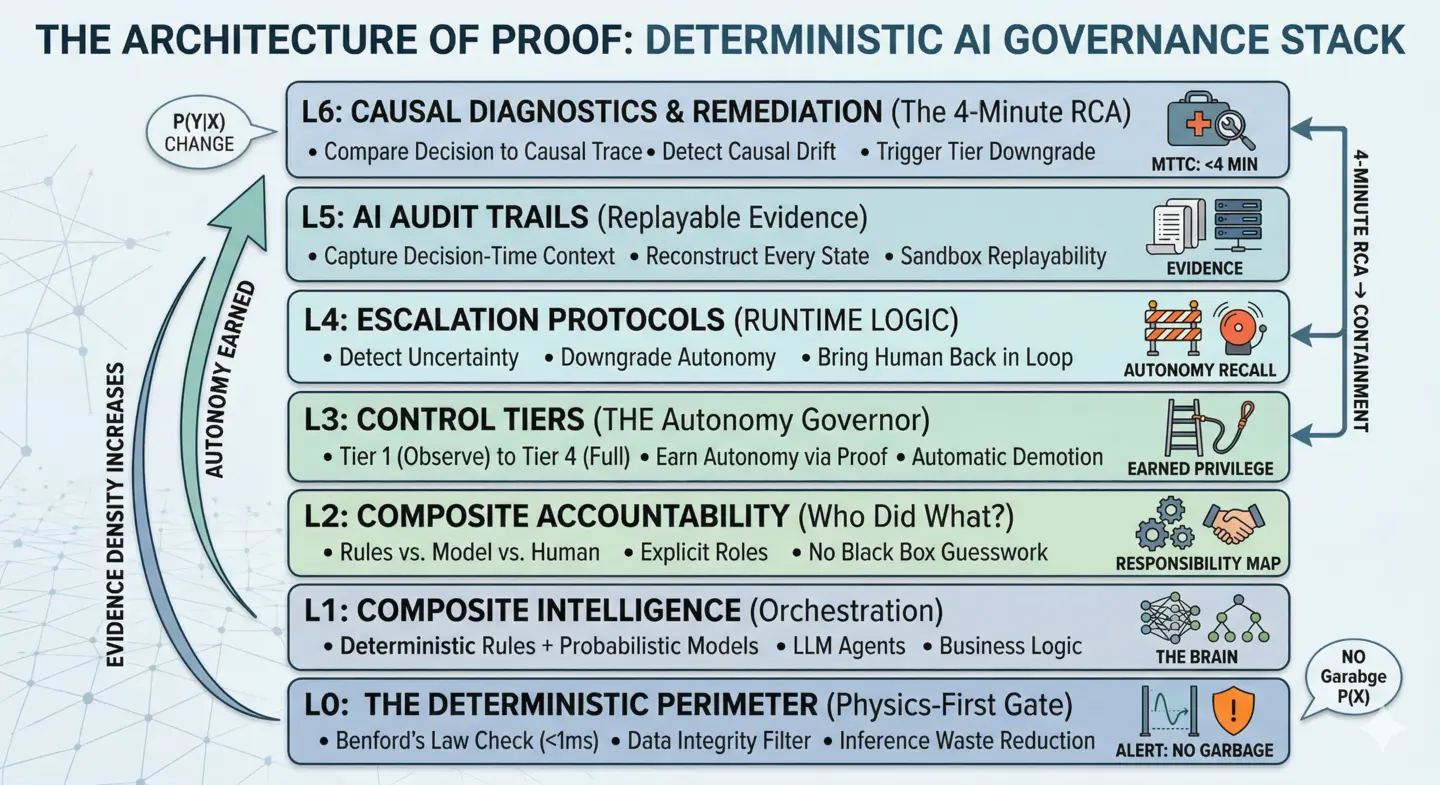
As AI products move from promising demos to critical infrastructure, the role of the product manager changes in a meaningful way. You are no longer just responsible for defining features and shipping roadmap items. You are responsible for shaping how the system behaves in the real world.
That shift matters because AI products are not ordinary software products. They can generate outputs, make recommendations, trigger actions, and influence decisions in ways that are probabilistic rather than deterministic. That means product management has to account not only for what the system does, but also for when it should defer, how it should escalate, and how its behavior will be monitored after launch.
Why Is AI Product Management Fundamentally Different?
Traditional software management asks a bounded question: what should we build? AI product management retains that foundation while confronting four operational invariants: determining what decisions the system may execute autonomously, defining the conditions that mandate human intervention, bounding the blast radius when outputs fail, and verifying behavioral stability against real-world drift.
This expansion broadens the product manager's fiduciary mandate. Rather than merely defining features, user personas, and conversion funnels, the AI product manager architects the boundaries of authority, liability, and verifiable evidence:
graph LR
    A[Business Goal] --> B[User Workflow]
    B --> C[Model Behavior]
    C --> D[Governance Controls]
    D --> E[Production Monitoring]
    style A fill:#FBF7F0,stroke:#1B1917,stroke-width:2px
    style E fill:#FBF7F0,stroke:#1B1917,stroke-width:2px
Why Does Governance Belong Inside Core Product Architecture?
In conventional software engineering, governance operates as an external, downstream compliance checkpoint. Legal or security auditors inspect the system before release, certify static controls, and disengage. That paradigm collapses when applied to probabilistic systems.
When a language model hallucinates an unauthorized commercial discount, extracts corrupted medical histories, or introduces systemic demographic skew into underwriting, the failure is rarely a legal loophole. It is an unhandled runtime product defect. Because probabilistic models generate novel behaviors across shifting input distributions, governance cannot exist outside the core application. Defensible governance must be engineered directly into the software's operational state machine.
The Audit Note: The fiduciary accountability of an AI Product Manager is measured by the deterministic range of the model's behavior under edge conditions.
What Defines the AI Governance Designer Mindset?
The AI product manager operates at the intersection of three interdependent disciplines:
- Technical Feasibility: Identifying model reasoning boundaries, latent hallucinations, and distribution shift sensitivities.
- Operator Experience: Designing calibrated handoffs, uncertainty indicators, and low-friction verification interfaces.
- Enterprise Liability: Establishing deterministic failure perimeters, regulatory audit trails, and financial loss containment.
This synthesis transforms the product manager from a feature planner into a behavioral architect, engineering how software behaves in the presence of irreducible statistical uncertainty:
flowchart LR
    Start([Task Initiated]) --> Model[AI Generates Response]
    Model --> Threshold{Confidence > Threshold?}
    Threshold -- Yes --> Auto[Automatic Response]
    Threshold -- No --> Trigger[Human Review Trigger]
    Trigger --> Review[Escalation Path: Expert Review]
    Review --> Close([Final Output])
    Auto --> Close
    style Threshold fill:#f7f9f8,stroke:#1B1917
How Do You Embed Governance into the Product Roadmap?
Enterprise AI roadmaps cannot measure progress through feature delivery velocity alone. A production-ready release must allocate explicit engineering capacity to behavioral invariants: programmatic guardrails, deterministic circuit breakers, automated regression eval suites, operator override logging, and drift telemetry. An AI capability that achieves stellar benchmark accuracy in a development sandbox but lacks containment controls in production is an incomplete engineering artifact.
What Are the Three Layers of Operational Governance?
Governing probabilistic systems requires coordinating intent, enforcement, and verification across three synchronized operational layers:
| Governance Layer | Operational Mandate | Product Implementation Artifacts |
|---|---|---|
| Policy Layer (Intent) | Establishes statutory boundaries, organizational risk appetite, and autonomy limits. | Machine-readable policy schemas, regulatory compliance mappings, and acceptable error budgets. |
| Controls Layer (Enforcement) | Translates abstract policy into deterministic runtime assertions and execution limits. | Input sanitization filters, Pydantic contract validators, confidence-calibrated routing, and circuit breakers. |
| Operations Layer (Evidence) | Captures continuous production evidence to verify ongoing compliance and model stability. | Immutable audit logs, operator override captures, automated drift tripwires, and incident replay suites. |
These layers form a continuous feedback loop: policy parameters configure runtime controls, controls bound production behavior, and production telemetry validates whether policy assumptions hold under real-world usage.
graph LR
    P[Policy] --> C[Controls]
    C --> B[Production Behavior]
    B --> M[Monitoring/Evidence]
    M --> F[Product Feedback]
    F --> P
What Do Resilient AI Product Teams Do Differently?
Disciplined product managers treat initial deployment not as the finish line, but as the activation of an empirical measurement instrument. They continuously interrogate production telemetry to confirm that operator trust is grounded in empirical reliability, that human overrides are captured for capability retraining, and that anomalous edge-case behaviors trigger deterministic containment before compounding into enterprise liabilities.
stateDiagram-v2
    direction LR
    [*] --> Define
    Define --> Build
    Build --> Test
    Test --> Launch
    Launch --> Monitor
    Monitor --> Adjust
    Adjust --> Monitor
    Adjust --> Build : Major Refinement
What Is the Ultimate Litmus Test for an AI Product Manager?
The real test of an AI product manager is simple: If the system makes a mistake tomorrow, can you explain exactly what happened, prove why it happened, and stop it from happening again?
If the answer is no, the product is not yet governable. If the answer is yes, then you have built something more durable than a feature. You have built a system that can operate safely in the real world.
graph LR
    PM[PM: Behavior & Trade-offs]
    ENG[Engineering: Implementation]
    RISK[Risk/Legal: Constraints]
    OPS[Ops: Monitoring & Response]

    PM --- ENG
    PM --- RISK
    PM --- OPS
    ENG --- OPS
| Area | Traditional PM | AI PM |
|---|---|---|
| Scope | Features and roadmap | Features, behavior, and escalation |
| Launch | Release to users | Release plus monitoring and safety checks |
| Quality | User satisfaction | Accuracy, trust, drift, and override behavior |
| Risk | Product bugs | Product bugs plus model failure and misuse |
| Governance | Optional / late-stage | Built into the product from the start |
The PM's AI Behavioral Governance Matrix: 5 Questions for Product PRD Reviews
Before signing off on any Product Requirement Document (PRD) involving probabilistic models or agentic execution, product managers must walk through these five core vectors with their Tech Lead, Designer, and Risk Counsel:
| Product Vector | Traditional Software Focus (The Trap) | AI Behavioral Governance Invariant | Production Telemetry Indicator | PM Go/No-Go Release Gate |
|---|---|---|---|---|
| Authority Limits | "Model generates suggestions for customer service." | Define hard financial and write-action boundaries (e.g., maximum refund authority $\le \$50$). | Number of out-of-scope tool invocation attempts. | NO-GO if agent has unbounded database mutation access without explicit schema caps. |
| Escalation Triggering | "Users can thumbs-down bad outputs." | Programmatic routing of low-confidence ($<0.70$) or high-consequence states to human queues. | P95 latency and queue depth on escalated review items. | NO-GO if model errors or unhandled prompts default to conversational apologies. |
| Review Ergonomics | "Clinicians or adjusters review the AI draft." | Active interface design bounding cognitive Time-to-Context (TTC) with unanchored side-by-side diffs. | Reviewer dwell time (flagging reflexive clicks $<3\text{s}$). | NO-GO if operator review console lacks highlighted source citations and structured change diffs. |
| Drift Tripwires | "Engineers monitor server uptime (99.9%)." | Automated circuit breakers that trip when Population Stability Index ($PSI$) or false-positive rate breaches tolerance. | Rolling 7-day PSI drift and client-side edit distance ($L_{\text{edit}}$). | FREEZE SPRINT if real-world operator edit distance increases $>25\%$ post-deployment. |
| Post-Incident Forensic Replay | "Check application error logs in Datadog." | Cryptographic capture of exact input vectors, model version hash, and active policy registry ID. | % of disputed decisions fully reconstructable bit-for-bit. | NO-GO if audit team cannot bit-for-bit replay a customer dispute from 30 days ago. |
How Do Invariants Enable Operational Scale?
Scaling autonomous capabilities requires advancing beyond fragile prompt prototypes into deterministic operational state machines. Scalability becomes achievable only when behavioral governance is engineered as a foundational architectural primitive rather than an afterthought.
The Architectural Invariant: Every autonomous decision emitted by an enterprise AI system must link deterministically to an authorized design-time policy schema. Systems lacking cryptographic causal provenance operate as unhedged corporate liabilities.
The Adversarial Stress-Test: Five Critical Inquiries
1. What is the strongest argument against this approach?
Expanding the AI product manager's scope to encompass behavioral governance design dilutes core product velocity and market focus. Critics argue that burdening product managers with compliance schemas, policy registries, and risk thresholds introduces organizational friction, preventing squads from achieving product-market fit against competitors deploying lightweight, unconstrained agents.
The Practical Resolution: Unconstrained agents accumulate invisible assumption debt that triggers catastrophic operational churn, regulatory sanctions, and customer loss upon scaling. Establishing lightweight, standardized governance primitives (such as Pydantic boundary contracts and automated circuit breakers) accelerates sustainable delivery velocity by eliminating multi-week post-incident forensic audits and legal escalations.
2. Under what circumstances would this fail?
This framework fails when foundation model updates induce silent reasoning regressions that bypass static confidence thresholds. If an unannounced model checkpoint or prompt modification subtly alters intermediate logic without depressing output confidence scores, pre-configured confidence gates will remain dormant while corrupted decisions reach end-users.
The Practical Resolution: Decouple behavioral assertions from raw model confidence. Implement deterministic syntactic and semantic validation fixtures—such as schema linters, mathematical balance assertions, and citation coordinate verifiers—that validate the structural correctness of the output regardless of the model's reported self-confidence.
3. What would a skeptical customer, client, or colleague object to?
Engineering and data science leads will object that behavioral governance design is fundamentally a systems engineering and MLOps responsibility, arguing that product managers lack the statistical and mathematical depth to configure confidence thresholds, drift monitors, and automated fail-safes.
The Practical Resolution: Product managers do not write MLOps infrastructure; they define operational blast radiuses, acceptable business loss rates, and human escalation handoffs. Pair PMs with lead ML engineers to translate commercial risk tolerances into explicit mathematical assertions, maintaining clear role division between business risk specification and technical implementation.
4. Which alternative deserves more consideration?
Rather than embedding governance logic into product management workflows, an enterprise could delegate real-time oversight to an autonomous multi-agent critic ensemble and external safety proxies, freeing product managers to focus exclusively on user problem discovery and feature mechanics.
The Practical Resolution: Critic agent ensembles still require behavioral specifications, cost budgets, and authority boundaries defined by someone with customer and commercial context. Automated critic models can execute runtime inspection, but the product manager must determine what constitutes an unacceptable trade-off between false refusals and task throughput.
5. What am I assuming that may not be true?
This approach assumes that real-world AI failures can be cleanly anticipated and mapped into deterministic escalation pathways, whereas open-ended multi-modal interactions generate emergent failure modes that resist pre-launch governance specification.
The Practical Resolution: Build dynamic discovery mechanisms into production runtime. When an unmapped failure mode or novel user override occurs, capture the complete session trace, payload, and environmental state into an immutable exception ledger, triggering mandatory review and automatically updating the golden evaluation harness to prevent recurrence.
One-Line Synthesis
AI product management requires engineering the deterministic behavioral boundaries under which probabilistic systems act, defer, or escalate, embedding institutional trust directly into runtime product architecture.
Subscribe to the Architecture of Proof Dispatch
Rigorous, decision-forcing systems engineering and AI governance monographs for technical leaders. Delivered periodically, zero spam.