AI Governance Maturity Score | Architecture of Proof
Your AI Governance Maturity Score
Where are you? Where do you need to be?
Most AI teams are operating at Stage 1, sitting on unmitigated regulatory and operational risk. Answer 12 questions and get your score, gap analysis, and personalized roadmap, in under 90 seconds.
Score My Org →
⏱ 90 seconds
The 4-Stage Maturity Model
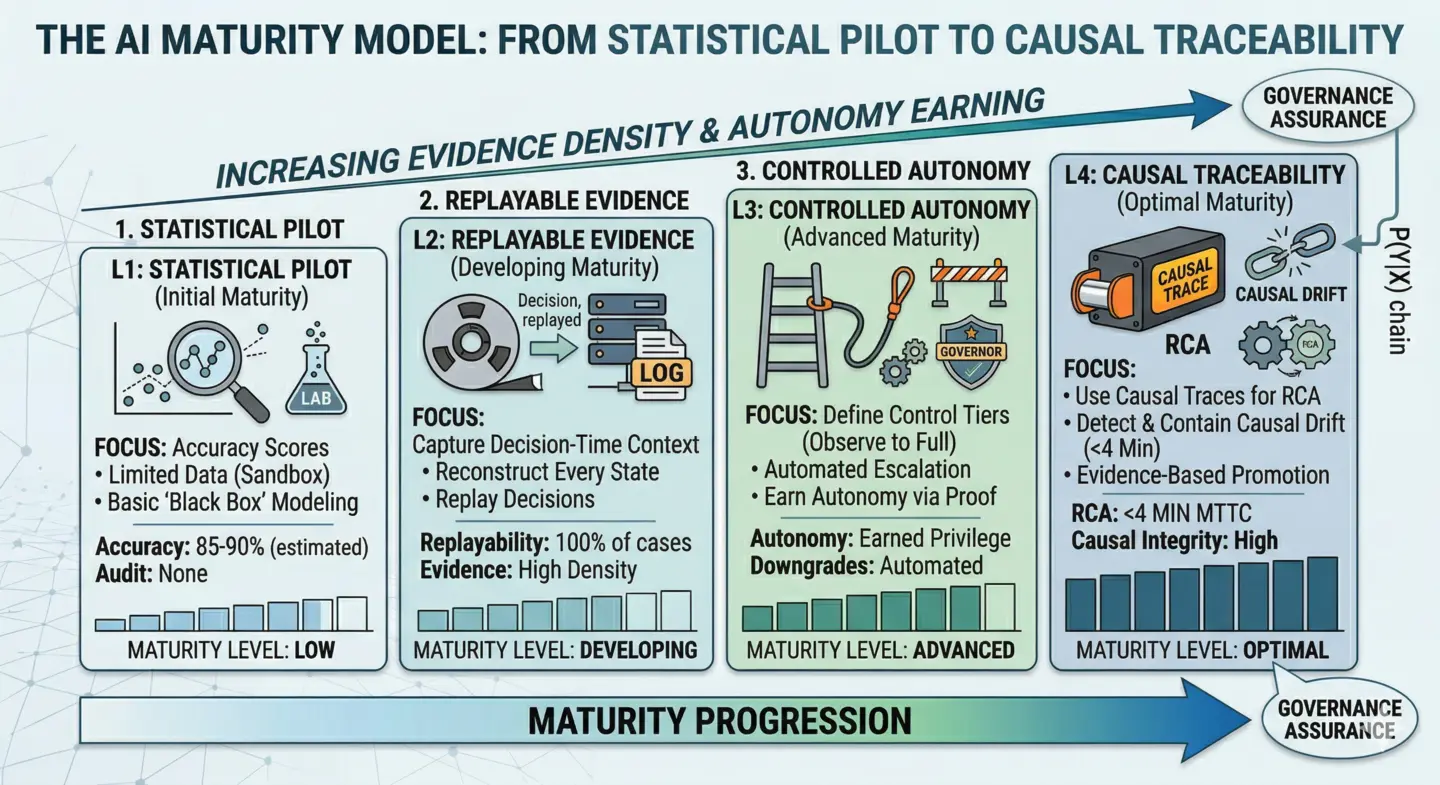
Stage Definitions
Stage 1 · Most AI teams
Statistical Pilot
⚠ Business Risk: Unmitigated liability. No fiduciary defensibility. Post-hoc explainability (SHAP/LIME) is insufficient for high-stakes audits.
Stage 2
Evidence Collection
⚠ Business Risk: Partial coverage. Logs exist but are not causally linked, making root-cause analysis slow and expensive.
Stage 3
Control Tiers
✓ Business Risk: Manageable. Autonomy tiers and automated escalation provide a defensible operating model for most regulators.
Stage 4 · Gold Standard
Causal Diagnostics
✓ Business Risk: Minimal. Full causal traces and replayable audit trails allow you to scale autonomy aggressively with total confidence.
Maturity: Stage 1
Grade Your Organization
12 questions. Instant results. No email required to see your score.
---
### **The PM's AI Governance Maturity Gate: 5 Verification Questions for Sprint & Audit Reviews**
To evaluate where a product workload stands in the 4-stage maturity lifecycle without relying on subjective self-reporting, review this diagnostic checklist:
| Maturity Stage | Engineering Verification Check | Red Flag Condition (Downgrade Trigger) | PM Mandate & Action |
| :--- | :--- | :--- | :--- |
| **Stage 1: Statistical Pilot** | Are prompts and hyperparameters tracked in Git rather than untracked playground scripts? | Developers test prompts in unmonitored web consoles without version tagging. | Restrict feature to sandbox; prohibit production database write permissions. |
| **Stage 2: Replayable Evidence** | Can an engineer replay a specific production run bit-for-bit in staging using saved parameters? | Decision outcomes cannot be reproduced due to missing random seeds or lost context. | Enforce Decision State Vector logging before granting user-facing autonomy. |
| **Stage 3: Controlled Autonomy** | Are autonomy tiers (Advise vs Act) and runtime circuit breakers enforced at the gateway? | High-liability transactions execute without human sign-off gates or anomaly tripwires. | Enforce Layer 3 Control Tiers; require supervisor sign-off on out-of-bounds cases. |
| **Stage 4: Causal Diagnostics** | Can engineering isolate root cause for an anomalous decision within 4 minutes via replay? | Incident postmortems require multi-day log scraping and cross-team blame shifting. | Mandate causal audit envelope emission; benchmark MTTC in staging drills. |
| **Cross-Stage Promotion Gate** | Does moving from Stage 1 to Stage 2+ require programmatic test passing in CI/CD? | Promotion between maturity tiers granted via informal verbal agreements in standup. | Require automated test suite verification in CI before upgrading service maturity tier. |
---
## **The Adversarial Stress-Test: What Could Invalidate Maturity Scores?**
### **1. What is the strongest argument against this approach?**
*The Objection:* Self-assessment maturity models reduce complex systems engineering to superficial, subjective checkbox exercises. Teams routinely inflate their scores by misinterpreting ad-hoc logging as comprehensive auditability or confusing basic prompt rules with architectural control tiers, producing an unwarranted sense of compliance safety.
*The Practical Resolution:* Couple the maturity score directly to automated telemetry assertions and evidentiary artifacts. A team cannot claim Stage 2 maturity without providing a cryptographically signed execution log, nor can they claim Stage 3 without demonstrating automated circuit breaker triggers in CI/CD pipeline tests. Replace subjective honor-system self-reporting with programmatic validation gates.
### **2. Under what circumstances would this fail?**
*The Failure Mechanism:* The maturity framework fails when an organization progresses to Stage 3 or Stage 4 in development sandbox environments but deploys into production across uninstrumented legacy data stores, undocumented microservices, or third-party SaaS APIs that break the causal trace chain.
*The Practical Resolution:* Enforce end-to-end trace propagation contracts across all API boundaries using distributed tracing headers (such as W3C Trace Context). Any external API call or database transaction that fails to return a verifiable trace identifier is automatically restricted to Stage 1 (read-only advisory mode), preventing unmonitored external dependencies from compromising enterprise audit custody.
### **3. What would a skeptical customer, client, or colleague object to?**
*The Skeptical Pushback:* Skeptical engineering managers and financial controllers will argue that reaching Stage 4 (Causal Diagnostics) incurs excessive engineering overhead, database storage costs, and query latency that outweigh the speculative risk of rare production edge cases.
*The Practical Resolution:* Quantify the operational ROI of Mean Time to Containment (MTTC). Contrast the standard multi-week engineering investigation and forensic consulting costs of an un-instrumented AI failure against the four-minute automated root cause diagnosis enabled by causal replay. Stage 4 architecture pays for itself within a single averted production outage or regulatory inquiry.
### **4. Which alternative deserves more consideration?**
*The Counter-Architecture:* Adopting external vertical-specific compliance certifications (such as ISO/IEC 42001, SOC 2 Type II AI criteria, or HITRUST AI controls) rather than an internal systems-engineering maturity model.
*The Practical Resolution:* Use external compliance certifications to validate organizational process hygiene and vendor management, while applying the Architecture of Proof Maturity Model to govern real-time software execution, model inference boundaries, and automated runtime safety interlocks. The two approaches are complementary: compliance audits evaluate policy, whereas the maturity model evaluates code.
### **5. What am I assuming that may not be true?**
*The Latent Vulnerability:* We are assuming that organizations follow a linear, orderly progression through Stages 1, 2, 3, and 4. In production reality, organizations frequently operate as fragmented mosaics—deploying sophisticated Stage 4 causal diagnostics in fraud detection while simultaneously running unmonitored Stage 1 shadow AI agents in customer service.
*The Practical Resolution:* Evaluate AI maturity at the individual service and agent workload level rather than assessing the enterprise as a monolithic whole. Generate decoupled maturity scorecards for each production pipeline, requiring that high-liability Tier 3 workloads achieve Stage 3 or Stage 4 verification before being granted write access to core databases.
---
## **What Is the Core Maturity Invariant?**
> **AI governance maturity represents the empirical capability of systems architecture to reconstruct, isolate, and remediate autonomous failure states within minutes.**
×
Wait! Don't leave without your score.
How does your AI risk compare?
See where you stand in the 4-Stage Maturity Model in under 60 seconds.
Subscribe to the Architecture of Proof Dispatch
Rigorous, decision-forcing systems engineering and AI governance monographs for technical leaders. Delivered periodically, zero spam.