Who's Accountable When the AI Gets It Wrong? | AI Governance
Every executive eventually asks it. A loan is denied incorrectly. A fraud system blocks the wrong customer. An AI workflow executes a decision nobody intended.
The organization investigates. Three weeks later, the postmortem concludes with process improvements. Nobody can identify precisely which decision caused the failure, who owned that decision, or what changed to prevent it from happening again.
This failure is accountability debt.
Most teams reach for the phrase "human in the loop." That phrase specifies the presence of a human without defining the structure of their authority, the evidence they require, or the decisions they own. It names no one. It controls nothing. It collapses under the first serious production incident.
The remedy is a set of explicit architectural decisions made before a model goes live. The accumulation of the ones organizations skip is accountability debt.
What Is Accountability Debt in Enterprise AI?
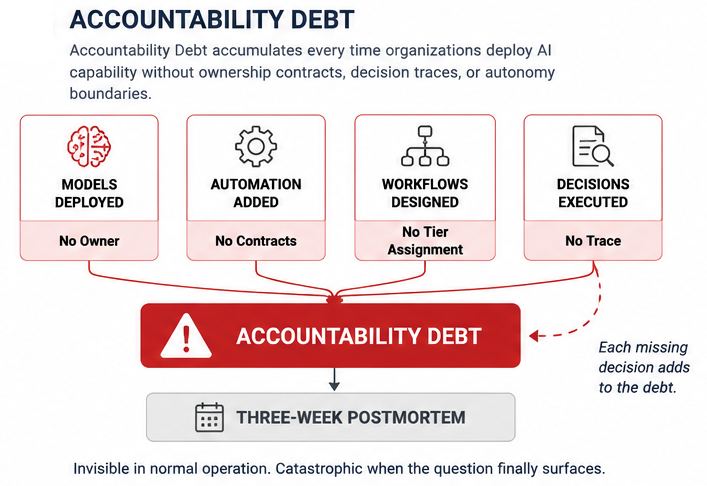
Accountability Debt is the accumulation of AI capabilities without corresponding ownership contracts, decision traces, and autonomy boundaries.
Every model deployed without a contract. Every threshold set without a documented owner. Every workflow designed without an explicit tier assignment. Every human review step added informally without a defined escalation protocol.
Each one adds to the debt, invisible in normal operation and catastrophic when an incident surfaces.
Most organizations carry significant Accountability Debt. They know it exists when they cannot answer the boardroom question without a three-week postmortem. They know it exists when the postmortem ends with "process improvements" rather than a specific finding and a specific owner.
This article is about how to pay it down before the next incident forces the question.
What follows is a proposed design framework, not a claim that these mechanisms represent standardized industry practice. The four instruments below (Control Tier Matrix, Accountability Stack, Contract Lifecycle, and Verification Loop) form one coherent approach to structuring AI accountability. Their purpose is to make the question "who's accountable?" answerable at every layer, before an incident forces it.
The accountability gap is not a mystery. It is the predictable consequence of deploying AI systems that were built to perform but never built to prove.
Layer One: The Control Tier Matrix
Before you can assign accountability, you must assign autonomy.
The first design instrument is a matrix that closes the autonomy gap. For every major AI-influenced workflow in your system, you assign it to one of four explicit tiers:
Tier 0: Observe Only. The system analyzes, scores, and suggests. Humans make every consequential decision. This is the appropriate starting point for new deployments, regulatory mandates requiring human approval, or any domain where the failure cost of an autonomous error is not yet understood.
Tier 1: Act in the Sandbox. The system takes low-risk, reversible actions autonomously. Humans review aggregate outcomes, not individual decisions. This tier requires demonstrated stable performance in a prior pilot, fully reversible actions within a defined scope, and automatic revert conditions the system enforces itself.
Tier 2: Act with Circuit Breakers. The system takes high-leverage, bounded actions autonomously. Humans handle escalations and own incident response. This tier requires strong calibration and low error rates demonstrated in production, tested circuit breakers with documented auto-downgrade behavior, and signed-off risk appetite.
Tier 3: Human Only. The system provides analysis and recommendations. All consequential decisions require human sign-off. This applies to clinical decisions with direct patient impact, large financial transactions above defined thresholds, and any domain where the regulatory framework prohibits automated decisions.
| Tier | Name | AI Authority | Human Role |
|---|---|---|---|
| 0 | Observe Only | Suggest | Decide everything |
| 1 | Act in Sandbox | Low-risk, reversible actions | Review aggregate outcomes |
| 2 | Act with Circuit Breakers | High-leverage, bounded actions | Handle escalations, own incidents |
| 3 | Human Only | Advise | Decide everything |
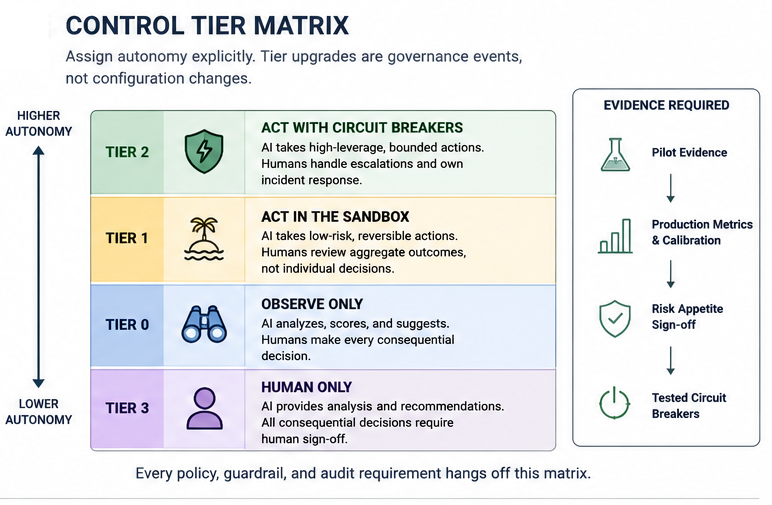
Every policy, guardrail, and audit requirement in your system hangs off this matrix. Without it, you do not have governance. You have a model and a hope.
Tier upgrades are governance events, not configuration changes
The most common governance failure in production AI is tier drift: autonomy increases informally through shortcuts, informal approvals, or promises to add review steps back later that never materialize.
The principle that prevents this: no evidence, no tier upgrade. Moving from Tier 0 to Tier 1 requires evidence that the system performs as designed on held-out data, that the pilot produced no unexpected behavior, and that the revert conditions have been tested. Moving from Tier 1 to Tier 2 requires more: demonstrated production calibration, tested circuit breakers, and formal risk sign-off.
Circuit breakers: the automatic downgrade path
A circuit breaker is a hard-coded threshold that moves the system to a lower tier when a key metric breaches a defined limit.
A fraud system that auto-blocks transactions does not require a human to decide to stop when its false positive rate spikes. The circuit breaker fires. The system downgrades to challenge-only. That decision was made in advance, before the incident, not during it.
This is what separates a system that degrades gracefully from one that fails silently.
Layer Two: The Multi-Layer Accountability Stack
Here is where most governance frameworks stop too soon.
They assign accountability at the component level: the rule layer failed, the model drifted, or the human override was undocumented. That framing is correct, but incomplete.
Consider this scenario: the model routed every case correctly. The rules executed perfectly. Humans followed policy exactly as written. And the decisions were still systematically wrong because the risk threshold set by the product team was economically miscalibrated from the start.
No contract was violated. No component failed its defined role. The problem was two layers upstream, in a product decision that shaped every downstream component but was owned by no governance instrument.
Accountability is not a component question. It is a stack question. The failure that surfaces at the model layer often originates at the workflow design layer or the product decision layer; tracing it requires a complete accountability structure, not just component-level contracts.
The complete accountability stack runs from business goals down through every layer that shapes AI behavior:
| Stack Layer | Governance Function | Typical Contract Invariant | Primary Accountability Owner |
|---|---|---|---|
| 1. Business Goal | Executive Intent & Risk Appetite | Portfolio loss bounds, compliance mandate | Business Unit Head / Executive Sponsor |
| 2. Product Decision | Boundary Design & Thresholds | False positive/negative tolerance, escalation rules | AI Product Manager |
| 3. Workflow Design | Orchestration & Tier Routing | Safe routing to models or human review queues | Systems Architect / Lead Engineer |
| 4. Rules Engine | Hard Invariant Enforcement | Deterministic regulatory & eligibility gates | Compliance / Domain Specialist |
| 5. ML Models | Probabilistic Scoring & Ranking | Calibration curves, drift thresholds, AUC targets | Machine Learning Engineering |
| 6. Infrastructure | Latency, Freshness & State | Token throttling, data lineage, TTL boundaries | MLOps / Platform Engineering |
| 7. Human Oversight | Justified Exception Handling | Mandatory reason codes, override SLAs | Operations / Underwriting Lead |
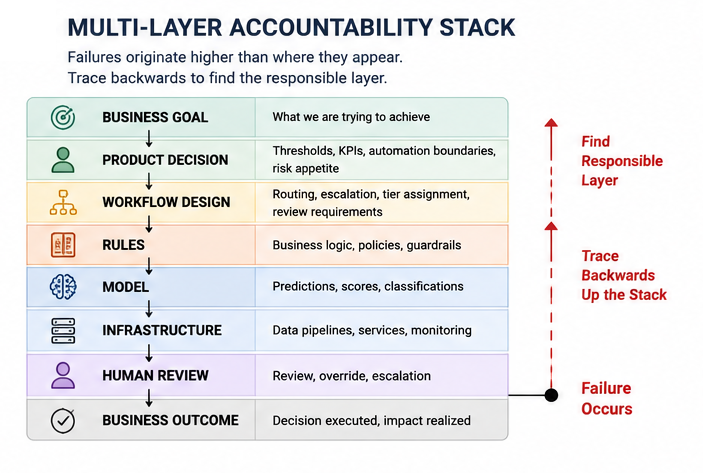
Each layer needs explicit accountability. The question is not just "which component failed its contract?" It is "which layer in the stack produced the failure, and who owns that layer?"
The Product layer: the most distinctive and most overlooked accountability owner
Most AI governance discussions structure accountability as: Model → Risk → Compliance → Human oversight. The more accurate structure is: Business goal → Product decision → Workflow design → Rules → Model → Infrastructure → Human. The consequence is significant: sometimes the model is not the problem at all. The product team may have established the wrong threshold, the wrong KPI, the wrong automation boundary, or the wrong risk appetite, and the model executed that decision faithfully.
Product managers sit at the intersection of business goals and system design. They define acceptable risk thresholds. They set automation boundaries. They choose the KPIs that govern escalation. They decide rollout strategy and the pace of tier advancement.
These are accountability decisions. They are made before the model goes live and they shape every downstream component. Yet product is absent from most accountability frameworks.
The PM's contract for an AI workflow binds the system to authorized risk limits. It specifies false-positive tolerances, escalation triggers, the empirical evidence thresholds required for tier advancement, and the explicit policies governing human intervention. When an outcome fails because a boundary was miscalibrated rather than because a model drifted, the failure belongs at the product layer. The product manager who authorized the threshold owns the finding, not the model that executed it faithfully.
Component contracts: rules, models, and humans
Below the product and workflow layers, component contracts govern the technical execution of AI decisions.
Rules contract: "No application with fewer than 12 months in business passes to the model." Either the rule fired or it did not. This is not ambiguous. It can be audited from the log.
Model contract: "Given valid inputs, the model ranks higher-risk cases above lower-risk cases on held-out data at least 92% of the time." This is measurable. If the model drifts below that threshold, the contract is violated, and the violation is visible before the outcome deteriorates.
Human contract: "Reviewers who override a model recommendation must select a reason code from the approved list and attach supporting evidence." This can be audited. If overrides are being logged without reason codes, the human contract has a gap, and that gap is a governance finding, not a policy aspiration.
| Layer | What the Contract Promises | What the Metric Measures |
|---|---|---|
| Product | Thresholds reflect authorized risk appetite | Threshold calibration vs. outcomes, quarterly review |
| Workflow Design | Routing logic directs cases to the correct tier | Routing accuracy, misrouting rate |
| Rules | Catch all policy violations | Violation catch-rate, coverage across channels |
| Models | Correct ranking and calibration | AUC, drift by segment, calibration curves |
| Humans | Documented, policy-consistent overrides | Override rate, reason code distribution, latency |
| Infrastructure | Data freshness and version consistency | Feature lag, model version drift |
When something goes wrong, the first question is not "what happened to the outcome?" It is "which layer of the stack produced the failure, and which contract at that layer was violated?"
Decision traceability: the evidence chain that connects every layer
The accountability stack is only usable after the fact if every layer leaves a trace.
Log the reasoning path of every decision separately from the raw output, and log it across the full stack, not just at the model level.
For every major AI-influenced decision, capture: which product threshold governed the decision; which routing logic directed the case; which rules fired and on which inputs; which model was called, with what inputs and outputs; which human touched the case, what they saw, and what they chose; the final action and its timestamp; the link from that action to the eventual outcome.
The reasoning path is not the same as the outcome. A model can produce a correct output through an incorrect process. A product threshold can be correctly applied to produce a systemically wrong outcome. Decision traceability captures the process across every layer, because accountability requires proof of process, not just proof of outcome.
Layer Three: The Contract Lifecycle
Contracts without lifecycle management become Accountability Debt.
A contract written at launch reflects what the system was designed to do when it was built. Systems evolve. Models are retrained. Thresholds are recalibrated. Regulatory requirements change. Workflows are extended. Without a defined process for updating contracts, the governance structure becomes a historical artifact describing a system that no longer exists.
Every contract in the accountability stack requires four lifecycle disciplines:
Ownership. Every contract has a named owner: the function responsible for keeping it current. The model contract is owned by the model risk function. The product threshold contract is owned by the product lead. The human override contract is owned by operations. Contracts without named owners are no one's responsibility.
Change approval. Changes to contracts are governance events, not configuration changes. A threshold adjustment that changes the model contract requires documented justification, risk sign-off, and a record of what changed, when, and why.
Versioning. Every version of a contract is preserved. When an incident occurs, you trace it against the contract that was in force at the time, not the current version. Without version history, the accountability trail is incomplete.
Retirement. Contracts for deprecated workflows must be explicitly retired. Leaving orphaned contracts in the governance system creates noise in audits and confusion in incident reviews.
A governance model without a contract lifecycle defers the accountability gap rather than closing it. Contracts drift and ownership erodes. Without a lifecycle process, the accountability architecture built at launch remains a depreciating asset.
Layer Four: The Verification Loop
Most governance frameworks end at diagnosis. This one does not.
Diagnosis is the output of a working accountability system, not the final goal. The goal is a system that improves: tracing failures back to their origin, updating the contracts that governed the failure, and verifying that the update holds.
The Architecture of Proof accountability loop:
| Step | Operating Phase | Technical & Governance Action | Verifiable Proof Artifact |
|---|---|---|---|
| 1 | Incident Surface | Production anomaly detected via telemetry breach or circuit breaker trip | Automated Incident Log & Severity Ticket |
| 2 | Trace Retrieval | Full decision context extracted across business, product, and component layers | Cryptographically Hashed Decision Payload |
| 3 | Layer Isolation | Determine precise failure origin (Product threshold, Routing rule, Model drift, Human override) | Root-Cause Layer Attribution Record |
| 4 | Contract Audit | Compare executed telemetry against active component invariant contract | Contract Breach Finding & Delta Analysis |
| 5 | Contract Recalibration | Update invariant threshold; obtain formal sign-off from named contract owner | Versioned Contract Spec ($v_{n+1}$) |
| 6 | Offline Regression | Re-run updated contract and model against historical 90-day incident fixtures | Regression Test Suite Scorecard |
| 7 | Tier Re-evaluation | Review autonomy tier assignment; enforce automated downgrade if variance exceeds tolerance | Control Tier Re-certification Sign-Off |
| 8 | Verified Deployment | Redeploy updated workflow with active circuit breakers and telemetry hooks | Production Stream Verification Telemetry |
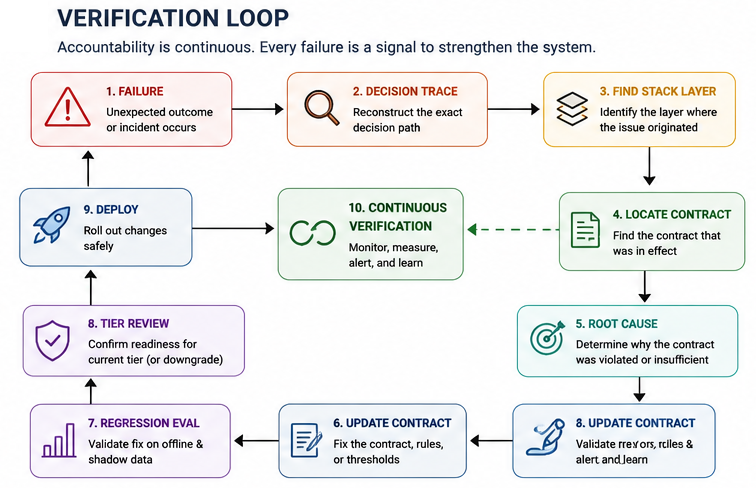
This loop is what separates an accountability architecture from a postmortem practice. A postmortem ends with a finding. The loop converts the finding into an updated contract, a regression test, and a verified re-deployment.
Without this loop, the accountability system is retrospective only. With it, every incident makes the system more governable than it was before.
Continuous Verification is the operational requirement: active verification that every contract is still being kept in production, rather than passive monitoring of trailing outcomes. The distinction matters: monitoring tells you an outcome deteriorated; Continuous Verification tells you a contract was violated before the outcome had time to deteriorate.
The accountability model, complete
Accountability = Assigned Tier × Component Contract × Decision Trace × Continuous Verification
This is a conceptual model rather than an algebraic equation, but it is strictly multiplicative: each term is necessary, and none is sufficient alone. An assigned tier without contracts indicates how much autonomy the system holds, but cannot verify whether components keep their promises. Component contracts without a decision trace leave commitments with no forensic evidence. A decision trace without continuous verification degenerates into post-hoc archaeology. Continuous verification without contracts lacks baseline invariants to evaluate. A failure in any single dimension collapses the accountability structure to zero.
What this looks like in practice
Take a lending decision workflow, before and after.
Before this architecture: a loan is denied incorrectly. The team reviews the outcome. The model had a score of 640. No one is sure whether the denial was driven by the eligibility rule, the model score, an override, or a routing misconfiguration. The postmortem lasts three weeks and concludes with "process improvements." Nobody is named. Nothing is changed precisely.
After this architecture: the same denial is flagged. The audit log shows the rule layer passed the application correctly. The model scored it at 642, above the auto-decline threshold. The orchestration layer routed it to auto-decline instead of the underwriter queue due to a misconfigured routing rule. The routing rule is owned by the workflow design function, which reports to the product lead who signed off on the routing logic. The fix is specific. The contract is updated. The regression runs against the last 90 days of similar cases. The postmortem takes two hours.
Extend the scenario: what if the routing was correct, the model scored correctly, the rules fired correctly, and the denial rate is still too high because the risk threshold set by product is miscalibrated? That failure has a home in the multi-layer stack. It surfaces at the product contract layer. The PM who owns that threshold owns the finding. The fix is a threshold recalibration, not a model retrain.
The AI did not get it wrong. A specific layer of the accountability stack failed a specific contract. That is a finding with a named owner. When the contract is updated, the verification loop ensures it holds.
The PM's Postmortem Attribution Matrix: Who Actually Owns the Failure?
When an AI workflow makes a high-visibility error, incident postmortems often degenerate into vague debates where data science blames edge-case inputs, engineering blames third-party APIs, and operations blames the model.
Use this 5-question attribution matrix during incident reviews to immediately isolate the true owner:
| The Postmortem Discovery | What Actually Happened Under the Hood | True Owner of the Failure | The Immediate Corrective Action |
|---|---|---|---|
| Product Threshold Miscalibration | The model predicted an accurate risk score of 0.64, but the PM set the auto-decline cutoff at 0.60 instead of routing 0.55–0.70 to human underwriters. | AI Product Manager (Boundary & Appetite) |
Adjust the decision boundary; do not waste ML engineering sprints retraining an accurate model. |
| Workflow Routing Error | The model produced a high-confidence score, but an unversioned routing script sent the case to the wrong regional queue, dropping SLA turnaround times. | Workflow / Systems Architect (Orchestration) |
Patch the routing DAG and write an automated integration test verifying tier assignment rules. |
| Model Distribution Drift | The model began under-predicting risk on new business accounts opened after an interest-rate change, missing its calibration target on that sub-cohort. | ML Engineering / Data Science (Model Contract) |
Temporarily demote autonomy for that sub-cohort to Tier 0 (Observe Only) and initiate slice retraining. |
| Deterministic Rule Bypass | An LLM agent promised an unauthorized $5,000 refund because the prompt lacked an explicit ceiling, and no backend code validated the amount before sending. | Software Engineering & Legal (Rule Invariants) |
Never trust prompt instructions for hard business limits. Enforce deterministic API parameter assertions in code. |
| Human Review Rubber-Stamping | An underwriter approved a fraudulent loan in 1.2 seconds without opening the flagged proof documents, bypassing model warnings. | Operations Lead (Human Contract) |
Enforce minimum reviewer dwell times and require mandatory structured reason codes before commits. |
The question that ends the shrug
When an executive asks "who's accountable when the AI gets it wrong?" they are asking whether the system was architected to answer that question.
Resolving that inquiry requires four coordinated mechanisms. First, the Control Tier Matrix assigns explicit autonomy boundaries and automatically revokes execution rights when failure thresholds trip. Second, the Multi-Layer Accountability Stack isolates failures from outcomes back through components, workflow routing, and product thresholds to their precise origin. Third, an active Contract Lifecycle ensures that performance promises remain versioned and owned rather than decaying into historical artifacts. Finally, the Verification Loop converts postmortem findings into regression suites and continuously monitored production deployments.
"Human in the loop" is not an answer; it is an evasion. Structuring the matrix, defining the contracts, managing their lifecycle, and closing the verification loop replaces executive shrugs with systematic diagnosis, remediation, and proof.
The Adversarial Stress-Test: Five Critical Inquiries
To ensure this accountability architecture is defensible against rigorous engineering skepticism and real-world failure modes, we subject it to five decision-forcing inquiries:
1. What is the strongest argument against this approach?
- The Operational Sclerosis Thesis: Structuring explicit component contracts, lifecycle reviews, and formal sign-offs across seven distinct layers creates immense organizational overhead. In early-stage or rapidly evolving product environments, this level of rigor can paralyze velocity. Skeptics argue that fast-moving competitors deploying end-to-end frontier models without bureaucratic micro-contracts will ship features 5x faster, out-iterating heavily governed architectures in low-consequence domains.
- The Practical Resolution: Calibrate accountability rigor to operational blast radius. Early prototypes and internal drafting tools operate under lightweight Tier 0/1 configurations with basic programmatic assertions. The full seven-layer stack and versioned contract lifecycle are reserved strictly for high-liability workflows (such as lending, clinical support, or automated trading) where an uncontained failure triggers legal or financial catastrophe.
2. Under what circumstances would this fail?
This accountability architecture breaks down under three specific failure regimes:
- The Multi-Agent Blame Carousel: In complex multi-component agent graphs, errors propagate subtly across boundaries. An upstream retrieval step surfaces ambiguous text chunks that technically satisfy the schema contract, inducing the model to produce a plausible hallucination that passes downstream rules. When investigated, each component owner claims their local contract was kept, leading to accountability gridlock.
- Contract Obsolescence: Engineering teams frequently update system prompts, retrieval parameters, or fine-tuned weights without updating the companion contract schemas. The contracts become ceremonial "dead letters" that describe a historical system rather than active production reality.
- Rubber-Stamp Review Fatigue: When human reviewers in Tier 2 or Tier 3 are bombarded with high-volume escalations, cognitive fatigue leads them to approve automated recommendations automatically without examining the causal decision trace, invalidating the human contract.
3. What would a skeptical customer, client, or colleague object to?
- "This looks like enterprise waterfall dressed in AI terminology. Pre-specifying rigid contracts across probabilistic systems is unrealistic because LLMs are non-deterministic reasoning engines whose emergent capabilities cannot be boxed into static invariant tables."
- The Resolution: Contracts govern operational invariants and boundary conditions, not internal cognitive steps. The model retains complete probabilistic freedom to reason, draft, and explore within its bounded sandbox. What the contract enforces are external invariants: input validity, output schema conformance, latency bounds, and deterministic business rules.
4. Which alternative deserves more consideration?
- End-to-End Black-Box Evals with Automated Blast-Radius Containment: Rather than maintaining fragile, multi-layered contracts across individual rules, models, and workflows, treat the entire system as an end-to-end black box. Focus 100% of engineering bandwidth on continuous synthetic red-teaming, automated post-hoc behavioral monitors, and instant transaction-reversal mechanisms (financial indemnification, automated rollbacks, and circuit breakers) that cap enterprise losses regardless of which specific sub-component failed.
5. What am I assuming that may not be true?
- Fault Isolability: Systemic AI failures can always be cleanly decomposed and mapped to a single responsible layer, when in reality emergent model behavior often arises from non-linear feedback loops between components.
- Cognitive Capacity: Human operators possess the time, incentive, and domain acumen to parse multi-step causal traces during high-pressure operational escalations.
- Fiduciary Alignment: Executive leadership will prioritize provable auditability over market time-to-delivery before an existential compliance crisis or regulatory sanction forces their hand.
One-Line Synthesis
AI accountability is an architectural property built before deployment: bounding autonomy with explicit control tiers, tracing causal failures across the product stack, and converting incidents into verified operational invariants.
Related reading
-
Control Tiers for AI-enabled Processes: The four-tier model for designing AI autonomy levels on purpose, with evidence gates and circuit breakers.
-
Autonomy and Escalation: How systems ask for help, downgrade, and hand off to humans cleanly.
-
How to Write AI Component Contracts: Practical guide for specifying behavioral bounds and input invariants in production AI systems.
-
Composite Accountability: Multi-actor attribution and forensic verification across rules, models, and human operators.
-
AI Accountability Architecture: The structural design that makes every component prove it did its job.
-
Decision Traceability: How to build the evidence chain that makes decisions reconstructable.
-
The Accountability Gap: Why PMs struggle to own AI outcomes, and how to redefine ownership through uncertainty and system design.
Frequently Asked Questions
Who is accountable when an AI system makes a wrong decision?
Accountability is not assigned to 'the AI.' It is assigned to the layer that failed: which may be a rule that didn't fire, a model that drifted, a human who overrode without justification, or a product decision that set the wrong threshold in the first place. In a system designed for accountability, every failure has a traceable owner at a specific layer.
What is Accountability Debt in AI systems?
Accountability Debt is the accumulation of AI capabilities without corresponding ownership contracts, decision traces, and autonomy boundaries. Every model deployed without a contract, every threshold set without a documented owner, and every workflow designed without an explicit tier assignment adds to the debt, remaining invisible until an incident forces the question.
What does 'human in the loop' actually mean for AI accountability?
'Human in the loop' is not a governance architecture. Without explicit review authority, escalation rules, evidence requirements, and measurable contracts, it becomes little more than a slogan. Structured accountability replaces it with Control Tiers: explicit autonomy assignments with preconditions, permissions, and automatic downgrade paths.
What is the multi-layer accountability stack for AI systems?
A complete accountability stack runs from Business Goals down through Product Decisions, Workflow Design, Technical Components (rules, models, humans), and Infrastructure. Most AI failures are diagnosed at the wrong layer, blamed on the model when the actual cause was a product threshold decision or a workflow design choice made months earlier.
What is a Contract Lifecycle in AI governance?
A Contract Lifecycle defines who owns a component's contract, who must approve changes to it, how versions are tracked, and when the contract is retired. Without this, contracts written at launch drift as the system evolves, producing the illusion of governance while the actual accountability structure decays.
Subscribe to the Architecture of Proof Dispatch
Rigorous, decision-forcing systems engineering and AI governance monographs for technical leaders. Delivered periodically, zero spam.