Composite Accountability: Proving Each Part of Your AI System Did Its Job | AI Governance
This post is part of the AI Accountability Architecture pillar.
Enterprise AI incidents are rarely solitary model failures. In production pipelines, decision workflows distribute execution across deterministic validation rules, statistical scoring models, external API lookups, and human underwriting queues. Yet when an operational breakdown occurs, organizations routinely scapegoat "the AI"—reverting model weights or issuing superficial prompt tweaks while leaving systemic interface bugs intact.
Blaming an undifferentiated "AI" obscures the architectural fault line. Composite accountability enforces modular contractual boundaries across every participant in the decision pipeline. By binding deterministic rules, probabilistic models, and human operators to explicit, verifiable contracts and local metrics, engineering teams transform post-incident postmortems from speculative finger-pointing into deterministic root-cause attribution.
How Do You Hold a Multi-Part AI System Accountable?
Composite intelligence describes systems where deterministic logic, probabilistic models, and human operators collaborate within a unified decision topology. While this architecture overcomes the limitations of standalone foundation models, it introduces an acute governance hazard: shared execution without discrete responsibility.
Holding a composite system accountable requires abandoning aggregate vanity metrics such as global accuracy or end-to-end conversion. Instead, each subsystem must be governed by three architectural anchors:
- An Explicit Functional Scope: The bounded domain of decisions, transformations, or invariants the component is authorized to execute.
- A Testable Invariant Contract: The precise conditions under which the component guarantees valid operation, and the explicit preconditions that trigger immediate circuit breakers.
- An Attributable Local Metric: An independent, runtime observable signal that measures the component's calibration or compliance without confounding variables from neighboring pipeline stages.
When an automated decision fails in production, this decomposition isolates whether deterministic validation rules failed to block corrupt input, probabilistic models produced miscalibrated inferences, human operators executed non-compliant overrides, or the orchestration gateway executed an invalid routing topology.
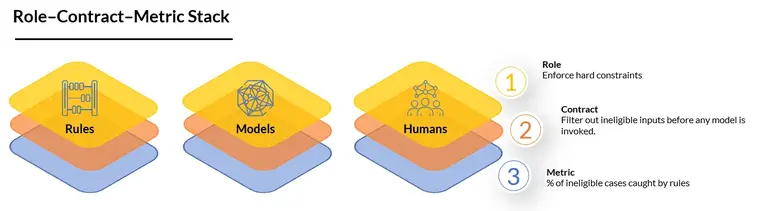
The Composite Accountability Matrix
Assigning explicit contractual boundaries prevents operational ambiguity during high-stakes decision execution:
| Pipeline Actor | Architectural Role | Verifiable Contract Definition | Primary Operational Metric |
|---|---|---|---|
| Deterministic Rules | Invariant enforcement, statutory boundaries, schema validation | Must reject invalid inputs, enforce regulatory bans, and gate model execution | Policy violation catch-rate; zero rule-bypass leaks |
| Statistical Models | Probabilistic scoring, classification, semantic embedding | Must generate calibrated predictions given validated feature payloads | Expected Calibration Error (ECE); segment AUC; drift velocity |
| Human Reviewers | Exception handling, qualitative edge cases, policy overrides | Must log structured reason codes and operate within documented adjudication limits | Override rate; reason-code concordance; review latency SLA |
| Orchestration Gateway | Flow control, fallback execution, circuit breaking | Must route cases strictly according to policy thresholds and dispatch fallbacks | Routing invariant adherence; fallback trigger frequency |
1. Defining Deterministic Rule Contracts
Rule engines act as the constitutional perimeter of an AI system. Their contracts must be absolute, non-probabilistic, and verifiable prior to model invocation:
- Inbound payloads failing schema checks or KYC verification must be dropped before model scoring.
- Sanctioned entities or blacklisted jurisdictions must trigger instant deterministic rejections without consuming inference tokens.
- Applications crossing statutory exposure limits must mandate dual-authorization human sign-off regardless of model confidence scores.
2. Defining Probabilistic Model Contracts
Machine learning models produce uncertainty estimates rather than absolute truths. Their contracts must specify statistical boundaries rather than deterministic certainties:
- Given normalized, schema-validated inputs, the model maintains a maximum Expected Calibration Error (ECE) below 0.04 across all demographic tiers.
- Inferences generated with epistemic uncertainty exceeding configured thresholds must immediately divert to secondary fallback models or human review queues.
- The model possesses zero authority to override deterministic business constraints or bypass compliance filters.
3. Defining Human Operator Contracts
Human-in-the-loop controls often degenerate into rubber-stamping mechanisms when operators face cognitive fatigue. Contracts for human personnel formalize operational oversight:
- Operators reversing a model or rule recommendation must select a valid categorical reason code and input verifiable corroborating evidence into the audit log.
- Manual reviews must execute within defined service-level agreements to prevent artificial queuing bottlenecks that incentivize unvetted bulk approvals.
- High-risk manual overrides must trigger automated peer-review consensus workflows prior to downstream ledger commitment.
Instrumenting Attributable Decision Telemetry
Accountability requires comprehensive state reconstruction. Logging the terminal decision alone leaves the causal path unverifiable. Distributed tracing headers must track the decision payload across the architectural lifecycle:
- Ingress State Serialization: Cryptographic digests of the raw incoming payload, schema validation results, and active policy version IDs.
- Deterministic Rule Log: A Boolean manifest recording every rule evaluated, input parameters observed, and filter decisions triggered.
- Model Inference Telemetry: Model checkpoint hashes, input prompt tokens, raw logit distributions, calibrated probability scores, and inference latency.
- Operator Context Snapshot: The exact UI view rendered to the human reviewer, duration of manual review, and signed override justification.
- Downstream Outcome Binding: Asynchronous webhooks that link the unique decision ID to real-world performance milestones (such as repayment default, dispute initiation, or claims reversal).
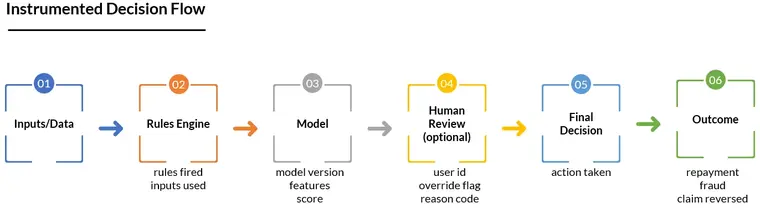
Component-Level Postmortem Attribution
Standard postmortems frequently conclude with unfocused declarations that "the pipeline performed unexpectedly." Composite accountability enforces a diagnostic triage matrix that maps observable failures to responsible components:
| Failure Pattern | Primary Fault Attribution | Immediate Engineering Remedy |
|---|---|---|
| Corrupt Payload Ingestion | Ingress Validation Layer | Introduce strict runtime schema enforcement and reject malformed payloads at the API boundary. |
| Bypassed Compliance Mandate | Deterministic Rule Engine | Add hard-coded circuit breakers upstream of model routing; update regression test suites with adversarial rule-bypass payloads. |
| Miscalibrated Risk Scoring | Probabilistic Model Layer | Trigger automated model fallback to conservative heuristic rules; retrain and recalibrate scoring models on fresh production distributions. |
| Unjustified Manual Reversals | Human Governance Layer | Audit operator reason codes; implement mandatory two-person authorization for anomalous override clusters. |
| Invalid Case Routing | Orchestration Gateway | Correct routing matrix logic; implement automated integration tests verifying escalation threshold enforcement. |
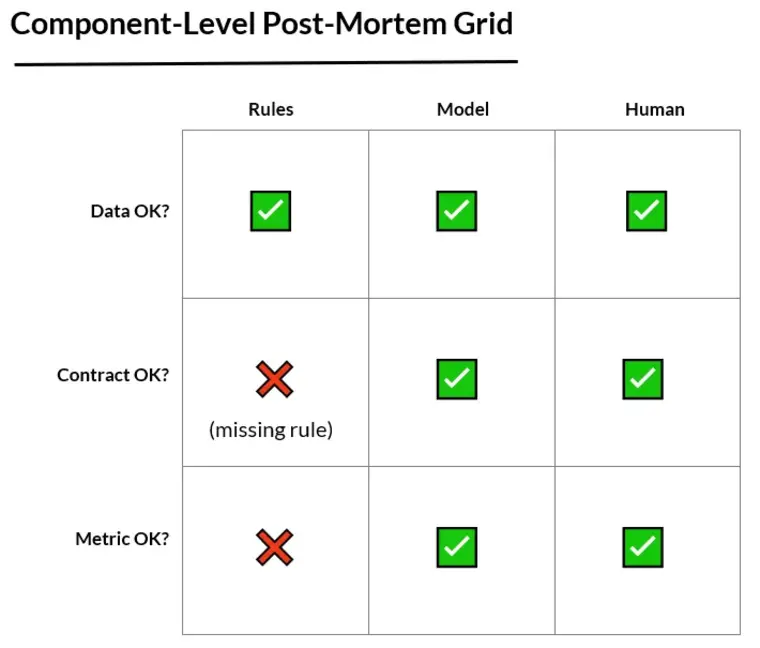
The PM's Composite Incident Triage Cheat Sheet: Rapid Diagnosis in Standups & Postmortems
When an incident hits production in a composite AI workflow, the engineering standup often descends into chaos: frontend blames the API, backend blames the prompt, and data science blames user input. The Product Manager needs to diagnose the broken handoff in 60 seconds.
Use this operational cheat sheet during standups and incident triage:
| What Broke in Production | The First Telemetry Question to Ask | What the Trace Actually Shows | The PM's Triage Ruling & Immediate SPRINT Task |
|---|---|---|---|
| Garbage / Empty AI Output | "Did the model receive null or malformed fields from upstream APIs?" | Ingress schema validator allowed missing user parameters; model was asked to score incomplete data. | Ingress Contract Defect: Reject missing fields at the API gateway with 400 Bad Request; do not blame model weights. |
| Compliance or Policy Leak | "Did the deterministic rule filter evaluate before or after model invocation?" | Rule was configured as an advisory warning rather than a blocking gateway invariant; payload bypassed check. | Rule Contract Defect: Move the rule gate upstream of the model; hardcode as a blocking precondition in code. |
| Sudden Surge in False Approvals | "Did the error rate surge globally or only on a specific user cohort?" | Model AUC is stable on historical users, but calibration drifted on accounts opened after an interest-rate change. | Model Contract Defect: Restrict autonomy tier for that sub-cohort to Tier 0 (Observe Only); schedule slice retraining. |
| Erroneous State Commit | "Who approved the transaction: the model or a human reviewer?" | Human reviewer clicked 'Approve' in 1.4 seconds without reviewing flagged proof documents. | Human Contract Defect: Audit reviewer dwell times; enforce mandatory reason codes and two-person authorization. |
| Dropped Customer Request | "Did the system timeout or enter an unhandled infinite tool loop?" | Orchestrator waited 15s on an external API response before crashing with an unhandled 504 error. | Gateway Contract Defect: Add a 3.5s timeout circuit breaker that routes immediately to a safe heuristic fallback queue. |
Institutional Governance and Defensibility
When regulators, counterparties, or internal risk committees examine an automated decision, "the model made an unexplainable prediction" invites severe sanctions and loss of charter.
Composite accountability replaces hand-waving with an auditable division of labor:
- Product & Platform Teams own the orchestration layer, routing contracts, and circuit-breaker thresholds.
- Data Science & ML Engineering own statistical calibration, feature engineering invariants, and drift monitoring.
- Risk, Compliance, & Legal own deterministic business rules, statutory guardrails, and operator override policies.
- Operations & Adjudication own manual review SLAs, reason-code fidelity, and escalation execution.
Establishing clear component boundaries ensures that every participant maintains verifiable ownership over their slice of the operational surface.
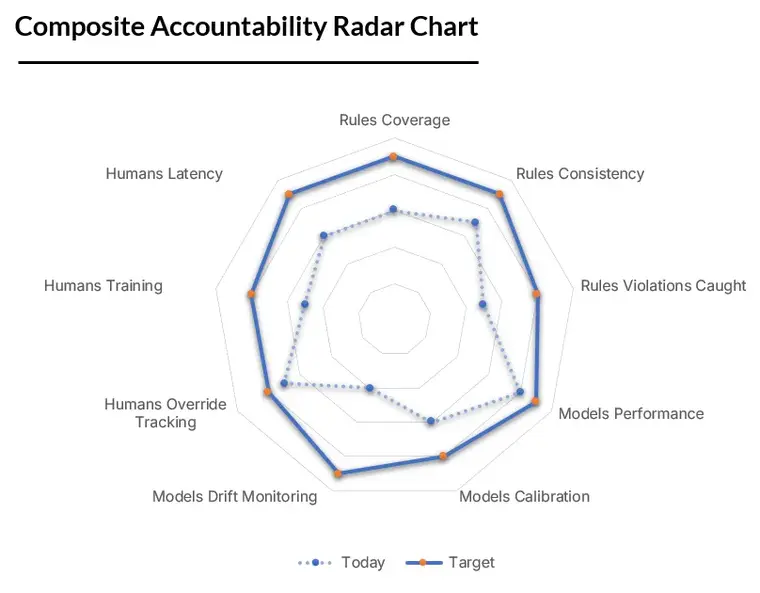
Engineering Readiness Checklist
Before deploying a composite AI architecture into production, verify that the system satisfies five core criteria:
- Role Disambiguation: Are deterministic constraints, probabilistic inferences, and human exception pathways governed by distinct, written functional specifications?
- Local Observability: Does each pipeline actor expose dedicated telemetry measuring internal performance independently of end-to-end outcome metrics?
- Causal Trace Serialization: Can any historical transaction be replayed deterministically from an immutable trace showing inputs, rule fires, model logits, and operator actions?
- Contractual Failure Traps: Does the orchestration layer immediately halt execution or trigger deterministic fallbacks when any component violates its local invariant?
- Continuous Contract Evolution: Does the engineering organization maintain an automated postmortem protocol that translates production anomalies into updated regression test suites?
The Adversarial Stress-Test: Five Critical Inquiries
1. What is the strongest argument against this approach?
Attributing individual component blame in a tightly coupled composite AI system is often theoretically impossible due to non-linear feedback loops and emergent interactions. Decomposing failures into isolated rule, model, or human errors creates an artificial illusion of separability when catastrophic failures frequently stem from the complex intersections between otherwise conforming components.
The Practical Resolution: Treat the orchestration layer itself as an explicit, contractually governed component with its own local invariants. Instrument interaction monitors that measure cross-component latency, distribution shifts between stages, and routing divergence, capturing emergent interface dynamics rather than treating orchestration as an invisible pipe.
2. Under what circumstances would this fail?
This architecture fails when an organization experiences a "compliance carousel" where each stakeholder uses component contracts defensively to evade responsibility. The ML team proves the model met its AUC threshold, the risk team proves rules fired, and human operators prove they followed guidelines, yet the aggregate system still inflicts a catastrophic business loss with nobody accountable for system-level emergence.
The Practical Resolution: Establish shared system-level circuit breakers owned jointly by product and risk leadership. If cumulative business loss or aggregate anomaly metrics breach predefined safety thresholds, automated kill-switches halt pipeline autonomy regardless of whether individual subsystem contracts were nominally satisfied.
3. What would a skeptical customer, client, or colleague object to?
A skeptical engineering manager or product leader will argue that maintaining granular contracts, invariant tests, and local metrics for every sub-component adds crushing operational drag, turning lightweight product development into a rigid, waterfall compliance bureaucracy.
The Practical Resolution: Automate contract verification within standard CI/CD pipelines using contract-testing frameworks (such as Pact or typed Protobuf schemas). Embed telemetry instrumentation directly into baseline application middleware so that developers inherit traceable logging and metric collection without authoring bespoke audit harnesses.
4. Which alternative deserves more consideration?
End-to-End Holistic Outcome Verification with automated indemnification. Rather than instrumenting and arbitrating blame across microscopic components, treat the entire composite flow as a unified black-box executor. Guarantee system SLAs via programmatic reconciliation, automated rollbacks, and financial liability pools, measuring only the macro outcome.
The Practical Resolution: Reserve holistic outcome verification for low-stakes, highly reversible consumer workflows (such as dynamic recommendation feeds or search query expansions). In regulated or high-liability domains, statutory compliance mandates require granular root-cause disclosure that black-box verification cannot legally satisfy.
5. What am I assuming that may not be true?
This framework assumes that human reviewers operate as independent, objective judges capable of validating model recommendations. In reality, human operators frequently suffer from automation bias (blindly deferring to high-confidence scores) or cognitive exhaustion (rubber-stamping ambiguous cases), invalidating the assumption of human contractual independence.
The Practical Resolution: Continuously audit human review fidelity by injecting synthetic canary cases and measuring operator disagreement rates. Enforce blind adjudication protocols on critical decision tiers, requiring operators to formulate independent judgments before revealing model recommendations.
One-Line Synthesis
Composite accountability secures high-stakes AI systems by binding rules, models, and human operators to independent verifiable contracts that isolate defects to their exact architectural layer.
Related in this series
-
How to build AI Audit Trails: Learn how to capture the evidence needed for accountability.
-
What are the 4 levels of AI autonomy?: See how Control Tiers define the scope of accountability.
Frequently Asked Questions
What is composite accountability in AI?
Composite accountability is a framework where every actor in an AI system (rules, models, and humans) has an explicit role, a verifiable contract, and a measurable local metric.
How do you hold an AI system accountable?
Accountability is established by move from vague model accuracy to component-level contracts, using audit trails to prove whether rules were met, models calibrated, or humans followed policy.
Subscribe to the Architecture of Proof Dispatch
Rigorous, decision-forcing systems engineering and AI governance monographs for technical leaders. Delivered periodically, zero spam.