Control Tiers for AI‑enabled Processes: Controlling When AI Acts, Asks, or Stops
This post is part of the Autonomy and Escalation pillar.
AI operates across varying degrees of autonomy: generating suggestions, executing actions within guardrails, or yielding control entirely to human operators. Matching machine autonomy to operational consequence is a prerequisite for production safety.
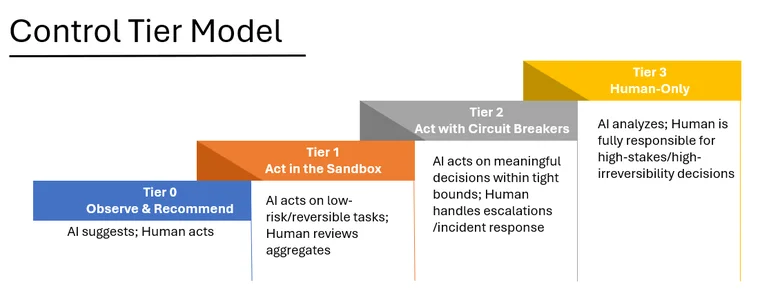
Without deliberate tier assignments, systems default into two catastrophic failure modes:
- Unbounded Autonomy: Systems execute consequential actions with insufficient verification, creating uncontrolled enterprise liability.
- Review Paralysis: Systems route trivial decisions to human operators, causing cognitive fatigue and operational bottlenecks.
Composite Intelligence orchestrates rules, models, and humans. Composite Accountability ensures each actor proves its execution trace. Control Tiers resolve the operational boundary: determining how far a system is authorized to act independently.
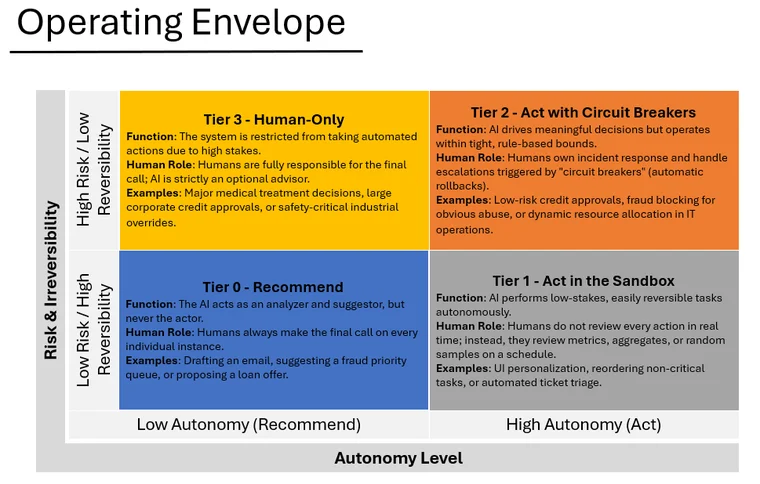
Control Tiers establish predefined autonomy envelopes, each governed by three explicit criteria:
- Permissions: Exactly what actions the system is authorized to execute.
- Preconditions: Empirical proof requirements that must hold before operating at this tier.
- Escape Routes: Deterministic triggers that force escalation or trigger automated downgrades.
The Four Levels of AI Autonomy
| Tier | Name | Permissions | Example Workflows |
|---|---|---|---|
| Tier 0 | Observe | Analysis, scoring, and recommendation drafting | Drafting responses, ranking leads, medical note drafting |
| Tier 1 | Act in Sandbox | Bounded, reversible actions with automated rollbacks | Internal ticket tagging, UI personalization, micro-discounts |
| Tier 2 | Act with Circuit Breakers | High-leverage, bounded actions with active telemetry | Automated credit approvals, fraud blocking, resource scaling |
| Tier 3 | Human Only | Autonomous execution prohibited; machine acts as advisor | Clinical diagnosis, capital disbursement, regulatory filings |
Every production workflow must operate under an explicit tier assignment with documented justification.
Connecting Tiers to Rules, Models, and Humans
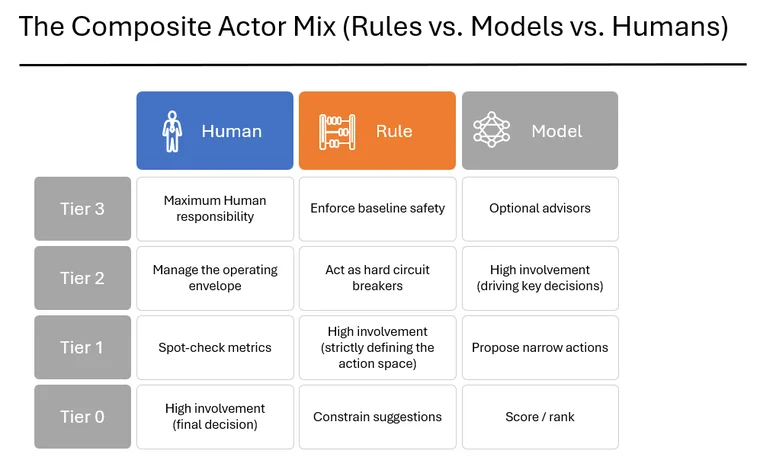
Each Control Tier establishes a distinct balance between probabilistic models, deterministic rules, and human oversight.
Tier 0: Observe (Advisory Ingress)
Tier 0 is read-only. Probabilistic models summarize, draft, and rank information, but they have zero authority to push the "submit" or "send" button. Deterministic rules strip out prohibited words and compliance violations before surfacing recommendations to users. Final judgment, validation, and real-world execution remain exclusively with a human operator.
Tier 1: Bounded Sandbox Autonomy
Tier 1 grants models direct execution privileges over narrow, low-consequence actions where blast radius is tightly constrained and state changes can be rolled back automatically. Deterministic rules define the invariant perimeter—such as maximum promotional discounts or tenant routing tags—while human operators monitor aggregate telemetry distributions and spot-check random samples.
Tier 2: High-Leverage Autonomy with Circuit Breakers
At Tier 2, models drive consequential financial or operational decisions without per-transaction human approval. Autonomy is safe at this tier only because execution is bounded by real-time circuit breakers: deterministic loss caps, sliding-window rate limiters, and automated downgrade triggers that pull authority the moment runtime metrics drift outside statistical baselines.
Tier 3: Human Only (Protected Air-Gap)
In high-liability domains like clinical drug administration, fiduciary capital disbursements, or binding regulatory filings, autonomous model execution is strictly forbidden. Probabilistic systems are restricted to ambient context synthesis and structured retrieval. Statutory compliance and deterministic policies enforce an absolute air-gap: execution rights belong solely to credentialed practitioners.
How Does an AI System Earn More Autonomy?
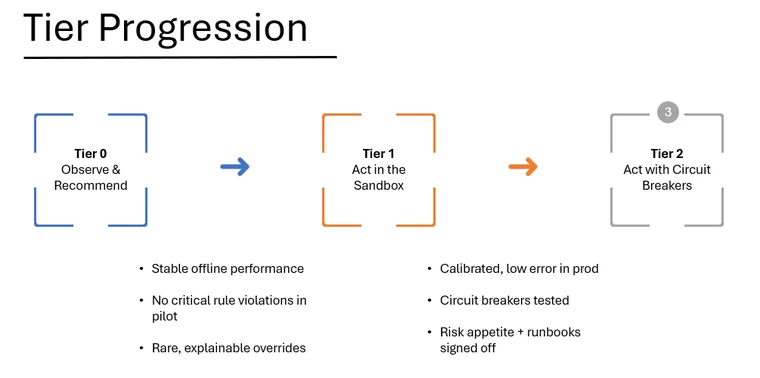
Tier promotions are governance events, not configuration changes. Moving a workflow up an autonomy tier requires empirical proof:
Advancing from Tier 0 to Tier 1 requires:
Advancing from Tier 1 to Tier 2 establishes higher evidentiary hurdles:
The guiding invariant is consistent: no evidence, no tier upgrade.
The PM's Autonomy Promotion Gate: The 4-Question Readiness Checklist
When executives or engineers ask to give an AI agent more autonomous execution authority, product managers should run this four-question gating checklist in the review:
| Question for the Engineering & Risk Review | Why It Matters Before Launch | What Happens If You Cannot Answer It |
|---|---|---|
| 1. Is there an automated 'Undo' button? | Can an erroneous database write or customer message be cleanly rolled back in $< 60$ seconds? | Stay at Tier 0. If you cannot easily reverse the action, an AI should not execute it autonomously. |
| 2. What is the hard dollar or transaction cap? | What is the maximum blast radius if the agent enters an infinite retry loop or hallucinates values? | Stay at Tier 0. Autonomy requires hard code caps (e.g., max 50 actions/hour, max $100 per action). |
| 3. Does the system know when to say 'I don't know'? | Does the model have a tested refusal path (decision_status: escalate), or does it guess on edge cases? |
Stay at Tier 0. If the model never refuses, it will confidently execute bad decisions. |
| 4. What automatically pulls the plug if metrics drift? | Is there a circuit breaker that downgrades the system to Tier 0 if error rates exceed 3% over 1 hour? | Stay at Tier 0. If an engineer has to manually log in to shut off the agent, you don't have a circuit breaker. |
Automated Degradation and Circuit Breakers
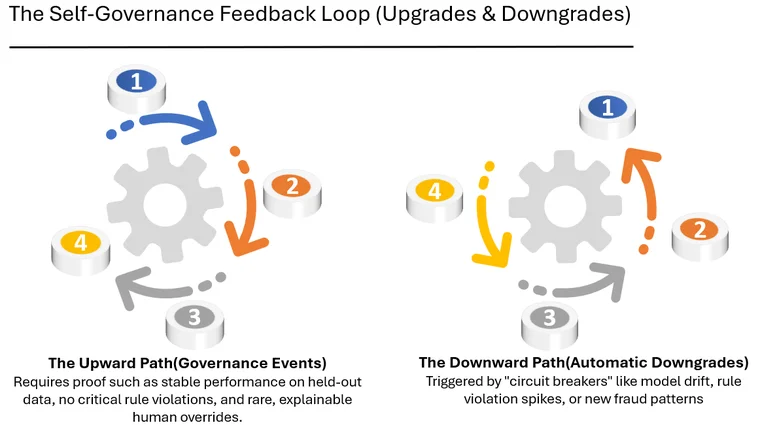
A resilient control plane designs the downgrade path before enabling the execution path. When telemetry indicates model drift or constraint violations, the system must downgrade autonomy automatically:
The system self-governs deterministically: when telemetry breaches predefined thresholds, the system sheds autonomy immediately.
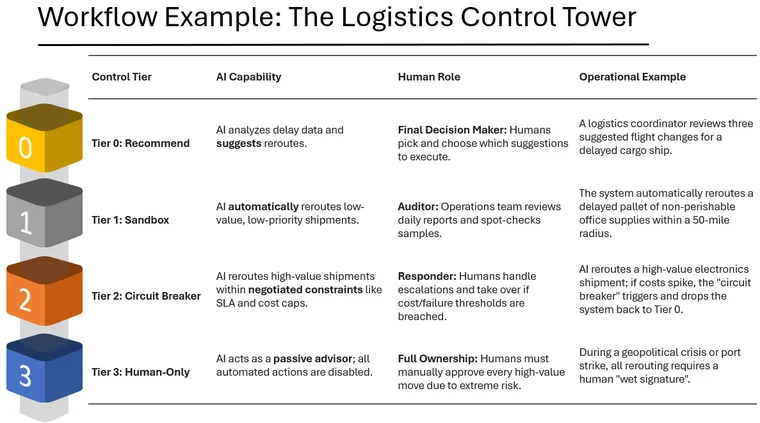
Example: Operations Workflow in a Logistics Control Tower
In high-throughput logistics control towers, the same underlying model infrastructure dynamically shifts between control tiers based on operational context, parcel value, and runtime error rates:
| Autonomy Tier | Operational Scope | Execution Mechanism | Circuit Breaker & Downgrade Gate |
|---|---|---|---|
| Tier 0 (Observe) | Critical or delayed shipments | AI drafts reroute candidates; human coordinators review and execute. | Baseline state for high-uncertainty or customs-hold freight. |
| Tier 1 (Sandbox) | Low-value regional parcels ($<\$100$) | AI commits automated carrier rerouting within bounded geographic zones. | Rollback action triggers if delivery ETA slips $> 2\text{ hours}$. |
| Tier 2 (Circuit Breakers) | High-value freight ($<\$50,000$) | AI reroutes active fleets under strict fuel and carrier cost-variance budgets. | Auto-downgrades to Tier 0 if cost variance breaches $5\%$ over rolling 1-hour window. |
| Tier 3 (Human Only) | Embargos & severe weather events | Automated rerouting revoked across network; system restricts output to advisory maps. | Enforced by deterministic policy engine during declared emergencies. |
The Adversarial Stress-Test: Five Critical Inquiries
To ensure the Control Tier framework withstands technical failure modes and organizational friction, we subject it to five decision-forcing inquiries:
1. What is the strongest argument against this approach?
- The Autonomy Throttle & Commercial Disadvantage Thesis: Rigid four-tier partitioning artificially constrains AI productivity. In fast-moving commercial markets, competitors deploying unconstrained agentic systems capture rapid operational leverage and user engagement while organizations bound to formal evidence gates and tier promotions remain stalled in Tier 0 pilots.
2. Under what circumstances would this fail?
- Failure Mode A: Threshold Flapping and Queue Flooding: Rapidly oscillating telemetry near circuit breaker boundaries triggers repeated downgrades, overwhelming human review queues with sudden volume spikes.
- Failure Mode B: Silent Tier Creep: Organizational shortcuts, informal approvals, and unversioned pipeline changes allow Tier 0 advisory models to mutate into de facto autonomous executors without triggering formal promotion audits.
- Failure Mode C: Rubber-Stamp Review Decay: When high-throughput systems degrade to Tier 0 or Tier 3, human operators face insurmountable review volumes, degrading oversight into reflexive approval without cognitive evaluation.
3. What would a skeptical customer, client, or colleague object to?
- "Why are we paying for enterprise AI if 80% of our workflows remain trapped in Tier 0 advisory modes?" Enterprise stakeholders expect immediate labor replacement; imposing multi-stage evidence requirements and formal rollback triggers can make software feel constrained.
4. Which alternative deserves more consideration?
- Continuous Stochastic Hedging and Post-Hoc Financial Indemnification: Instead of hard four-tier boundaries, permit continuous probabilistic execution backed by dynamic micro-collateral, insurance pools, and automated transaction rollback engines that absorb downside risk financially without choking operational velocity.
5. What am I assuming that may not be true?
- Assumption 1: Clean Autonomy Discretization: We assume complex, multi-agent workflows can be partitioned neatly into four discrete tiers, whereas emergent agentic behavior often spans continuous autonomy boundaries.
- Assumption 2: Reliability of Downgrade Triggers: We assume telemetry and drift detectors fire accurately before catastrophic failures occur, rather than suffering silent failure modes where models remain confidently wrong.
- Assumption 3: Human Readiness for Escalation: We assume human operators maintain situational awareness and capacity to intervene safely when an automated tier instantly downgrades during an operational crisis.
One-Line Synthesis
Control Tiers transform operational oversight into an engineered envelope: system autonomy is granted strictly through empirical evidence, bounded by deterministic invariants, and instantly revoked by automated circuit breakers.
Related in this series
- AI Incident Response and Escalation: Learn how systems move between control tiers at runtime.
- What is Composite AI Intelligence?: See how rules and humans provide the guardrails for autonomous tiers.
- Who's Accountable When the AI Gets It Wrong?: The flagship framework for multi-layer accountability and contract lifecycles.
Subscribe to the Architecture of Proof Dispatch
Rigorous, decision-forcing systems engineering and AI governance monographs for technical leaders. Delivered periodically, zero spam.