Composite AI Architectures: Orchestrating Rules, Models, and Humans | AI Governance
This post is part of the AI Accountability Architecture pillar.
High-stakes enterprise products do not fail because an engineer selected a marginally inferior foundation model or authored an imperfect prompt. They fail because the system was conceived as a monolithic model wrapper rather than a choreographed multi-actor architecture.
Reliability in automated production systems emerges from choreography. When deterministic compliance logic, probabilistic statistical models, and human domain experts operate within distinct operational boundaries, the system achieves both computational scale and statutory defensibility.
Why Can't Monolithic Models Replace Composite Systems?
Every resilient production AI deployment distributes operational authority across three distinct architectural actors:
| Architectural Actor | Computational Nature | Primary System Strength | Core Governance Boundary |
|---|---|---|---|
| Deterministic Rules | Non-probabilistic, discrete boolean logic | Zero-tolerance invariant enforcement, compliance guardrails | What constraints must never be violated, regardless of model confidence? |
| Statistical Models | Probabilistic pattern recognition, embeddings | High-dimensional classification, risk scoring, unstructured extraction | Where do empirical distributions and semantic inference outperform static heuristics? |
| Human Experts | Qualitative evaluation, context disambiguation | Fiduciary ownership, moral judgment, novel exception handling | Which high-consequence edge cases mandate signed legal accountability? |
Composite intelligence rejects the false choice between brittle rule-based heuristics and unaccountable deep neural networks. Instead, it assigns computational responsibilities to the actor uniquely equipped to execute them.
Architectural Orchestration Topologies
The flow of authority between rules, models, and human adjudicators determines the system's risk profile and operational latency:
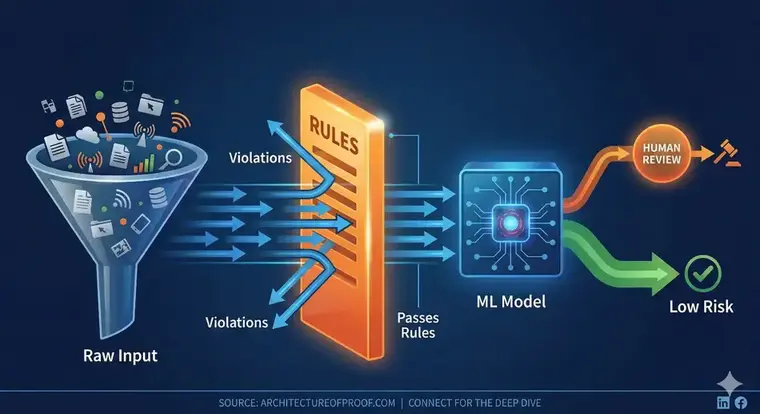
1. Conservative Invariant Filtering (Rules → Model → Human)
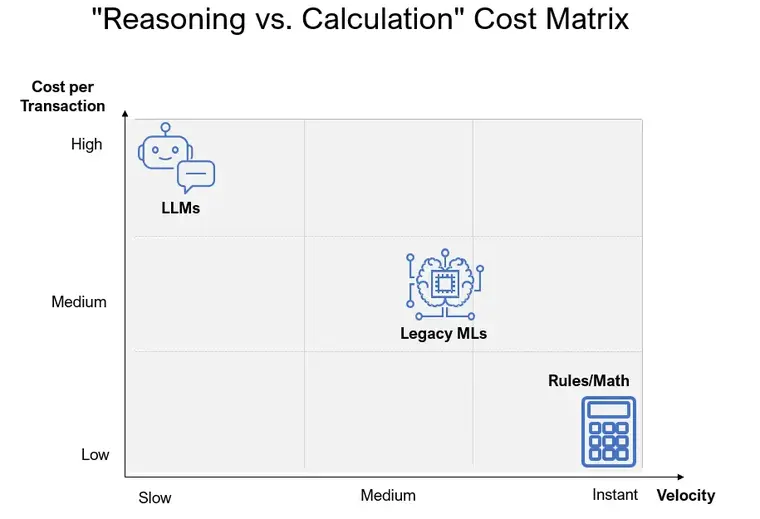
Deterministic compliance rules execute at the ingress boundary, dropping ineligible, malformed, or high-risk payloads before inference. Probabilistic models score the remaining ambiguous cases. Human reviewers adjudicate only the marginal band surrounding the decision threshold. This topology minimizes inference spend and shields operators from mundane manual sorting.
2. Proposal with Invariant Clipping (Model → Rules → Human)
A foundation model synthesizes messy unstructured context to generate candidate actions, drafts, or configuration adjustments. A downstream deterministic rules engine intercepts the proposed payload, validating it against hardcoded statutory parameters, budget caps, and schema contracts before execution. Disallowed actions route directly to human exception queues.
3. Dynamic Peer Supervision (Rules ↔ Model)
Deterministic triggers define the exact operational envelope in which a statistical model is authorized to evaluate payloads. Concurrently, recurring model inference patterns that demonstrate sustained calibration and zero drift are programmatically harvested and compiled into new deterministic invariants, progressively reducing ongoing inference overhead.
4. Human Feedback and Curriculum Injection
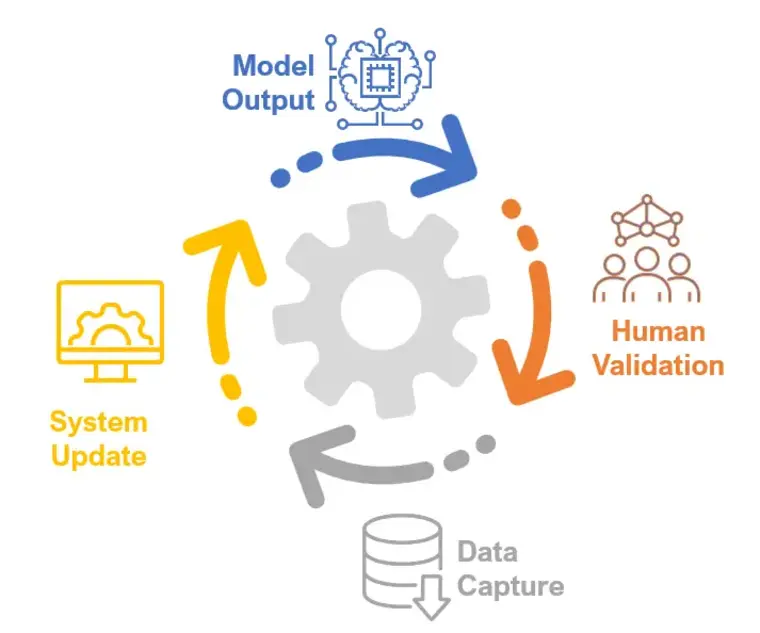
Human operators do not function as passive safety nets. Every manual adjustment, override justification, and edge-case correction is serialized as a structured telemetry record. These audit records continuously generate high-fidelity regression test suites and curriculum data for downstream fine-tuning.
Cross-Domain Composite Architecture Comparison
Real-world enterprise systems combine these primitives to balance execution throughput against operational exposure:
| Domain Application | Deterministic Rule Guardrails | Probabilistic Model Inferences | Human Oversight Boundaries |
|---|---|---|---|
| Customer Support Copilots | Statutory disclosures, SLA timers, refund dollar ceilings, regional compliance bans | Multi-turn intent extraction, semantic thread summarization, candidate reply drafting | High-sentiment dispute resolution, goodwill credits above policy limits, legal escalations |
| Transaction Monitoring | Sanctions lists, velocity counters, geographic travel mismatches, KYC/AML filters | Graph-based anomaly clustering, fraud probability scoring, synthetic identity detection | Suspicious Activity Report (SAR) filing, frozen account appeals, law enforcement inquiries |
| Commercial Credit Decisioning | Hard debt-service ratio caps, prohibited business categories, regulatory exposure ceilings | Default probability curves, cashflow volatility forecasts, revenue trend extrapolation | Covenant waivers, cross-collateralization exceptions, loan commitments exceeding $500k |
| In-Product Recommendations | Contractual catalog rights, real-time inventory levels, localized age/jurisdiction blocks | Collaborative filtering, semantic affinity vectors, dynamic conversion optimization | Promotional campaign strategy, margin-versus-volume trade-offs, loss-function adjustments |
| Operational Control Towers | Maximum overtime labor limits, mandatory rest periods, vehicle maintenance intervals | Multi-variable demand forecasting, delivery delay modeling, inventory replenishment math | Disrupted supply route re-allocations, carrier contract disputes, weather emergency protocols |
The PM's Composite Orchestration Matrix: Choreographing Rules, Models, and Humans in Product Spec Reviews
When product managers write PRDs for AI-powered workflows, they must resist the temptation to treat the model as a silver bullet that handles everything from intent extraction to financial commitment.
Bring this division-of-labor matrix into your product architecture reviews to ensure every actor owns the right slice of execution:
| Workflow Stage | Assigned Actor | What the Actor Must Own | What the Actor Is Strictly Forbidden From Doing |
|---|---|---|---|
| Stage 1: Input Validation & Eligibility | Deterministic Code / Rules | Validate mandatory schema fields, verify KYC/AML identity, check regulatory eligibility, and drop malformed payloads in microseconds. | Attempting semantic fuzzy matching or probabilistic intent classification; all rules must evaluate discrete booleans. |
| Stage 2: Semantic Extraction & Scoring | Probabilistic ML / LLM Model | Parse unstructured messy customer text, extract relevant entities, evaluate risk curves, and generate draft recommendations. | Executing unconstrained database state mutations, sending unapproved user communications, or committing financial liabilities. |
| Stage 3: Boundary Clipping & Guardrails | Deterministic Code / Rules | Enforce hard policy limits (e.g., maximum refund $25, credit limit cap $50k), verify required disclaimers, and format output schemas. | Relying on prompt instructions to enforce compliance ceilings; all limits must be enforced in code. |
| Stage 4: Edge-Case Exception Escalation | Human Domain Expert | Review cases falling in the ambiguous confidence band (e.g., score 0.40–0.70), adjudicate novel disputes, and sign off on high-value exceptions. | Rubber-stamping batches without reviewing flagged evidence; overriding system recommendations without structured reason codes. |
| Stage 5: State Commit & Telemetry Ledger | Orchestrator Platform | Write immutable Decision State Vector to append ledger, verify synchronous commit, and dispatch action to downstream APIs. | Disbursing funds or returning responses before the cryptographic audit record has been durably persisted. |
Designing the Operational Choreography
Systems architects designing composite workflows must evaluate five structural design questions before committing code:
- Constitutional Invariant Mapping: Which business rules represent statutory redlines that must execute deterministically prior to model invocation?
- Probabilistic Uncertainty Boundaries: What explicit confidence interval or calibration threshold marks the boundary between autonomous execution and mandatory review?
- Fiduciary Signature Requirements: Which high-consequence actions require explicit, authenticated human sign-off regardless of model certainty?
- Graceful Degradation Paths: How does the orchestration gateway dynamically transition from autonomous execution to human recommendation when live drift metrics trip?
- Telemetry Attribution Hooks: Does the system capture every rule firing, model logit distribution, and human override code within an immutable decision record?
For a deeper analysis of downstream auditability and escalation protocols, examine our frameworks for Composite Accountability and Autonomy and Escalation.
The Adversarial Stress-Test: Five Critical Inquiries
1. What is the strongest argument against this approach?
Orchestrating disparate rules engines, machine learning models, and human escalation workflows introduces severe architectural complexity and high coordination latency. Maintaining synchronization between hardcoded business rules, evolving statistical model distributions, and shifting human operational policies creates integration friction that slows product velocity compared to unified end-to-end foundation models.
The Practical Resolution: Decouple rule definition from application code using a versioned Policy-as-Code registry. Standardize inter-component payload serialization using typed protocol buffers, enabling the orchestration gateway to execute validation rules in microseconds without distributed network hops.
2. Under what circumstances would this fail?
The architecture breaks down when boundary interactions produce unintended deadlocks or priority inversions. If deterministic rules filter out valid non-linear edge cases before the model can evaluate them, or if the model produces confident predictions that subtly contradict the intent of unwritten regulatory rules, the system passes bad inferences to downstream operators. Additionally, if human reviewer queues become backlogged, the entire composite pipeline stalls.
The Practical Resolution: Implement dynamic backpressure controls and automated circuit breakers at the orchestration boundary. When human review queues exceed SLA thresholds, the system automatically falls back to conservative deterministic defaults rather than queuing transactions indefinitely or bypassing safeguards.
3. What would a skeptical customer, client, or colleague object to?
A skeptical engineering executive would argue that modern frontier models with reasoning capabilities and tool calling already integrate logic, classification, and safety, rendering an elaborate composite tri-actor orchestration layer redundant and overly expensive to maintain.
The Practical Resolution: Demonstrate that frontier model tool-calling remains fundamentally probabilistic; prompts cannot provide mathematical guarantees against regression or hallucination during adversarial inputs. Deterministic rules supply non-negotiable legal perimeters that zero-shot model reasoning cannot legally guarantee in regulated fiduciary domains.
4. Which alternative deserves more consideration?
Autonomous Reasoning Agents with constrained tool-use interfaces (such as function calling and JSON schema decoding). Instead of building separate rule engines and routing middleware, an enterprise can rely on a single capable frontier model instructed with deterministic tool contracts and self-reflection loops, minimizing custom architectural scaffolding.
The Practical Resolution: Deploy autonomous tool-calling agents exclusively within Tier 1 reversible sandboxes where operational blast radiuses are mathematically bounded. Mandate hardcoded composite orchestration for Tier 2 and Tier 3 irreversible financial, clinical, or legal transactions.
5. What am I assuming that may not be true?
This architecture assumes that enterprise decisions can be cleanly partitioned into deterministic invariants, statistical probabilities, and human judgment. In practice, real-world operational domains often feature ambiguous policies where rules lack crisp boundaries and human reviewers introduce more variance and cognitive inconsistency than the statistical models they oversee.
The Practical Resolution: Treat human adjudicators as probabilistic actors governed by explicit contracts. Continuously benchmark human agreement rates, enforce double-blind adjudication on contentious classifications, and systematically codify verified consensus decisions into updated deterministic invariants.
One-Line Synthesis
Enterprise AI defensibility emerges when deterministic compliance rules, probabilistic scoring models, and human adjudicators operate within a choreographed decision topology with isolated failure boundaries.
Related in this series
-
The 4 Tiers of AI Autonomy: Learn how to manage control within a composite system.
-
Proving AI Accountability: See how to hold every actor in a composite flow responsible.
Frequently Asked Questions
What are composite AI architectures?
Composite AI architectures are systems that orchestrate deterministic rules, machine learning models, and human domain expertise into a single, high-fidelity decision flow.
How do you build a reliable AI product?
Reliability in AI products comes from the choreography of rules for safety, models for patterns, and humans for accountability.
Subscribe to the Architecture of Proof Dispatch
Rigorous, decision-forcing systems engineering and AI governance monographs for technical leaders. Delivered periodically, zero spam.