AI Accountability Architecture: Designing Systems That Can Prove What They Did | AI Governance
Production AI systems are built to optimize predictive performance. Far fewer are engineered to generate verifiable proof.
A predictive system delivers plausible outputs under favorable conditions. An accountable system proves, after an incident, that every component operated within pre-negotiated behavioral bounds, isolating precisely where and why a decision failed. AI accountability architecture establishes that boundary.
What AI Accountability Architecture Means
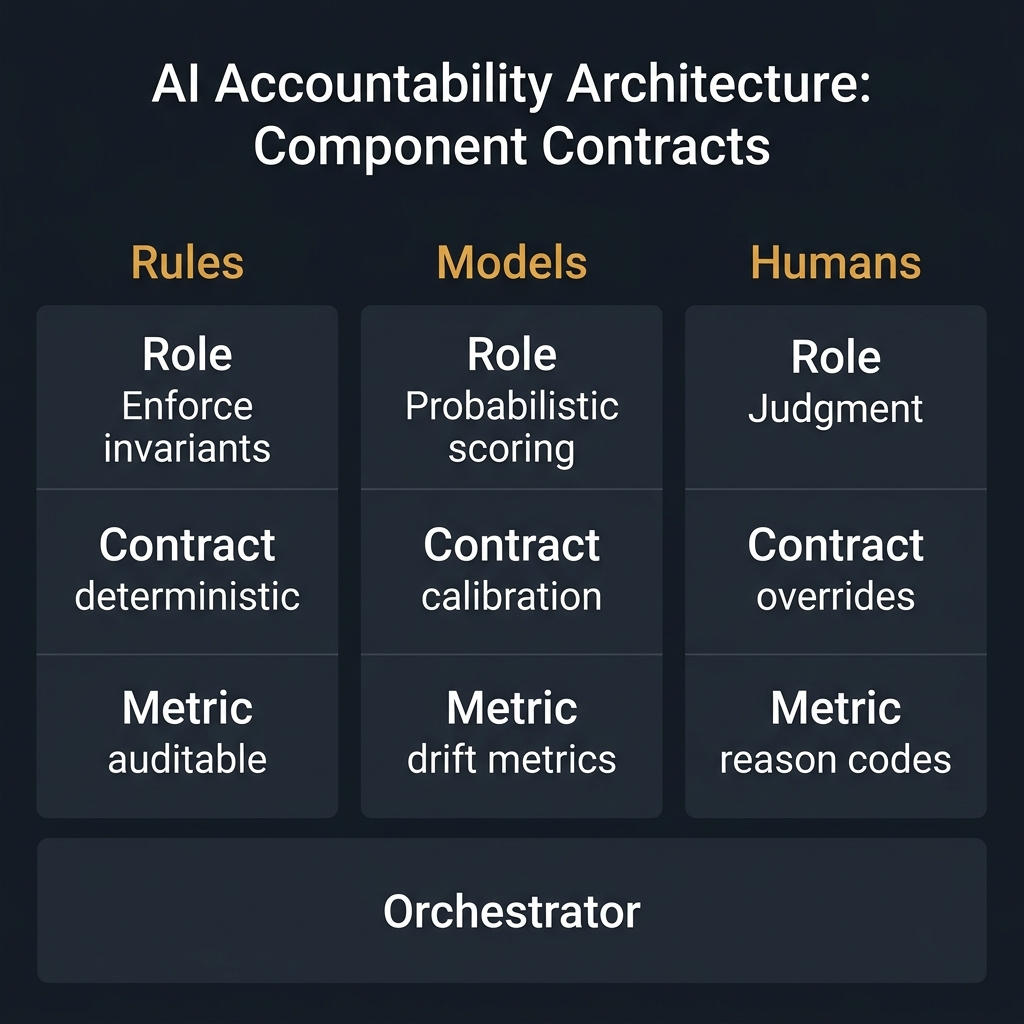
AI accountability architecture is the structural design discipline where rules, models, and humans each carry an explicit role, a verifiable contract, and a measurable local metric.
It is not an operational dashboard or a retrospective compliance review; it is the underlying software design that makes observability actionable. In composite workflows—where deterministic business rules, probabilistic foundation models, and human adjudicators collaborate on a single transactional decision—accountability cannot be evaluated as an aggregate scalar score. It must be isolated across each executing layer.
Why Does Standard AI Governance Miss the Core Problem?
Traditional AI governance focuses almost exclusively on generic model risk: measuring aggregate benchmark accuracy, auditing training data distributions, or scanning output tokens for toxicity. While necessary, these measures fail to provide operational accountability during an incident postmortem.
Forensic accountability requires granular layer attribution. An engineer or auditor must be able to determine whether the deterministic rule engine admitted an unauthorized payload, whether the model scored an anomalous input accurately according to its calibration curve despite upstream schema corruption, or whether a human reviewer approved an override based on a miscalibrated product threshold. None of these distinctions are detectable from downstream outcome metrics alone; they require an inspectable execution trace logged at every handoff.
The Three Structural Requirements
An accountable composite architecture enforces three non-negotiable disciplines at every layer:
1. Explicit Roles
Rules enforce deterministic invariants: statutory constraints, minimum eligibility criteria, and mandatory human review triggers. Models provide probabilistic estimates: ranking, classification, and unstructured synthesis within the perimeter permitted by the rules. Humans contribute contextual judgment: resolving novel edge cases, evaluating ambiguous trade-offs, and absorbing legal liability.
When these boundaries blur, accountability collapses. If an engineering team asks an LLM to evaluate deterministic regulatory rules that belong in code, failure attribution becomes impossible. If human operators routinely override model recommendations through unstructured, unlogged channels, human error cannot be separated from model calibration failure.
2. Verifiable Contracts
Each component requires a formal contract defining verifiable behavioral bounds:
- Rules Contract: "No transaction with an unverified corporate identifier advances to the model." The assertion either holds or fails; it is deterministically verifiable from the trace log.
- Model Contract: "Given valid input features, the ranking engine maintains an AUC $\ge 0.88$ on held-out test distributions, with expected calibration error (ECE) below 0.05."
- Human Contract: "Operators overriding a model recommendation must select an authorized reason code and append corroborating documentary evidence before state mutation."
3. Local Metrics
Every contract must connect to an active runtime metric evaluated in production:
| Component | Contract Invariant | Local Runtime Metric | Audit Cadence |
|---|---|---|---|
| Deterministic Rules | Catch all statutory and policy violations | Rule violation catch-rate; cross-channel coverage | Continuous inline blocking |
| Probabilistic Models | Maintain ranking calibration within drift limits | AUC, Brier score, feature drift by user cohort | Daily batch drift profiling |
| Human Reviewers | Document justified policy overrides | Override rate, reason code distribution, review latency | Weekly supervisory audits |
| System Orchestrator | Enforce DAG state transitions and SLA bounds | Routing error rate, P99 queue latency, timeout trips | Real-time APM telemetry |
When a decision fails, the diagnostic inquiry does not ask "what happened to the outcome?" It asks "which local metric breached its contract, and at which layer?"
Four Systemic Pathologies Bounded by Accountability Architecture
| Governance Pathology | Operational Failure Mechanism | Architectural Remedy |
|---|---|---|
| 1. Diffuse Blame | Cross-functional finger-pointing between model developers, rule authors, and operations teams during postmortems. | Programmatic invariant contracts that attribute the failure to a single accountable layer. |
| 2. Silent Violations | Rules failing to execute or models drifting while top-line outcomes temporarily appear stable. | Decoupled local metrics that detect component violations before aggregate outcomes deteriorate. |
| 3. Governance Theater | Compliance policies that exist in slide decks and PDF manuals without enforcing runtime constraints. | Machine-executable rules and automated CI/CD release gates linked to policy definitions. |
| 4. Postmortem Paralysis | Engineering teams unable to reconstruct decision lineage due to uninstrumented, unversioned logs. | Immutable Decision State Vectors that preserve full context, feature hashes, and reasoning paths. |
The PM's Component Contract Matrix: Who Owns What When an AI Workflow Fails
When an AI workflow causes an operational error or customer escalation, cross-functional teams reflexively blame "the model." The Product Manager's job is to cut through finger-pointing and attribute the defect to the exact broken contract.
Use this operational matrix during postmortems and sprint triage to assign root-cause ownership:
| System Layer & Owner | The Exact Failure Mode | What the Cross-Functional Team Argues | The PM's Attribution Ruling & Fix |
|---|---|---|---|
| Deterministic Rules (Software Eng / Legal) |
Model outputs an unapproved $10,000 fee concession to a customer. | "The LLM hallucinated the discount despite our clear prompt guidelines." | Rule Contract Breach: Never ask a probabilistic prompt to enforce hard financial ceilings. Hardcode deterministic business constraints into code before the payload leaves the API. |
| Probabilistic Models (Data Science / ML Eng) |
Credit approval error rate surges on applicants with under 2 years of history. | "The overall model AUC is 0.89, so the system is operating within global tolerances." | Model Contract Breach: Reject aggregate metrics. The model breached its sub-cohort calibration contract. Retrain or restrict autonomy on young accounts immediately. |
| Human Reviewers (Operations / Clinicians) |
A loan officer approves an applicant flagged by the model for severe fraud risk. | "The officer had final sign-off authority and used their business discretion." | Human Contract Breach: Check the override trace. If the officer bypassed the warning without an authorized reason code or supporting documentation, treat as an operational audit defect. |
| System Orchestrator (Platform / SRE) |
Upstream vector database times out; system defaults to empty context and hallucinates. | "The third-party vector provider had an intermittent latency spike." | Orchestrator Contract Breach: When context retrieval fails, the orchestrator must trip a circuit breaker into a pre-authorized fallback queue, never emit ungrounded inferences. |
Architectural Anti-Patterns in Production
- Rolling Models into Rules: Hardcoding an uncalibrated model score as a binary eligibility gate (e.g., auto-declining any applicant with score $< 650$) treats a non-deterministic probability as a deterministic business rule, eliminating auditability without improving accuracy.
- Treating Overrides as Discardable Exceptions: Human overrides represent the most valuable training telemetry for system failure. Discarding override context hides the operational boundary where model contracts are miscalibrated.
- Conflating Accuracy with Accountability: High test-set accuracy measures aggregate predictive output; accountability measures whether the execution process followed its authorized contract. A correct decision produced through an unverified, rule-violating path remains a failure of governance.
The Adversarial Stress-Test: Five Critical Inquiries
To ensure this accountability framework withstands engineering skepticism and technical stress, we subject component contracts, local metrics, and explicit role boundaries to five decision-forcing inquiries:
1. What is the strongest argument against this approach?
- The Modularity Fallacy: Partitioning AI workflows into strict, decoupled roles with formal contracts assumes software modularity that modern multimodal reasoning models intentionally collapse. End-to-end models perform extraction, synthesis, and decisioning simultaneously; imposing artificial boundaries between rules, models, and humans introduces severe orchestration latency and prevents squads from leveraging emergent end-to-end capabilities.
- The Practical Resolution: Enforce contracts at external execution boundaries rather than policing intermediate model thoughts. The model retains complete internal reasoning autonomy, but all external tool interactions, state mutations, and final payloads must pass through deterministic schema and rule validations before touching production databases.
2. Under what circumstances would this fail?
This architecture fails when an unexpected, unmodeled external distribution shift corrupts the input space simultaneously across all components. If macroeconomic or regulatory conditions shift abruptly, deterministic rules evaluate invalid assumptions, model calibration collapses, and human operators experience cognitive fatigue, causing all three layers to fail concurrently and rendering localized contract metrics meaningless.
3. What would a skeptical customer, client, or colleague object to?
- "Building contracts, local telemetry, and multi-tier postmortem tooling before achieving product-market fit creates debilitating organizational friction. Early-stage products need rapid iteration, not an elaborate compliance-first scaffold that triples delivery time."
- The Resolution: Adopt tiered accountability. Exploratory prototypes operate in sandboxed Tier 0/1 environments with basic programmatic schema checks. The full multi-layer contract stack is activated only when a workflow graduates to consequential, state-mutating production environments where a single defect carries significant financial or legal liability.
4. Which alternative deserves more consideration?
- Post-Hoc Anomaly Clustering and Financial Blast-Radius Containment: Instead of preemptively formalizing dozens of component contracts, deploy systems with strict financial limits, account caps, and automated rollback scripts. When an outcome fails, use automated clustering over execution logs to isolate patterns asynchronously, paying compensation out of risk reserves rather than pre-engineering deterministic contracts.
5. What am I assuming that may not be true?
- Organizational Transparency: Stakeholders across engineering, data science, and compliance are genuinely willing to accept explicit component attribution, when corporate incentives often reward ambiguity to diffuse personal liability.
- Contract Linearity: Composite failures can be cleanly mapped to a single component breach, when in reality emergent non-linear interactions between models and tools often create shared culpability.
- Telemetry Bandwidth: Enterprise data infrastructure can sustain the storage and throughput overhead of logging full decision state vectors across millions of daily transactions.
One-Line Synthesis
AI accountability replaces speculative postmortems with technical forensics by binding rules, models, and humans to machine-verifiable operational contracts.
Related Posts in This Pillar
- Composite AI Architectures: How rules, models, and humans share the work of a decision.
- Composite Accountability: The detailed implementation guide for assigning contracts and metrics to each component.
- The Glass Box Manifesto: The case for moving from predictive faith to deterministic proof.
Downloadable Resource
The Architecture of Proof Readiness Checklist: A one-page diagnostic for assessing whether your current AI system meets the accountability standard.
Frequently Asked Questions
What is AI accountability architecture?
AI accountability architecture is the design discipline of building systems where every component (rules, models, and humans) has an explicit role, a verifiable contract, and a measurable local metric, so that failures can be traced to a specific part of the system.
How do you design an accountable AI system?
Start by separating deterministic rules from probabilistic models. Assign each component a contract (what correct behavior looks like). Instrument every decision so the reasoning path is logged separately from the outcome. Then build postmortem processes that attribute failures to specific components, not the system as a whole.
Why does AI accountability matter in regulated industries?
Regulators and auditors require evidence that decisions were made within policy. Saying 'the model decided' is not an acceptable answer. An accountable architecture gives you the evidence to show exactly which rule applied, which model scored what, and who intervened, before and after any incident.
Subscribe to the Architecture of Proof Dispatch
Rigorous, decision-forcing systems engineering and AI governance monographs for technical leaders. Delivered periodically, zero spam.