Autonomy and Escalation: The Complete Operational Guide to Designing AI Systems That Know When to Stop
"Keep a human in the loop" is not a product specification. It is a sentiment.
It does not tell an engineer which decisions require human sign-off. It does not define the statistical threshold that triggers escalation. It does not dictate what the system must do when the human review queue breaches its SLA, nor does it specify what happens when human reviewers introduce more variance and cognitive fatigue than the model itself.
In high-stakes enterprise applications (including commercial credit scoring, clinical triage routing, automated customer dispute settlement, and fraud intercept), unbounded autonomy is an uninsurable liability, while naive human review is an operational bottleneck that destroys unit economics.
Autonomy and escalation design replaces wishful thinking with deterministic choreography: explicit control tiers, objective evidence requirements for progression, real-time escalation triggers, and hard-coded circuit breakers that automatically pull the system back into safe harbor.
Why Does AI Autonomy Drift Out of Control in Production?
AI systems almost never experience catastrophic governance failures because someone deliberately turned on an unsafe feature. They fail because of autonomy drift.
A machine learning model is launched into production under tight supervision (Tier 0). Over the first quarter, the team observes high accuracy and low complaint volume. Operational bottlenecks emerge; human reviewers complain of repetitive work; backlog queues expand. A product lead decides to auto-approve "obvious low-risk cases." Two sprints later, the boundary expands again to alleviate customer wait times. Someone disables the manual verification step for a partner integration with the verbal agreement that "we will re-enable it once the new queue UI ships."
Months later, a subtle shift in upstream vendor data or macroeconomic customer behavior causes model calibration to degrade. Because autonomy drifted without formal architectural gates, the system continues executing thousands of autonomous decisions on flawed premises.
By the time leadership notices, the organization is facing regulatory inquiries, financial write-downs, and forensic panic.
Key Architectural Insight: Autonomy is not a static configuration toggle. It is an operational asset that inevitably drifts toward maximum velocity and minimum oversight unless bounded by deterministic constraints and programmatic downgrade mechanisms.
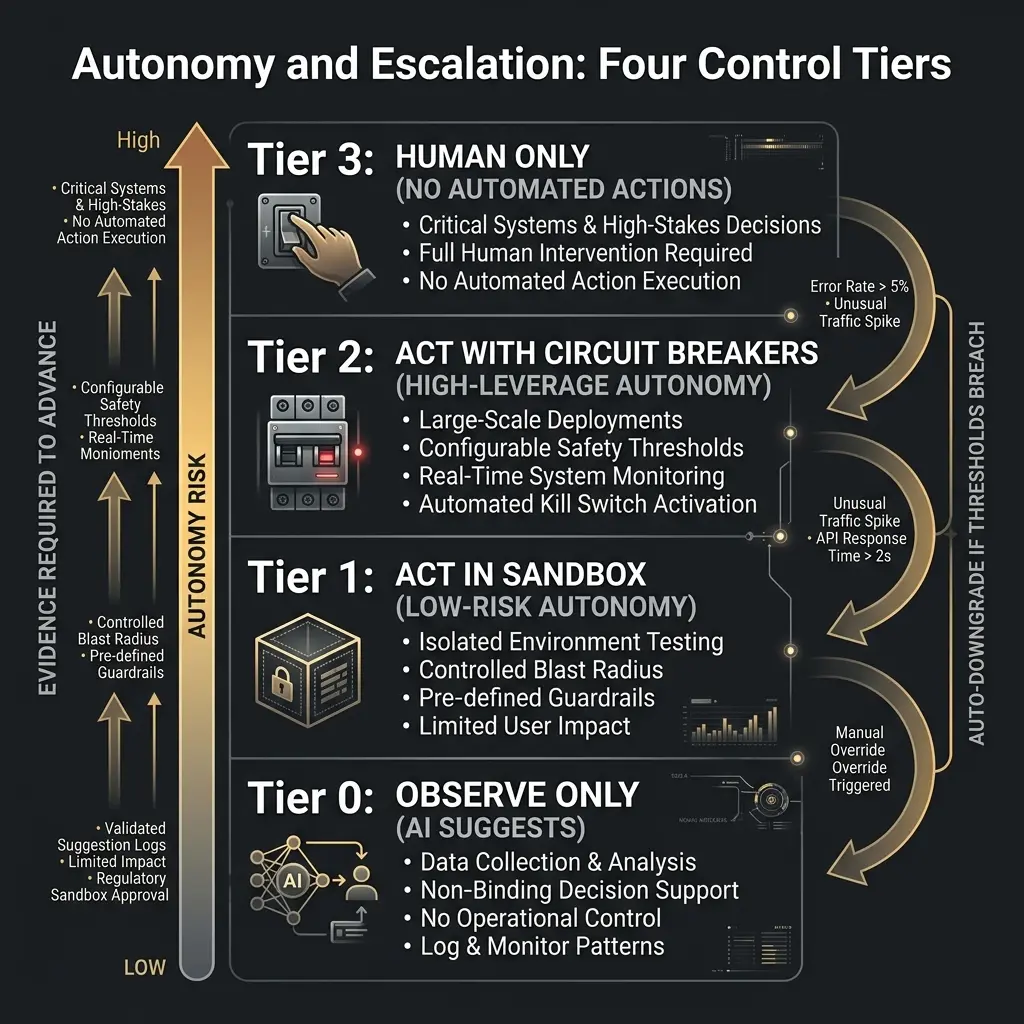
The Four Control Tiers: Standardizing Operational Agency
To eliminate ambiguity between engineering, product, and risk committees, Architecture of Proof standardizes system autonomy across four strictly defined operational tiers. Every AI-assisted workflow must be assigned to exactly one tier.
| Tier | Name | System Operational Role | Human Operational Role | Primary Risk Containment Gate |
|---|---|---|---|---|
| Tier 0 | Observe & Suggest | Analyzes data, calculates scores, drafts recommendations. Zero state-changing authority. | Reviews recommendation; executes 100% of state-changing actions. | Inability to write to production database or trigger external APIs. |
| Tier 1 | Act in Sandbox | Executes bounded, low-stakes, fully reversible actions within predetermined parameter fences. | Audits daily/weekly aggregate telemetry; handles edge-case escalations. | Automated rollback hooks; mathematical blast-radius caps. |
| Tier 2 | Act with Circuit Breakers | Executes high-leverage, high-frequency actions autonomously within normal operating parameters. | On-call for real-time escalation packets; investigates tripped breakers. | Hard-coded programmatic circuit breakers; automated tier demotion. |
| Tier 3 | Human-Only Mandatory | Ingestion and synthesis only; explicit prohibition against autonomous execution. | Retains sole fiduciary, legal, and operational execution authority. | Physical and cryptographic architectural blocks on autonomous execution. |
Tier 0: Observe & Suggest
At Tier 0, the model is an intelligent advisor. It parses unorganized inputs, identifies latent patterns, and surfaces candidate decisions to a human operator. The system has zero permission to update core records, disburse capital, or communicate directly with external parties without human confirmation.
- Typical Applications: Drafting complex commercial loan covenants; staging rare diagnostic hypotheses in pathology; suggesting dispute settlement terms to legal counsel.
- Preconditions: Baseline model validation and basic data schema checks.
Tier 1: Act in Sandbox (Reversible Execution)
At Tier 1, the AI is granted direct execution authority, but only for decisions that satisfy a strict reversibility constraint. If the model commits an error, the operational and financial cost to undo the action must be negligible, and an automated rollback hook must exist.
- Typical Applications: Routing customer support tickets to specialized queues; issuing goodwill promo credits under $15; tagging product taxonomy metadata in e-commerce catalogs.
- Preconditions: Holdout evaluation demonstrating stable error bounds; automated reversal scripts verified in staging; synthetic chaos testing of rollback flows.
Tier 2: Act with Circuit Breakers (Production Leverage)
Tier 2 is where enterprise scale is realized. The system makes irreversible or high-consequence decisions in real time without human pre-clearance. Because human review per transaction is impossible due to latency or volume constraints, safety is enforced via real-time statistical monitoring and automated circuit breakers.
- Typical Applications: Millisecond fraud blocking on payment gateways; dynamic inventory allocation across supply chain nodes; automated credit limit adjustments for prime accounts.
- Preconditions: Validated calibration curves; signed risk-appetite policy from legal and compliance; hard-coded circuit breakers integrated into the deployment pipeline; 24/7 on-call escalation routing.
Tier 3: Human-Only Mandatory (Fiduciary Redline)
Certain workflows must never be automated, regardless of model benchmark scores. In Tier 3, human judgment is legally, ethically, or strategically non-negotiable. The model is strictly quarantined to preparatory intelligence gathering.
- Typical Applications: Final adverse employment terminations; clinical interventions with direct mortality risk; capital expenditures exceeding board authorization thresholds; criminal sentencing risk scoring.
- Preconditions: Architectural air-gaps that prevent automated dispatch; cryptographic dual-custody approval gates.
The Four-Factor Matrix: How to Assign Tiers Objectively
Autonomy tiers must not be assigned based on executive intuition or data science enthusiasm. Product leaders must evaluate every proposed AI capability across four objective dimensions:
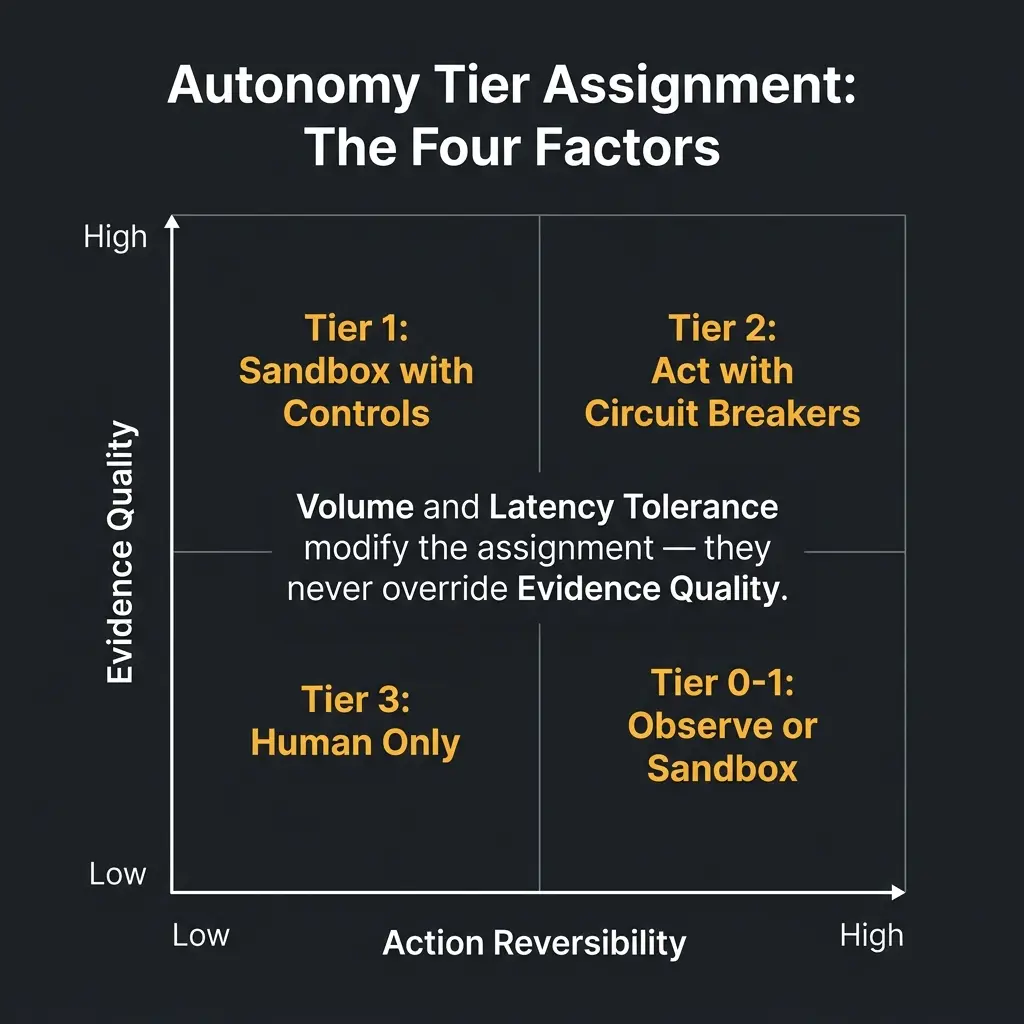
1. Decision Reversibility
If the model executes a flawed decision, what does it take to restore the prior state? * High Reversibility: Re-indexing a search tag, moving a support ticket back to an inbox, issuing a coupon. Eligible for Tier 1 or Tier 2. * Low/Zero Reversibility: Rejecting a mortgage applicant, reporting an AML violation to regulatory authorities, dispatching emergency medical vehicles. Constrained to Tier 0 or Tier 3.
2. Decision Velocity and Volume
What is the throughput demand of the workflow? * Sub-second Latency / High Volume (>50k/day): Human review is mathematically impossible. The workflow must either be designed for Tier 2 with aggressive circuit breakers or partitioned into deterministic rules. * Hours-to-Days Latency / Moderate Volume (<500/day): Human review is an affordable operational investment. Bias toward Tier 0 or Tier 1.
3. Review Capacity & Latency Tolerance
What happens to customer experience while a human reviews the case? * If human review introduces a 48-hour delay that causes customer churn to spike 30%, product architecture must solve the problem with bounded Tier 1 sandboxes rather than pretending human-in-the-loop is sustainable.
4. Evidence Quality in Prior Tiers
The Non-Negotiable Rule: Autonomy is earned through production mileage, not lab benchmarks. A model can never enter Tier 2 without documented, stable operational metrics inside Tier 1.
| Evaluation Factor | Factor State | Operational Tier Ceiling |
|---|---|---|
| Reversibility | Low / Zero | Automatically caps at Tier 0 (Observe Only) or Tier 3 (Human Mandatory) |
| Volume & Velocity | High (>50k/day) | Requires Tier 2 (Breakers Required) or deterministic rules |
| Evidence History | None / Unproven | Locked to Tier 0 regardless of throughput volume |
Worked Examples: Applying the Tier Assignment Matrix
Case 1: Automated Payment Fraud Blocking
- Context: High-velocity payment gateway processing 400 transactions per second.
- Factor Evaluation:
- Reversibility: Medium-Low (A false decline frustrates a legitimate cardholder; a missed fraudulent transaction is a direct chargeback loss).
- Volume/Latency: Extreme (Decision required in under 120ms; 35M daily transactions).
- Evidence Quality: High (Historical replay data across millions of prior settled transactions).
- Tier Assignment: Tier 2 (Act with Circuit Breakers).
- Design Specification: Transactions with risk scores between 0.00 and 0.15 auto-approve. Scores above 0.85 auto-block. The ambiguous middle band (0.16 to 0.84) routes to interactive SMS verification or temporary hold for human review. If the auto-block rate spikes above 2.4% over any rolling 15-minute window, the circuit breaker automatically demotes auto-blocking to "Step-Up Challenge Only" to prevent mass customer lockouts.
Case 2: Commercial Credit Underwriting ($100k - $2M)
- Context: Regional bank evaluating working capital loans for mid-sized enterprises.
- Factor Evaluation:
- Reversibility: Zero (Disbursed capital cannot be recalled without legal breach).
- Volume/Latency: Low (30 applications daily; 72-hour underwriting SLA).
- Evidence Quality: Moderate (Small sample size of macroeconomic default cycles).
- Tier Assignment: Tier 0 (Observe & Suggest).
- Design Specification: The model ingests bank feeds, tax returns, and debt schedules, synthesizing debt-service coverage ratios and highlighting covenants. The human underwriter must explicitly attest to each assumption. The model never holds signing authority.
When Does the System Ask for Help? The 4 Questions of Escalation
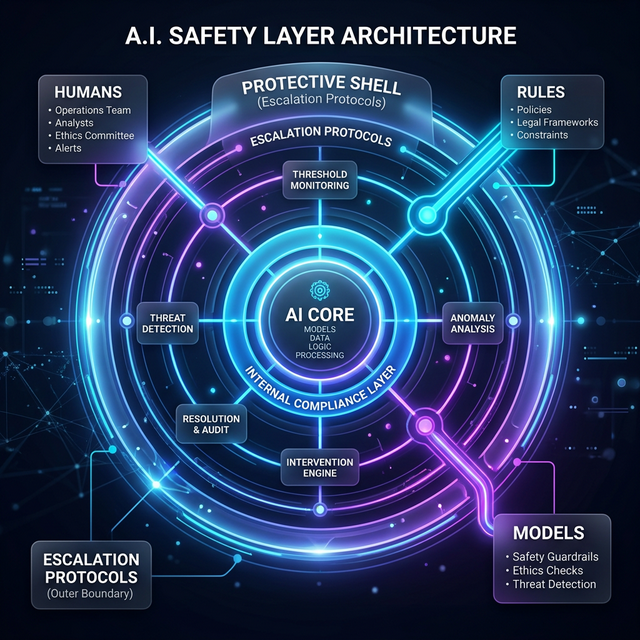
An AI system that does not know how to cleanly escalate is an operational failure waiting to happen. An escalation protocol is the runtime contract that dictates how an autonomous component recognizes boundary conditions, mitigates immediate risk, and passes operational control to humans.
Every escalation path must explicitly answer four architectural questions:
| Architectural Question | Operational Mechanism |
|---|---|
| 1. What are we watching? | Deterministic triggers, confidence fences, and data invariants |
| 2. What do we do first? | Immediate automated safe-state response (demote, queue, or fallback) |
| 3. Who do we tell? | Targeted incident routing (Platform SRE, ML Eng, or Risk Officers; no mass CC) |
| 4. What's in the packet? | Pre-assembled diagnostic context payload with direct decision buttons |
1. What Are We Watching? (The Three Trigger Classes)
Escalation must not rely solely on model confidence scores (which can be overconfident when out-of-distribution). A robust system monitors three independent signal classes:
- Data Quality Triggers (Input Integrity):
- Input schema shifts: Missing mandatory fields, unexpected character encodings, or missing upstream features.
- Distributional anomalies: Invariant breaches (e.g., an applicant age reported as negative or 145).
- Model Behavioral Triggers (Inferential Integrity):
- Epistemic uncertainty: The model's internal confidence falls below a designated threshold (e.g., confidence < 0.75).
- Divergent ensemble consensus: Two distinct models analyzing the same payload return opposing classifications.
- Policy & Business Constraint Triggers (Deterministic Perimeter):
- Regulatory boundaries: Transactions involving sanctioned jurisdictions or protected demographic classes.
- Financial thresholds: Any individual action committing capital above a predefined dollar limit.
2. What Do We Do First? (Immediate Safe-State Actions)
The instant a trigger fires, the system must execute an immediate, deterministic safe-state action before sending an alert. The system must not wait for a human to wake up or check an email.
- Safe-State Move A: Autonomous Tier Demotion. If a Tier 2 fraud blocker detects drift, it instantly drops to Tier 1 (requesting SMS two-factor challenges) rather than continuing to outright decline transactions.
- Safe-State Move B: Safe-Default Fallback. Reverting to a deterministic heuristic (e.g., "apply standard conservative pricing rules") while flagging the record for post-hoc review.
- Safe-State Move C: Process Quarantine. Isolating the suspect transaction in a holding queue while allowing unaffected transactions to flow through uninhibited.
3. Who Do We Tell? (Targeted Incident Routing)
Escalation is an operational routing problem. The antipattern is broadcasting a generic alert to an entire department #ai-alerts Slack channel where everyone assumes someone else is handling it.
- Data/Infrastructure Failures (Null values, API latency > 800ms) --> Platform SRE / Data Engineering
- Model Drift & Calibration Errors (Confidence degradation, score clustering) --> Applied ML / Product Science
- Boundary & Policy Violations (High-dollar thresholds, adverse action triggers) --> Credit / Risk / Compliance Officers
4. What’s in the Packet? (The Pre-Assembled Context Payload)
When a human operator receives an escalation, their cognitive load must be minimized. If they must spend 20 minutes copying IDs across three separate dashboards, the escalation design has failed.
Every escalation dispatch must generate a self-contained diagnostic packet containing:
1. The Exact Trigger Fired: (e.g., TRIGGER_CONFIDENCE_BELOW_THRESHOLD: Score 0.62 < 0.80).
2. The Decision Context: The raw input features, anonymized entity identifier, and transaction timestamp.
3. The Counterfactual Delta: What would have needed to change for the system to have reached an autonomous decision?
4. The Safe-State Action Taken: What immediate mitigation the system executed while waiting for review.
5. Direct Action Buttons: Pre-cleared buttons for the reviewer: [Approve Decision], [Reject Decision], [Override to Safe Mode].
The Circuit Breaker: Operational Design for Automated Downgrade
Tier advancement is earned through evidence. Downgrade is enforced by code.
A Circuit Breaker is an automated watchdog mechanism that monitors aggregate system health and automatically strips an AI component of its autonomy the moment system invariants are violated.
graph TD
    HEALTHY["HEALTHY STATE: TIER 2\nAutonomous Execution Active"] -->|Error rate or drift breaches threshold| BREAKER["BREAKER TRIPS: TIER DEMOTION"]
    BREAKER --> D1["1. Downgrade execution authority (Tier 2 --> Tier 1 or Tier 0)"]
    BREAKER --> D2["2. Lock system configuration (Freeze model weights & rules)"]
    BREAKER --> D3["3. Dispatch diagnostic payload to on-call PM & SRE"]
    D1 & D2 & D3 --> RESTORE["RESTORATION GATE: TIER PROMOTION\nRoot cause diagnosis + 48hr burn-in validation + PM sign-off"]
Core Circuit Breaker Scenarios
- The Adverse Outcome Breaker:
- Condition: If the rolling 24-hour default rate on auto-approved credits exceeds 1.8x the historical baseline.
- Automated Action: Suspend all auto-approvals immediately. Route 100% of applications to Tier 0 human underwriting.
- The Volume Spik Breaker:
- Condition: If the volume of automated decisions surges by more than 300% within a 10-minute window (indicative of a bot attack or upstream data corruption).
- Automated Action: Restrict throughput to standard capacity caps; place overflow into a prioritized review queue.
- The Escalation Queue Backlog Breaker:
- Condition: If the human escalation review queue latency exceeds 4 hours, risking regulatory SLA violations.
- Automated Action: Execute pre-approved conservative defaults (e.g., temporary approvals with restricted limits) and notify executive on-call.
Operational Standard: A circuit breaker that has never tripped in twelve months is either protecting a flawless system or, far more likely, is configured with thresholds so wide that it provides the illusion of safety without the protection.
Testing Your Escalation Path Before an Incident
You do not test a fire escape during a building fire. You do not test an AI escalation protocol during a production outage.
High-maturity product teams conduct Escalation Game Days before any component is promoted to Tier 1 or Tier 2.
The Step-by-Step Simulation Protocol
- Synthetic Out-of-Distribution Injection: Inject 100 synthetic payloads with extreme edge-case feature values into the staging pipeline. - Verification Criteria: Verify that 100% of synthetic anomalies fire behavioral triggers and zero execute autonomous state changes.
- Circuit Breaker Trip Verification: Artificially simulate a 5% error surge over a 5-minute window. - Verification Criteria: Confirm that the system programmatically demotes its autonomy tier in under 3 seconds without human intervention.
- Escalation Payload Usability Audit: Hand an escalation packet to a trained human operator who has not seen the test scenario. - Verification Criteria: Measure the time required for the operator to reach a correct, verified decision. If mean resolution time exceeds 6 minutes, re-engineer the payload context.
- Rollback Reversibility Drill: For all Tier 1 workflows, trigger the automated rollback hook for 50 executed actions. - Verification Criteria: Confirm that 100% of records revert to baseline state with zero orphaned database artifacts.
Summary Checklist for Product Leaders
Before approving the launch or tier promotion of any autonomous AI capability, verify that your product specification answers these five questions:
- [ ] Explicit Tier Assignment: Is the workflow formally designated as Tier 0, 1, 2, or 3, with signed consensus from risk and engineering?
- [ ] Objective Reversibility Audit: Has the financial and operational cost of reversing an autonomous error been quantified and capped?
- [ ] Predefined Triggers: Does the runtime system monitor data quality, model uncertainty, and deterministic policy boundaries simultaneously?
- [ ] Automated Safe State: What specific action does the system execute automatically at $T+0$ before human intervention occurs?
- [ ] Tested Circuit Breaker: Has the automatic downgrade pathway been executed and verified in staging within the last 90 days?
The PM's Autonomy & Escalation Design Matrix: Running the Go-Live Review
Before any AI feature moves from internal testing to live production execution, the Product Manager must lead a formal Go-Live Review with Engineering, Risk, and Operations.
Use this design matrix to establish and sign off on operational autonomy boundaries:
| Workflow & Feature | Target Tier | Reversibility & Blast-Radius Cap | Automated Trip Trigger | $T+0$ Safe-State Action & Routing |
|---|---|---|---|---|
| Customer Support Refund Bot | Tier 1 (Act in Sandbox) |
Fully reversible; hard financial cap of $25 per refund; max $1,000/hour account blast radius. | Individual refund request > $25; or refund frequency > 2 per customer per month. | Auto-Hold & Route: Transaction held; auto-dispatch diagnostic packet to Tier 0 Support Lead queue (SLA: 2 hours). |
| Real-Time Fraud Blocker | Tier 2 (Circuit Breakers) |
Low reversibility (cardholder friction vs. chargeback); sub-120ms execution requirement. | Rolling 15-minute auto-block rate > 2.5%; or confidence score drops below 0.85. | Graduated Demotion: System automatically drops from auto-block to SMS Step-Up Challenge; alerts on-call SRE. |
| Commercial Loan Underwriting | Tier 0 (Observe & Suggest) |
Zero reversibility; legal and credit default liability. | Any recommendation for loans > $250,000; or applicant business operating < 24 months. | Mandatory Human Sign-off: System drafts decision memo; human loan officer must explicitly review and sign off. |
| Adverse Credit Account Termination | Tier 3 (Human Mandatory) |
Zero reversibility; regulatory ECOA adverse action requirements. | Statutory redline; automated termination strictly prohibited in architecture. | Architectural Quarantine: Direct execution API disabled; system provides intelligence summary to Compliance Officer only. |
The Adversarial Stress-Test: Five Critical Inquiries
1. What is the strongest argument against this approach?
Enforcing formal control tiers, programmatic demotions, and structured escalation packets creates substantial bureaucratic and engineering overhead. Product velocity slows dramatically because every new autonomous capability requires exhaustive fallback paths, rollback handlers, and circuit breakers. In hyper-competitive markets, competitors taking reckless shortcuts may capture market share and iterate faster before safety infrastructure can demonstrate its defensive value.
The Practical Resolution: Standardize control-tier scaffolding as reusable platform middleware. By embedding automated circuit breakers, context packet assemblers, and rollback abstractions into the core platform SDK, individual product squads deploy governed Tier 1 and Tier 2 capabilities with minimal incremental code.
2. Under what circumstances would this fail?
This architecture fails when an escalation storm overwhelms human reviewers. If a sudden distribution shift causes 40% of transactions to trip confidence breakers simultaneously, human review queues backlog within minutes. Under intense backlog pressure, human operators suffer cognitive exhaustion and begin rubber-stamping escalations without scrutiny, converting the human-in-the-loop escalation safeguard into an unthinking bottleneck that rubber-stamps identical errors.
The Practical Resolution: Couple escalation queues with dynamic traffic shedding and automated safe-default heuristics. When queue depth crosses predefined SLA thresholds, the system sheds volume by falling back to conservative deterministic business policies (e.g., issuing standard challenge tokens or temporary holds) rather than dumping raw transaction spikes on human teams.
3. What would a skeptical customer, client, or colleague object to?
A skeptical commercial leader will object that frequent automated tier demotions destroy operational unit economics. They will argue that demoting from Tier 2 (autonomous execution) to Tier 0 (manual review) during false-positive alarms blows up customer SLAs and spikes human labor expenses, turning an automated product into an expensive manual consulting service.
The Practical Resolution: Implement multi-stage, graduated tier demotions rather than binary all-or-nothing shutoffs. When drift indexes trip initial canary thresholds, demote only high-variance sub-segments or widen boundary confidence bands (e.g., dropping 5% of traffic to Tier 1 challenges) while preserving autonomous Tier 2 throughput for high-certainty transactions.
4. Which alternative deserves more consideration?
Continuous Statistical Shadow Sampling paired with post-hoc reconciliation. Instead of interrupting synchronous workflows with real-time escalation gates and human review queues, allow autonomous execution for most cases while concurrently running an ensemble of independent auditor models and human sample audits asynchronously. Errors are compensated after execution via insurance funds, account credits, or automated rollback scripts, avoiding synchronous latency.
The Practical Resolution: Adopt asynchronous shadow sampling exclusively for low-stakes, fully reversible transactions where customer goodwill damage is negligible. For irreversible statutory, financial, or clinical actions, synchronous escalation gates and hardcoded circuit breakers remain legally and operationally mandatory.
5. What am I assuming that may not be true?
This framework assumes that human operators perform better than the AI when handling edge cases under pressure. In reality, human reviewers are prone to inconsistency, cognitive fatigue, and emotional bias. Escalating an ambiguous, high-dimensional anomaly to a tired human analyst often replaces a calculated probabilistic decision with arbitrary human error.
The Practical Resolution: Treat human adjudicators as structured, measurable components. Pre-assemble diagnostic context packets that isolate the exact decision criteria, enforce mandatory structured reason codes, and conduct continuous double-blind agreement audits to measure human variance against baseline models.
One-Line Synthesis
Sustainable AI autonomy is earned through deterministic boundary enforcement, verifiable reversibility, and programmatic fail-safes that automatically contain failure at machine speed.
Frequently Asked Questions
What is AI autonomy in product management?
AI autonomy is the degree of unprompted authority an AI system holds to execute actions, commit capital, or alter state without human sign-off. Rather than a binary on/off switch, it is an operational continuum of four distinct control tiers.
How should product teams design AI escalation protocols?
Escalation protocols define the deterministic runtime logic that triggers when confidence deteriorates, invariants break, or policy bounds are breached, automatically downgrading system autonomy, taking immediate safe-state action, and dispatching a structured diagnostic payload to designated human owners.
What is an AI circuit breaker?
An AI circuit breaker is an automated programmatic threshold that forcibly demotes an AI system to a lower autonomy tier (or halts execution) the instant an aggregate error rate, drift index, or financial exposure threshold is breached.
Subscribe to the Architecture of Proof Dispatch
Rigorous, decision-forcing systems engineering and AI governance monographs for technical leaders. Delivered periodically, zero spam.