Decision Traceability: Building the Evidence Chain for AI Systems | AI Governance
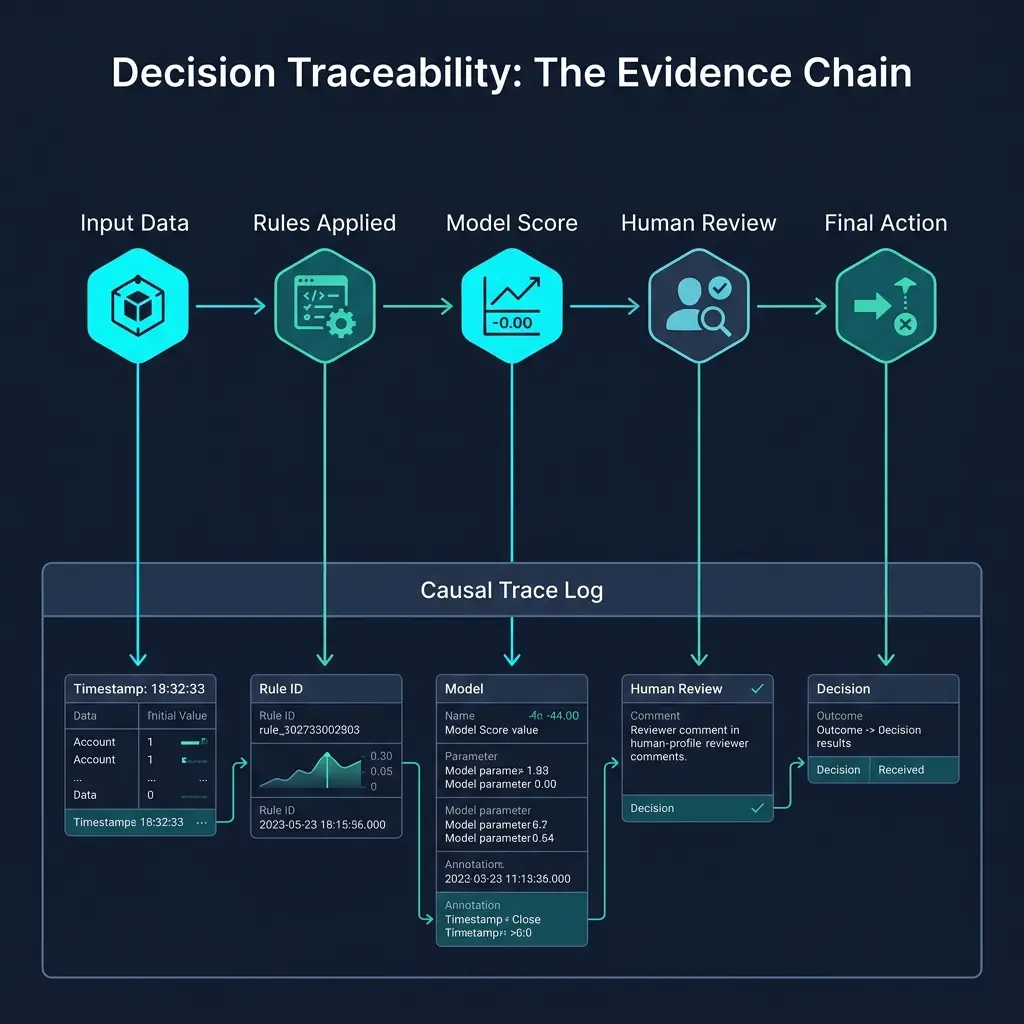
Most enterprise AI deployments demonstrate competence during normal inference but collapse into guesswork the moment an anomaly triggers a regulatory inquiry or customer dispute. When a high-stakes decision is challenged, statistical accuracy offers zero defense. Governance demands forensic reconstruction: proving exactly what data the system observed, which policy invariants evaluated, which model versions scored, and whether human personnel intervened.
Decision traceability provides the engineering discipline that turns ephemeral operational telemetry into an immutable evidence chain.
Why Is Standard Application Logging Insufficient for AI?
Decision traceability is the systematic reconstruction of an automated decision pipeline from initial payload ingestion to downstream operational outcome. It captures the exact dependency graph of an automated evaluation: input features, active policy rules, model checkpoints, runtime configurations, and operator interventions.
Generic application logging records that an event occurred at a particular millisecond. Traceability records why the system chose an action, capturing system state and causal boundaries with sufficient fidelity that an independent auditor, risk officer, or engineer can replay the identical decision path in an isolated sandbox without accessing the original production runtime.
Traceability compresses incident postmortems from multi-week forensic excavations into deterministic, reproducible replays.
What Counts as Evidentiary Proof
Standard log streams fail evidentiary standards because they are mutable, selective, and detached from business consequences. For a runtime trace to satisfy legal discovery and regulatory defense, the architecture must enforce four forensic criteria:
- Evidentiary Completeness. The recorded trace must span the entire decision topology. Persisting model outputs while omitting incoming payload payloads, feature store transformations, or deterministic filter states invalidates the audit trail.
- Cryptographic Immutability. Traces must be append-only and cryptographically sealed at write time. Any data store permitting retrospective modification or administrative redaction fails evidentiary scrutiny in contentious litigation.
- Outcome Linkage. An execution trace without longitudinal tracking cannot answer whether an automated action was defensible. The record must bind the initial inference to subsequent business realities—loan defaults, insurance claim adjustments, or operator reversals.
- Structured Schema Validation. Unstructured text strings and ad-hoc JSON blobs resist systematic parsing and regulatory compliance auditing. Traces require strictly versioned, typed schemas that permit programmatic query analysis across millions of executions.
Storage Architecture & Isolation Boundaries
Decision traces represent high-value forensic artifacts that require distinct architectural isolation from standard application logs and operational telemetry stores:
- Decoupled Causal Persistence: The causal execution path—the sequence of evaluated rules, weights, and routing branches—must be stored in dedicated append-only columnar stores or tamper-evident ledgers, separate from high-throughput operational application logs.
- Regulatory Retention Alignment: Trace retention cycles must map directly to domain liabilities (such as five to seven years for fair lending disclosures, or decades for clinical interventions), distinct from the thirty-day TTLs common in operational monitoring.
- Strict Access Segmentation: Trace repositories contain full prompt inputs, customer attributes, and system reasoning paths. Access must be governed by zero-trust role separation restricted to model risk, internal audit, and compliance teams, preventing casual inspection by general platform services.
Which Decisions Need Traceability
Because comprehensive trace persistence incurs serialization latency and storage costs, governance architectures tier requirements based on reversibility and decision severity:
| Decision Tier | Risk Profile | Traceability Requirement | Storage & Replay Strategy |
|---|---|---|---|
| Tier 1: High-Stakes & Irreversible | Credit underwriting, medical diagnosis, fraud denial | Full forensic trace: raw inputs, rule matrices, model embeddings, human overrides, and downstream outcomes | Cryptographically hashed write-once storage with deterministic container replay |
| Tier 2: Medium-Stakes & Reviewable | Support escalation, dynamic pricing, queue routing | Structural trace: rule evaluations, model version, confidence intervals, and linked customer response | Columnar trace store with 90-day hot retention and long-term cold compression |
| Tier 3: Low-Stakes & Reversible | Interface personalization, search re-ranking | Telemetry-only: execution timestamp, model checkpoint hash, and aggregate performance signals | High-throughput streaming logs sampled at fixed operational intervals |
| Tier 4: Operator Overrides | Manual adjudication, threshold bypassing | Override journal: operator identity, raw system recommendation, and standardized reason code | Mandatory transactional journal entry enforced prior to database write |
When evaluating ambiguous boundary workflows, engineers should err toward higher traceability tiers; reconstructing decision contexts retrospectively after an audit begins is technically impossible.
Proving Operational Defensibility
A defensible decision does not require a flawless real-world outcome; economic and biological environments remain inherently probabilistic. Defensibility requires proving that the system acted with demonstrable procedural correctness given the information available at execution time.
Forensic verification evaluates three sequential stages:
- Input Invariant Verification: The audit trail proves that inbound payloads satisfied all schema boundaries, feature cleansing routines, and data freshness thresholds before model invocation.
- Rule Hierarchy Compliance: The trace demonstrates that deterministic business rules, compliance blockers, and jurisdiction checks evaluated in their mandated sequence prior to any probabilistic scoring.
- Human Adjudication Integrity: In workflows involving human oversight, the trace records precisely what context the operator received, how long they reviewed the evidence, and which structured justification accompanied any manual divergence.
Satisfying these three criteria establishes institutional due care, even when the downstream commercial or operational outcome proves suboptimal.
The PM's Decision Traceability Audit Matrix: 5 Questions Regulators & Auditors Will Ask
When an enterprise customer files a formal dispute, or when regulators launch an adverse action examination, the Product Manager must produce verifiable proof, not slide decks.
Bring this audit matrix to your architecture reviews and regulatory readiness meetings:
| The Auditor's Question | What Traditional Logs Show | What True Decision Traceability Delivers | The Verification Artifact & Gate |
|---|---|---|---|
| 1. Model & Prompt Version "Which exact model and system instructions generated this decision?" |
Standard log: model: gpt-4o, which silently updates behind cloud APIs. |
Cryptographic digest: model_id: fin-v2, checkpoint_hash: sha256:8812af..., and prompt_registry_hash: sha256:9f83c1.... |
Proof Header: Invariant header bound to Decision State Vector; releases blocked if hashes are missing. |
| 2. Context Retrieval Provenance "What specific facts or documents did the agent see when it decided?" |
Ephemeral query string; vector database contents have since drifted or re-indexed. | Content-addressed chunk list: immutable IDs, similarity scores, and text digests of all retrieved snippets. | Retrieval Manifest: Write-once storage of retrieved context chunks; verified against source document hashes. |
| 3. Policy Sequence Verification "Did deterministic business rules evaluate before the AI executed?" |
Implicit assumption; rule code and model scoring are mixed in application logic. | Explicit execution manifest: ordered Boolean array proving statutory rules evaluated and passed prior to model inference. | Rule Manifest: Cryptographically signed execution order proving no rule-bypass leak occurred. |
| 4. Human Oversight Authenticity "Did a human genuinely review the case, or did they rubber-stamp it?" |
Timestamp showing an officer clicked 'Submit' at 14:02:11 UTC. | Ergonomic telemetry: reviewer dwell time (142s), field edit diffs, and mandatory structured reason code. | Human Telemetry Vector: Automated flag if review latency < 5s; mandatory two-person sign-off on overrides. |
| 5. Sandboxed Replayability "Can you re-run this exact decision today in an isolated sandbox?" |
Re-run fails: current model, prompts, and vector weights produce a completely different output. | Bit-level sandbox replay: quarantined container loads pinned weights, frozen chunks, and exact seed, reproducing the trace. | Sandbox Replay Harness: Verified replay capability tested in staging every 90 days. |
Architectural Failure Modes
| Failure Mode | Operational Symptom | Engineering Remedy |
|---|---|---|
| Egress-Only Logging | Production logs record final predictions but omit prompt templates, intermediate layer scores, and feature store snapshots, making postmortems purely speculative. | Implement distributed context propagation that serializes the complete decision payload at the orchestration gateway before returning responses. |
| Silent Rule Drift | Teams assume deterministic rule layers remain static, logging only model weights while unversioned configuration changes silently alter approval boundaries. | Treat business rules as immutable code artifacts; embed git commit hashes and runtime policy configuration digests directly into every trace header. |
| Unlinked Longitudinal Telemetry | Decisions are marked as successful at runtime, but subsequent charge-offs, customer complaints, or defaults never link back to the originating trace ID. | Establish asynchronous event-bridge listeners that append lifecycle milestones to the immutable decision identifier as real-world outcomes mature. |
| Unstructured Text Dumps | Freeform log strings require fragile regex scrapers during regulatory subpoenas, failing formal compliance verification and cross-tenant audits. | Enforce protocol buffer or typed JSON schema contracts for all decision events, rejecting unvalidated payloads at the logging pipeline ingress. |
The Adversarial Stress-Test: Five Critical Inquiries
1. What is the strongest argument against this approach?
Capturing full, immutable, multi-modal decision traces for every automated action introduces massive storage costs, latency penalties, and data privacy liabilities. In high-throughput consumer or streaming workflows, serializing complete input states, prompt versions, intermediate reasoning steps, and policy matrices inflates infrastructure expenses far beyond the statistical value of rare incident audits.
The Practical Resolution: Tier trace capture using deterministic risk boundaries. Persist complete raw payloads and execution graphs exclusively for Tier 1 irreversible actions and high-uncertainty model inferences near decision thresholds. For high-volume low-risk interactions, capture lightweight Merkle roots and deterministic seed values that enable on-demand forensic replay without continuous state serialization.
2. Under what circumstances would this fail?
This architecture fails when downstream outcome feedback is chronically delayed, unlinked, or corrupted by confounding variables. If a lending or clinical decision produces an outcome twelve months after execution, but the borrower moves, changes employment, or receives unrecorded concurrent treatments, attributing the outcome back to the original model trace creates false causality and misleads governance audits.
The Practical Resolution: Decouple operational execution verification from longitudinal outcome attribution. Instrument traces with causal validity windows and confounding flags. When downstream ground truth arrives after significant environmental drift, evaluate the trace against procedural correctness at execution time rather than applying retrospective outcome bias.
3. What would a skeptical customer, client, or colleague object to?
A skeptical compliance officer or legal counsel will object that storing detailed, immutable decision traces creates a "discoverability hazard." In litigation or regulatory investigations, exhaustive traces can be subpoenaed and used by opposing counsel to identify internal policy inconsistencies or marginal calibration drifts that would never have been exposed under standard aggregate retention policies.
The Practical Resolution: Align trace retention and access controls strictly with statutory legal requirements. Cryptographically isolate traces under dedicated key management hierarchies, establishing automated cryptographic shredding schedules that execute immediately upon expiration of mandated regulatory retention windows.
4. Which alternative deserves more consideration?
Ephemeral Cryptographic State Signatures and Sampling-Based Replay. Instead of persisting terabytes of redundant raw state and reasoning traces in operational databases, cryptographically sign input hashes and model weight manifests with Merkle roots, preserving full traces only for a statistically representative sample or anomalous outlier subset.
The Practical Resolution: Employ cryptographic state signatures as a front-line compression layer for Tier 2 and Tier 3 workflows. Persist full forensic traces where external statutory mandates (such as ECOA or HIPAA) compel individualized adverse action explanations upon demand.
5. What am I assuming that may not be true?
This framework assumes that reconstructing the technical execution trace of an AI decision is sufficient to prove that the decision was morally, legally, or commercially sound. In reality, a decision can follow every syntactic rule, pass every schema check, and log every human signature perfectly while still executing a discriminatory, catastrophic, or economically irrational outcome.
The Practical Resolution: Treat execution traceability as procedural hygiene rather than comprehensive ethical validation. Pair decision trace infrastructure with independent algorithmic bias audits, synthetic stress-testing suites, and continuous statistical monitoring across protected demographic cohorts.
One-Line Synthesis
Decision traceability replaces post-mortem speculation with immutable forensic proof by binding inputs, rules, model inferences, and human overrides into a verifiable causal chain.
Related Posts in This Pillar
- AI Audit Trails: The detailed guide to building replayable audit logs for high-stakes AI systems.
- The Cost of Proof: Why moving to defensible ROI requires traceability as a design requirement, not an afterthought.
- Benford's Law as a Security Perimeter: How statistical validation at the input layer protects the evidence chain from garbage-in failures.
Downloadable Resource
The Architecture of Proof Readiness Checklist: Includes a section on decision traceability requirements and the four questions your system must be able to answer.
Frequently Asked Questions
What is decision traceability in AI?
Decision traceability is the ability to reconstruct a specific AI decision after the fact: including which inputs were used, which rules fired, which model scored, and whether a human intervened. It is the evidence chain that makes AI systems auditable.
What is the difference between an audit trail and a log?
A log records that something happened. An audit trail records what happened, why it happened, and what the system state was at the time, in enough detail to replay and diagnose any decision independently.
Why does decision traceability matter for regulated industries?
Regulators require organizations to explain individual decisions, not just model performance statistics. Traceability makes it possible to answer an adverse action challenge, an audit inquiry, or an internal incident review with a structured evidence record, not guesswork.
Subscribe to the Architecture of Proof Dispatch
Rigorous, decision-forcing systems engineering and AI governance monographs for technical leaders. Delivered periodically, zero spam.