The Cost of Proof: Moving Beyond Efficiency to Defensible ROI | AI Governance
This post is part of the Decision Traceability pillar.
The gap between a "successful AI pilot" and a "production-grade system" isn't more data or better models. It's The Architecture of Proof.
For years, AI has been sold on the promise of efficiency—"saving 400 engineer hours" or "summarizing 1,000 documents." But for the Director or P&L owner, these metrics are table stakes. The real value of AI in mission-critical environments isn't just what it does, but whether you can prove it did it correctly.
1. The Director's Lens: ROI of Proof
Directors trade the low cost of "black box" pilots for the high-yield stability of Proven Systems, where every automated action carries a verifiable pedigree of evidence.
In a standard AI pilot, the cost is low, but the "hidden tax" of uncertainty is high. When the system fails—and it will—the time to diagnosis is measured in days, and the regulatory risk is unquantifiable.
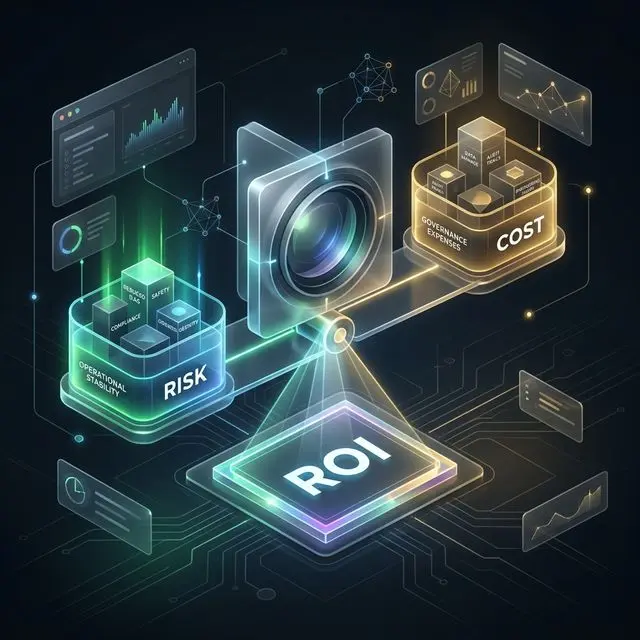
The Architecture of Proof (Audit Trails, Control Tiers, and Causal Traces) moves the ROI calculation from speculative to defensible.
| Factor | Legacy AI Pilot | Architecture of Proof |
|---|---|---|
| Primary Metric | "Hours Saved" | "Risk-Adjusted Margin" |
| Audit Readiness | Weeks of manual forensic work | Real-time "Replayable" evidence |
| Incident MTTR | 4-6 Hours (Engineer guessing) | 4 Minutes (Causal Trace) |
| Failure Cost | Unbounded (Brand + Legal) | Contained (Auto-downgrade) |
2. ROI: Moving Beyond Efficiency
A single avoided $720k incident, enabled by 4-minute causal diagnosis, pays for 18 months of proof infrastructure, proving that governance is a profit center, not a cost center.
Consider a lending system. A "Stage 2" governed system might take 6 hours to identify why a specific segment of loans is suddenly seeing a 15% spike in defaults. In those 6 hours, the system continues to bleed capital.
A "Stage 4" system using Causal Traces identifies the root cause—a specific data vendor drift—in 4 minutes. It automatically triggers a Control Tier downgrade from Autonomous to Recommend, halting the losses immediately.
The delta between 6 hours and 4 minutes isn't just a technical achievement; it’s a $1.1M loss prevention event.
3. Building the Proof Stack
The ROI of Proof is realized through a stack that captures inputs at the boundary, logs deterministic rules, and anchors model patterns in human-readable accountability.
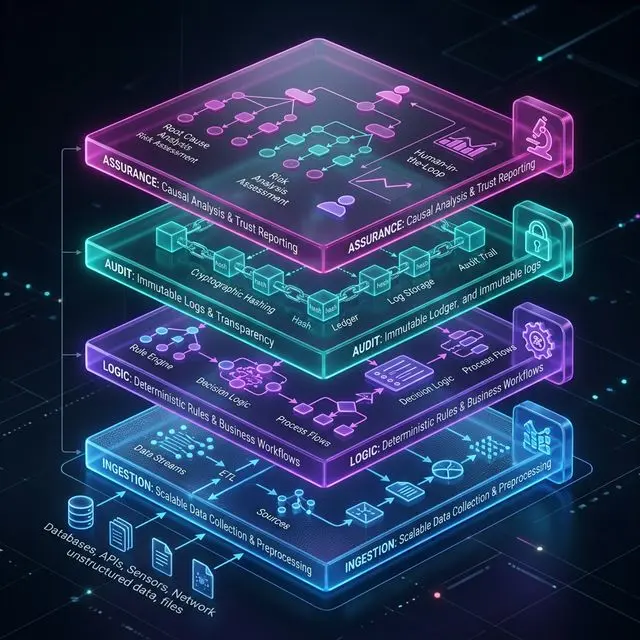
- Ingestion Layer: Stable references for every data point.
- Logic Layer: Deterministic rules that "sign" the model's intent.
- Audit Layer: Immutable records for every decision.
- Assurance Layer: Causal analysis that proves why the decision happened.
4. Governance as your Unfair Advantage
In the age of probabilistic AI, the company that can prove its logic the fastest will be the company that scales the furthest.
Junior PMs ship models. Senior Directors ship Proven Systems. When you build with The Architecture of Proof, you aren't just complying with regulations; you are building a system that can move faster because its brakes are better.
Investing in proof isn't about technical idealism. It's about ensuring your $1B AI strategy doesn't vanish during the first "Golden Hour" of a production incident.
Related in this series
- The AI Maturity Model: See which stage of proof your organization has reached.
- The 4 Tiers of AI Autonomy: Learn how to manage the authority you grant to your models.
- AI Incident Response: How to survive the first 60 minutes of an AI failure.
Frequently Asked Questions
What is proof infrastructure in AI?
Proof infrastructure is the set of tools and protocols—like audit trails, control tiers, and causal traces—that provide evidence of a system's logic and compliance in real-time.
How do you calculate the ROI of AI governance?
ROI is calculated as (Risk Reduction + Operational Efficiency) - Investment in Proof. It moves beyond 'hours saved' to 'incidents avoided' and 'audit readiness'.
Download the Architecture of Proof Checklist
Ready to implement? Get the definitive checklist for building verifiable AI systems.