The AI Incident Playbook: The Golden Hour, Forensic Postmortem, and the Evidence Trail That Survives Scrutiny
When a deterministic software system fails, you look for a bug. When a probabilistic AI system fails, you look for a shift.
In traditional software engineering, code is an explicit set of deterministic instructions. If an exception is thrown, developers inspect the stack trace, reproduce the exact pathway locally, and deploy a patch.
AI systems do not fail this way. A model can execute identical code, receive inputs that pass every syntactic validation check, and produce a catastrophic, liability-generating output. The codebase did not change; the failure occurred because the hidden statistical state (the retrieved vector embeddings, the prompt assembly, the tool-calling memory, or upstream calibration) diverged from expected bounds.
When an autonomous agent mistakenly liquidates a customer position, auto-denies a class of protected credit applicants, or leaks confidential IP to an untrusted endpoint, senior leadership does not ask which model weights were used.
They ask three blunt questions: 1. Has the financial and operational bleeding stopped right now? 2. Can you prove exactly why the system made this decision at that microsecond? 3. Can our evidence survive an audit by our general counsel, our board, and our regulators?
This playbook defines the end-to-end discipline for responding to high-consequence AI incidents: from the operational choreography of the first sixty minutes to the forensic architecture that guarantees complete state reconstruction.
What Must Happen in the AI Incident Golden Hour (T+0 to T+60)?
The difference between a minor operational bug and an uninsurable eight-figure liability is how your team handles the first sixty minutes following detection. We call this window the AI Incident Golden Hour.
| Incident Window | Phase | Primary Operational Focus |
|---|---|---|
| T+0 to T+15 | Phase 1: Auto-Containment | Trip circuit breakers, demote autonomy tiers, cap financial blast radius |
| T+15 to T+45 | Phase 2: Replay Diagnosis | Spin up quarantined sandbox, run exact Decision State Vector replay |
| T+45 to T+60 | Phase 3: Causal Fix & Recovery | Isolate root cause with counterfactual tests, satisfy restoration gate |
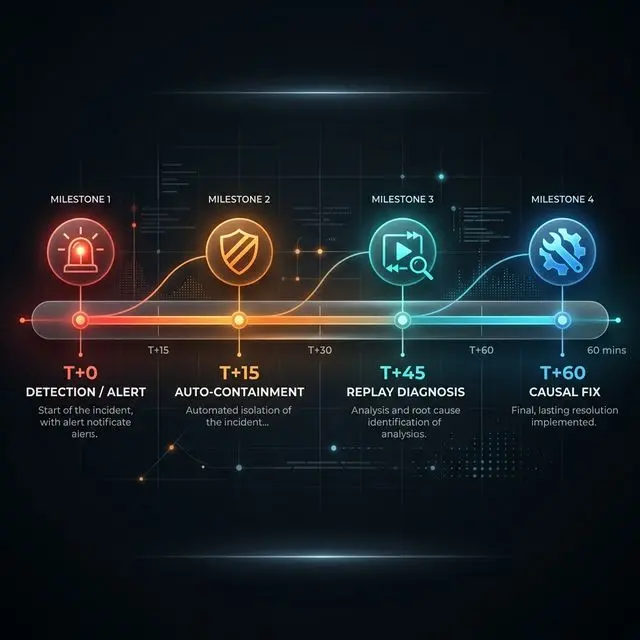
Phase 1: Auto-Containment (T+0 to T+15): Stop the Bleeding
The cardinal error in early incident management is "panic-patching," where engineers attempt to tweak prompts or adjust hyperparameters while the autonomous system continues processing live customer transactions.
Containment is about safety, not diagnosis. The sole objective of Phase 1 is capping financial, legal, and operational exposure.
- Trip the Autonomous Circuit Breaker: The instant an incident trigger fires (e.g., human override spike > 3x baseline, classification drift alarm, or customer complaint cluster), the system must execute an automated downgrade of its Control Tier. - Tier 2 (Autonomous Action) drops immediately to Tier 1 (Safe-Sandbox) or Tier 0 (Observe Only). - All state-changing authority is stripped from the autonomous component.
- Activate the Fallback Engine: Transactions currently in-flight do not stall indefinitely. They are automatically routed to pre-approved deterministic heuristics or held in a FIFO holding queue with a clear customer-facing SLA status.
- Establish Incident Command & Log Freeze: Generate an immutable cryptographic snapshot of the runtime environment, vector index state, and prompt registry. Rule: No engineer touches production configurations until the environment state is preserved.
Phase 2: Replay Diagnosis (T+15 to T+45): Reconstruct the Crime Scene
Once the blast radius is bounded, the team transitions to understanding what occurred. In probabilistic systems, reading traditional text logs is useless because inputs alone do not deterministically yield outputs.
- Extract the Decision State Vector (DSV): Pull the exact serialized state packet corresponding to the contested decision ID from the immutable audit ledger.
- Spin Up the Isolated Replay Sandbox: Instantiate a quarantined runtime environment that loads: - The exact prompt template version hash ($P_{hash}$). - The frozen retrieved context chunks ($C_{ret}$) captured at inference time. - The pinned model version and sampling hyperparameters ($H_{param}$).
- Execute Bit-Level Replay Verification: Re-run the inference payload through the exact execution graph. - Case A: Error Reproduces. The failure is intrinsic to the composite logic, retrieved data, or model behavior. Proceed to Phase 3. - Case B: Error Does Not Reproduce. The incident was caused by an ephemeral upstream dependency failure (e.g., API timeout fallback, partial vector store partition, or corrupted network serialization).
Phase 3: Causal Isolation & Recovery Gate (T+45 to T+60): Prove the Fix
Before any system is restored to its prior autonomy tier, the team must isolate the causal driver, rather than merely identifying a correlated variable.
- Counterfactual Hypothesis Testing: Using the replay harness, execute controlled counterfactual mutations: - Test 1 (Context Mutation): If chunk $K$ had been omitted from the retrieved prompt context, would the model have avoided the erroneous conclusion? - Test 2 (Prompt Invariant): Did the system prompt lack an explicit negative constraint for this edge case? - Test 3 (Upstream Feature Drift): Did an external data vendor alter an unversioned API field format?
- Deploy Targeted Surgical Patch: Implement a deterministic perimeter rule or hard constraint rather than hoping prompt engineering alone fixes the behavior.
- The Executive Restoration Gate: A system is never promoted back to Tier 2 based on developer confidence. Restoration requires meeting three criteria: - Counterfactual verification proving the failure mode is blocked. - Replay test suite across the last 1,000 production decisions showing zero regression. - Formal sign-off from both the Technical Lead and the Product Manager.
The Golden Hour Decision Matrix
| Metric / Question | Phase 1: Containment (T+0 to T+15) | Phase 2: Replay (T+15 to T+45) | Phase 3: Isolation (T+45 to T+60) |
|---|---|---|---|
| Primary Question | Is the bleeding stopped? | Can we reproduce the exact state? | Can we mathematically prove the fix? |
| Primary Owner | SRE / On-Call Engineer & PM | Applied ML / Systems Architect | Staff Architect & Risk Lead |
| System State | Demoted to Tier 0 or Tier 1 | Quarantined in Staging Sandbox | Gradual Canary Rollout to Tier 2 |
| Key Deliverable | Blast-Radius Containment Sign-off | Validated Replay Trace | Causal Root-Cause Attestation |
The PM's Incident War Room Command Matrix: 60-Minute Triage for Live AI Failures
During a production AI incident, the PM does not write code—they own the customer perimeter, financial exposure, regulatory disclosure clocks, and stakeholder alignment.
Bring this checklist directly into the incident command bridge:
| Incident Stage | The Operational Crisis | PM Action & Incident Decision | Cross-Functional Alignment Check |
|---|---|---|---|
| T+0 to T+15 (Auto-Containment) |
Model produces incorrect outputs on live traffic; engineers debate tweaking prompts in production. | Order Immediate Autonomy Demotion: Halt live model executions. Downgrade from Tier 2 (Autonomous Action) to Tier 1 (Human-in-the-Loop) or Tier 0 (Read-Only). Route transactions to heuristic fallback queues. | Engineering & SRE: Confirm circuit breaker tripped. Support: Post customer advisory banner; trigger queue hold messaging. |
| T+15 to T+30 (Blast-Radius Audit) |
Executives ask: "How many customers were affected and what is our financial liability?" | Quantify Blast Radius: Query the ledger between estimated onset timestamp and circuit break. Count exposed customer IDs, total dollars committed, or unauthorized disclosures. | Legal & Compliance: Assess if exposure crosses statutory breach notification thresholds (e.g., GDPR 72h or SEC cyber disclosure). |
| T+30 to T+45 (Replay & Isolation) |
Engineers claim: "We tested the prompt locally and it works fine; it was probably just a random hallucination." | Demand Decision State Vector Replay: Reject subjective guesses. Replay the exact serialized DSV payload (pinned model checkpoint, frozen vector retrieval chunks, exact temperature/seed) in the quarantined sandbox. | ML Engineering: Prove exact error reproduction before approving any patch. |
| T+45 to T+60 (Restoration Gate) |
Sales demands immediate restoration: "Enterprise customers are complaining about manual review delays." | Enforce the Restoration Gate: Refuse full Tier 2 restoration until: (1) root cause is proven via counterfactual test, (2) regression suite passes across last 1,000 production records, and (3) canary rollout is scheduled at 5% volume. | Executive Sponsor & Head of Risk: Obtain dual-signoff on canary promotion criteria. |
Part II: After Containment: The Forensic Postmortem
Traditional postmortems document timeline events, server resource spikes, and code diffs. A Forensic AI Postmortem is fundamentally different: it reconstructs the exact interaction between deterministic scaffolding and probabilistic reasoning.
Observability Is Not Forensics
Enterprise teams routinely confuse observability platforms with forensic systems.
| Capability Dimension | Production Observability (LangSmith, Arize, Datadog) | Forensic Architecture (Architecture of Proof) |
|---|---|---|
| Operational Purpose | Real-time aggregate health monitoring | Mathematical reconstruction of an individual decision |
| Core Questions | Is latency spiking? What is the 95th percentile cost? | Why did the system make this exact decision at 14:02:11 UTC? |
| Data Structure | Time-series metrics, traces, sampling spans | Cryptographically signed, immutable Decision State Vectors |
| Evidentiary Standard | Operational debugging & dashboard alerts | Legal, regulatory, and board-level proof |
Key Architectural Law: Observability alerts you that your fleet is drifting off course. Forensics provides the black-box flight recorder that proves why an individual aircraft touched down short of the runway.
Why Traditional Logs Fail on Probabilistic State Divergence
In deterministic software: $$\text{Input } X + \text{Code } Y \equiv \text{Output } Z$$
In modern composite and agentic AI systems: $$\text{Input } X + \text{Code } Y \implies \text{Unpredictable Output } Z$$
Why? Because the output is governed by an expansive space of hidden statistical state:
graph TD
    subgraph Traditional["Traditional Software Stack"]
        TI[Input] --> TC[Deterministic Code] --> TO[Output]
    end

    subgraph Composite["Composite AI Stack: The Hidden State Space"]
        CI[Input] --> HSS[Hidden State Space]
        HSS --> P1[Prompt Template Hash: Registry Version & System Instructions]
        HSS --> P2[Retrieved Context Vector: Dynamic Vector Chunks]
        HSS --> P3[Tool Execution State: API Responses & Memory]
        HSS --> P4[Sampling Hyperparameters: Temperature, Top-p, Seed]
        HSS --> P5[Model Weights Signature: Checkpoint & Provider API Hash]
        HSS --> P6[Multi-Agent Graph Node: Prior Agent Routing State]
        P1 & P2 & P3 & P4 & P5 & P6 --> INF[Inference Result]
    end
When an incident occurs three weeks after deployment, you cannot debug it by re-sending the original prompt to the current model API. The vector database has been re-indexed; the system prompt has been modified; the model checkpoint may have been silently updated by the cloud vendor.
Without capturing the state, you have an unprovable mystery.
The Anatomy of a Decision State Vector (DSV)
The core data structure of forensic AI engineering is the Decision State Vector (DSV). It is the serialized, content-addressed digital artifact that encapsulates every variable that shaped an inference.
$$DSV = { I_{\text{raw}},\ P_{\text{hash}},\ C_{\text{ret}},\ T_{\text{state}},\ H_{\text{param}},\ M_{\text{sig}},\ G_{\text{graph}},\ H_{\text{interv}},\ O_{\text{exec}} }$$
{
  "dsv_version": "2.4.0",
  "decision_id": "dec-9082-f7a21e-2026",
  "timestamp_utc": "2026-03-25T14:02:11.892104Z",
  "autonomy_tier": "Tier_2_Autonomous_Breakers",
  "execution_payload": {
    "raw_input_hash": "sha256:e3b0c44298fc1c149afbf4c8996fb92427ae41e4649b934ca495991b7852b855",
    "prompt_registry_hash": "sha256:9f83c18b7625a63e029c321ff",
    "retrieved_context_payload": [
      {
        "chunk_id": "chk_corp_credit_policy_v4",
        "content_hash": "sha256:4a8b71d9e2...",
        "similarity_score": 0.892
      }
    ],
    "tool_execution_history": [
      {
        "tool_name": "crm_account_lookup",
        "response_digest": "sha256:119bc2a4..."
      }
    ],
    "hyperparameters": {
      "temperature": 0.0,
      "seed": 42
    },
    "model_signature": {
      "provider": "internal_cluster",
      "model_id": "fin-reasoner-70b-v2",
      "checkpoint_digest": "sha256:8812af..."
    },
    "human_interventions": null
  },
  "cryptographic_signature": "MEUCIQDx8...[ECDSA_P256]"
}
The Black Box Recorder Architecture
A forensic log cannot be an optional asynchronous background task that drops messages when Kafka queues experience backpressure.
If a decision is returned to a user before its forensic record is securely persisted, your architecture has failed the fiduciary test.
graph TD
    REQ[Incoming Request] --> ORCH[Orchestration Pipeline\nAssemble Prompts, Retrieve Vector Context, Execute Guardrails]
    ORCH --> REC[The Black Box Recorder\n1. Serialize complete Decision State Vector\n2. Generate cryptographic hash & signature\n3. Synchronous commit to write-once append ledger]
    REC -->|Synchronous Commit Confirmed| PROD[Execute Production Action\nDisburse Funds / Commit State / Return Payload]
The Non-Negotiable Constraint: The Black Box Recorder enforces a synchronous commit gate. If the forensic record cannot be written to durable, append-only storage, the production action is aborted and routed immediately to Tier 0 human intervention.
Part III: The Evidence Trail That Survives Scrutiny
When an AI failure escalates beyond engineering into legal dispute, regulatory audit, or board inquiry, standard software development artifacts are scrutinized under evidentiary standards.
Regulatory frameworks, including Federal Reserve SR 11-7 (Model Risk Management), the EU AI Act (Article 12 & 13 Record-Keeping Requirements), and SEC cyber/AI disclosure rules, mandate specific proof standards:
- Bit-Level Reproducibility: Can your team spin up an environment twelve months after an incident and prove that the model acted in strict accordance with the policy approved at that time?
- Chain of Custody: Are your prompt registries, model weights, and retrieval indexes cryptographically signed and immutable, or could an engineer have quietly edited a database row post-incident?
- Attribution of Agency: Does the record unequivocally distinguish between what was generated by the probabilistic model, what was enforced by deterministic code, and what was approved by human sign-off?
Part IV: The Director's Dashboard
During an active incident, executive leadership and board risk committees do not need access to GitHub PRs or Slack war rooms. They require real-time, deterministic proof of operational containment.
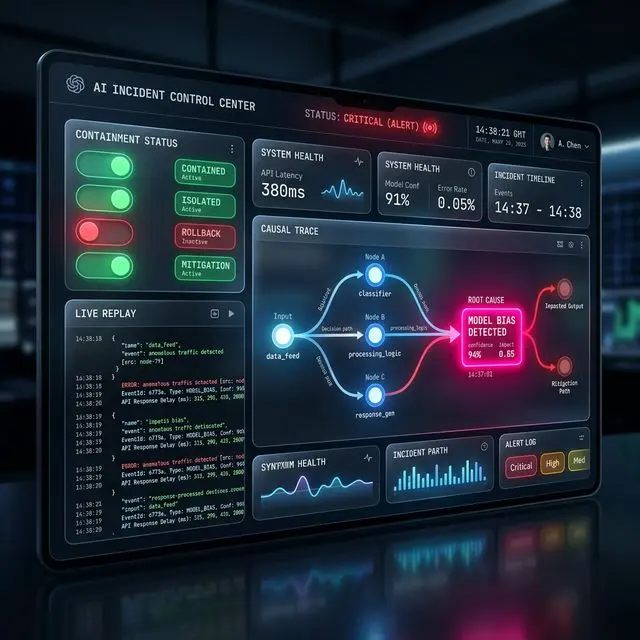
A mature enterprise incident architecture exposes a dedicated Incident Command View:
- Autonomy Containment Vector: Real-time visual status of every workflow tier across the enterprise (Green: Operating normally at Tier 2; Yellow: Degraded to Tier 1 Sandbox; Red: Quarantined to Tier 0).
- Financial Blast-Radius Meter: Live ticker of total capital exposed, transactions suspended, and customer accounts under containment.
- Replay SLA Telemetry: Mean Time to Containment (MTTC target: < 15 minutes) and Mean Time to Forensic Replay (MTTR target: < 45 minutes).
Post-Incident Review Checklist for Governance Leads
Before closing an incident ticket and authorizing the return of an AI workflow to full Tier 2 autonomy, the governance committee must review and archive the following artifacts:
- [ ] Immutable DSV Archive: Has the complete Decision State Vector of all affected decisions been written to cold, immutable storage?
- [ ] Replay Verification Dossier: Does the postmortem include a verified sandbox replay proving identical failure reproduction?
- [ ] Counterfactual Root-Cause Proof: Has the causal driver (prompt, retrieval, tool, or calibration) been mathematically isolated via counterfactual tests?
- [ ] Breaker Calibration Review: Why didn't existing circuit breakers trip earlier? Have trip thresholds been tightened?
- [ ] Customer & Regulatory Disclosure Packet: Has legal verified whether the incident crosses statutory disclosure thresholds?
The Adversarial Stress-Test: Five Critical Inquiries
1. What is the strongest argument against this approach?
Enforcing synchronous writes of complete Decision State Vectors prior to returning inferences introduces an inescapable latency and storage tax. In high-throughput consumer services processing thousands of queries per second, persisting multi-megabyte context chunks and cryptographic signatures creates database backpressure that degrades user experience and substantially increases infrastructure unit costs.
The Practical Resolution: Decouple payload body persistence from synchronous commit verification using content-addressed reference hashes. Synchronously commit only the lightweight DSV header (SHA-256 digests of input, context, and output, plus ECDSA signature) taking under 5 milliseconds. Stream the full multi-megabyte payload asynchronously into write-once object storage; the synchronous hash guarantees that any subsequent tampering or payload omission is immediately detectable.
2. Under what circumstances would this fail?
This protocol fails when third-party cloud foundation models silently modify internal weights, tokenizers, or server-side decoding algorithms behind static API endpoints. In such cases, identical Decision State Vectors, prompt hashes, and seeds will yield divergent outputs during sandbox replay, destroying bit-level deterministic reproducibility despite flawless internal logging.
The Practical Resolution: For closed-source cloud APIs, shift the evidentiary boundary from runtime model replay to immutable gateway serialization. Capture and cryptographically sign the raw HTTP request, system instructions, seed parameter, raw token log probabilities, and full response payload directly at the ingress proxy. In forensic audits, prove what the external vendor returned at that exact millisecond rather than attempting to reproduce internal vendor weights.
3. What would a skeptical customer, client, or colleague object to?
General Counsel and privacy officers will object that capturing exhaustive, immutable records of all retrieved contexts and model completions creates severe discoverability and regulatory hazards. Retaining detailed raw state vectors provides opposing litigants with subpoena-ready evidence of marginal internal drifts, while simultaneously complicating compliance with GDPR "Right to be Forgotten" mandates.
The Practical Resolution: Implement cryptographic erasure (crypto-shredding) paired with statutory retention schedules. Encrypt the customer-specific payload portion of each DSV with a dedicated per-tenant key in a Hardware Security Module. When an erasure mandate arrives or the statutory retention window expires, shred the decryption key, rendering the underlying PII permanently unreadable while leaving the non-sensitive mathematical hashes and policy rule metadata intact for regulatory compliance.
4. Which alternative deserves more consideration?
Ephemeral cryptographic state signatures and probabilistic trace sampling deserve serious consideration. By computing Merkle proofs over retrieved contexts and caching model parameters while storing full input-output payloads only when anomalous variance triggers fire, organizations can drastically reduce storage overhead and discoverability exposure while preserving mathematical integrity.
The Practical Resolution: Employ probabilistic trace sampling and Merkle signatures for Tier 1 bounded workflows where transactions are low-value and reversible. Maintain mandatory 100% synchronous DSV capture for Tier 2 and Tier 3 irreversible financial disbursements, clinical decisions, and adverse legal actions where individual statutory disclosure is legally required.
5. What am I assuming that may not be true?
This architecture assumes that bit-level technical reproducibility satisfies legal, regulatory, and fiduciary burdens of proof. Regulators and courts evaluating adverse action notices or anti-discrimination statutes may care little about identical vector reproduction if the underlying systemic logic remains fundamentally opaque or causally disconnected from human common-sense standards.
The Practical Resolution: Anchor technical Decision State Vectors directly to Model Risk Management (MRM) governance dossiers and explicit business policy rationale. In addition to recording the mechanical runtime state, the DSV must reference the approved business rule version and statutory justification, proving both that the system executed deterministically and that the governing rule was legally and ethically validated.
One-Line Synthesis
Probabilistic AI accountability demands an immutable flight recorder capable of reproducing the exact operational and statistical state at the microsecond of decision.
Frequently Asked Questions
What is the AI incident Golden Hour?
The Golden Hour refers to the first 60 minutes after a production AI anomaly or failure is detected. It is structured into three discrete phases: Auto-Containment (T+0 to T+15), Replay Diagnosis (T+15 to T+45), and Causal Isolation (T+45 to T+60) to stop operational bleeding before attempting permanent fixes.
What is the difference between AI observability and AI forensics?
Observability monitors aggregate production health in real time (latency, error rates, token throughput). Forensics reconstructs a specific historical decision with mathematical fidelity to prove the exact root cause. Observability alerts you that a system is failing; forensics proves why a specific decision was made.
What is a Decision State Vector (DSV)?
A Decision State Vector is a cryptographically signed, immutable data payload capturing the complete operating context of an inference call: raw inputs, prompt template version hash, retrieved context chunks, model weights identifier, sampling hyperparameters, agent tool outputs, and human supervisor interventions.
What should a Product Manager own during an AI incident?
The PM owns blast-radius containment, stakeholder communication, regulatory notification thresholds, and deciding whether customer-facing workflows downgrade to manual triage, fallback heuristics, or temporary holds.
Subscribe to the Architecture of Proof Dispatch
Rigorous, decision-forcing systems engineering and AI governance monographs for technical leaders. Delivered periodically, zero spam.