The AI Maturity Model: From Statistical Pilot to Causal Diagnostics | AI Governance
This post is part of the Governance Operating Model pillar.
The industry is obsessed with "AI adoption," but adoption without a framework for maturity is just accumulating technical and regulatory debt.
Real AI maturity is measured by Evidence-Based Promotion. You don't grant a system more autonomy because the model is "smart"; you grant it because the system has proven it is observable and controllable.
The 4 Stages of AI Maturity
Maturity is a ladder of evidence, where each stage increases the fidelity of the "Proof" provided to stakeholders and regulators.
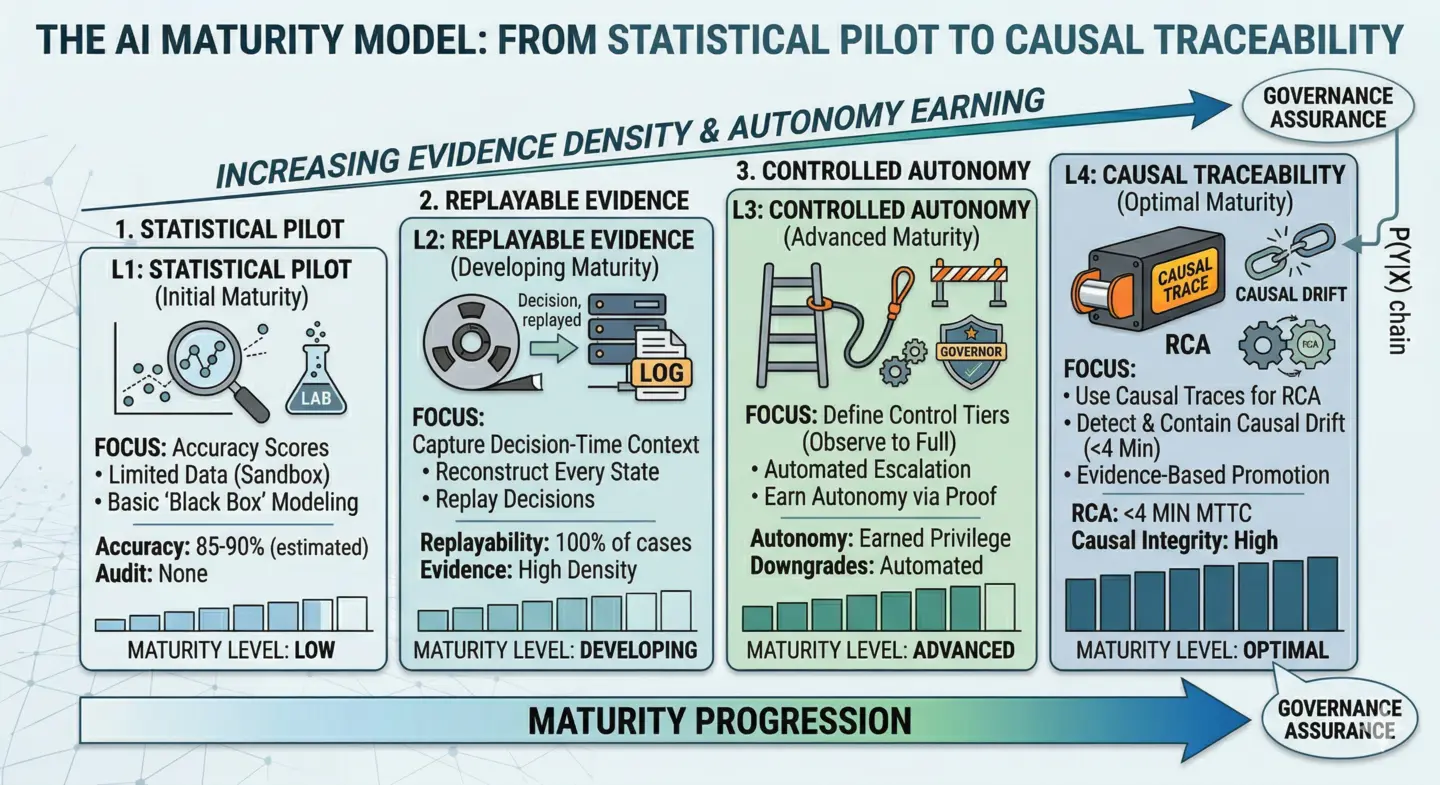
Stage 1: Statistical Pilot
At this initial stage, AI is a tool for exploration. Teams are focused entirely on laboratory accuracy. There are no formal gates, no decision logs, and no production accountability. - Proof: None. - Risk: High (Shadow AI). - Goal: Establish the engineering baseline to move into Stage 2.
Stage 2: Evidence Collection
The system moves from the lab to a structured environment. At this stage, you build the Audit Trails required to reconstruct exactly what the system saw at the moment it acted. This eliminates guesswork. - Proof: 100% Case Replayability. - Risk: Medium. - Goal: Implement deterministic rules and begin graduating the system through Control Tiers.
Stage 3: Control Tiers
The system begins to earn its autonomy. Using Control Tiers, you dictate exactly when the AI is allowed to act, when it must ask for help (via Escalation Protocols), and when it must stop altogether. - Proof: Pre-defined escalation triggers and rigorous guardrails. - Risk: Managed. - Goal: Achieve real-time observability of logic paths.
Stage 4: Causal Diagnostics
The pinnacle of the Architecture of Proof. The system uses Causal Traces not just to log what happened, but to establish why it happened. This enables a sub-4-minute Root Cause Diagnosis (RCA) and automatic tier downgrades when Causal Drift is detected. - Proof: Real-time Causal Diagnosis (MTTC <4 MIN). - Risk: Quantified and Automatically Contained. - Status: Ready for high-stakes enterprise mission-critical scale.
Frequently Asked Questions
What are the 4 stages of AI maturity in the Architecture of Proof?
The stages are: 1. Statistical Pilot, 2. Evidence Collection, 3. Control Tiers, and 4. Causal Diagnostics.
What is an Evidence-Based Promotion gate?
A promotion gate is a set of criteria—such as logging completeness or MTTC metrics—that a system must meet before it is allowed to move to a higher level of autonomy. Autonomy is earned via proof, not model accuracy.
Download the Architecture of Proof Checklist
Ready to implement? Get the definitive checklist for building verifiable AI systems.