Benford’s Law as a Security Perimeter | AI Governance
Before a single neuron fires, your system should subject incoming data to a "Physics Check."
Benford’s Law is the ultimate sub-millisecond filter for detecting synthetic tampering, manual data entry fraud, and bot-driven injection.
Why Does Benford’s Law Expose Synthetic and Bot-Injected Data?
Benford’s Law (the Law of First Digits) isn't just a statistical curiosity; it is a signature of natural data. In any naturally occurring dataset (such as transaction amounts, population sizes, or sensor readings), the leading digit '1' appears ~30.1% of the time, while '9' appears less than 5% of the time.
The Governance Insight: Fraudsters and automated bots are notoriously bad at mimicking this distribution. When they invent numbers (e.g., to bypass a credit limit or trigger a specific model response), they tend to distribute digits uniformly. A simple frequency check reveals the "fingerprint" of human or synthetic intervention before the data ever reaches your model.
How Does the Deterministic Defense-in-Depth Flow Work?
By placing Benford’s Law at the perimeter, you move from a "Model-Only" architecture to a Deterministic Gate architecture. This creates a sub-millisecond perimeter that catches bulk fraud before your models even start "thinking."
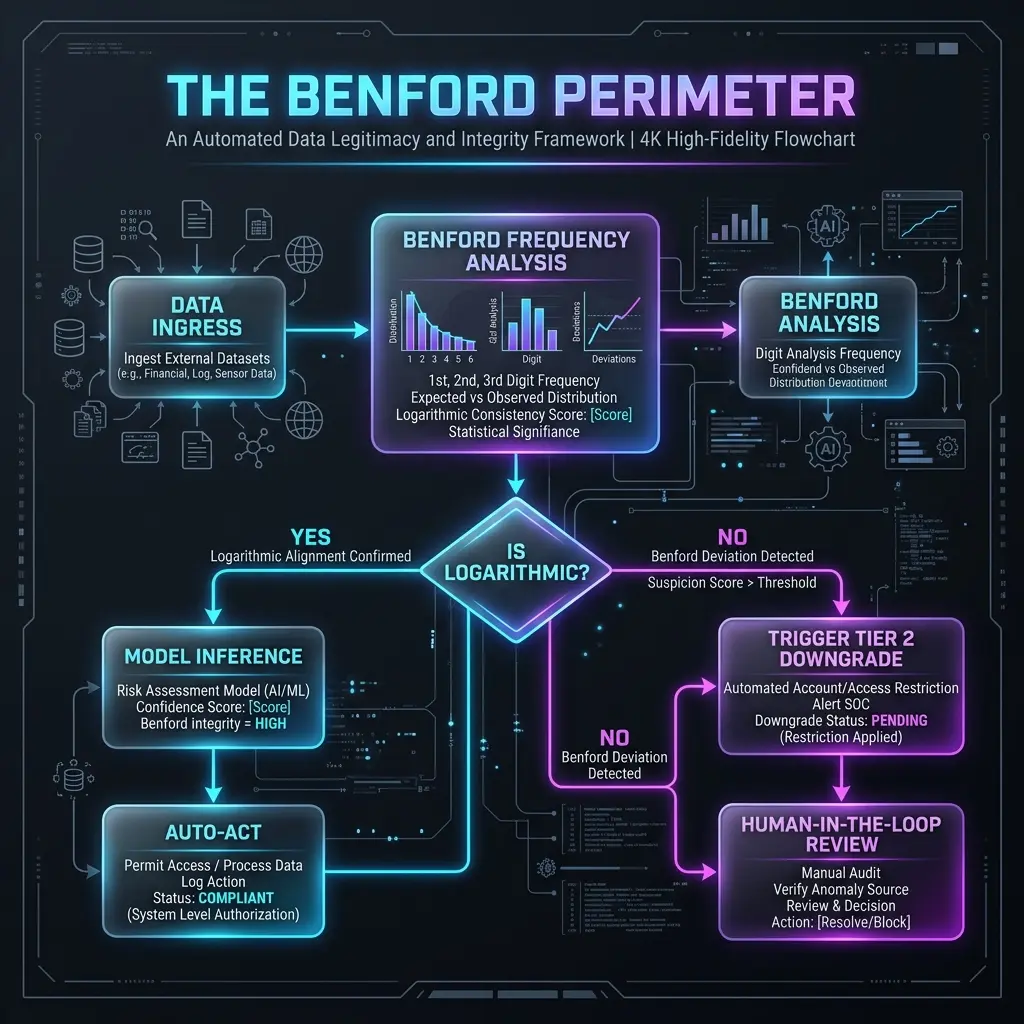
Perimeter Flowchart Logic
The Benford gate processes inbound data through a four-stage deterministic sequence:
| Pipeline Stage | Operational Execution | Latency SLA | Governance Outcome |
|---|---|---|---|
| 1. Ingestion | Inbound numerical payload arrives at API ingress. | Real-time | Raw payload buffered for statistical assertion. |
| 2. Deterministic Gate | Leading-digit frequency compared against logarithmic curve. | $< 1\text{ ms}$ | Calculates Z-score divergence from natural distribution. |
| 3. Tiered Control | High-conformance payloads proceed to full model execution; anomalies downgrade to Tier 2 (Advise). | Sub-millisecond | Enforces human review or step-up authentication on anomalies. |
| 4. Forensic Trace | Z-score and digit distribution hashed into immutable audit log. | Asynchronous | Supplies cryptographic proof for 4-minute root cause diagnosis. |
How Does a Pre-Inference Perimeter Slash the Cost of Proof?
Running a large-scale fraud model (like a Random Forest or a LLM-based agent) on every single packet is expensive in terms of both compute and latency.
| Approach | Logic | Cost (per 1k packets) |
|---|---|---|
| Traditional | Run 1,000 packets through a $0.05 model | $50.00 |
| Architecture of Proof | Run 1,000 through $0.0001 Benford Gate; drop 5% anomalies; run 950 through model | ~$47.51 |
This is how you turn a "Cost Center" (Compliance) into a "Value Center" (Efficiency).
When Should Benford Divergence Downgrade Agent Autonomy?
In a high-velocity environment, you cannot stop every minor statistical fluctuation. You need a Deterministic Governor that automates the transition between Control Tiers based on hard evidence.
| Z-Score | Confidence | Governance Action | Logic |
|---|---|---|---|
| < 1.96 | High | Tier 4 (Full Autonomy) | Data is "Natural." The AI model acts without human intervention. |
| 1.96 - 3.0 | Caution | Tier 3 (Act & Notify) | Data is "Suspicious." The AI acts, but an incident report is generated instantly. |
| > 3.0 | Critical | Tier 2 (Advise) | Automated Kill-Switch. The AI is stripped of autonomy; human sign-off required. |
Implementation Sidebar: The "Red Flag" Distribution
When designing your dashboard, look for the "Uniformity Spike." If your leading digits 1 through 9 all hover around 11%, you aren't looking at natural data; you are looking at a "Flat Distribution" attack.
The PM's Pre-Inference Perimeter Matrix: 5 Verification Gates for Ingress & Fraud Reviews
To ensure product managers can establish mathematical ingress perimeters without stalling engineering roadmaps, evaluate these five gates in PRD and architecture syncs:
| Ingress Dimension | Verification Check | Red Flag Condition (Perimeter Breach) | PM Mandate & Control Action |
|---|---|---|---|
| 1. Dataset Suitability Gate | Are Benford assertions restricted strictly to multi-order numerical distributions? | Applying Benford checks to fixed SKU prices ($19.99), phone numbers, or credit card CVVs. | Restrict Benford gates to natural datasets (invoice amounts, balances, claim totals). |
| 2. Rolling Sample Window | Are digit frequencies evaluated across rolling windows of 50–100 transactions per tenant? | Evaluating single isolated transactions, triggering false-positive rejections. | Mandate rolling streaming windows in Redis/Envoy; evaluate Z-score divergence per API key. |
| 3. Tiered Step-Up Escalation | Does a Benford divergence (>3.0 Z-score) trigger step-up auth rather than an outright drop? | Outright blocking legitimate retail clusters that hit seasonal round-number promotions. | Downgrade autonomy to Tier 2 (Advise) with SMS OTP or human supervisor sign-off. |
| 4. Pre-Inference Compute Savings | Does the API gateway drop or quarantine synthetic bot floods before LLM token generation? | Gateway passes millions of synthetic bot payloads directly to frontier reasoning models. | Block LLM invocation on failed perimeter assertions; preserve inference budget. |
| 5. Tamper-Evident Receipt | Is the leading-digit Z-score and sample count hashed into the transaction receipt? | Incident retrospectives cannot determine why a transaction cluster was flagged. | Embed Benford Z-score and window hash directly into the causal execution envelope. |
The Adversarial Stress-Test: What Could Break a Benford Perimeter?
1. What is the strongest argument against this approach?
Benford's Law applies exclusively to scale-invariant, naturally spanning numerical datasets (such as invoice line items, loan amounts, or transaction sizes), making it ineffective or prone to false positives on constrained numbers like hourly wages, fixed subscription prices, credit card CVVs, or package weights.
The Practical Resolution: Gate the Benford assertion engine on dataset metadata. Ingestion pipelines apply Benford checks only to numerical fields that span multiple orders of magnitude without artificial minimum/maximum cutoffs. For bounded or assigned quantities (such as transaction timestamps, fixed SKU prices, or interest rates), the perimeter switches to distinct deterministic invariant checks (such as range validation, checksums, and schema constraints) rather than forcing logarithmic digit analysis.
2. Under what circumstances would this fail?
Benford's Law fails at low transaction sample sizes (an individual single transaction cannot violate Benford's Law on its own) and against sophisticated adversarial attackers who deliberately craft synthetic payloads using Benford-compliant logarithmic sampling algorithms to bypass the perimeter filter.
The Practical Resolution: Evaluate Benford conformity across rolling sliding windows (e.g., 50–100 transactions per merchant, IP subnet, or API key) rather than evaluating single isolated payloads in a vacuum. To counter adversaries who algorithmically simulate Benford distributions, pair digit frequency screening with secondary deterministic entropy checks, timestamp jitter validation, and IP reputation scoring.
3. What would a skeptical customer, client, or colleague object to?
Fintech and fraud risk managers will object that dropping or downgrading transactions based on statistical digit frequency creates false-positive rejections that frustrate legitimate customers whose transaction patterns naturally cluster around specific retail price tiers (e.g., $9.99, $49.99, $99.00).
The Practical Resolution: Never auto-reject retail customer transactions based solely on Benford anomalies. Instead, use Benford Z-score deviations strictly as an automated control tier governor: transactions from anomalous clusters route to Tier 2 (Supervised Delegation) with secondary step-up authentication (such as SMS OTP or biometric verification) rather than a hard fail, protecting conversion while catching distributed bot floods.
4. Which alternative deserves more consideration?
Supervised machine learning fraud classifiers or gradient-boosted trees trained specifically on historical transaction fraud patterns, which evaluate hundreds of non-linear behavioral features simultaneously rather than relying on a single univariate statistical law.
The Practical Resolution: Position the Benford perimeter as an ultra-fast, pre-inference filter ahead of machine learning models rather than a replacement. Evaluating leading digits in memory takes sub-100 microseconds and negligible compute, dropping 5–15% of obvious synthetic bot attacks before paying the latency and token overhead of full ML inference. The heavy ML classifier evaluates only the legitimate payloads that clear the perimeter gate.
5. What am I assuming that may not be true?
This approach assumes that enterprise data ingestion architectures can reliably batch and compute statistical digit distributions at line-rate in streaming proxies without introducing state-synchronization bottlenecks across distributed edge nodes.
The Practical Resolution: Implement streaming sketches (such as Count-Min sketches and hyperloglog counters) directly within Redis or Envoy edge proxy filters. By tracking rolling digit counts in lightweight memory-mapped data structures, edge nodes compute Z-scores locally in sub-millisecond cycles without locking distributed databases or adding gateway latency.
What Is the Core Architecture Invariant?
Deterministic mathematical checks at the network perimeter filter synthetic manipulation and bound inference spend before probabilistic models ever execute.
Subscribe to the Architecture of Proof Dispatch
Rigorous, decision-forcing systems engineering and AI governance monographs for technical leaders. Delivered periodically, zero spam.