The Forensic Postmortem: How to Debug a Probabilistic Failure
When an AI system makes a million-dollar mistake, executives do not ask which model generated the answer.
They ask: Why did the system make this decision?
Increasingly, nobody can answer. Not because the engineers are incompetent. Because the infrastructure to answer that question was never built.
The loan was denied. The claim was flagged. The autonomous agent took the wrong action. The system ran perfectly by every operational metric. And when the question arrived—why did this specific decision occur, at this specific moment, on this specific input?—the investigation produced guesses dressed as findings.
This is the forensic gap in modern AI architecture. And it is not a monitoring problem. It is a design problem.
Observability Is Not Forensics
Before building a solution, it is worth being precise about the problem. Most AI engineering discussions conflate two distinct capabilities.
| Observability | Forensics |
|---|---|
| Monitor production health in real time | Reconstruct a specific past decision |
| Detect anomalies and drift signals | Explain the root cause of a specific failure |
| Metrics, dashboards, and alerting | Immutable, cryptographically signed evidence |
| Operational health | Accountability |
Observability answers: Is the system degrading?
Forensics answers: Why did this specific decision occur?
The major AI monitoring platforms—LangSmith, Weights & Biases, Arize, Helicone—are observability tools. They are valuable. They are not forensic instruments. When an auditor, a regulator, or a plaintiff's attorney asks for the exact state of your system at the millisecond of a contested decision, a latency dashboard does not answer the question.
Observability tells you the system is failing. Forensics tells you why a specific decision was wrong.
The architectural concept this post introduces—the Decision State Vector—is a forensic instrument. It is not a monitoring metric.
Why Traditional Logs Cannot Reconstruct an AI Decision
Traditional logging frameworks trace execution pathways. They record which code branch fired, what HTTP status was returned, and when a database transaction committed. This is sufficient for deterministic systems, where the same inputs through the same code path always produce the same output.
AI systems are not deterministic systems.
Traditional systems fail because execution diverges. Probabilistic systems fail because state diverges.
Consider the hidden state that shapes a single inference call:
Deterministic Software
───────────────────────
Input → Code → Output

AI System (Composite)
───────────────────────
Input
  ↓
Prompt Template (versioned, mutable)
  ↓
Retrieved Context (vector search result, changes as index updates)
  ↓
Tool State (external API responses, browser state, memory)
  ↓
Workflow Graph (agent plan, conditional routing)
  ↓
Sampling Parameters (temperature, top-p, seed)
  ↓
Model Weights (version pinned or floating)
  ↓
Human Interventions (overrides, escalations, approvals)
  ↓
Output
Each layer in that stack is a variable. A model call can fail not because the code changed, not because the inputs changed, but because a retrieval index was re-embedded, a prompt template was edited, or a tool returned a stale response. The codebase is identical. The failure is in the state.
Traditional debugging traces the path of execution. Probabilistic forensics reconstructs the space of hidden state.
This is why the forensic traceability metric from the frontmatter reads: Forensic Traceability = (Captured State Bits + Deterministic Anchors) / Total Input Entropy. As the number of hidden variables increases—as AI systems grow from single model calls into composite, agentic workflows—the denominator grows. Without a deliberate mechanism to capture the hidden state, forensic traceability approaches zero.
The Anatomy of a Decision State Vector
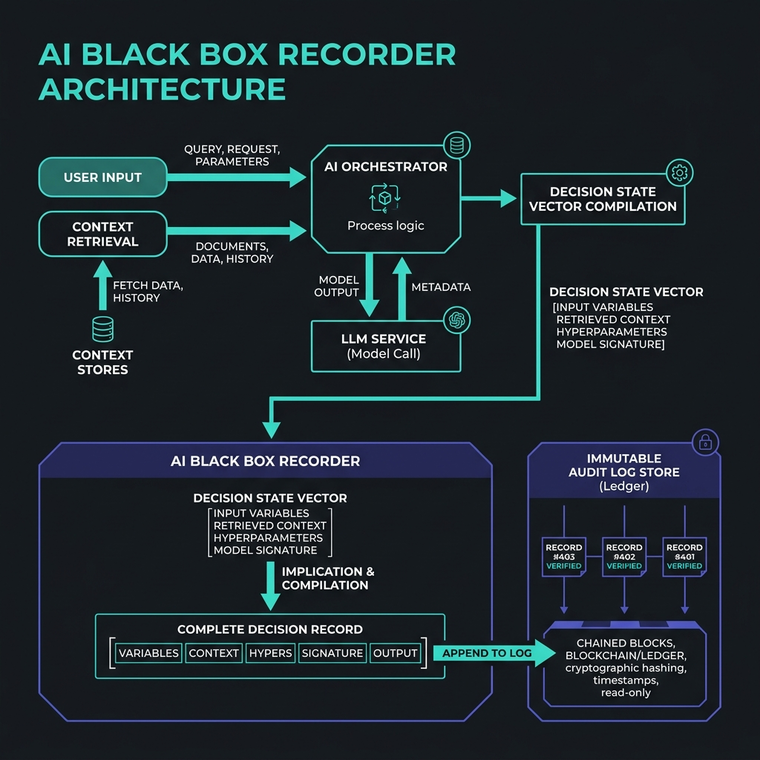
The mechanism for collapsing hidden state entropy into something reconstructible is the Decision State Vector (DSV). It is the statistical equivalent of a core dump—and the AI equivalent of a database transaction log.
Start with the core. For any single model inference, the minimum DSV is:
$$DSV_{core} = { I_{raw},\ P_{hash},\ C_{ret},\ H_{param},\ M_{sig},\ O_{prob} }$$
| Symbol | Component | Description |
|---|---|---|
| $I_{raw}$ | Raw Input | Unedited user input or system event payload |
| $P_{hash}$ | Prompt Hash | SHA-256 of the exact prompt template version, keyed to a versioned prompt registry |
| $C_{ret}$ | Retrieved Context | Content-addressed payload of all documents, rows, or vectors injected into the context window |
| $H_{param}$ | Hyperparameters | Runtime sampling configuration: temperature $\tau$, top-p $p_{top}$, random seed $s_{seed}$ |
| $M_{sig}$ | Model Signature | Provider, model name, API version, and weights hash |
| $O_{prob}$ | Output Log-Probs | Token-level log probabilities capturing the uncertainty distribution of the generation |
This core DSV is sufficient for a single-model, single-call system. Production AI systems are rarely that simple.
Composite and agentic systems extend the core with five additional components that represent the wider decision surface:
$$DSV_t = DSV_{core}\ \cup\ { W_{graph},\ T_{out},\ R_{policy},\ \Omega_{mem},\ \mathcal{H}_{int} }$$
| Symbol | Component | Description |
|---|---|---|
| $W_{graph}$ | Workflow Graph | Agent plan state, conditional routing decisions, and branch path taken |
| $T_{out}$ | Tool Outputs | Complete responses from all tool calls: APIs, browser, code interpreter, search |
| $R_{policy}$ | Policy Version | The exact rule version and threshold configuration active at decision time |
| $\Omega_{mem}$ | Memory State | All context retrieved from short-term and long-term memory stores |
| $\mathcal{H}_{int}$ | Human Interventions | All override events, escalation triggers, and approval records in the decision path |
A DSV scoped only to the model call cannot trace failures that originate in a tool response, a policy threshold change, or an undocumented human override. The vector must cover the full decision surface—not just inference.
A Practical Constraint: Vendor Interoperability
Not every component of the extended DSV is available from every provider. Some model APIs expose token-level log probabilities. Others do not. Some expose reasoning traces. Others intentionally withhold them as proprietary infrastructure. Some orchestration frameworks instrument tool calls with full request and response payloads. Others emit summary telemetry only.
A practical DSV specification does not assume identical telemetry across providers. It uses optional fields with graceful degradation: when a field cannot be populated from the upstream provider, the DSV records the absence explicitly rather than omitting the field silently. An explicit null with a provenance note — "log probabilities not available: provider OpenAI gpt-4o-mini API v2026-05-13 does not expose this field" — is a forensically honest record. A missing field is an invisible gap.
This constraint also informs implementation architecture. Organizations that route all model calls through a centralized inference proxy or AI gateway can instrument the DSV at the proxy layer, applying consistent telemetry capture regardless of which downstream provider handles each request. The architectural role — a layer that intercepts, enriches, and durably records — matters more than the label attached to it.
How do we build a Black Box Recorder?
The DSV requires an architectural mechanism to compile and persist it. That mechanism is the Black Box Recorder—a forensic infrastructure layer positioned between orchestration and inference.
Database engineers have a direct analogue: the write-ahead log. Before any transaction modifies state, the WAL records what is about to happen—making recovery, replay, and audit possible from first principles. The Black Box Recorder is the AI equivalent. Before any decision is returned to a caller, the full DSV is committed to an append-only ledger. That record is what makes forensic reconstruction possible months later when a regulator or audit team asks for it.
It is not a logging library. A logging library is optional instrumentation that developers add where they remember to add it. The Black Box Recorder is an architectural constraint: every model call, every tool invocation, and every agent action in a consequential workflow must route through it. There is no bypass path.
The recorder intercepts each call, assembles the full DSV from orchestration context, executes the inference or tool request, appends the output, and writes the complete record to durable storage before returning the result to the caller.
def execute_model_call(user_input: str, prompt_template_id: str) -> str:
    # 1. Resolve exact prompt template version and hash it
    prompt_template = prompt_registry.get(prompt_template_id)
    prompt_hash = sha256(prompt_template.content)

    # 2. Retrieve context and hash the payload content, not the DB key
    retrieved_docs = vector_store.similarity_search(user_input, limit=3)
    context_payload = [doc.text for doc in retrieved_docs]
    context_hash = sha256("\n---\n".join(context_payload))

    # 3. Capture sampling configuration
    hyperparameters = {"temperature": 0.0, "top_p": 0.95, "seed": 42}
    model_signature = {"provider": "openai", "model": "gpt-4o", "version": "2026-05-13"}

    # 4. Render and execute
    raw_prompt = prompt_template.render(input=user_input, context=context_payload)
    response = model_client.generate(prompt=raw_prompt, **hyperparameters)

    # 5. Compile the complete Decision State Vector
    dsv = {
        "raw_input": user_input,
        "prompt_hash": prompt_hash,
        "retrieved_context": context_payload,   # full payload, not a DB reference
        "context_hash": context_hash,
        "hyperparameters": hyperparameters,
        "model_signature": model_signature,
        "policy_version": policy_registry.current_version(),
        "output": response.text,
        "logprobs": response.logprobs,
        "timestamp_utc": utc_now_iso()
    }

    # 6. SYNCHRONOUS durable write with commit before returning to caller.
    #    If the write fails, raise — do not silently return the response.
    #    The caller must not receive the decision before it is forensically sealed.
    audit_ledger.commit(dsv, raise_on_failure=True)

    return response.text
The Audit Note: The commit at step 6 is synchronous by design for high-consequence decisions (Tier 2/3). An asynchronous fire-and-forget write creates a permanent gap: if the process crashes between the model returning a response and the ledger write completing, that decision is unauditable. The forensic contract is: the decision does not exist until it is sealed.
High-throughput, low-consequence paths (Tier 1) can use a write-ahead log pattern—the DSV is written to durable staging before the response is returned, then flushed to the immutable ledger asynchronously with acks=all semantics. This is not the same as async-fire-and-forget. The WAL guarantees the record survives a process crash; the async flush preserves throughput. The durability guarantee is preserved; only the latency profile changes.
Without this layer, application logs drift from model configurations silently. When an engineer edits a prompt template in production, the execution logs record the same function call as before—but the actual inputs to the model have changed. The Black Box Recorder guarantees that the exact variables passed to the weights are durably recorded before any downstream system acts on the result.
The Tension: Storage Cost vs. Audit Fidelity
The principal design tension in forensic logging is straightforward: logging the full DSV for every inference in a high-velocity system generates terabytes of data daily. Discarding the state makes reconstruction impossible.
The resolution is Adaptive Logging—tiering forensic fidelity by decision risk.
Tier 1 — Hash-Only (Low Risk, High Confidence): Store the content-addressed SHA-256 hash of each retrieved context payload—not a database key or a vector index reference. The distinction matters: if the vector store is re-indexed or re-embedded, any key reference becomes forensically invalid. A SHA-256 hash of the actual retrieved text is stable; given the source documents are retained in append-only storage, the payload can be reconstructed from the hash at any future point.
Tier 2 — Full DSV (High Risk, Escalated, or Uncertainty-Boundary): If a decision requires escalation, falls within an uncertainty band (e.g., confidence $\in [0.4, 0.6]$), involves a human override, or triggers a circuit breaker, write the complete uncompressed DSV immediately. No hash-only shortcut.
Tier 3 — Continuous Sampling (Monitoring): For baseline statistical health checks, maintain a rolling 1% sample of full DSVs regardless of confidence level. This catches distributional drift in retrieval quality and prompt behavior that tier thresholds alone do not surface.
The governing rule across all tiers: every stored record must be reconstructible from durable, append-only sources. A log entry that references mutable state is not a forensic record. It is a pointer to a moving target.
Why Regulations Already Require an Equivalent Capability
The engineering case for the DSV is clear. The governance case is not a future concern — it is already embedded in existing frameworks.
Regulators typically specify outcomes, not implementation mechanisms. They will not mandate a structure called a Decision State Vector. What they do mandate, consistently across domains, is the ability to reconstruct consequential decisions with enough fidelity to demonstrate that a system behaved within policy. Whether an organization calls it a DSV or something else, an equivalent evidentiary record is becoming a compliance requirement.
Federal Reserve SR 11-7 (model risk management) requires that consequential model outputs be explainable and that model behavior be attributable to specific inputs and parameters. An investigation that concludes "the model generated this output" without reconstructing the input state does not satisfy SR 11-7's expectation of model governance.
EU AI Act, Article 13 mandates transparency for high-risk AI systems. Transparency includes the ability to explain why a specific output was produced for a specific input. An observability dashboard showing that the model's average accuracy is 94% does not explain why a specific loan application was denied.
FDA Guidance on AI/ML-Based Software as a Medical Device requires that algorithm changes be tracked and that outputs be attributable to a defined algorithm version. Without a model signature in the decision record, clinical AI systems cannot demonstrate that a specific output was produced by an approved algorithm version.
The pattern is the same across domains. At some point, an investigator—a regulator, an auditor, a court—will ask: Show me exactly why this recommendation was made.
If you cannot reconstruct the state, you cannot demonstrate compliance. Whatever it is called, the evidentiary record that makes regulated AI governable is a DSV under another name.
Organizations that build forensic infrastructure now are building the evidence trail before they need it. Organizations that defer are accumulating a liability that surfaces at the worst possible moment.
Evaluation Tells You Whether AI Fails. Forensics Tells You Why.
Forensics does not replace evaluation. It completes it.
Evaluation frameworks—held-out test sets, shadow deployment comparisons, A/B experiments—tell you that a system's performance has degraded. They identify that the model is failing. They do not identify why a specific decision was wrong.
The complete engineering loop runs as:
Evaluation
  ↓
System performance degrades on segment X.
  ↓
Forensics
  ↓
Reconstruct DSVs for failing cases in segment X.
  ↓
Root Cause
  ↓
Retrieved context is stale (index rebuilt without re-embedding source docs).
Prompt template v2.3 changed the system instruction boundary.
Policy threshold was updated without re-validating segment X behavior.
  ↓
Remediation
  ↓
Update retrieval pipeline.
Pin prompt template version.
Re-run policy calibration on segment X.
  ↓
Regression Evaluation
  ↓
Confirm performance restored. Seal new DSV baseline.
Without the forensic step, the loop breaks between "performance degraded" and "root cause." Teams are left attributing failures to the model when the actual cause is a retrieval pipeline change, a prompt edit, or a policy threshold that shifted three weeks before the degradation signal appeared in the metrics.
Evaluation tells you the system is failing. Forensics closes the gap from signal to structural fix.
The DSV Is Also a Governance Liability
The Decision State Vector solves a forensic problem. It creates a governance problem.
A complete DSV for a consequential AI decision contains some of the most sensitive data in the enterprise: the exact user input, the full text of every retrieved document injected into the context window, the system prompt (which may encode proprietary business logic), the model's reasoning trace, and any human intervention records. Across millions of daily decisions, the forensic ledger accumulates a concentration of sensitive material that requires its own governance architecture.
Three categories of risk compound simultaneously.
Privacy. Retrieved context payloads frequently contain personal information — the loan application details, the patient record fragment, the customer support history that was surface by the retrieval pipeline. Storing that content verbatim in the forensic ledger subjects it to data residency requirements, right-to-erasure requests, and access control obligations that often do not apply to the transactional database from which it was retrieved.
Confidentiality. System prompts and policy versions encode organizational decision logic. The forensic ledger, if accessible to the wrong parties, is a complete blueprint of how the organization makes consequential decisions — including which thresholds trigger escalation, which rules govern exceptions, and which confidence boundaries determine autonomous action.
Chain-of-custody integrity. A forensic record that can be read by anyone who can read the audit logs is not a forensic record — it is a disclosure risk. Adversarial access to DSV content enables both gaming of the system (if an actor can read the policy version and confidence thresholds) and post-hoc manipulation (if write controls are insufficient).
The governance response is architectural, not procedural. The DSV ledger requires:
- Encryption at rest and in transit, with key management tied to a hardware security module, not application-layer secrets.
- Tiered access controls that separate operational read access (incident responders reconstructing a specific decision) from bulk export access (which should require explicit, logged authorization).
- Retention policies tied to the risk tier of each decision — not a single org-wide retention window, since low-risk decisions and regulatory-hold decisions require different lifecycle management.
- Separation from application telemetry — the DSV ledger should be a distinct system from operational logs, with independent access controls, because the sensitivity profiles are fundamentally different.
The forensic record that makes AI systems governable is itself a system that must be governed. An organization that builds a DSV ledger without a corresponding access control and retention architecture has not solved the accountability problem — it has concentrated it.
One-Line Synthesis
Every mature engineering discipline eventually standardized its primary forensic artifact:
- Software engineering standardized the stack trace.
- Database engineering standardized the transaction log.
- Networking standardized the packet capture.
- Aviation standardized the flight data recorder.
- Cybersecurity standardized the audit trail.
AI engineering is reaching the same inflection point. The Decision State Vector is not an isolated proposal—it is the next step in a well-established pattern of engineering disciplines building the infrastructure to answer the question why did this happen after something goes wrong.
Organizations that can reconstruct every consequential AI decision won't just debug systems faster. They will build AI that regulators, executives, and customers can actually trust.
The ideas in this post are my own — they emerged from questions I asked while learning applied AI concepts and putting them to work in my job and my projects. The prose was developed with AI assistance.
Frequently Asked Questions
What is the difference between AI observability and AI forensics?
Observability monitors production health in real time—detecting anomalies, tracking latency, and surfacing drift signals. Forensics reconstructs a specific past decision with enough fidelity to identify the exact root cause. Observability tells you a system is degrading. Forensics tells you why a specific decision was wrong. The Decision State Vector is a forensic instrument, not an observability dashboard.
Why do traditional logging methods fail for AI decisions?
Traditional logs trace execution paths rather than statistical states. A model can produce different outputs with the exact same code path, because the failure resides in the hidden state—retrieved context, prompt template version, sampling parameters, agent tool outputs—not in the code that executed. Logging the input and output captures a correlation, not the decision.
What is a Decision State Vector (DSV)?
A Decision State Vector (DSV) is a serialized, cryptographically signed record capturing the complete set of variables that determined an AI system's output at a specific moment in time. For composite and agentic systems, this includes raw inputs, prompt hashes, retrieved context payloads, hyperparameters, model signatures, workflow graph state, tool call outputs, policy versions, memory state, and any human interventions.
How does a Black Box Recorder differ from an AI logging library?
A Black Box Recorder is a forensic infrastructure layer positioned between orchestration and inference—every model call must route through it, with no bypass path. It compiles the complete Decision State Vector, writes it to durable storage with a synchronous commit before returning the result to the caller, and signs the record to prevent tampering. A logging library is optional instrumentation. A Black Box Recorder is an architectural constraint.
Why does forensic AI infrastructure matter for regulatory compliance?
FDA guidance on Software as a Medical Device, Federal Reserve SR 11-7 on model risk management, and EU AI Act Article 13 all require that consequential AI decisions be explainable and reconstructible. Regulators specify outcomes, not implementation mechanisms — they will not mandate a structure called a Decision State Vector. What they do mandate is the ability to demonstrate that decisions were made within policy, with enough evidentiary fidelity to satisfy an examination. Whatever an organization calls it, a DSV-equivalent record is becoming the infrastructure that makes that demonstration possible.
How do you manage the storage cost of forensic AI logging?
Adaptive logging tiers fidelity by risk. Low-risk decisions store content-addressed SHA-256 hashes of retrieved context payloads—not database key references, which become forensically invalid if the index is rebuilt. High-risk, escalated, or uncertainty-boundary decisions store the full uncompressed DSV. The key distinction is that even hashed records must be reconstructible from stable, append-only source data.
Download the Architecture of Proof Checklist
Ready to implement? Get the definitive checklist for building verifiable AI systems.