The Hidden Tax of Low-Trust AI
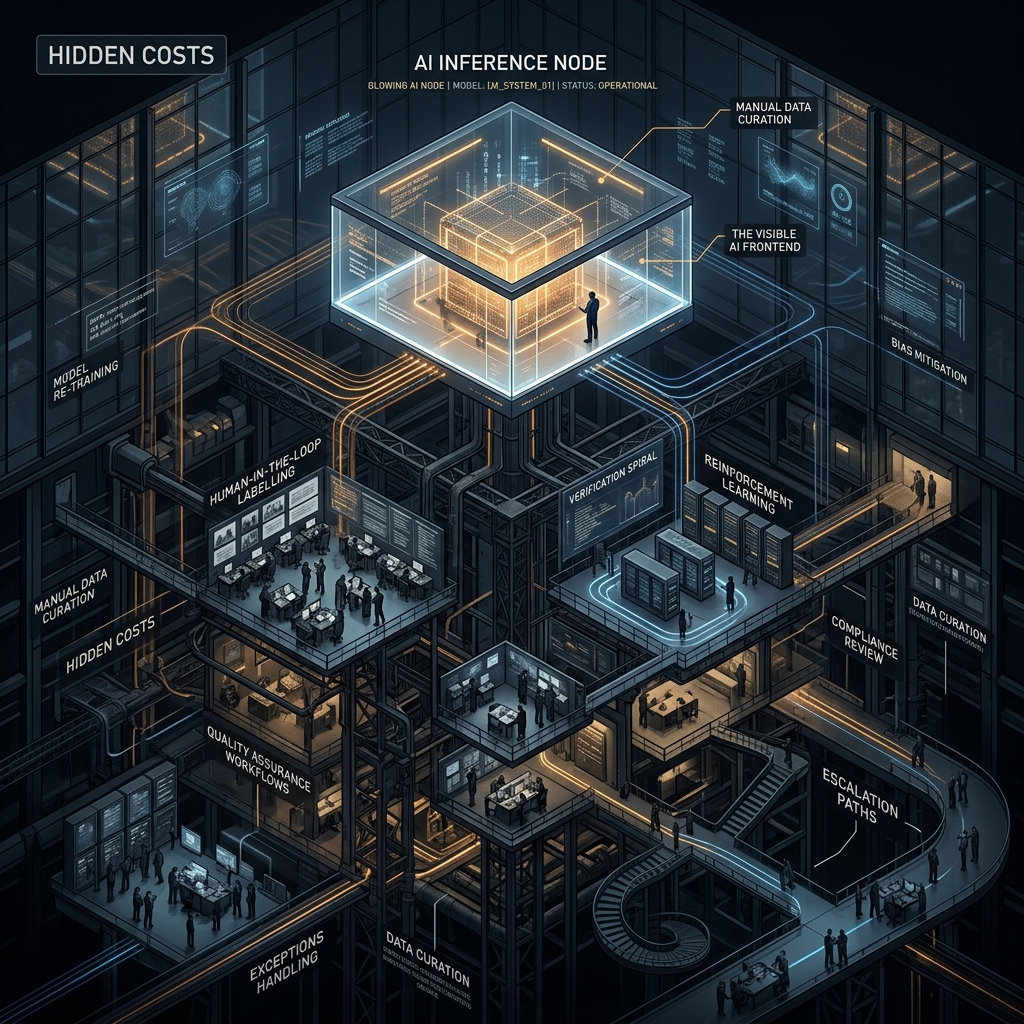
Most AI teams model the obvious costs. They account for inference spend, infrastructure, GPUs, API usage, and latency. Those numbers matter, and they are easy to measure. But many AI products fail economically for a very different reason: they create operational distrust.
That distrust is expensive. Not in theory, but in labor, rework, oversight, escalation, and duplicated workflows that quietly compound across the organization. The result is a hidden tax on every workflow the AI touches.
And importantly, this does not mean human involvement is bad. In many environments, human review is absolutely necessary. The problem is not “humans in the loop.” The problem is when the system creates unstructured verification labor because trust was never operationalized properly in the first place. That distinction matters.
What Is the Verification Cost Nobody Budgets For?
The standard AI ROI story is simple. Human work gets replaced or reduced by AI automation, and the organization saves time and money.
On paper, the workflow looks like this:
Human work → AI automation → labor savings
In reality, many deployments behave more like this:
Human work → AI suggestion → human verification
→ correction or escalation → audit or rework → final approval
The AI still helps, but the human layer does not disappear. In some cases, it expands. That is the paradox of low-trust AI systems. They appear efficient locally while increasing operational cost systemically.
A support agent responds faster, but managers add review requirements. A legal assistant drafts contracts faster, but attorneys spend additional time validating citations. A finance workflow becomes automated, but analysts build reconciliation steps around the output “just to be safe.” The organization starts compensating behaviorally for uncertainty. That compensation is where the hidden economics live.
How Does "Probably Correct" Erode Enterprise Margins?
Traditional software usually feels binary. It either works or it fails. AI introduces a third state: Probably correct. That sounds manageable until it enters production workflows.
Once outputs become probabilistic, organizations adapt through defensive operational routines. Line employees double-check generated figures, managers mandate secondary sign-offs, financial analysts rerun database queries manually, legal counsel verifies source citations line-by-line, and compliance units institute sampled audits. None of these compensating behaviors appear in vendor product demonstrations; all of them appear on the enterprise balance sheet. The primary economic liability of low-trust AI is rarely the overt catastrophic hallucination, but the continuous, distributed human labor demanded to confirm whether routine outputs are safe to act upon.
How Does Strategic Leverage Differ From Compensating Human Infrastructure?
Human oversight in high-consequence workflows represents sound systems engineering rather than an operational deficiency. A radiologist reviewing machine-assisted oncology scans, a partner approving litigation strategy, or a fraud investigator validating high-value transaction blocks provides irreplaceable contextual judgment. The critical failure occurs when human reviewers become permanent, uncalibrated shock absorbers for brittle software architecture. When an AI system cannot isolate its own epistemic boundaries or communicate confidence deterministically, human operators are forced into exhaustive, undifferentiated manual review across every transaction. High-trust architectures invert this dynamic: automated guards resolve unambiguous cases with verified provenance, directing scarce human attention exclusively toward true edge cases, novel policy conflicts, and high-liability anomalies.
How Does the Verification Burden Escalate Across Regulated Verticals?
The verification burden escalates exponentially in regulated or high-liability environments, where downstream defensibility matters far more than upstream generation speed:
| Vertical Domain | Naive Automation Assumption | Low-Trust Compensating Drag | High-Trust Grounding Architecture |
|---|---|---|---|
| Legal Review | LLMs draft contract summaries and redlines in seconds, slashing associate billing hours. | Attorneys spend duplicate time verifying external citations, cross-checking defined terms, and verifying statutory references line-by-line. | Deterministic citation anchoring mapping clauses directly to source document spans with diff highlights. |
| Healthcare Operations | Models automate prior authorization, clinical triage notes, and medical claims approvals. | Ambiguous outputs force clinicians and billing coders into manual chart audits to prevent statutory claim denials or malpractice liability. | Confidence-calibrated triage routing ambiguous diagnostic markers directly to physician review queues with highlighted rationale. |
| Corporate Finance | Generative models synthesize 10-K filings, journal anomalies, and internal audit reconciliations. | Analysts export AI outputs into external spreadsheets to rerun queries manually and re-audit reconciliations from scratch. | Frozen-snapshot data provenance ensuring every generated figure links to an immutable ERP ledger transaction ID. |
| Customer Support | Synthetic agents draft customer resolutions across enterprise ticketing channels. | Support leads build manual QA review queues and tone-correction scripts, paying for both automated inference and full-time inspection. | Strict capability boundaries routing policy-sensitive disputes to senior human operators while safely auto-resolving deterministic queries. |
What Are the Mechanics of the Verification Spiral?
Low-trust AI systems trigger a predictable operational breakdown. Initial enthusiasm stems from rapid generation speed across standard tasks. Soon, edge-case hallucinations or policy violations emerge, prompting executive panic. Organizations respond not by redesigning the underlying system architecture, but by bolting on external safeguards: manual review queues, secondary approval gates, random spot-check audits, and parallel operational fallbacks.
Each safeguard seems rational in isolation. Collectively, they create the verification spiral—a runaway condition where the operational expense of human oversight outstrips the labor saved by initial task generation. The enterprise ends up funding duplicate systems: the AI platform and the manual review apparatus required to monitor its uncertain outputs.
Why Is the Verification Spiral a Product Architecture Failure Rather Than Model Defect?
Engineering teams routinely misdiagnose this dynamic as a pure model quality issue. They focus exclusively on prompt engineering, larger parameter scales, benchmark evaluations, and retrieval optimization. While model quality matters, the root cause of the verification spiral lies in operational product architecture. The decisive question is never whether a language model can synthesize plausible prose; it is whether the surrounding enterprise system can safely ingest that prose without forcing human operators into continuous, uncompensated babysitting.
What Is the True Economic Ledger of Verification Costs?
AI financial models consistently underestimate post-generation operating expenses. True production verification overhead spans six measurable operational components:
| Verification Cost Driver | Operational Manifestation | Economic Impact |
|---|---|---|
| Primary Inspection | Human reviewers re-reading generated artifacts against source records. | Linear labor cost scaling with transaction volume, neutralizing initial automation gains. |
| Audit & Governance | Secondary compliance teams sampling decisions to satisfy regulatory defensibility. | Fixed supervisory overhead requiring certified domain specialists (legal, actuarial, medical). |
| Exception Remediation | Engineering and support handling false positives, edge-case rejections, and user complaints. | High-friction context switching pulling senior operators away from strategic core duties. |
| Fallback Processing | Deterministic legacy systems or manual teams processing transactions when confidence dips. | Duplicate infrastructure and licensing costs to maintain redundant processing rails. |
| Shadow Reconciliation | Employees maintaining private spreadsheets to cross-verify AI outputs before trusting them. | Invisible productivity degradation hidden within baseline departmental labor hours. |
| Trust Repair Workflows | Executive escalations, customer churn mitigations, and external regulatory remediation. | Tail-risk catastrophic costs triggered by undetected catastrophic hallucination in production. |
Two AI products can achieve identical benchmark F1 scores while producing radically divergent unit economics. The product that forces humans to verify entire outputs operates at a financial deficit; the product that isolates uncertainty to deterministic token spans operates at sustained profit.
The PM's Verification Drag Matrix: 5 Questions for PRD & Operations Reviews
To ensure product managers identify hidden verification taxes before shipping AI workflows, evaluate this checklist in cross-functional design reviews:
| Verification Vector | Architecture Inspection Check | Red Flag Condition (Verification Spiral) | PM Mandate & Action |
|---|---|---|---|
| 1. Reviewer Ergonomics | Does the interface highlight the exact diffs and low-confidence token spans requiring review? | Operators are forced to re-read entire multi-page documents to spot potential errors. | Build surgical verification UI; highlight token spans below confidence thresholds. |
| 2. Citation Provenance | Can every extracted claim or numerical figure be clicked to view its exact source coordinate? | Reviewers copy-paste figures into secondary search tools to verify accuracy. | Mandate immutable chunk coordinates and bounding-box provenance in API payloads. |
| 3. Shadow Reconciliation | Are operators keeping private spreadsheets or duplicate paper logs to cross-check AI outputs? | Department heads admit team members double-check AI calculations in Excel. | Quantify shadow labor; redesign interface to provide cryptographic reconciliation receipts. |
| 4. Explicit Failure Declaration | Does the system halt generation and return an explicit error when confidence falls below bounds? | Model produces syntactically confident but factually hallucinatory prose on ambiguous inputs. | Implement deterministic circuit breakers; enforce abstention over hallucinated guesses. |
| 5. Perturbation Auditing | Does the platform periodically inject synthetic test errors to measure human reviewer diligence? | Reviewers approve 100% of cases in under 2 seconds (automation bias rubber-stamping). | Inject synthetic canary anomalies into queues; gamify precision audits and track vigilance. |
What Do High-Trust Architectures Do Differently to Bound Review Labor?
Resilient systems minimize the operational friction required to believe a synthetic output. They transform probabilistic uncertainty from an unbounded operational risk into a calibrated engineering invariant:
| Architecture Dimension | Low-Trust Fragile System | High-Trust Grounded System |
|---|---|---|
| Uncertainty Localization | Emits uniform, uncalibrated text requiring full contextual verification. | Highlights specific low-confidence token spans, bounding boxes, and missing data dependencies. |
| Reviewer Ergonomics | Forces operators into full-document re-reading to spot subtle factual errors. | Delivers surgical verification diffs linking directly to immutable source telemetry snapshots. |
| Failure Modes | Hallucinates plausible assertions or fails silently when context is ambiguous. | Executes deterministic circuit breakers, halting automated generation and declaring explicit failure. |
| Escalation Path | Dumps unhandled exceptions into undifferentiated, generic manual ticket queues. | Routes edge cases to certified domain specialists with structured decision matrices and frozen state. |
| Defensibility Surface | Ephemeral inference traces lost across stateless API invocations. | Cryptographically signed audit manifests logging prompts, retrieved chunks, and operator sign-offs. |
How Should Product Leaders Formulate a Realistic Net AI ROI Equation?
A complete enterprise AI ROI framework balances automation speed against total supervisory friction:
Net AI ROI = (Productivity Gain + Capacity Expansion)
           – (Direct Inference & Infrastructure Cost)
           – (Active Operator Verification Labor)
           – (Governance, Compliance & Audit Overhead)
           – (Failure Remediation & Shadow Reconciliation Cost)
Most executive dashboards track only generation speed and API compute costs, treating human oversight as an unmeasured fixed externality. When organizations measure the full equation, they recognize that sustainable AI ROI requires engineering for verifiability rather than raw generative autonomy.
The Adversarial Stress-Test: What Could Break a High-Trust Verification Architecture?
1. What is the strongest argument against this approach?
Investing engineering resources into structured verification UX, provenance tracking, and calibrated uncertainty indicators adds substantial upfront development overhead compared to deploying standard conversational wrappers. Skeptics argue that rapid foundation model performance gains will render complex verification harnesses obsolete within quarters.
The Practical Resolution: Upstream model intelligence improves reasoning capability, but enterprise liability remains anchored to statutory compliance, auditability, and legal defensibility. Higher parameter models still produce statistical hallucinations on long-tail edge cases. Building verification ergonomics into core workflow primitives permanently insulates the product against tail-risk failure, regardless of which underlying foundation model powers the inference pipeline.
2. Under what circumstances would this fail?
This architecture fails when confidence calibration scores drift or decouple from true error rates, giving human reviewers false reassurance. If the system flags 99% of ambiguous outputs correctly but experiences a silent failure mode on a novel distributional shift, operators conditioned to trust the calibration will rubber-stamp catastrophic errors without inspection.
The Practical Resolution: Decouple calibration monitoring from production runtime using adversarial shadow eval suites and dynamic drift detection. Enforce random, unflagged canary audits where senior operators independently verify synthetic outputs across all confidence strata, measuring reviewer diligence and immediately updating calibration thresholds whenever precision falls below 99.5%.
3. What would a skeptical customer, client, or colleague object to?
A budget-conscious executive or client will object that highlighting uncertainty and routing ambiguous cases to human specialists slows down headline turnaround times and undermines the core marketing promise of autonomous operational scale.
The Practical Resolution: Quantify the full total cost of ownership by instrumenting and publishing shadow reconciliation metrics. Demonstrate that clean routing and deterministic uncertainty bounding eliminate invisible multi-hour post-incident forensics, customer churn, and compliance re-audits. Speed without bounded verification is an unhedged operational liability.
4. Which alternative deserves more consideration?
Rather than building complex in-workflow verification ergonomics and confidence routing, an organization could restrict generative AI strictly to zero-liability, internal ideation tasks (e.g., search synthesis, draft brainstorming) while keeping production transactions executed entirely through deterministic, rule-based software.
The Practical Resolution: While safe, an ideation-only posture forfeits the genuine throughput advantages of generative models on high-volume semi-structured tasks. The balanced alternative is progressive delegation: deploy generative automation exclusively behind strict, programmatically verified schema boundaries where outputs must pass automated syntax, reference, and policy linters before reaching either end-users or human operators.
5. What am I assuming that may not be true?
This architecture assumes human operators will remain vigilant reviewers when presented with surgical verification diffs, maintaining rigorous skepticism even as automated accuracy reaches 95% or higher.
The Practical Resolution: Human reviewers succumb predictably to automation bias over time. Mitigate vigilance decay by implementing synthetic perturbation injection: routinely inject calibrated, synthetic errors into reviewer queues to measure detection rates, gamify precision audits, and enforce mandatory affirmative validation actions (e.g., explicit confirmation of source citations) rather than passive approval clicks.
What Is the Core Economic Takeaway?
Enterprise AI profitability depends on minimizing the labor required to verify probabilistic outputs rather than maximizing autonomous task generation.
Subscribe to the Architecture of Proof Dispatch
Rigorous, decision-forcing systems engineering and AI governance monographs for technical leaders. Delivered periodically, zero spam.