The New Product Sense: Knowing When AI Should Stop
The New Product Sense: Knowing When AI Should Stop
Why the Most Important AI Product Decision Is Where Autonomy Ends
Series Notice: Part I of the AI Product Leadership Series
Part I (This Monograph): Knowing When AI Should Stop: Designing Asymmetric Escalation Boundaries and the Friction Vector.
Part II: Why AI Product Sense Requires Systems Judgment →: Why AI is Collapsing the Boundary Between Product Strategy and System Architecture.
Why Is Knowing When AI Should Stop the Defining Challenge of Modern PMs?
For decades, product managers were rewarded for removing friction. The best products reduced clicks, eliminated approvals, simplified workflows, and accelerated the path from intent to outcome. That philosophy emerged during an era when software was fundamentally deterministic: given the same input, the system produced the exact same output every time.
AI changes the optimization problem. Large Language Models, agentic loops, and autonomous workflows operate probabilistically. They do not simply succeed or fail. They drift, degrade, accumulate uncertainty, and occasionally remain confident while being factually wrong.
The defining challenge of modern product management centers on deciding when the AI should stop.
AI product leaders are defined by how intelligently they design boundaries around automation. This requires transitioning from absolute friction removal to dynamically engineering the Friction Vector.
Why Does More Autonomy Create Non-Linear Liabilities?
Most AI roadmaps begin with a deceptively simple question: What can we automate? Teams identify workflows, connect models to system tools, build multi-agent orchestrations, and gradually increase autonomy. The underlying assumption is straightforward:
$$\text{More Autonomy} = \text{More Value}$$
In practice, the relationship is rarely linear. As autonomy increases, systems accumulate hidden non-linear liabilities:
$$\text{Uncertainty} \;\longrightarrow\; \text{State Drift} \;\longrightarrow\; \text{Context Degradation} \;\longrightarrow\; \text{Debugging Complexity} \;\longrightarrow\; \text{Oversight Costs}$$
| System Archetype | Structural Complexity | Primary Failure Mode | Net Enterprise ROI Profile |
|---|---|---|---|
| Deterministic Rules / Regex | Low (Static invariants) | High rigidity; zero nuance | Predictable, bounded utility |
| Single-Turn Grounded RAG | Moderate (Vector retrieval) | Retrieval misses; local drift | Peak Enterprise Value & ROI |
| Complex Multi-Agent Chains | Extreme (Recursive loops) | State decay, chaos loops, high TTC | Negative ROI; uncontainable risk |
Beyond a certain point, additional autonomy creates more operational burden and risk than customer value. The question therefore shifts. Instead of asking: How much can we automate? product leaders must ask: Where should automation intentionally end?
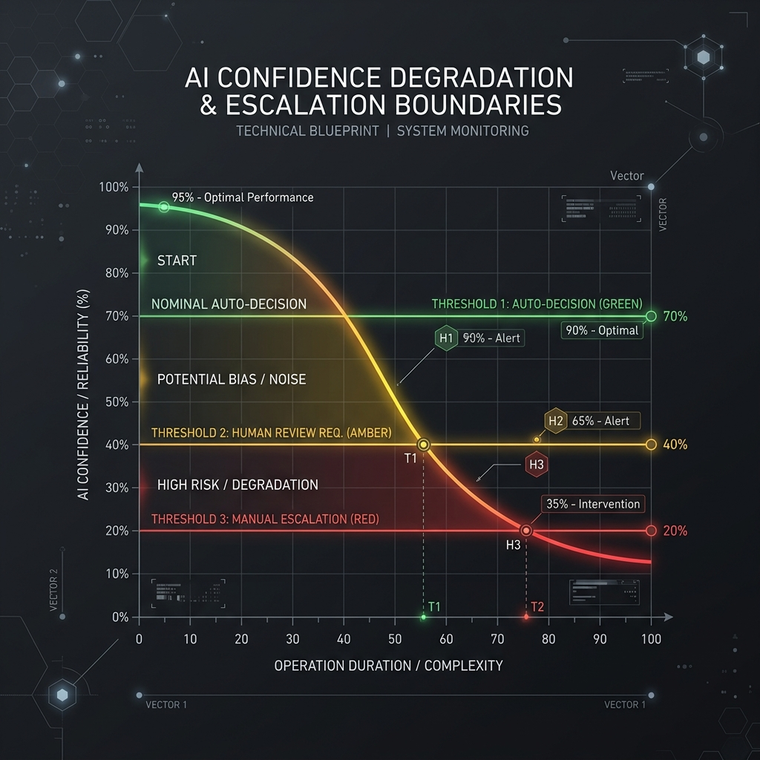
How Do AI Systems Fail Along a Confidence Degradation Curve?
Imagine an AI-powered insurance claims assistant. A customer uploads a note: "My car was damaged in a parking lot."
The system extracts basic metadata, identifies policy coverage, estimates eligibility, and recommends a reimbursement amount. At the beginning of this workflow, the system is confident. But as additional information is processed, uncertainty accumulates: missing incident details, ambiguous policy language, and conflicting historical claim patterns.
This confidence degradation is gradual rather than catastrophic. By the time the final recommendation is generated, the system may still produce a structurally coherent answer while operating far outside the confidence envelope that originally justified autonomous execution.
The model did not fail from lack of intelligence. The product failed because nobody designed the precise point where confidence degradation should trigger an alternative workflow. The product problem centered on escalation rather than reasoning.
AI product sense involves understanding when an autonomous system should stop, pause, request confirmation, switch to deterministic logic, or hand over to an expert.
Why AI Fails Differently
Traditional software typically fails through explicit, binary exceptions:
$$\text{Success} \longrightarrow \text{Success} \longrightarrow \text{Success} \longrightarrow \text{Failure (Error Code)}$$
AI systems fail through a gradual erosion of confidence:
$$\text{95% Confidence} \longrightarrow \text{89%} \longrightarrow \text{82%} \longrightarrow \text{74%} \longrightarrow \text{Confidently Wrong}$$
The degradation is incremental. The challenge is recognizing when system autonomy is no longer justified.
The Missing Product Capability
Most AI discussions focus on model quality, prompt tuning, retrieval strategies, and benchmark scores. Yet many enterprise failures occur because the system lacked a mechanism for deciding when to stop.
Consider the insurance claims assistant again. Each step of claim processing introduces a fraction of uncertainty. By the final recommendation, the system may still produce a structurally coherent answer while operating far outside the confidence range that originally justified autonomous execution.
The model did not crash, and the backend executed normally. The product failed because nobody designed the boundary between autonomy and oversight.
How Does Context Decay Break Multi-Agent System Integrity?
Deconstructing how multi-agent systems lose structural integrity and why binary success/fail triggers are insufficient.
1.1 Understanding Context Decay & The Drift
As workflows become multi-step and multi-agent, context decays. Each reasoning layer introduces opportunities for information loss, interpretation drift, retrieval mismatch, and planning divergence. This creates the Multi-Agent Illusion: the appearance of coherent orchestration despite growing semantic misalignment underneath.
Rather than waiting for an outright system collapse, PMs must track telemetry that predicts degradation:
-
Semantic Divergence: The vector distance between the original user intent and the current sub-agent task state. When this distance crosses an invariant threshold, the system is no longer solving the user's problem; it is solving its own mutated interpretation of it.
-
Confidence Interval Compression: The shrinking separation margin between competing classifications or predictions.
-
Recursive Loops: Repeated token sequences, task reallocations, tool-calling, or recursive planning structures indicating the agent is trapped in a semantic dead end.
-
State Fragmentation: Conflicting memory, vector retrieval chunks, and tool execution states across multi-agent hand-offs.
1.2 The Three-Zone Operating Model
Traditional software relies on a catch-and-recover paradigm that assumes failures are discrete, identifiable events. Because AI systems degrade continuously, product managers must enforce a Three-Zone State Machine:
-
Green Zone (Autonomous): High confidence, low risk. Fully autonomous, frictionless execution.
-
Amber Zone (Active Attenuation): Confidence decay detected. The product dynamically adjusts the friction vector to damp down probabilistic noise before it breaches the perimeter. Additional validation is introduced.
-
Red Zone (Deterministic Hold): Autonomy is suspended. Immediate execution of a safety protocol: the system freezes the state, voids temporary tokens, and shifts to a hard-coded security posture for expert review.
The Amber zone is where product design actually happens.
How Should Product Teams Map Asymmetric Escalation Boundaries?
A tactical framework for mapping AI anomalies against operational, financial, and legal risk.
| Risk Profile | Required Response: Fast (Sub-Second) | Required Response: Bounded / Human Pace |
|---|---|---|
| High Liability (Financial / Legal / Clinical) | Zone 3: Deterministic Hold • Automated isolation & hard circuit-breaker • Token voiding & instant state freeze |
Zone 4: Human Intervention • Contextual hand-off with bounded TTL • High-accountability expert review |
| Low Liability (Operational / UX Drafts) | Zone 1: Silent Recovery • Deterministic fallback / regex substitution • Zero user-visible friction |
Zone 2: Just-in-Time Friction • Micro-verification / UI affirmation • Lightweight single-click user confirmation |
The matrix forces product teams to answer two operational questions simultaneously: How dangerous is the failure, and how quickly must the system respond?
2.1 The Four Quadrants
-
Zone 1: Silent Recovery (Low Risk + Fast Velocity): The user never sees the intervention. Examples include seamless fallbacks from an LLM entity extraction failure to a structural regular expression or deterministic lookup table. The objective is invisible resilience.
-
Zone 2: Just-in-Time Friction (Low Risk + Slow Velocity): The system requests lightweight validation before proceeding. Examples include requiring an approval click for an AI-generated expense line item or content draft. The objective is micro-verification.
-
Zone 3: Deterministic Hold (High Risk + Fast Velocity): The system immediately enters an automated, protected state. Examples include fraud detection lockouts or trading circuit breakers triggered by unusual agent API behavior. The objective is immediate damage containment.
-
Zone 4: Human Intervention (High Risk + Slow Velocity): The system packages the decayed context and escalates it to an expert human operator with a defined time-to-live (TTL) parameter. The objective is legally defensible, accountable oversight.
How Do You Engineer the Friction Vector to Maximize Trust?
How to design intervention experiences that maximize safety while minimizing user burden.
3.1 The Product Principle
The goal is allocating friction where it generates more enterprise value than operational cost. Too little friction creates uncontrolled, high-risk autonomy. Too much friction creates an unusable, slow product.
The challenge lies in engineering friction as a vector: a force with both a specific magnitude (how much friction) and a direction (where it points the user or system).
| Vector Dimension | Operational Levers | Engineering & Governance Implementation |
|---|---|---|
| Magnitude (How much friction) | • Micro-frictions (1-click confirmations) • High-friction gates (Formal appraisal/sign-off) • System holds (Token freezes & session locks) |
Calibrated dynamically based on real-time confidence margin and transaction dollar exposure. |
| Direction (Where friction points) | • Human Operator (Escalation queue with causal delta) • Deterministic Fallback (Hard-coded safety logic) • Silent Rerouting (Secondary SLM or cached consensus) |
Routes away from probabilistic failure paths directly into verified recovery perimeters. |
3.2 The Glass Box Design Pattern
When an escalation triggers, reviewers must understand what happened, why it happened, and what changed, without digging through raw prompt logs.
Glass Box Escalation Payload: Confidence Decay Alert (71% Baseline Breach)
Causal Trace:
User Intent (Process Invoice) → Agent Step 3 (Extract Line Items)Delta Highlight:
- Contract Invariant Expected:
USD Currency (Matches contractual PO terms)Observed Telemetry:
Extracted Value: "10,000 EUR" (Found in raw invoice line item 4)Intervention Action Required: Approve automated FX currency conversion or route to manual underwriting queue.
-
The Causal Trace: Visualizing the execution path. A human reviewer should be able to grasp the core reason for an AI escalation within five seconds.
-
The Delta Highlight: Show only the explicit difference between the last trusted state and the current questionable state. Humans review changes drastically faster than they review history.
3.3 Calculating the Cognitive Re-entry Tax
Every escalation imposes an operational tax. The product metric that matters here is Time-to-Context (TTC): the total time required for a human reviewer to gain enough situational awareness to make a safe decision. Reducing TTC often creates far greater enterprise value than chasing a minor 2% improvement in model accuracy.
3.4 Productizing the Hand-Off
Great hand-offs are engineered features, not operational afterthoughts.
-
Synthesis Filters: Generate concise summaries of the uncertainty and the specific decision required, rather than replaying raw multi-paragraph reasoning chains.
-
Asynchronous Staging: Batch escalations by semantic similarity or failure pattern rather than standard chronological order. This keeps the human reviewer in a consistent mental context.
What Are the Real Unit Economics of Escalation and Oversight?
Treating automation as the ultimate goal is a structural mistake. Automation is a variable; economic efficiency is the objective. Every intervention introduces distinct costs that must be balanced against the cost of failure.
-
Oversight Costs: Human review hours, queue management, and operational staffing.
-
User Costs: Frustration, waiting, reduced trust, and product abandonment.
-
Autonomous Failure Costs: Direct financial loss, compliance violations, and reputational damage.
| Autonomy Regime | Primary Cost Drivers | Economic Failure Profile | Net Enterprise ROI Position |
|---|---|---|---|
| 0% – 20% (Heavy Manual) | Human review wages, queue latency, user wait time | Linear scaling bottleneck; high COGS | Inefficient; fails to capture AI leverage |
| 60% – 85% (Optimal Boundary) | Lightweight micro-verifications, automated circuit breakers | Minimized combined cost; rapid recovery | Peak Economic Efficiency ($E^*$) |
| 90% – 100% (Unchecked Autonomy) | Undetected hallucinations, legal liability, churn | Exponential disaster costs; brand damage | Net negative ROI; existential tail risk |
The ideal escalation point is the boundary where the combined system cost is minimized.
Recoverability Is the Product
Traditional SaaS optimized for throughput: $\text{Success} = \text{Throughput}$. AI systems operate on Confidence-Adjusted Throughput:
$$\text{Success} = \text{Throughput} \times \text{Confidence} \times \text{Recoverability}$$
The capability to safely fail and recover forms part of the core value proposition.
Which Metrics of Proof Validate an AI Escalation Architecture?
The core performance indicators that validate an escalation architecture.
| Metric | Definition | Target |
|---|---|---|
| Intervention ROI | Value of loss prevented per review dollar spent. | Maximize ($>1.0$) |
| Time-to-Context (TTC) | Speed of human situational awareness during an escalation. | Minimize ($<8\text{s}$) |
| Friction Precision | Percentage of escalations that genuinely required an override. | Optimize ($>85\%$) |
| Cascade Leakage | Failures that bypassed escalation layers entirely. | Hard Zero ($0.0\%$) |
| Recovery Efficiency | Percentage of escalations resolved without a cold workflow restart. | Maximize ($>95\%$) |
The goal is maximizing the quality and precision of escalations rather than minimizing their raw count.
How Do Product Teams Implement Invariant Perimeters in Production?
The operational checklist for product teams building AI control planes:
-
Map the Perimeters: Define hard, quantitative boundaries for token budgets, execution depth, tool invocation counts, and maximum acceptable semantic variance.
-
Standardize the State Payload: Every agent action must emit an invariant, structured payload containing input metadata, executing prompts, confidence scores, and a causal parent ID. This provides a clear execution lineage for audits.
-
Instrument the Intercept: Implement middleware layers that validate output arrays against deterministic constraints before rendering data to users or executing downstream webhooks.
-
Design Escalation Before Autonomy: Most teams build the AI workflow first and worry about safety loops later. The reverse is required: define escalation rules, intervention paths, and accountability boundaries before turning on autonomous execution.
Autonomy should emerge inside predefined guardrails, never outside them.
The Audit Note: Invariant perimeters must be validated at runtime via cryptographic signature verification and schema validation of all state payloads prior to triggering any downstream actions or API webhooks.
Where Do Trust, Accountability, and Gross Margins Converge?
Traditional software product management centered on answering whether a workflow could be automated. Autonomous AI product leadership requires answering an entirely different operational question: under what explicit conditions must automation cease? This question sits at the intersection of user trust, risk allocation, unit economics, and statutory compliance. Resolving it demands systems judgment rather than benchmark score optimization.
Trust, operational accountability, and product margins converge at the boundary where the system yields control to a specialized sub-model, a deterministic invariant check, or a human supervisor.
The PM's Autonomy Escalation Gate: 5 Checkpoints for Friction & Boundary Reviews
When product teams evaluate agentic workflows, the instinct is to maximize autonomy and eliminate user friction. In probabilistic systems, friction is an essential trust and containment asset. Use this 5-gate checklist in PRD reviews and UX audits to ensure your product bounds autonomy effectively.
| Evaluation Gate | The Naive Automation Bias | Operational Failure Risk | Engineered Friction Response | Hard Acceptance Criteria |
|---|---|---|---|---|
| 1. Zone Boundary Definition | Binary execution: "auto-run or crash" | Silent degradation across ambiguous inputs | Three-Zone state machine: Green (Auto), Amber (Micro-validation), Red (Hold) | Dynamic hysteresis thresholds prevent UI flapping between confidence tiers |
| 2. Time-to-Context (TTC) | Dumping raw multi-page prompt history on human reviewers | Reviewer cognitive overload and rubber-stamping | Glass Box Delta: visual 3-line delta [Initial Goal, Divergence Point, Proposed Fix] |
Reviewers achieve situational awareness and resolve escalations in $< 8\text{s}$ |
| 3. Causal Lineage Tracking | Passing untracked state vectors across sub-agents | Unbounded context decay and recursive agent loops | Structured state payload carrying invariant metadata and causal parent IDs | Every agent decision trace maps $1:1$ to an immutable root user intent |
| 4. Asymmetric Reversibility | Treating irreversible external API calls as ordinary background jobs | Unauthorized financial concessions or unhedged trades | Segregated execution tiers: optimistic execution on reversible actions; hard holds on irreversible writes | Irreversible mutations require deterministic policy engine checks or human sign-off |
| 5. Calibration & Probe Audit | Assuming vendor self-reported confidence reflects true accuracy | High-confidence hallucinations bypassing safety gates | Synthetic calibration probes inserted into production queues measuring reviewer vigilance | Expected Calibration Error ($ECE$) $< 0.05$; probe detection rate $> 95\%$ |
Continue the Series
- Up Next: Part II: Why AI Product Sense Requires Systems Judgment →
Explore how retrieval topology, context window dynamics, tiered model routing, and unit economics directly dictate customer experience and enterprise liability.
What Survives an Adversarial Stress-Test of Escalation Boundaries?
To ensure the Friction Vector and Three-Zone State Machine withstand real-world operational pressure, we stress-test the framework against five decision-forcing inquiries:
1. What is the strongest argument against this approach?
The Objection: For two decades, leading product organizations optimized relentlessly to remove user friction. Introducing artificial friction vectors, micro-approval steps, and deterministic holds degrades user engagement and conversion metrics. Users will migrate to competitor tools that offer instantaneous answers, even if those answers carry unquantified hallucination risk.
The Practical Resolution: Frame friction as a high-assurance trust asset. User telemetry demonstrates that in high-stakes operational domains (such as corporate treasury, payroll, and diagnostic coding), unhedged instantaneous automation triggers anxiety and skepticism, whereas contextual micro-affirmations ("Matched against 3 historical claims; confirm $4,200 payout") build user confidence and lift long-term retention. In low-liability contexts, preserve zero friction via silent deterministic fallbacks.
2. Under what circumstances would this fail?
The Failure Mechanism: The state machine fails when model confidence oscillates rapidly around zone thresholds (boundary flapping), when causal traces fail to compress context resulting in cognitive reviewer overload (Time-to-Context exceeding several minutes), or when an adversarial input induces high-confidence hallucinations that bypass Amber and Red zones entirely.
The Practical Resolution: Implement Schmitt-trigger hysteresis bands around threshold boundaries (e.g., enter Amber at 75%, require 85% to return to Green) to eliminate UI flapping. For human review, constrain causal summaries to a three-line structured delta: [Initial Constraint, Divergence Point, Proposed Remediation]. To catch high-confidence hallucinations, enforce Layer 0 deterministic perimeter checks that validate structural invariants and business logic independently of model self-reported probabilities.
3. What would a skeptical customer, client, or colleague object to?
The Skeptical Pushback: Enterprise executives and engineering leaders will object that after investing millions into generative AI, introducing manual review queues and deterministic rules feels like a regression to legacy software, signaling that the AI product is immature or incapable of autonomous labor replacement.
The Practical Resolution: Present the quantitative unit economics of failure containment. Contrast the blended cost of a 2% human escalation rate against the existential financial, legal, and reputational liabilities of an uncontained autonomous hallucination. Bounded autonomy allows enterprises to deploy AI into production immediately across 95% of routine workflows while maintaining a deterministic safety net for complex edge cases.
4. Which alternative deserves more consideration?
The Counter-Architecture: Optimistic Autonomous Execution with Automated Compensating Transactions. Rather than interrupting user workflows with inline friction gates, permit the model to execute autonomously with zero friction, wrapping every action in an automated transactional ledger that executes instant refunds, state rollbacks, or credit adjustments upon downstream failure detection.
The Practical Resolution: Deploy an asymmetric risk routing model. Apply optimistic execution with automated compensating transactions to low-stakes, reversible operations (such as provisional scheduling, draft document routing, or minor customer support refunds). For irreversible, legally binding actions (such as wire transfers, clinical prescriptions, or regulatory filings), mandate inline deterministic holds and explicit human sign-off.
5. What am I assuming that may not be true?
The Latent Vulnerability: We are assuming that model confidence scores correlate reliably with true semantic correctness, that human reviewers can make accurate decisions in under eight seconds without rubber-stamping, and that enterprise buyers prioritize error containment over headline autonomy metrics.
The Practical Resolution: Continuously audit model calibration curves using ECE (Expected Calibration Error) metrics across production telemetry. To counter human review rubber-stamping, insert synthetic calibration probes into the escalation queue to measure reviewer attention and response fidelity. If reviewer accuracy decays below acceptable baselines, automatically demote the system to a read-only advisory mode.
One-Line Synthesis
AI product leadership is measured by where autonomy ends: engineering asymmetric escalation boundaries, three-zone state machines, and recoverable failure paths that make automation defensible.
Subscribe to the Architecture of Proof Dispatch
Rigorous, decision-forcing systems engineering and AI governance monographs for technical leaders. Delivered periodically, zero spam.