Proof-Driven Requirements: Why AI Product Execution Cannot Stop at the PRD
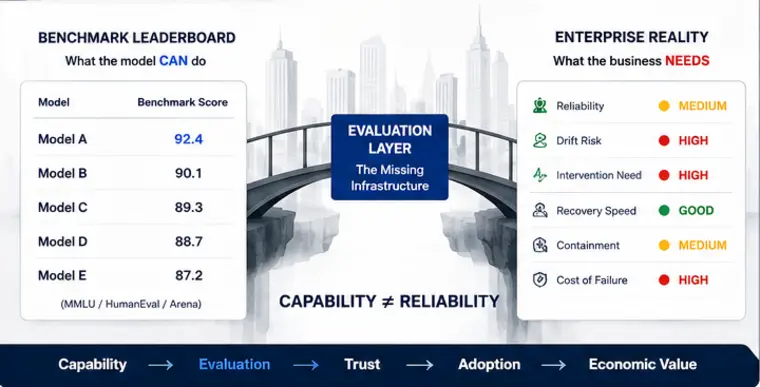
The traditional Product Requirement Document (PRD) was designed for a world where execution is mostly deterministic.
You define the inputs. You specify the expected behavior. Engineering builds to specification. QA validates outcomes. If the test suite passes, the feature ships.
That model still works.
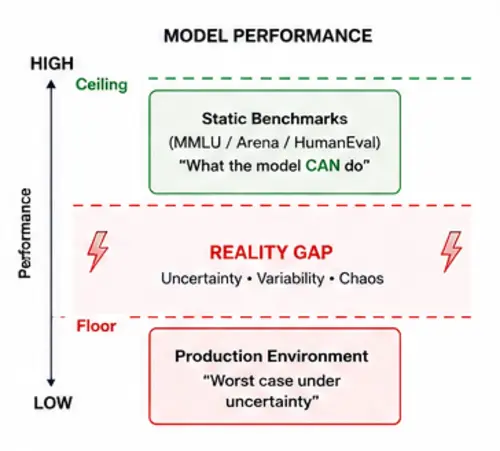
But AI systems introduce a different operational reality: behavior cannot be fully specified upfront.
A language model can pass the same scenario repeatedly and then fail when a production user introduces ambiguity, unusual formatting, conflicting instructions, or simply a data distribution your team never anticipated.
The problem is not that AI systems are unreliable. The problem is that product quality can no longer be proven through static requirements alone.
To build reliable AI products at scale, teams should not replace PRDs. They should extend them.
-
PRDs define intent.
-
Proof-Driven Requirements (PDRs) define evidence.
PDR introduces a second execution layer: a continuous evaluation and telemetry system that turns product quality into something measurable, repeatable, and operational.
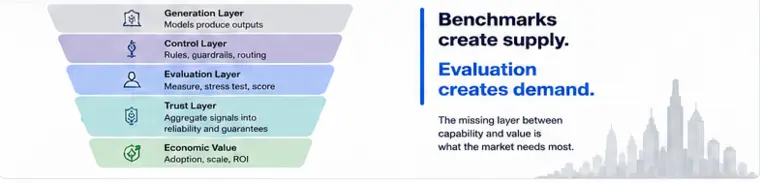
Why Does Shipping Velocity Conflict With Long-Term Operating Reliability?
Tuning prompts to satisfy individual user complaints without a PDR loop leads to "Prompt Whack-a-Mole": where fixing one edge case silently degrades another. Reconciling these loops requires treating evaluation as the primary execution layer.
This creates a fundamental split between two development paradigms, each optimizing for a distinct operational feedback loop:
| Development Loop | Core Optimization Target | Specification Modality | Quality Assurance Mechanism | Failure Exposure Vector |
|---|---|---|---|---|
| The PRD-Driven Loop | Rapid delivery velocity and initial demo launch. | Static text specifications frozen at the design phase. | Binary QA evaluating manual "happy path" scenarios. | High vulnerability to silent distribution drift and edge-case hallucinations. |
| The PDR-Driven Loop | Longitudinal operating reliability and bounded risk. | Dynamic programmatic assertions and versioned eval suites. | Automated regression suites testing historical production failures. | Minimal; regressions trigger automated release blocking in CI/CD pipelines. |
For AI products to scale, these loops must be unified. Engineering teams cannot choose shipping speed at the expense of control, nor can they lock down generative capabilities so heavily that the system degenerates into a brittle, hardcoded heuristic.
How Do Teams Translate Narrative PRD Intent Into Programmatic Assertions?
Subjective requirements fail at scale. Reliable AI products require translating product intent into deterministic, programmatically verifiable assertions.
Traditional product specifications describe desired behavior through subjective prose: “The agent should summarize customer transcripts accurately.” While superficially clear, narrative instructions are impossible to verify automatically at scale. Proof-Driven Requirements translate subjective intent into programmatic, machine-verifiable assertions across four concrete dimensions:
| Assertion Dimension | Verification Standard | Implementation Mechanism |
|---|---|---|
| Structural Invariants | Strict payload conformity ($100\%$ required). | Pydantic JSON schemas and typed API contracts halting malformed responses. |
| Grounding & Provenance | Zero unverified factual claims. | Deterministic token-span matching linking extracted entities to source document coordinates. |
| Safety & Policy Guardrails | Compliance bounds under adversarial stress. | Input/output content classifiers, prompt-injection filters, and refusal tripwires. |
| Operational Performance | Service-level latency and compute constraints. | Strict $p_{50}$ and $p_{99}$ latency thresholds and per-transaction token budgets. |
The objective is not achieving theoretical perfection across all inputs, but defining non-negotiable operational boundaries that can be continuously verified at machine speed.
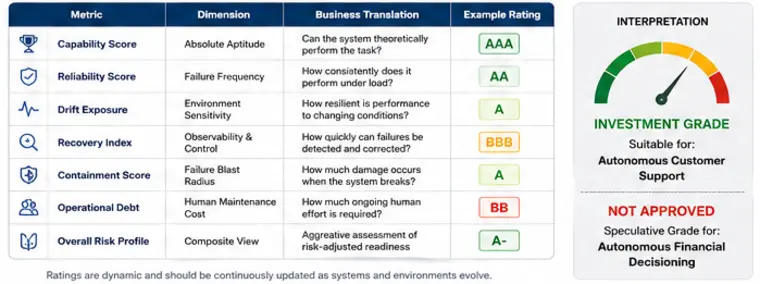
An assertion is not an engineering artifact. It is the PM's primary instrument of accountability. If you cannot define what the system must not do, you cannot govern what it will do.
How Does the Proof-Driven Requirements Lifecycle Function in Practice?
Launch is the beginning of requirement discovery, not the end. The PDR lifecycle establishes a continuous feedback loop from production telemetry back to evaluations.
Execution becomes a closed-loop learning system.
flowchart TD
    A[Define Assertions] --> B[Build Reliability Layer]
    B --> C[Run Evaluation Harness]
    C --> D[Deploy]
    D --> E[Observe Telemetry]
    E --> F[Capture Failures]
    F --> G[Update Evaluations]
    G --> A

    style A fill:#FBF7F0,stroke:#1B1917,stroke-width:2px
    style B fill:#FBF7F0,stroke:#1B1917,stroke-width:2px
    style C fill:#FBF7F0,stroke:#1B1917,stroke-width:2px
    style D fill:#FBF7F0,stroke:#1B1917,stroke-width:2px
    style E fill:#FBF7F0,stroke:#1B1917,stroke-width:2px
    style F fill:#FBF7F0,stroke:#1B1917,stroke-width:2px
    style G fill:#FBF7F0,stroke:#1B1917,stroke-width:2px
Deployment is not completion. Deployment begins evidence collection.
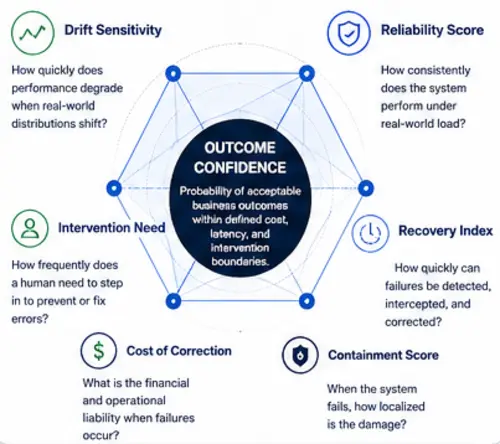
How Is the Deterministic Reliability Layer Built Around the Model?
A reliable AI system is a probabilistic core bounded by deterministic infrastructure. The reliability layer shields both the model from toxic inputs and the user from raw model failures.
Reliable AI systems are rarely just a model. They are deterministic infrastructure wrapped around probabilistic components. The reliability layer exists to contain and constrain uncertainty.
The AI System Architecture
The blueprint below illustrates how runtime transactions are intercepted at both ends, preventing raw user input from hitting the model directly, and shielding the user from raw, unvalidated model behavior.
flowchart TD
    A[USER INPUT] --> B[INPUT CONTROLS] --> C[PROMPT / CONTEXT] --> D[LLM CORE]
    D --> E[DYNAMIC RETRIES] --> F[OUTPUT CONTROLS] --> G[USER VIEW]

    style A fill:#FBF7F0,stroke:#1B1917,stroke-width:2px
    style B fill:#FBF7F0,stroke:#1B1917,stroke-width:2px
    style C fill:#FBF7F0,stroke:#1B1917,stroke-width:2px
    style D fill:#FBF7F0,stroke:#1B1917,stroke-width:2px
    style E fill:#FBF7F0,stroke:#1B1917,stroke-width:2px
    style F fill:#FBF7F0,stroke:#1B1917,stroke-width:2px
    style G fill:#FBF7F0,stroke:#1B1917,stroke-width:2px
Deterministic Reliability Controls
Runtime transactions are intercepted before hitting the foundation model and before returning responses to users:
| Reliability Layer | Control Mechanism | Failure Prevention Target |
|---|---|---|
| Input Controls | Payload normalization and prompt sanitization. | Neutralizes prompt injection, malformed syntax, and jailbreaks before inference. |
| Input Controls | Semantic intent classification and capability routing. | Routes tasks to narrow, specialized prompts rather than open-ended generalist queries. |
| Input Controls | Token quota limits and payload size budgets. | Prevents runaway inference costs and memory saturation attacks. |
| Input Controls | Retrieval context grounding validation. | Filters stale or conflicting RAG chunks before populating model context windows. |
| Output Controls | Pydantic schema contract validation. | Halts malformed JSON payloads at the runtime boundary with automated retry schemas. |
| Output Controls | Programmatic citation span verification. | Flags ungrounded factual assertions, preventing hallucinations from reaching users. |
| Output Controls | Automated self-correction retry loops. | Feeds validation failure diffs back to the model for bounded correction prior to escalation. |
| Output Controls | Deterministic circuit breakers & human escalation. | Reverts to safe rules-based fallbacks or human queues when confidence thresholds fail. |
Why Must Evaluation Serve as the Primary Execution Layer?
Synthetic test coverage and production observability are not alternatives; they are the twin pillars of a mature evaluation harness.
Traditional testing asks: Does the feature work? AI evaluation asks: Under what conditions does the system remain acceptable?
That requires an evaluation harness. But synthetic testing alone is insufficient. A mature evaluation stack compounds evidence across multiple layers:
flowchart TD
    A[Synthetic Edge Cases] --> B[Historical Production Cases]
    B --> C[Shadow Traffic]
    C --> D[Production Telemetry]

    style A fill:#FBF7F0,stroke:#1B1917,stroke-width:2px
    style B fill:#FBF7F0,stroke:#1B1917,stroke-width:2px
    style C fill:#FBF7F0,stroke:#1B1917,stroke-width:2px
    style D fill:#FBF7F0,stroke:#1B1917,stroke-width:2px
-
Synthetic evaluations provide coverage.
-
Production telemetry reveals reality.
Both are necessary. Shipping criteria evolve from "The code compiles" to "Behavior remains inside acceptable operating boundaries."
How Do Teams Prevent "Prompt Whack-a-Mole" Across the Jagged Frontier?
Without systematic regression tracking, tuning AI parameters becomes an endless game of prompt whack-a-mole. PDR turns every production failure into a permanent system constraint.
One of the hardest realities of AI execution is that improvements are rarely isolated. Fix one edge case, another degrades. Tune retrieval, formatting breaks. Switch models, costs shift.
Teams without evaluation discipline often enter an endless cycle engineers recognize immediately: Prompt Whack-a-Mole.
A system prompt changes to satisfy User A. Unexpectedly, User B’s workflow regresses. A retrieval adjustment improves relevance, but latency spikes elsewhere.
PDR introduces a different operating model:
-
Detect the anomaly via production alerts.
-
Capture the exact runtime payload conditions.
-
Convert the failure into a permanent regression test case in your evaluation suite.
-
Improve the system parameters.
-
Verify that previous system performance remains completely stable across the whole suite.
Every production incident becomes institutional knowledge. Over time, the evaluation harness becomes the living specification.
At agentic scale, this discipline becomes non-negotiable. A single regression that escapes containment does not affect one user flow, it propagates across tool ecosystems, downstream agents, and third-party integrations simultaneously. Without a PDR loop anchoring each agent's behavioral boundaries, a distributed system has no shared definition of acceptable. It has only compounding drift.
What Is the Cardinal Rule of AI Production Telemetry?
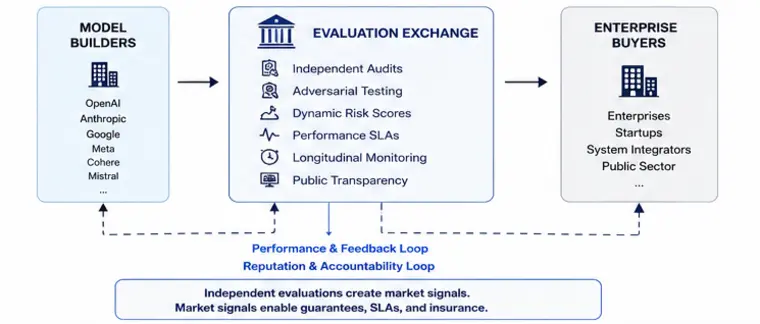
Requirements are not fully discovered before launch. They emerge through runtime evidence. Execution becomes a production learning loop:
$$\text{Telemetry} \longrightarrow \text{Discovery} \longrightarrow \text{Failure Extraction} \longrightarrow \text{Eval Library} \longrightarrow \text{System Improvement} \longrightarrow \text{Redeployment}$$
Your strongest product requirements are often discovered: not written.
Which Operational KPIs Prove AI Reliability in Cross-Functional Reviews?
AI execution changes what product teams optimize. The question is no longer: "How many features shipped?" The question becomes: "How reliably does the system produce acceptable outcomes?"
| Metric | What It Measures | Example Healthy Direction |
|---|---|---|
| Assertion Pass Rate | Reliability across evaluation suite | Improving toward high stability |
| Regression Escape Rate | Failures missed by pre-deployment testing | Near zero for critical paths |
| Silent Failure Rate | User-visible semantic/hallucination failures | Declining over time |
| Fallback Frequency | Dependence on deterministic recovery circuits | Balanced against UX and economics |
| Cost per Successful Outcome | Economic efficiency of autonomous runs | Improving unit economics |
| Time-to-Proof | Speed from issue discovery to validated improvement | Shortening feedback loops |
The PM's PDR Sprint Review Checklist: 5 Gate Checks Before Releasing Prompts or Models
Product managers can run this practical release gate during sprint planning or release Go/No-Go reviews:
| Review Gate | Standup / PRD Review Question | Go / No-Go Threshold | Required Deliverable for Sign-Off |
|---|---|---|---|
| 1. Structural Invariants | Does the inference endpoint enforce strict Pydantic schemas on all outputs? | Strict Gate: $100\%$ schema conformity; zero malformed JSON payloads allowed to escape to clients. | Validated Pydantic schema file and automated retry test fixture. |
| 2. Citation Provenance | Are all extracted claims and facts bound to character-level source coordinates? | Strict Gate: $0\%$ ungrounded hallucination tolerance on factual extraction fields. | Deterministic token-span matching test receipt across golden test fixtures. |
| 3. Regression Escape | Does the proposed prompt/model change break any historical production incident cases? | Strict Gate: $0$ regressions on the curated regression library ($100\%$ pass on historical failure fixtures). | Green CI/CD evaluation run comparing proposed prompt against baseline checkpoint. |
| 4. Fallback Circuit Breakers | What happens when model latency spikes past P99 or output confidence drops? | Operational Gate: Programmatic fallback to deterministic rules or human escalation queue within 500ms. | Documented fallback handler logic and simulated failure test log. |
| 5. Telemetry Feedback Loop | Will user edits, negative feedback, and operator overrides automatically feed the eval corpus? | Process Gate: Production telemetry pipeline must harvest and scrub edge cases into candidate test cases weekly. | Telemetry hook specification linked to centralized eval repository. |
The exact numbers will vary by domain. The operating model does not. These metrics transform AI delivery from intuition into evidence.
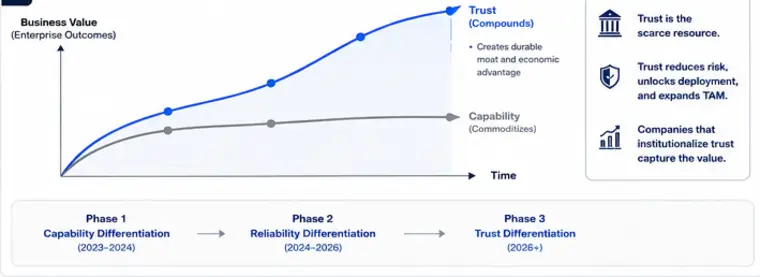
PRDs still matter. But in AI systems, requirements alone are not enough. Product execution becomes the practice of continuously generating proof that the system remains trustworthy as reality changes.
The Adversarial Stress-Test: What Could Break Proof-Driven Requirements?
1. What is the strongest argument against this approach?
Mandating programmatic assertions, schema validation, and continuous evaluation harnesses adds substantial development friction to early-stage product exploration. Critics argue that forcing product managers to specify formal assertions before achieving product-market fit paralyzes prototyping speed and causes teams to prematurely optimize test suites for features customers may not want.
The Practical Resolution: Tier assertion rigor by lifecycle stage. During Phase 0 discovery, enforce only two non-negotiable structural constraints: data privacy token isolation and an immutable trace log. As customer demand and transaction volume validate the capability, introduce formal golden eval datasets and release-blocking assertion suites before granting operational authority over production workflows.
2. Under what circumstances would this fail?
This approach fails when evaluation harnesses become static regression tests that decouple from real-world user interactions. If teams only test against historic payloads, prompt engineers will subtly overfit system prompts to the benchmark corpus, maintaining a 99% assertion pass rate while production users trigger novel edge-case failures across unmonitored distributions.
The Practical Resolution: Automate the telemetry-to-eval flywheel. Instrument production logs to harvest anomalous sessions, low-confidence completions, and explicit human corrections automatically. Sanitize sensitive tenant data and continuously convert production anomalies into active evaluation fixtures in the nightly regression harness, ensuring the test suite evolves alongside user behavior.
3. What would a skeptical customer, client, or colleague object to?
An engineering manager will object that translating subjective qualitative expectations (e.g., tone, nuance, brand alignment) into deterministic code assertions is fundamentally impossible, arguing that language models require subjective human judgment rather than rigid mathematical assertions.
The Practical Resolution: Acknowledge the distinction between structural and qualitative properties. Enforce 100% deterministic assertions on mechanical properties (schema validity, arithmetic totals, citation spans, API parameters), while governing subjective quality through calibrated LLM-as-a-judge ensembles benchmarked against double-blind human expert scoring.
4. Which alternative deserves more consideration?
Rather than maintaining extensive internal evaluation harnesses and assertion layers, an enterprise could outsource capability verification to commercial prompt-security firewalls and hosted LLM evaluation platforms that provide off-the-shelf guardrails.
The Practical Resolution: Hosted firewalls handle generalized threats (jailbreaks, standard PII redaction) effectively, but they lack context on proprietary domain invariants, enterprise accounting rules, and specialized regulatory obligations. Use commercial gateway proxies for commodity edge filtering, but own the domain assertion suites and evaluation corpora internally to preserve proprietary enterprise defensibility.
5. What am I assuming that may not be true?
This framework assumes that product managers possess the technical and statistical capability to define executable code assertions and interpret statistical evaluation metrics alongside traditional user research.
The Practical Resolution: Build internal tooling that provides declarative, low-code assertion builders. Allow product managers to define input/output rules, acceptable boundary thresholds, and failure tolerances in intuitive YAML configurations or visual interfaces, while platform engineering compiles those rules into automated Pydantic contracts and CI/CD test fixtures.
One-Line Synthesis
AI product management requires translating narrative feature intent into machine-verifiable programmatic assertions that continuously prove operational reliability under real-world distribution shift.
Frequently Asked Questions
What is a Proof-Driven Requirement (PDR)?
A Proof-Driven Requirement (PDR) is an extension of the traditional PRD that translates subjective product intent into programmatic assertions, continuous evaluation harnesses, and runtime guardrails to manage the probabilistic nature of AI.
Why is a traditional PRD insufficient for AI systems?
A traditional PRD assumes deterministic code paths. AI systems are probabilistic and non-deterministic; they can pass static QA tests but fail when encountering real-world user ambiguity or input distribution shifts. PDR provides the continuous evidence layer needed to keep AI safe.
Subscribe to the Architecture of Proof Dispatch
Rigorous, decision-forcing systems engineering and AI governance monographs for technical leaders. Delivered periodically, zero spam.