Writing Proof-Oriented Product Requirements in a Multi-Agent World
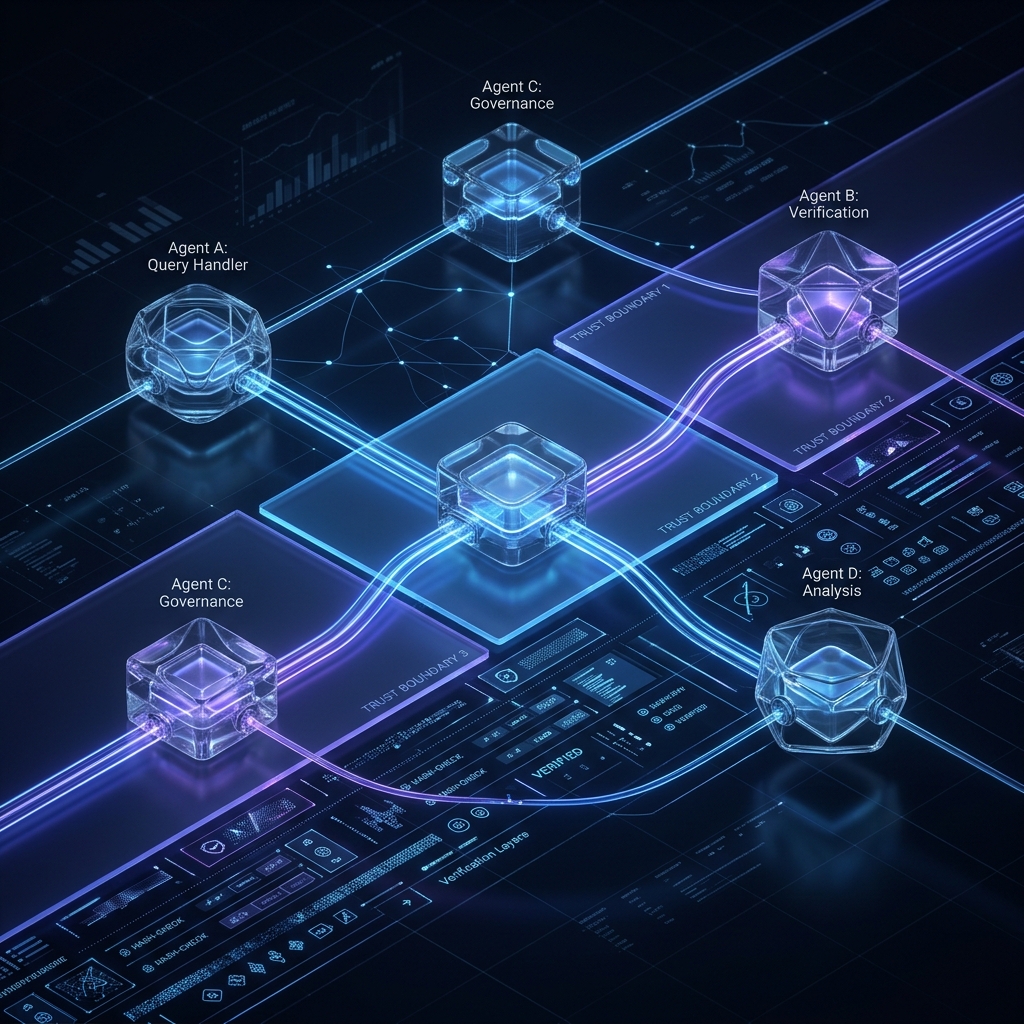
What Fundamental Shift Must Product Managers Make for Multi-Agent Systems?
Traditional PRDs were designed for deterministic software. Agentic systems break that assumption completely.
In traditional software development, product requirements were written around a relatively stable mental model. A PM defined the inputs, expected outputs, acceptance criteria, and edge cases. Engineering implemented the logic, QA validated the behavior, and if the tests passed, the requirement was considered complete.
That model worked because the system itself was fundamentally deterministic. The same input produced the same output. Workflows were linear. Execution paths were predictable. Requirements could describe behavior with a high degree of precision.
That assumption no longer holds in agentic AI systems.
In a multi-agent world, a PM is no longer specifying a fixed sequence of behaviors. Instead, the PM is defining goals, constraints, delegation boundaries, verification rules, escalation logic, and acceptable uncertainty. The requirement document stops being only a feature specification and starts becoming something much deeper: a proof system.
The PM’s role shifts from asking:
“What should the software do?”
to asking:
“How does the system prove the outcome is trustworthy?”
That is not a small evolution in product management. It is a fundamentally different discipline.
Why Do Traditional PRDs Fail in Multi-Agent Workflows?
Traditional PRDs assume workflows are linear, execution paths are predictable, components behave consistently, and outputs are reproducible. Multi-agent systems violate all of those assumptions simultaneously.
An agent may choose different tools, retrieve different context, delegate tasks dynamically, synthesize information in different ways, or recover from failure using alternative reasoning paths. Two executions of the same task may generate different intermediate steps and different reasoning traces while still arriving at acceptable outcomes.
The workflow itself becomes adaptive.
That changes the nature of product definition entirely. Behavior is no longer fully specifiable. Correctness becomes probabilistic. A requirement document can no longer focus only on describing features because the central problem is no longer execution alone. The real problem becomes verification.
A useful way to think about this is through a simple example. Imagine a multi-agent financial research workflow. One agent retrieves market data, another summarizes company performance, another validates regulatory disclosures, and a final orchestration layer synthesizes recommendations. Each layer introduces uncertainty. A retrieval issue in the first step may quietly distort the reasoning quality of every downstream agent.
The challenge is no longer simply whether the agents complete the workflow. The challenge is proving that the reasoning chain remained trustworthy end to end.
That is the real shift.
Traditional PRDs describe features. Agentic systems require verification.
How Does Proof-Oriented Product Design Structure Agentic Reasoning?
In deterministic software, the architecture often looked like this:
Requirements → Logic → Output
In agentic systems, the architecture changes fundamentally:
Goal → Agent reasoning → Verification → Controlled outcome
Verification becomes a first-class product layer.
Without it, agents hallucinate silently, workflows drift, delegation chains become opaque, and failures become extremely difficult to localize. This is one of the main reasons many early agentic products feel impressive in demos but unstable in production. They optimize execution before proof.
That distinction matters more than most teams realize.
A proof-oriented system is not a system that never fails. That is unrealistic in probabilistic environments. A proof-oriented system is one that can explain, validate, contain, and recover from failure when it occurs.
The requirement document therefore evolves from describing behavior to defining how trust is operationalized.
What Belongs in a Proof-Oriented Multi-Agent PRD?
A modern AI PRD increasingly needs to define much more than feature behavior.
It starts with goal definition. Traditional requirements often describe tasks mechanically, such as “Generate financial report.” In agentic systems, that is insufficient. A stronger requirement might say:
“Generate a source-grounded financial risk summary with citation-backed claims, confidence scoring, and escalation for unsupported assertions.”
That single sentence changes the nature of the system. The goal no longer describes only the output. It embeds evidence expectations, verification requirements, and operational safeguards directly into the product definition.
The PRD must also define delegation boundaries. Multi-agent systems require explicit autonomy limits because agents naturally expand into areas they were never originally intended to control. A research agent may summarize findings. A compliance agent may validate policy references. A recommendation engine may suggest actions. Final approval, however, may still remain human.
These distinctions are not implementation details. They are product decisions that define operational trust.
Verification requirements become even more critical. Every meaningful output increasingly needs validation logic, confidence thresholds, proof artifacts, and cross-check mechanisms. That may include citation enforcement, SQL cross-validation, source grounding, reasoning trace storage, structured outputs, or external fact verification.
The important shift is that evidence itself becomes part of the product contract.
Without verification requirements, agentic systems eventually degrade into sophisticated guess generators.
Failure containment becomes equally important. Traditional PRDs often treat failure as an exception. Agentic systems require explicit failure design because failure is guaranteed, not hypothetical.
The product requirement therefore needs to specify fallback behavior, retry limits, escalation logic, refusal conditions, uncertainty thresholds, and safe degradation paths. A single sentence such as:
“If confidence drops below threshold, route to human review instead of autonomous execution.”
may ultimately matter more than entire pages of feature specification.
This represents one of the biggest mindset shifts in AI product management. The goal is no longer preventing all failure. The goal is preventing uncontrolled failure.
The PM's Multi-Agent PRD Review Matrix: 5 Architecture Gates for Sprint Reviews
Before approving any PRD that coordinates multiple autonomous agents or LLM sub-tasks, the lead PM should enforce this 5-gate checklist across Engineering and Risk:
| Architecture Gate | Standup / PRD Review Question | Red-Flag Implementation Signal | Required Deliverable for Sign-Off |
|---|---|---|---|
| 1. Delegation Boundaries | Does each sub-agent have a strictly bounded authority ceiling and discrete tool access? | An agent provisioned with write permissions across multiple unassociated systems without isolation. | Explicit authority matrix defining permissible actions and blocked mutations per agent. |
| 2. Inter-Agent Handoff Schemas | Do agents communicate via strictly typed Pydantic contracts or unstructured natural language? | Upstream agents passing conversational text blobs to downstream agents without schema validation. | Typed JSON/Pydantic schema definitions for all inter-agent handoff payloads. |
| 3. Cascade Circuit Breakers | What happens when an intermediate agent fails or returns confidence below threshold? | System allows downstream agents to hallucinate corrective context or propagate errors forward. | Deterministic circuit breaker specification detailing fallback routes and execution aborts. |
| 4. Traceability & Observability | Can an on-call engineer reconstruct the exact DAG of agent tool calls and prompt states? | Inter-agent calls logged as unstructured stdout strings or discarded after session termination. | Causal trace logging schema capturing parent-child span IDs and tool-call parameter hashes. |
| 5. Escalation & Intervention | Under what precise conditions must the multi-agent swarm halt and page a human operator? | System attempts autonomous self-correction loops indefinitely without human escalation boundaries. | Documented Escalation Test protocol (action attempted, failure reason, decision required). |
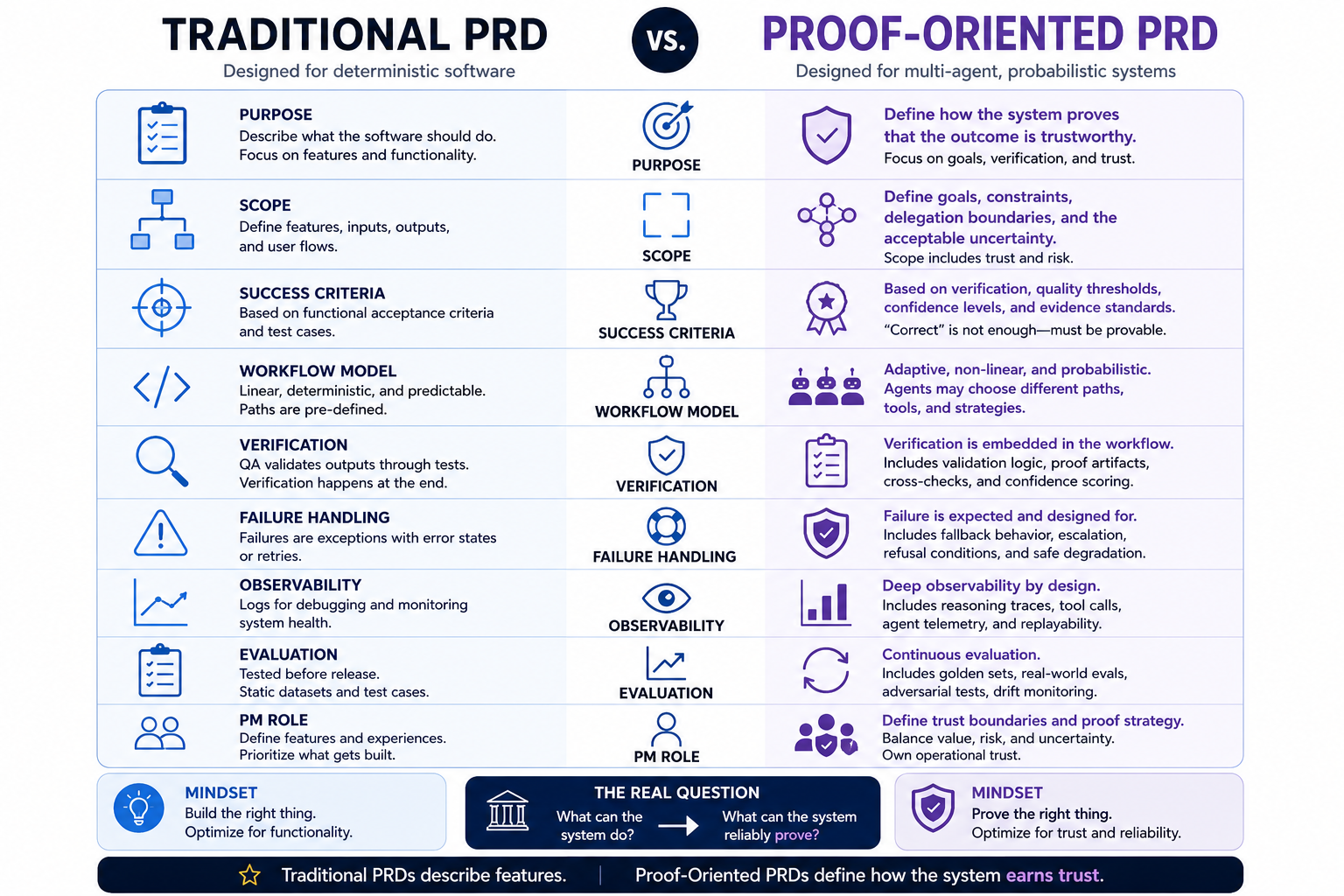
How Does a Traditional PRD Differ From a Proof-Oriented PRD?
The following comparison highlights the fundamental shift in how product requirements must be structured for agentic systems:
| Requirement Dimension | Traditional Deterministic PRD | Proof-Oriented Agentic PRD |
|---|---|---|
| Primary Focus | Feature specification and user workflows. | Behavioral boundaries, autonomy limits, and verification rules. |
| Acceptance Criteria | Binary pass/fail against predetermined scenarios. | Statistical confidence bands, assertion pass rates, and eval suites. |
| Execution Path | Deterministic, sequential, hard-coded logic. | Dynamic tool selection, adaptive delegation, and multi-agent synthesis. |
| Failure Handling | Edge-case exceptions and error modal dialogues. | Bounded degradation, deterministic fallback circuits, and human review gates. |
| Evidence Contract | Implicit: code execution assumes valid state. | Explicit: cryptographic coordinate grounding, assertion receipts, and audit traces. |
| Lifecycle Posture | Feature complete upon passing pre-release QA. | Continuously verified via production telemetry and dynamic eval sets. |
Why Is Observability an Uncompromising Product Requirement?
One of the most underappreciated shifts in agentic systems is the importance of observability.
If teams cannot inspect agent behavior, they cannot improve it.
Multi-agent systems often fail diffusely rather than visibly. One agent may retrieve weak context. Another agent may summarize incorrectly. A third agent may execute against flawed assumptions. Externally, the workflow may still appear coherent while internally compounding error across layers.
Without strong observability, teams end up fixing symptoms instead of causes.
That is why modern AI PRDs increasingly need to define logging expectations, reasoning trace visibility, tool-call telemetry, replayability, auditability, and evaluation hooks as part of the product definition itself.
Debugging an agentic workflow without observability is like debugging a distributed system without logs.
Why Must Continuous Evaluation Precede Multi-Agent Deployment?
Traditional testing models assume relatively stable outputs. Agentic systems invalidate that assumption because models drift, retrieval quality changes, prompts evolve, workflows mutate, and user behavior shifts over time.
This means evaluation can no longer be treated as a final QA stage.
A proof-oriented PRD increasingly needs to define continuous evaluation strategies from the beginning. That includes golden datasets, adversarial testing, real-world evaluation, drift monitoring, production telemetry, and longitudinal accuracy tracking.
The system is never truly finished. It must continuously prove reliability over time.
That is a fundamentally different operational model from traditional software delivery.
How Does Multi-Agent Product Management Shift Into Systems Architecture?
This changes the role of the PM significantly.
PMs are no longer only defining features, workflows, prioritization, and UX behavior. Increasingly, they are defining acceptable uncertainty, operational trust boundaries, evidence requirements, escalation policies, and risk allocation.
That starts looking much closer to systems design, governance engineering, reliability architecture, and operational control theory.
This is why AI product management increasingly overlaps with architecture decisions.
What appears to be an architecture problem is often actually a product problem in disguise.
Should the model be allowed to make this decision autonomously? Should outputs require verification before execution? Should uncertain cases escalate to humans? Should the workflow fail open or fail closed?
Those are not purely engineering questions anymore. They define trust, liability, operational risk, and customer confidence. In other words, they define the product itself.
You are no longer only designing experiences.
You are designing how the system earns trust.
How Do Multi-Agent Systems Create Hidden Failure Cascades?
Single-agent systems often fail visibly.
Multi-agent systems fail diffusely.
One agent retrieves weak context. Another synthesizes incomplete reasoning. A third acts on the flawed synthesis. The orchestration layer still produces an answer that sounds coherent and intelligent.
This creates a dangerous illusion. The system sounds confident. The reasoning chain appears sophisticated. The workflow looks operationally successful. But no layer has actually proven correctness.
The more advanced the orchestration becomes, the harder hidden failures become to localize.
That is one of the biggest emerging operational risks in agentic AI systems.
Proof-oriented requirements exist precisely to stop this type of failure cascade. They force teams to define where evidence must exist, where validation occurs, where uncertainty is tolerated, and where escalation becomes mandatory.
Without that structure, multi-agent systems become increasingly difficult to trust at scale.
What Defines the Emerging Multi-Agent Product Management Skill Set?
The next generation of strong AI PMs will not simply be the people who write the best prompts.
They will be the people who can define trust boundaries, design verification systems, operationalize evaluation, structure fallback logic, allocate uncertainty intelligently, and build systems that remain reliable under probabilistic behavior.
The competitive advantage shifts from:
“Can the agent do the task?”
to:
“Can the system prove the task was done correctly?”
That is a much harder problem.
And a far more defensible one.
As models become increasingly commoditized, execution capability alone becomes less differentiated. Trust infrastructure does not.
The Adversarial Stress-Test: What Could Break Multi-Agent Proof Requirements?
1. What is the strongest argument against this approach?
Requiring proof-oriented specifications, typed inter-agent schemas, and deterministic verification gates adds heavy cognitive and engineering overhead. Skeptics argue that autonomous multi-agent systems should self-coordinate through natural language negotiation, and that imposing formal verification contracts reduces flexible emergent reasoning to brittle microservice orchestration.
The Practical Resolution: Natural language coordination without typed schemas creates unconstrained error compounding across agent swarms. When sub-agents communicate via unstructured text, ambiguous outputs from an upstream agent degrade downstream reasoning without triggering exceptions. Enforcing typed JSON schemas and assertion checks at agent handoff boundaries preserves emergent reasoning within each agent while eliminating diffuse semantic drift between them.
2. Under what circumstances would this fail?
This architecture fails when an upstream context retrieval agent passes subtly corrupted or out-of-date information that satisfies schema constraints. If an agent receives syntactically valid but factually distorted context, it will generate logically coherent downstream actions that execute without triggering structural assertions.
The Practical Resolution: Implement semantic provenance assertions alongside structural schema checks. Require intermediate agents to attach source-span hashes or vector similarity distance scores to all extracted factual premises. If source grounding confidence falls below calibrated thresholds, halt downstream execution and route the raw context to a verification agent or human operator.
3. What would a skeptical customer, client, or colleague object to?
A product lead or client will object that inserting verification layers and proof requirements between sub-agents increases latency and compute costs, turning what should be a sub-second response into a multi-step pipeline that costs ten times more in token spend.
The Practical Resolution: Measure latency and token economics against the true cost of failure recovery. Unverified multi-agent execution generates compounding hallucinations that require expensive human remediation. Furthermore, intermediate verification filters out hallucinated execution branches early, preventing downstream agents from wasting tokens on invalid reasoning trajectories.
4. Which alternative deserves more consideration?
Rather than embedding formal proof requirements into the PRD, an organization could deploy an autonomous consensus protocol: running three identical agent ensembles in parallel and executing actions only when a majority reaches unanimous agreement on the final output.
The Practical Resolution: Majority voting mitigates random variance, but it fails to protect against systematic hallucinations where all models share training biases or flawed retrieval context. Furthermore, running redundant swarms triples inference compute without creating an immutable audit trail. Explicit proof-oriented requirements enforce deterministic verification rules that catch systemic bias at a fraction of the compute cost.
5. What am I assuming that may not be true?
This framework assumes that product managers can anticipate and specify all critical verification boundaries and failure conditions before multi-agent swarms interact with real-world environments.
The Practical Resolution: Treat proof-oriented requirements as living behavioral envelopes. Capture all multi-agent interaction traces, tool calls, and state transitions into an immutable observability ledger. When an unmapped emergent behavior occurs in production, harvest the execution trace and compile it into a new regression fixture and assertion contract within 24 hours.
One-Line Synthesis
In agentic architectures, product requirements must evolve from narrative feature descriptions into machine-enforceable proof specifications that govern delegation, verification, and failure containment.
Subscribe to the Architecture of Proof Dispatch
Rigorous, decision-forcing systems engineering and AI governance monographs for technical leaders. Delivered periodically, zero spam.