Why AI Product Sense Requires Systems Judgment
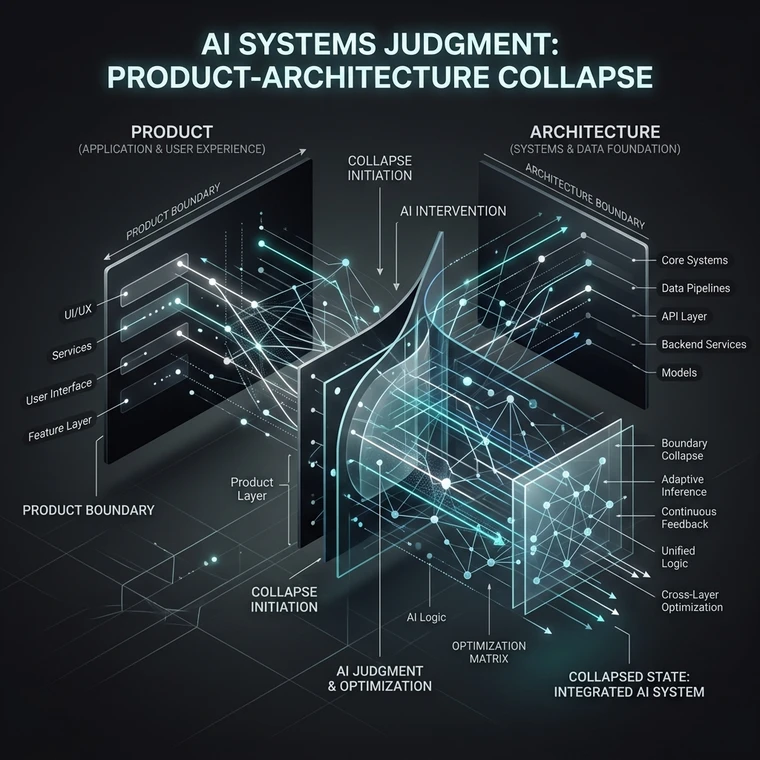
Why AI Product Sense Requires Systems Judgment
Why AI Is Collapsing the Boundary Between Product and Architecture
Series Notice: Part II of the AI Product Leadership Series
← Part I: The New Product Sense: Knowing When AI Should Stop: Designing Asymmetric Escalation Boundaries and the Friction Vector.
Part II (This Monograph): Why AI Product Sense Requires Systems Judgment: Navigating the Collapse Between Product Strategy and System Architecture.
Why Is the Boundary Between Product Strategy and System Architecture Collapsing?
One of the most common pieces of product advice is becoming increasingly incomplete: PMs should focus on the "what" and leave the "how" to engineering.
That separation worked remarkably well during the deterministic software era. Product teams defined user problems, workflows, and outcomes. Engineering teams translated those requirements into technical implementations. While architectural decisions certainly mattered, they rarely changed the fundamental behavior of the product itself.
AI changes that relationship entirely.
In AI-native systems, implementation choices directly shape user experience. A retrieval strategy affects trust. A routing policy affects latency. A memory architecture affects continuity. A guardrail design affects liability. The architecture is no longer hidden beneath the product.
Increasingly, the architecture is the product.
This does not mean Product Managers need to become system architects or machine learning engineers. It means they must develop a new competency: systems judgment.
| Paradigm | Strategic Sequence | Implementation Coupling | Primary PM Focus |
|---|---|---|---|
| Traditional Software | User Need $\longrightarrow$ Product Feature $\longrightarrow$ Invisible Backend | Loosely Coupled (Implementation is transparent) | Functional requirements, UX flow, and delivery speed |
| AI-Native Systems | User Need $\longrightarrow$ Architectural Blueprint $\longrightarrow$ Emergent UX | Tightly Coupled (Architecture is the product) | Trust boundaries, error containment, and unit economics |
Traditional product sense asks what should we build? AI product sense asks: What kind of system can reliably deliver the promised outcome under uncertainty, cost constraints, and trust requirements? This shift represents one of the most critical evolutions of the PM role in a generation.
Why Did the Separation of Product and Architecture Work in Deterministic SaaS?
For most of software history, product management and system architecture operated on parallel tracks. The boundaries were clear. A PM could define user workflows, requirements, success metrics, and business objectives without needing deep expertise in database architecture, caching strategies, distributed systems, or service orchestration.
Engineering decisions certainly affected performance and scalability, but they rarely altered the fundamental nature of the user experience. An e-commerce checkout remained an e-commerce checkout whether the backend ran on Oracle, MySQL, or PostgreSQL. The implementation mattered, but it was largely invisible.
How Does AI Architecture Directly Dictate the User Interface?
AI systems introduce a different reality. Consider a customer support assistant. At first glance, the product requirement appears straightforward: Answer customer questions accurately.
But that outcome can emerge from radically different architectures, and each technical decision alters the product itself:
| Architectural Choice | Technical Implementation | Direct User Experience Impact |
|---|---|---|
| Parametric Memory Only | Relying entirely on base model training data. | Faster responses, but high risk of fluent hallucinations. |
| Grounded Retrieval (RAG) | Pulling from a live vector database. | More factual answers accompanied by traceable source citations. |
| Stateless Sessions | Processing each prompt independently. | Fragmented, repetitive conversations for complex user issues. |
| Persistent Memory | Storing multi-turn historical context. | High continuity, but requires complex data governance. |
| Single-Model Routing | Funneling all queries to a frontier model. | Consistent deep reasoning, but high cost and higher latency. |
| Dynamic Model Routing | Tiering queries between small (SLM) and large models. | Optimized economics and speed, but variable response depth. |
| Action Execution | Granting tool-calling and API access to agents. | High-value automation mixed with critical operational risk. |
| Recommendation Mode | Constraining outputs to drafts and text options. | Lower automated throughput, but preserves strict human oversight. |
The architecture is no longer merely supporting the experience. It is actively shaping it. The infrastructure has become visible through the interface.
Where Do Product Strategy and Architecture Decisions Intersect?
This is the strategic shift many organizations are still adjusting to. In deterministic software, product and engineering decisions were loosely coupled. In AI systems, they are tightly coupled.
A PM deciding whether to use retrieval, vector memory, autonomous agents, integration tools, human review loops, or dynamic model routing is no longer making a purely technical decision. They are making core decisions about trust, liability, economics, user experience, and operational scalability.
The distinction between product strategy and architecture strategy begins to blur: not because PMs suddenly own the technical implementation, but because architectural choices directly determine business outcomes.
Why Does Systems Judgment Matter for Probabilistic AI Products?
Traditional product sense has always required balancing customer value, business viability, usability, and operational feasibility. AI introduces a non-deterministic dimension: probabilistic behavior.
Unlike traditional software, AI systems do not simply execute static logic. They generate probabilities. This means product leaders must reason about how systems behave when uncertainty accumulates across an execution chain.
Questions that once belonged exclusively to technical discussions increasingly become product questions:
-
How much confidence is sufficient to execute an automated action?
-
At what point must the system stop and trigger an escalation protocol?
-
What degree of hallucination risk is acceptable for this specific revenue line?
-
How much latency will a user tolerate in exchange for a highly reasoned answer?
-
What level of deterministic auditability is required by our buyers?
These are product judgments expressed through architecture.
How Does Systems Judgment Reframe Resource Allocation Around Tokens and Trust?
One of the most important changes in AI product management is the nature of trade-offs. Traditional product trade-offs often looked like build vs. buy, Feature A vs. Feature B, or growth vs. monetization.
AI introduces an entirely new set of allocation problems. Product leaders must now allocate:
Every architectural decision becomes an economic and experience trade-off. Choosing a larger model may improve response quality, but it may also double cost of goods sold (COGS) and exceed your latency budget. Adding human review loops can guarantee 99.9% accuracy, but increases operational expense and response latency.
The goal is optimizing outcomes across a system of competing operational constraints.
What Are the Hidden Non-Linear Costs of Unbounded Autonomy?
One of the most common mistakes in AI product development is assuming that more autonomy automatically creates more value. The reality is often the opposite. As systems become increasingly autonomous, they accumulate non-linear hidden costs:
$$\text{State Drift} \quad\longrightarrow\quad \text{Context Degradation} \quad\longrightarrow\quad \text{Debugging Complexity} \quad\longrightarrow\quad \text{Escalation Overhead}$$
| System Archetype | Structural Complexity | Primary Failure Mode | Net Enterprise Value Profile |
|---|---|---|---|
| Single Prompt Call | Low (Zero retrieval context) | Fluent hallucinations; ungrounded drift | Brittle toy; zero enterprise defensibility |
| Bounded Retrieval (RAG) | Moderate (Vector lookup + guardrails) | Retrieval misses; local semantic drift | Peak Enterprise Utility & Predictable ROI |
| Unbounded Autonomous Agents | Extreme (Recursive loops & tool calls) | State decay, chaos loops, high TTC | Exponential oversight costs; negative ROI |
Beyond a certain point, additional autonomy creates more operational burden and risk than customer value. This is why many successful AI products succeed through constraint: deliberately limiting autonomy, narrowing the problem space, introducing deterministic perimeters, and reducing the number of nodes where uncertainty can accumulate.
The highest-leverage architecture is often the one you choose never to build.
How Do Organizations Progress Across the Four Levels of AI Product Maturity?
Rather than deploying isolated features, leading organizations progress through four distinct tiers of systems engineering maturity:
| Maturity Level | Systems Architecture | Product & Economic Reality |
|---|---|---|
| Level 1: The Prompt Product | Single base foundation model, zero retrieval context, no persistent memory, minimal operational logging. | Fragile, highly variable UX; directly vulnerable to unannounced model alignment shifts and vendor pricing changes. |
| Level 2: The Grounded Product | Vector embeddings, retrieval pipelines (RAG), basic evaluation harnesses, and context ingestion tools. | Significantly enhanced domain relevance; reduces obvious hallucinations but remains vulnerable to retrieval noise. |
| Level 3: The Operational Product | Input/output guardrails, human-in-the-loop interfaces, append-only execution ledgers, and automated escalation paths. | High operational defensibility; errors are contained within explicit blast perimeters, enabling deployment in regulated workflows. |
| Level 4: The System Product | Dynamic model routing middleware, real-time cost throttling, automated context pruning, and multi-tier governance. | Sustainable gross margins at scale; autonomous workflows operate under hard economic, legal, and latency bounds. |
The Reality Check: Predictable enterprise value concentrates at Levels 3 and 4: not because the underlying frontier models suddenly become smarter, but because the surrounding system becomes dramatically more reliable.
The Audit Note: Systems judgment must be verified at the unit-economics layer by mapping token spend per user session against user-validated outcomes in real-time billing metrics.
What Are the Eight Vectors of the AI PM Operating Stack?
To navigate the collapse between product strategy and architecture, AI product leaders must align eight foundational systems vectors:
| Operating Vector | Systems Domain | Product Management Mandate |
|---|---|---|
| 1. User Reality | Customer Workflows | Identify exact cognitive friction points and manual intervention tasks in the human experience. |
| 2. Model Capability | Inference Runtime | Track shifting baselines across latency, context window degradation, and token pricing curves. |
| 3. System Topology | Orchestration Architecture | Design the interaction graph linking retrieval stores, state machines, and specialized sub-agents. |
| 4. Risk and Liability | Governance & Compliance | Enforce statutory and contractual constraints governing automated decisions and data egress. |
| 5. Unit Economics | Financial P&L | Measure cost-per-interaction (CPI) directly against revenue-per-interaction (RPI) and customer LTV. |
| 6. Guardrails | Ingress/Egress Control | Deploy sub-millisecond deterministic filters that intercept and sanitize payloads before and after neural execution. |
| 7. Auditability | Forensic Lineage | Capture immutable decision state vectors to prove precisely why an autonomous system executed a state mutation. |
| 8. Organizational Adoption | Human-Agent Calibration | Calibrate operator trust to prevent both automation bias (blind trust) and algorithmic aversion (total rejection). |
Weak product decisions emerge when any single layer is ignored. Strong product decisions emerge when all layers remain aligned. The challenge is understanding how a mutation in one layer propagates through the entire stack. That is systems judgment.
Why Must Product Strategy Become Architectural Strategy?
AI does not replace traditional product sense. Demanding a deep understanding of users, markets, incentives, workflows, and business models remains fundamental.
What changes is where product decisions live. For decades, product managers could reasonably treat architecture as an implementation detail handled after the fact. AI turns architecture into your core product strategy.
The retrieval system determines trust. The memory system determines continuity. The routing layer determines economics. The guardrails determine liability. The escalation path determines accountability.
Users experience the architecture itself through the interface. That is why AI product sense requires systems judgment.
The PM's Systems Architecture Trade-off Matrix: 5 Gates for Technical PRD Reviews
In AI products, technical architectural choices directly shape user experience, legal liability, and gross margins. When reviewing technical PRDs, architecture proposals, or sprint designs with engineering leads, product managers should use this trade-off matrix to evaluate how systems choices impact business outcomes.
| Systems Dimension | The Technical Proposal | The Hidden Product Failure Mode | Systems Judgment Counter-Standard | Hard Production Release Boundary |
|---|---|---|---|---|
| 1. Memory & State | Unbounded multi-turn conversational context | State drift, context contamination, and ballooning token COGS | Bounded ephemeral memory with deterministic state summarization into Pydantic schemas | Maximum session context capped at target token ceiling ($< 8\text{k}$ tokens); zero state drift |
| 2. Retrieval Strategy | Pure dense vector semantic similarity lookup | Hallucinated entity linkages on proper nouns, ticker symbols, and contract IDs | Hybrid retrieval: lexical BM25 + dense embeddings + reranker with Bates coordinate pinning | All factual claims bound to verifiable document spans with NLI entailment score $> 0.90$ |
| 3. Model Routing | Route 100% of queries to top-tier frontier reasoning model | P99 latency $> 12\text{s}$ and negative unit economics ($> \$0.15/\text{query}$) | Tiered dynamic routing: deterministic rules $\to$ small language models (SLM) $\to$ frontier model | Average cost per query capped at $\le 10\%$ of gross transactional value; P95 latency $< 1.8\text{s}$ |
| 4. Action Execution | Open-ended agentic function calling across external APIs | Uncontrolled external API mutations and irrecoverable state changes | Bounded state graphs: model proposes tool payload; deterministic policy engine gates execution | Zero irreversible database or payment writes without policy check or human confirmation |
| 5. Guardrail Ingress/Egress | Post-generation regex filters or LLM-as-a-judge evaluators | Severe latency overhead and leaky prompt injection vulnerabilities | Sub-millisecond deterministic AST parsers, schema validation, and sandboxed input sanitization | Latency overhead of guardrail pipeline $< 45\text{ms}$; zero unparsed JSON payloads rendered to UI |
Series Navigation
- ← Revisit Part I: The New Product Sense: Knowing When AI Should Stop
Designing the Three-Zone State Machine, Asymmetric Escalation Matrix, and the Friction Vector.
What Survives an Adversarial Stress-Test of AI Systems Judgment?
To stress-test the thesis that product management must subsume system architecture, we address five decision-forcing inquiries:
1. What is the strongest argument against this approach?
The Objection: The history of software engineering is a history of successful modular abstraction. By decoupling product specifications from backend database engines, networking protocols, and compilers, software teams scaled massively without requiring product managers to understand systems programming. Forcing product managers into retrieval indexing, model routing, and token management violates the separation of concerns and creates organizational confusion.
The Practical Resolution: Maintain functional separation while sharing an architectural contract. Product managers do not write retrieval algorithms or tune vector indexes; rather, they specify operational boundary invariants—such as maximum allowable latency ($500\text{ms}$), required source coordinate precision, and gross margin floors ($>\$0.02/\text{turn}$). Systems judgment ensures PMs define the economic and operational constraints that dictate architectural choices rather than treating infrastructure as an unbudgeted black box.
2. Under what circumstances would this fail?
The Failure Mechanism: Systems judgment fails when product managers become trapped in micro-optimization rabbit holes—debating vector chunk sizes, embedding distance metrics, and temperature hyperparameters while neglecting user research and commercial positioning. It also fails when teams over-engineer multi-model consensus networks that inflate latency beyond user tolerance thresholds.
The Practical Resolution: Establish strict time-boxed guardrails between product validation and infrastructure tuning. If an AI prototype fails to demonstrate user engagement using a simple baseline model and standard retrieval within two sprints, kill the initiative rather than attempting to rescue it through architectural over-engineering. Enforce a hard P95 latency budget ($<1.5\text{s}$) that automatically disqualifies multi-hop fallback chains for interactive user-facing workflows.
3. What would a skeptical customer, client, or colleague object to?
The Skeptical Pushback: Enterprise engineering leads and technical architects will object to product managers dictating infrastructure decisions, viewing systems judgment as an infringement on technical leadership and arguing that latency, routing, and data stores belong exclusively to engineering.
The Practical Resolution: Frame systems judgment around business metrics and unit economics rather than technical implementation details. Instead of telling engineering which database or model to use, the PM presents the economic envelope: "At our \$20/month subscription tier, this workflow cannot exceed \$0.008 per query while maintaining a 98% factual precision SLA." This equips engineering to architect the optimal solution while establishing clear, measurable product boundaries.
4. Which alternative deserves more consideration?
The Counter-Architecture: Standardized Centralized AI Gateways with Fixed Utility SLAs. Rather than requiring every product team to understand model routing, prompt compression, and token economics, an infrastructure platform team abstracts all AI capabilities behind a centralized internal gateway that provides fixed pricing, caching, and compliance boundaries out of the box.
The Practical Resolution: Implement a tiered platform architecture. Use a centralized gateway for standard utility capabilities (such as basic translation, PII scrubbing, and generalized text extraction). For core differentiating product loops where accuracy, latency, and context depth directly define the competitive moat, embed product and systems engineering squads together to customize domain-specific retrieval, memory, and routing pipelines.
5. What am I assuming that may not be true?
The Latent Vulnerability: We are assuming that foundation models will remain leaky, non-deterministic, and economically constrained for the foreseeable future. If next-generation models natively integrate infinite context windows, instant reasoning, zero hallucination, and sub-cent unit costs, the necessity for complex surrounding scaffolding, manual routing, and context compression could diminish significantly.
The Practical Resolution: Recognize that compute demand always expands to consume available capacity. Even as baseline model capabilities advance, enterprise requirements inevitably escalate toward multi-agent coordination, real-time video reasoning, and autonomous high-liability execution, recreating context and cost boundaries at a higher plane of abstraction. Developing systems judgment instills architectural discipline that remains durable across every technology transition.
One-Line Synthesis
In AI-native software, architecture is the product: systems judgment is the discipline of engineering trust, cost, and escalation boundaries before deploying probabilistic intelligence.
Subscribe to the Architecture of Proof Dispatch
Rigorous, decision-forcing systems engineering and AI governance monographs for technical leaders. Delivered periodically, zero spam.