The Telemetry-to-Eval Flywheel, Part 3: Tiered CI/CD Portfolios, Anti-Gaming, and the Minimum Viable Loop
A Systems Product Blueprint for AI Product Managers, Engineering Leads, and Evaluation Architects
Part of the Telemetry-to-Eval Flywheel Series:
- Part 1: Signal Discovery, Feasibility, and Enterprise Data Contracts
- Part 2: Architectural Isolation, Prioritization, and Boundary Mapping
- Part 3: Tiered CI/CD Portfolios, Anti-Gaming, and the Minimum Viable Loop (Current Post)
The primary bottleneck in production AI is sustaining the carrying cost of the evaluation portfolio, not generating test cases. When every new invariant slows down releases, engineering velocity stalls and squads bypass safety gates.
In Part 1: Signal Discovery, Feasibility, and Enterprise Data Contracts, we established the foundational observability architecture: filtering workflows through the Observability Feasibility Gate, safeguarding enterprise IP through Telemetry Data Contracts, and interpreting behavioral friction.
In Part 2: Architectural Isolation, Prioritization, and Boundary Mapping, we detailed how to triage confirmed incidents: running the Failure Diagnosis Matrix to strip deterministic calculations into code, filtering candidates through qualitative severity tiers, and mapping failure boundaries into concrete Eval Spec Sheets.
Now comes the operational execution: how does an engineering organization integrate these parameterized invariants into automated release pipelines, prevent telemetry gaming, manage expert auditing costs, and govern the system over time without creating paralyzed development teams?
The Tiered Evaluation Portfolio: Cadence and Gating
A common failure mode in AI engineering is committing every promoted test into a monolithic CI/CD pipeline. This either inflates build times until engineers bypass tests, or forces teams to make tests so lightweight that they lose discriminatory power.
Mature teams organize their evaluation assets into a Tiered Testing Portfolio:
| Portfolio Tier | Focus & Assertion Type | Execution Cadence & Latency SLA | Release Gating Authority |
|---|---|---|---|
| 1. Deterministic Unit & Contract Tests | Pydantic/Zod schemas, state machines, date/math calculations, tool signature matching. | Every code commit / PR (< 30 seconds). | Hard blocker: 100% pass required; zero tolerance for schema violation. |
| 2. Critical Invariant Regression Suite | High-severity, high-confidence semantic scenarios (e.g., refund ceilings, unauthorized tool execution). | Every Pull Request / Release Candidate (< 5 minutes). | Hard blocker: Zero regressions allowed on high-severity invariants. |
| 3. Curated Capability Benchmark | Broad distribution coverage across customer input cohorts, document layouts, and complex queries. | Nightly batch runs (~30 minutes). | Soft blocker: Requires PM sign-off if pass rate drops below baseline. |
| 4. Stochastic & Model-Judge Evaluations | LLM-as-a-judge consistency, style compliance, tone calibration, reasoning trace depth. | Scheduled weekly or pre-major-release (~2 hours). | Trend indicator: Monitored for longitudinal drift; triggers review if variance $> 3\%$. |
| 5. Risk-Stratified Expert Audits | Deep human review of production traces for silent hallucinations and proxy calibration. | Continuous / Weekly sampling (1–2 hrs/week). | System calibration: Identifies blind spots in tiers 1–4. |
| 6. Tenant-Specific Acceptance Suites | Contractual compliance tests specific to bespoke enterprise terms. | Per-tenant deployment release gate. | Contractual gate: Required for tenant-specific release sign-off. |
The Operational Constraint (Expert Bandwidth Bottleneck): Tier 5 (Risk-Stratified Expert Audits) is the tier most organizations fail to sustain. Credentialed domain experts (healthcare clinicians, licensed attorneys, CPA-qualified accountants) are not routinely available for weekly AI product reviews. Process logic cannot solve an access and budget problem. Before committing to this tier, the product team must answer three concrete questions: Who are the specific named experts? What are the contractual terms for their recurring time? What is the per-session cost? Without clear answers, Tier 5 collapses into ad-hoc consulting that is neither continuous nor risk-stratified. The Minimum Viable Flywheel approach (one expert, one hour per week on five sampled traces) is a realistic entry point for most enterprise teams.
The PM's Release Gate Checklist: Running Cross-Functional Go/No-Go Reviews
When running release meetings with Engineering, QA, and Risk leads, product managers need unambiguous, objective criteria for deployment. Use this release checklist to arbitrate go/no-go decisions:
| Evaluation Tier | Who Owns the Gate | What Must Pass Before Deployment | What Happens If It Fails |
|---|---|---|---|
| Tier 1: Unit & Contract Schemas | Backend / ML Engineer | 100% pass on Pydantic / Zod schemas and state rules in $< 30$ seconds. | Hard Blocker: Instant pull request rejection. Code cannot be merged. |
| Tier 2: High-Severity Invariants | Product Manager & QA | Zero regressions on high-severity scenarios ($\le 20$ core cases) in $< 5$ minutes. | Hard Blocker: Release candidate held. Cannot ship to production. |
| Tier 3: Nightly Capability Suite | Data Science / ML Eng | Pass rate remains within $\pm 2\%$ of the rolling 30-day baseline. | Soft Blocker: Requires written PM sign-off; does not block urgent hotfixes. |
| Tier 4: Stochastic Judge Drift | QA / Eval Architect | Judge score variance $< 3\%$ across weekly runs. | Investigation: Triggers prompt/model audit; does not block release. |
| Tier 5: Expert Audit Sample | Lead Clinician / Legal SME | 1 hour / week audit of 5 sampled production traces reveals zero unhandled critical errors. | Rollout Freeze: Pauses progressive feature rollout if expert spots silent lies. |
The Proxy Optimization Trap & Telemetry Gaming
The central vulnerability in behavioral evaluation is Goodhart's Law: once a telemetry marker becomes a performance KPI, engineering squads inadvertently optimize the proxy rather than the underlying customer outcome.
Telemetry gaming surfaces in production through three distinct pathologies:
- Client-Side Obfuscation: When leadership tracks "Prompt Thrashing Reduction" as a bonus metric, squads deploy client-side auto-complete or speculative background prompt rewriting. The visible thrashing metric drops by 60%, but actual customer task failure remains identical—the friction was simply hidden behind the client UI.
- Checkpoint Drift and the Confidence Paradox: Swapping an older foundation model for a frontier reasoning checkpoint often cuts prompt reformulation by 35%. This does not prove superior accuracy; modern models frequently generate more persuasive, fluent hallucinations that users accept without verification.
- The Silent Hallucination Regime: In clinical decision support, regulatory tax compliance, or corporate contract review, users routinely trust authoritative fabrications. When a practitioner accepts an erroneous calculation without re-prompting or editing the clipboard, telemetry reports 100% satisfaction on an unmitigated disaster.
To counteract proxy gaming, behavioral telemetry must be anchored by Risk-Stratified Expert Audits. Instead of flat random sampling (e.g., pulling a generic 2% slice of production spans), teams must deliberately oversample high-consequence tool mutations, novel enterprise tenants, low-confidence model traces, and workflows where operators lack the technical domain expertise to spot subtle hallucinations.
Operational Health Diagnostics: Beyond Perverse Test Yields
Earlier AI literature suggested tracking metrics like "Failure-to-Invariant Yield" (the percentage of investigated anomalies turned into permanent tests). However, treating test yield as a goal creates a perverse incentive: teams bloat their test suites with low-value, brittle tests simply to hit their quota.
To evaluate whether your assurance flywheel is functioning effectively, monitor these five operational diagnostics:
| Operational Diagnostic | Definition & Formula | Target Benchmark | Governance Failure Mode Addressed |
|---|---|---|---|
| 1. Telemetry Signal Precision | % of investigated behavioral anomalies yielding verified architectural or invariant improvements. | $30\% - 50\%$ | Prevents squads from chasing low-signal behavioral noise or cosmetic UI churn. |
| 2. Time to Containment | Mean hours from anomaly detection to deterministic guard deployment for high-severity failures. | $< 24\text{ hours}$ | Measures speed of architectural isolation before permanent eval suites are finalized. |
| 3. Regression Recurrence Rate | Frequency with which an invariant-encoded failure mode re-emerges in production traffic. | $0\%$ on Tier 3+ risks | Verifies that regression suites actually block regressions rather than drifting into vanity tests. |
| 4. Silent Error Discovery Rate | % of critical defects uncovered via expert audits that emitted zero anomalous telemetry signal. | Decreasing trend | Directly measures the blind spots of telemetry-led discovery; guides hazard modeling. |
| 5. Portfolio Freshness | % of active evaluation suites reviewed and re-baselined against current models and corpora within 90 days. | $> 80\%$ | Prevents the accumulation of dead tests and unmaintained evaluation debt. |
The 9-Step PM Decision Loop: From Production Friction to Durable Asset
Putting this architecture into practice requires restructuring team operations around a systematic product decision sequence:
sequenceDiagram
    autonumber
    participant User as Production User
    participant Tel as Telemetry Engine
    participant PM as AI Product Manager
    participant Eng as Engineering Squad
    participant Port as Tiered Eval Portfolio

    User->>Tel: Emits Behavioral Signal (Thrashing / Edit / Drop)
    Tel->>PM: 1. Surfaces High-Priority Failure Hypothesis
    PM->>PM: 2. Filters Through Observability Feasibility Gate
    PM->>Eng: 3. Runs Failure Diagnosis Matrix (Code vs. Model vs. UX)
    Eng-->>PM: 4. Establishes Ground Truth with Domain Expert
    PM->>PM: 5. Evaluates Prioritization Rubric (Severity & Reconstructability)
    PM->>Eng: 6. Maps Failure Boundary (Targeted Perturbations)
    Eng->>Port: 7. Commits Invariant into Tiered Portfolio
    Port->>Port: 8. Monitors for False Refusals & Evaluator Drift
    PM->>Port: 9. Prunes Deprecated Tests When Architecture Evolves
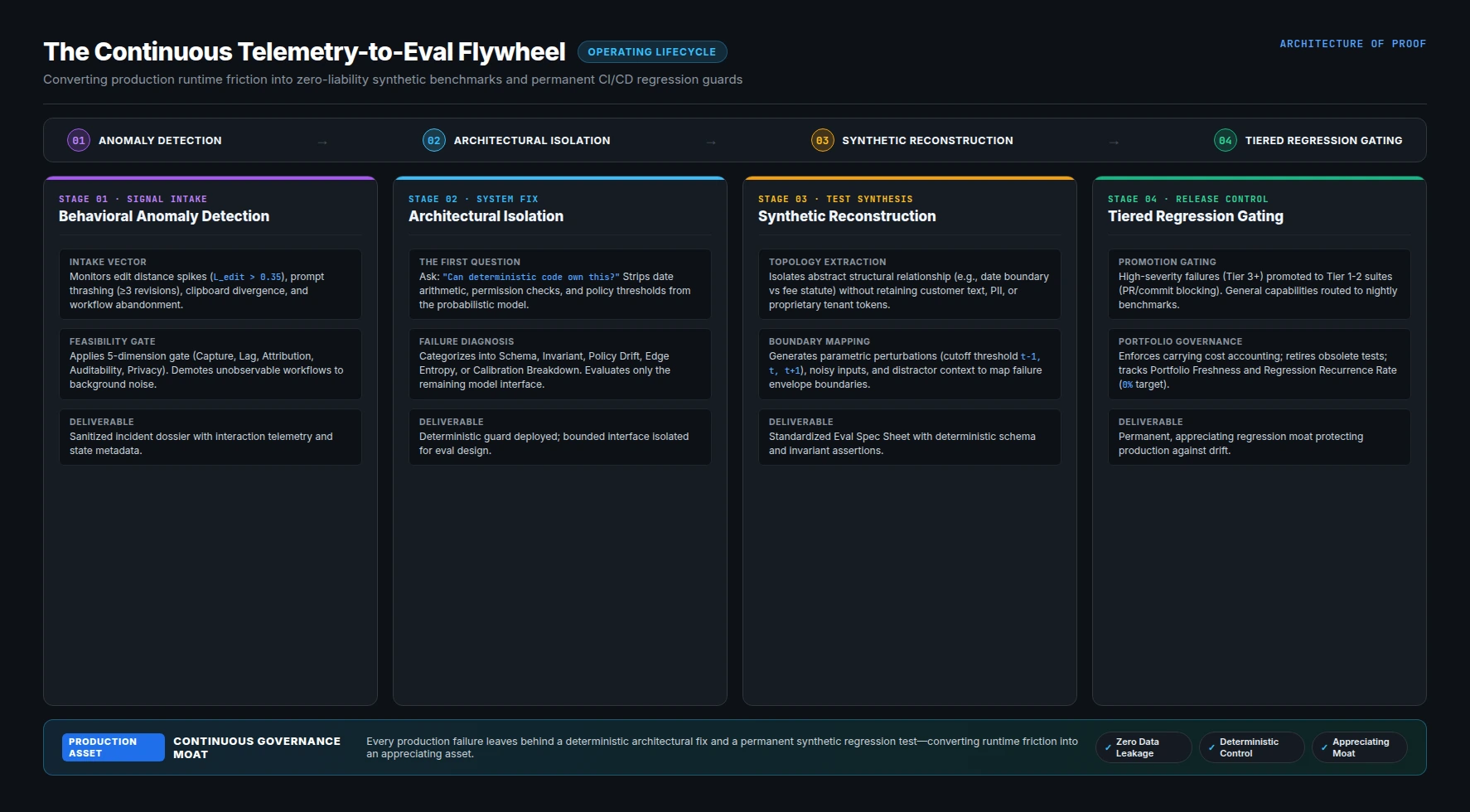
Executing this sequence transforms incident response from ad-hoc emergency patches into a systematic operational rhythm. When production traffic surfaces an unhandled edge case, telemetry flags an operational hypothesis rather than an absolute ground truth. The product manager first verifies that the workflow satisfies the Observability Feasibility Gate and data privacy boundaries before assigning engineering investigation hours.
From there, the engineering squad runs the Failure Diagnosis Matrix to decouple deterministic calculations from model interfaces. If an algorithm, state gate, or regex can enforce the rule, it is committed to code immediately. Where stochastic reasoning is genuinely required, the PM consults with accredited domain experts to define unambiguous invariant criteria, balancing defect severity against long-term portfolio maintenance taxes.
Once the failure boundary is mapped across discrete cutoffs and syntactic permutations, the new invariant is committed into its designated portfolio tier—preventing regressions at the commit or nightly level. Finally, as foundation model weights and enterprise policies evolve, the team ruthlessly prunes obsolete assertions, ensuring that evaluation suites appreciate in diagnostic value rather than accumulating dead maintenance debt.
Is This Too Much Process? The Minimum Viable Flywheel
A fair objection to this article is that its full machinery (Feasibility Gate, Diagnosis Matrix, Prioritization Rubric, Boundary Mapping, six-tier portfolio, five operational diagnostics, and Data Contract) represents a substantial operational commitment. The framework relocates overhead from "too many tests accumulating silently" to "conscious governance decisions with explicit cost accounting." But running the governance process must not exceed the cost of the test bloat it prevents.
For teams that cannot staff a full evaluation function, here is the Minimum Viable Flywheel: three moves that preserve the framework's core logic without the full apparatus:
| Minimal Move | Core Strategic Action | Operational Mechanism | Early-Stage Economy |
|---|---|---|---|
| 1. Fix Architecture First | Strip deterministic logic from the model. | Before writing an eval, ask: "Can deterministic code own this?" Move date arithmetic, permissions, and policy checks to code. | Resolves the majority of early-stage incidents on day zero without writing or maintaining new evals. |
| 2. Two Eval Tiers Only | Compress the portfolio into two essential layers. | Tier 1: Deterministic schema/contract tests on every commit. Tier 2: Curated list of $\le 20$ high-severity invariants reviewed weekly. |
Skips nightly benchmarks and stochastic judges until production volume justifies signal density. |
| 3. One Expert, One Hour / Week | Implement a lightweight calibration loop. | Route 5 sampled production traces to a credentialed domain expert for 60 minutes weekly. Ask: "Did any of these mislead you?" | Replaces a heavy, continuous expert audit board (detailed as Tier 5 in the evaluation portfolio above) while preventing silent hallucination drift. |
The full 9-step loop is the steady-state target for enterprise teams with compliance obligations and sufficient production volume. The 3-move version is the entry point.
The Telemetry Volume Prerequisite: Telemetry-driven discovery requires sufficient signal density to distinguish structural failure patterns from random noise. As a practical threshold: if your product has fewer than 500 distinct user sessions per week in a given workflow, failure clustering may not produce statistically meaningful patterns. At that scale, the Hazard-Led Prevention and Outcome-Led Calibration legs of the Assurance Triad should carry proportionally more weight than the Telemetry-Led Discovery leg.
The Adversarial Stress-Test: Five Critical Inquiries
To ensure this portfolio governance framework withstands operational scrutiny and organizational friction, we subject the tiered evaluation lifecycle to five decision-forcing inquiries:
1. What is the strongest argument against this approach?
- The Governance Tax and Velocity Paralysis: Operating a six-tier portfolio, running five operational diagnostics, and enforcing synthetic data contracts creates real organizational friction. Critics argue that the overhead of running this governance process can exceed the cost of the test bloat it prevents, slowing teams down while competitors ship fast with unconstrained wrappers.
- The Countermeasures:
- Strict Asynchronous Isolation: Tiers 3, 4, and 5 never block individual developer pull requests or everyday sprint commits. Developer PRs are bounded strictly by Tiers 1 and 2, which run in under 5 minutes combined.
- The "Earn Your Gate" Principle: Teams do not deploy all 6 tiers on day one. Early-stage products start with the 3-move Minimum Viable Flywheel (Tier 1 unit contracts + $\le 20$ Tier 2 invariants + 1 weekly audit hour). Higher tiers are unlocked only when production traffic and defect severity justify the carrying cost.
- Automated Pruning TTLs: Every regression test in Tier 3 and 4 carries an automatic 90-day expiration timer. If a test has not caught a regression or been re-validated in 90 days, it is queued for retirement to keep CI runtime flat.
2. Under what circumstances would this fail?
Even disciplined portfolio governance collapses under three enterprise conditions:
- Circumstance A: Low Signal Density (<500 Sessions/Week)
- The Failure: In low-volume enterprise tools, behavioral friction clustering lacks statistical significance to separate structural bugs from user confusion.
- The Countermeasure: Rebalance the Assurance Triad. Lean heavily on pre-deployment Hazard Analysis (FMEA) and weekly expert red-teaming, treating telemetry as a secondary discovery channel.
- Circumstance B: Foundation Model Checkpoint Upgrades
- The Failure: When a foundation model provider updates model weights, prompt sensitivities shift and tokenization alters, invalidating baseline scores and triggering false-alarm test failures across Tier 3 and 4 suites.
- The Countermeasure: The Dual-Run Shadow Burn-In. Never cut traffic to a new foundation checkpoint immediately. Route production traces through the candidate model in shadow mode for 7 days, running outputs against the Tier 2 and Tier 3 suites to establish a differential baseline before promoting it to primary status.
- Circumstance C: Cross-Functional DRI Breakdown
- The Failure: The 9-step loop places the PM at the center of coordination across telemetry engineering, ML infrastructure, legal, and compliance, none of whom report to the PM. Without an agreed executive RACI, failure triage stalls at step 4.
- The Countermeasure: An Executive-Chartered AI Risk RACI. Establish a formal operating contract signed by engineering and risk leadership with an explicit 48-hour SLA for Tier 3+ incident triage.
3. What would a skeptical customer, client, or colleague object to?
- Objection 1: "Your Tier 5 Expert Audit is an operational fantasy. Where are we getting licensed lawyers or physicians to spend hours auditing model traces every week?"
- The Resolution: Expert bandwidth is the genuine bottleneck of enterprise AI assurance. Organizations cannot design their way around budget and access constraints. Teams must either secure dedicated retainer hours with named advisory specialists or adopt the Minimum Viable Flywheel: routing just 5 sampled traces per week to one expert for 60 minutes ($500/week retainer), targeted specifically at silent hallucinations.
- Objection 2: "Isn't telemetry gaming inevitable? The moment prompt thrashing or edit distance becomes a KPI, engineers will simply patch the UI to make the metrics look good."
- The Resolution: That is precisely why the Silent Error Discovery Rate and Risk-Stratified Audits exist as counter-metrics. If prompt thrashing drops by 50% while the Silent Error Discovery Rate spikes or expert audits reveal unprompted hallucinations, the engineering squad is flagged for proxy optimization gaming.
4. Which alternative deserves more consideration?
- The 3-Move Minimum Viable Flywheel & Algorithmic Liability Insurance:
- Rather than deploying the complete 6-tier apparatus on day one, early-stage enterprise squads should implement the 3-move Minimum Viable Flywheel (strip deterministic logic to code first, enforce only 2 eval tiers, and audit 5 weekly traces).
- High-volume products can pair this lightweight posture with commercial algorithmic liability insurance to absorb residual probabilistic tail risk while preserving startup shipping velocity.
5. What am I assuming that may not be true?
To maintain intellectual honesty, product leaders must recognize where this operational framework reaches its limits:
- Assumption: Outcome Observability Exists Downstream. In strategic, advisory, and creative knowledge work, outcomes occur months later in external meetings, emails, and financial performance.
- The Safeguard: Where downstream behavior is unobservable in-app, teams must rely on observational user shadowing and pre-deployment hazard modeling rather than telemetry.
- Assumption: A Single "Ground Truth" Exists for Every Defect. Nuanced legal, clinical, and business decisions frequently lack a single correct answer.
- The Safeguard: The "Consensus Floor or Escalate" Rule. If domain experts cannot achieve $\ge 80\%$ agreement, do not automate the decision. Require the system to output an explicit escalation state (
decision_status: escalate).
- The Safeguard: The "Consensus Floor or Escalate" Rule. If domain experts cannot achieve $\ge 80\%$ agreement, do not automate the decision. Require the system to output an explicit escalation state (
- Assumption: Observed Telemetry Reflects the True Risk Distribution. $P(\text{signal} \mid \text{failure})$ is low for silent hallucinations.
- The Safeguard: Decouple quality measurement from user complaints. Mandate risk-stratified expert audits that oversample "happy" sessions where users made zero edits.
- Assumption: Defects Must Be Reproducible to Be Fixed. In non-deterministic LLM systems, failures depend on fragile context combinations.
- The Safeguard: Optimize for reconstructability of system state (prompt template hash, model version, temperature, seed, and frozen vector chunks) rather than naive 100% reproducibility.
- Assumption: A Single PM Has the Authority to Coordinate This Loop. A feature PM cannot compel compliance officers or infrastructure squads to prioritize eval triage.
- The Safeguard: The executive-mandated AI Risk RACI, which ensures that severe failures (Tier 3+) trigger formal incident response protocols across departmental boundaries.
Series Conclusion & Navigation
The complete Telemetry-to-Eval Flywheel trilogy outlines an end-to-end operational framework for converting volatile runtime friction into durable, appreciating enterprise assets:
- Part 1: Signal Discovery, Feasibility, and Enterprise Data Contracts covers the Observability Feasibility Gate, the Assurance Triad, Telemetry Data Contracts, and behavioral signal interpretation.
- Part 2: Architectural Isolation, Prioritization, and Boundary Mapping details the Failure Diagnosis Matrix, the Evaluation Prioritization Rubric, Calibrated Severity Tiers, and Failure Boundary Mapping.
- Part 3: Tiered CI/CD Portfolios, Anti-Gaming, and the Minimum Viable Loop (Current Post) provides the multi-tier release architecture, anti-gaming controls, operational health metrics, the 9-Step Decision Loop, and the Minimum Viable Flywheel.
One-Line Synthesis
Sustainable AI evaluation is an exercise in portfolio economics: organizations survive by structuring tiered release gates, budgeting credentialed expert calibration, and relentlessly pruning evaluation debt as architectures evolve.
Frequently Asked Questions
Why is a monolithic CI/CD pipeline toxic to LLM evaluation?
Committing every promoted regression test into a single CI pipeline either inflates build runtimes until engineers bypass test gates, or forces teams to make tests so lightweight that they lose discriminatory power. A tiered portfolio decouples commit-time deterministic checks from pull-request invariants, nightly capability distributions, and weekly expert audits.
What is the Expert Bandwidth Bottleneck in Tier 5 auditing?
Credentialed domain experts (healthcare clinicians, licensed attorneys, CPA-qualified accountants) are not routinely available for weekly AI product reviews. Process design cannot solve an access and budget constraint. Teams must contract named experts with explicit hourly terms or adopt a Minimum Viable Flywheel with lightweight stratified sampling.
What is the Proxy Optimization Trap?
The moment a behavioral telemetry marker becomes a product KPI, squads inadvertently optimize the proxy rather than the underlying customer outcome. For example, introducing UI auto-complete lowers prompt thrashing metrics without fixing customer task failure.
How does the Minimum Viable Flywheel work for smaller squads?
Teams without a dedicated evaluation architecture function apply three moves: (1) strip deterministic calculations and state gates to code first, (2) maintain only two eval tiers (unit contracts and no more than 20 high-severity invariants), and (3) route five sampled production traces to one credentialed expert for one hour weekly.
Subscribe to the Architecture of Proof Dispatch
Rigorous, decision-forcing systems engineering and AI governance monographs for technical leaders. Delivered periodically, zero spam.