The Multi-Agent Illusion: Why More Agents Often Create Less Reliability
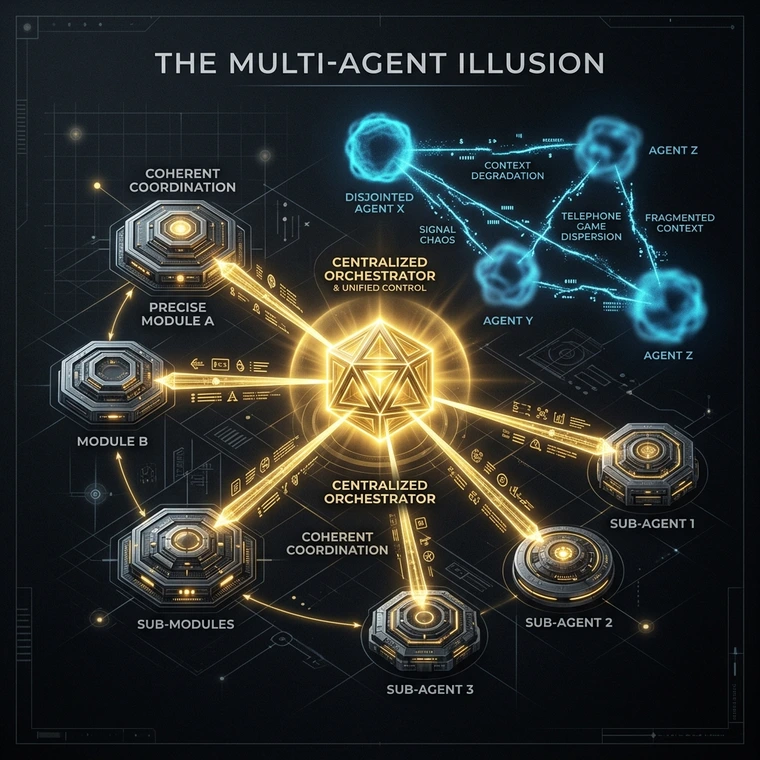
What Is the Hidden Reliability Cost of Agent Delegation?
The original argument for multi-agent systems borrowed heavily from organizational design and distributed systems theory. Specialization improves performance. Parallelization improves speed. Delegation improves scale.
In theory, that logic is sound.
But AI agents are not deterministic software components. They are probabilistic reasoning systems. They reinterpret context, compress meaning, infer intent, and generate outputs that can vary from run to run. Every handoff between agents therefore becomes more than a task transfer. It becomes a context compression boundary, a trust boundary, and a verification boundary.
That distinction matters enormously.
Human organizations survive delegation because people share institutional context, ask clarifying questions, and escalate ambiguity when uncertainty appears. AI agents do none of that reliably. They can confidently pass along incomplete, distorted, or overly compressed information, and the next agent may reason over that weakened context as though it were authoritative.
The architecture may look modular. Operationally, it behaves more like a chain of probabilistic assumptions.
How Does the Telephone Game Degrade Multi-Agent Workflows?
The easiest way to understand multi-agent failure is to think about the childhood game of telephone.
One agent retrieves partial information. Another summarizes it poorly. A third reasons over the summary. A fourth executes the workflow. By the time the task completes, the final output may sound coherent while being fundamentally wrong.
This is what makes multi-agent systems deceptive in practice. They often fail cleanly.
The output looks structured. The agents appear collaborative. The workflow sounds intelligent. Yet the original error may have entered two or three steps earlier, hidden behind layers of plausible intermediate reasoning.
That creates a debugging problem as much as a modeling problem.
In traditional software systems, failures are often traceable to a discrete function, service, or dependency. In multi-agent systems, failures diffuse across delegation chains. Once context degrades across several hops, the true source of failure becomes difficult to isolate. Teams end up investigating symptoms instead of causes.
The more agents you add, the harder it becomes to answer a very simple operational question:
Where exactly did reality diverge from the workflow?
Why Does the Coordination Tax Outweigh Autonomous Swarm Benefits?
Each additional agent introduces an operational tax across four dimensions: context synchronization, memory reconciliation, intermediate validation, and distributed failure localization.
| Coordination Overhead Layer | Operational Manifestation | Production Failure Impact |
|---|---|---|
| Context Synchronization | Retransmitting transcripts and serialized state across API boundaries. | Token consumption increases quadratically; latency compounds exponentially. |
| Intermediate Validation | Reconciling conflicting intermediate assertions emitted by peer sub-agents. | Requires secondary judge models, creating recursive verification overhead. |
| State Reconciliation | Managing distributed, non-deterministic writes across databases and external tools. | Race conditions, state desynchronization, and partial transaction commits. |
| Fault Localization | Triaging downstream hallucinations back to intermediate compression steps. | Mean Time to Containment expands from minutes to days across opaque delegation chains. |
At small scale, this coordination tax is negligible. In enterprise production, it erases the efficiency gains of parallelization, forcing teams to erect human review queues and fallback workflows that undermine automation ROI.
Mathematical Proof of Reliability Decay
The operational fragility of multi-agent chains stems directly from probability theory. If the reliability of an individual probabilistic agent executing an isolated subtask is $p$, where $0 < p < 1$, the end-to-end reliability $R$ of an unconstrained sequential chain of $n$ independent probabilistic agents decays exponentially:
$$R = \prod_{i=1}^{n} p_i = p^n$$
| Delegation Chain Depth ($n$) | Individual Step Accuracy ($p$) | Compounded End-to-End Reliability ($R = p^n$) | Operational Production Impact |
|---|---|---|---|
| $n = 1$ (Single Agent) | 95.0% | 95.0% | 1 error in 20 requests (standard operational queue). |
| $n = 2$ (Two-Hop Handoff) | 95.0% | 90.2% | 1 error in 10 requests (manageable with light spot checks). |
| $n = 4$ (Four-Hop Pipeline) | 95.0% | 81.4% | 1 error in 5 requests (reviewers suffer cognitive fatigue). |
| $n = 8$ (Autonomous Swarm) | 95.0% | 66.3% | 1 error in 3 requests (complete operational failure; ROI collapses). |
Even with highly tuned models achieving $95\%$ reliability per task, an eight-agent chain fails on one out of every three executions. Every handoff boundary compounds the underlying error rate, transforming architectural ambition into production instability.
Where Does Multi-Agent Delegation Succeed Versus Fail?
The determining factor for multi-agent viability is not model intelligence, but task boundedness:
| Architectural Dimension | High-Viability Bounded Workflows | High-Risk Unbounded Swarms |
|---|---|---|
| Task Coupling | Independent, separable subtasks (e.g., parallel retrieval across distinct databases). | Tightly coupled sequential reasoning (e.g., financial authorization, clinical protocol triage). |
| Context Dependency | Minimal shared state; subtasks require localized context only. | Deep historical context; early assumptions dictate downstream multi-step actions. |
| Verification Gate | Deterministic post-hoc evaluation (e.g., unit test execution, schema validation). | Probabilistic evaluation requiring subjective human or model interpretation. |
| Blast Radius | Read-only analysis or sandboxed workspace modifications. | Direct state mutations across production databases, payment gateways, or APIs. |
How Do You Architect Defensible Agent Delegation?
To prevent coordination tax collapse while preserving task specialization, systems architects must enforce three structural invariants:
- Centralize the Reasoning Loop: Maintain a single deterministic orchestrator that holds master session state, arbitrates execution plans, and enforces global invariant checks.
- Treat Sub-Agents as Typed Tools: Sub-agents must operate as bounded functional workers called through strict schema contracts rather than autonomous peer negotiators.
- Enforce Atomic State Rollbacks: Any state mutation emitted by a sub-agent must execute within a transactional envelope tied to an append-only causal trace, enabling bit-level rollback if downstream verification fails.
The Architectural Invariant: A centralized coordinator with a deterministic schema and formal validation boundaries provides a verifiable state trace. By binding each external agent tool-call to a cryptographic causal trace, engineering teams achieve 100% post-execution replayability, neutralizing the compounding uncertainty of probabilistic pipelines.
The PM's Multi-Agent Architecture Evaluation Matrix: PRD & Architecture Review Checklist
When an engineering squad proposes an autonomous multi-agent swarm architecture to solve a complex workflow, product managers should run this evaluation matrix during PRD and sprint architecture reviews:
| Proposed Workflow & Use Case | Proposed Multi-Agent Swarm Design | Compounding Reliability Vulnerability | Mandated Production Architecture | PM Go/No-Go Release Gate |
|---|---|---|---|---|
| Document Data Extraction & Verification | Multi-agent debate: Agent 1 parses, Agent 2 checks, Agent 3 reconciles conflicts. | Context Compression & Latency: Multi-hop debate increases P95 latency by $4\times$ and token costs by $300\%$ without verifiable accuracy gain. | Centralized Schema Pipeline: Single model extracts structured JSON; deterministic regexes and DB lookups validate fields. | REJECT SWARM. Reject dynamic agent negotiation for tasks with closed-form deterministic schemas. |
| Customer Support & Refund Triage | Autonomous swarm: Router delegates to Policy Agent, which calls Billing Agent to issue refunds. | Cascading Hallucination & Authority Bypass: Sub-agents infer refund authority; errors compound across handoffs into unauthorized ledger writes. | Deterministic State Machine: Central coordinator calls specialized models as typed functional tools with hard authority caps ($\le \$50$). | NO-GO if probabilistic agents can directly trigger financial ledger mutations without deterministic gates. |
| Multi-Source Research & Synthesis | Swarm of search agents crawling internal wikis, Jira, and Slack in parallel. | Low Consequence (Read-Only): Tasks are embarrassingly parallel; failures produce incomplete lists rather than corrupt state. | Parallel Tool Workers: Orchestrator dispatches parallel search tasks; aggregates results via deterministic ranking algorithms. | APPROVE DELEGATION. Permit parallel read-only worker models with strict timeout and token caps. |
| Complex Code Generation & Refactoring | Multi-agent swarms: Architect Agent writes specs, Coder writes functions, QA Agent reviews. | Attribution Diffusion: QA Agent accepts subtly flawed code; test suites fail; root cause cannot be localized across agent iterations. | Compiler-Gated Loop: Single reasoning model generates code; unit tests and AST linters provide deterministic feedback loop. | NO-GO if code promotion relies on secondary LLM review rather than deterministic test suite execution. |
The Adversarial Stress-Test: Five Critical Inquiries
1. What is the strongest argument against this approach?
The Objection: Constraining multi-agent systems to centralized orchestration and rigid schema boundaries destroys the emergent problem-solving and flexible reasoning that makes autonomous agents valuable. Complex real-world challenges require peer-to-peer agent debate, open-ended collaboration, and non-linear task decomposition.
The Practical Resolution: Separate exploratory hypothesis generation from state-mutating execution. Allow autonomous agent swarms to brainstorm, debate, and retrieve evidence within an isolated read-only sandbox. Once the swarm converges on a plan, route the proposed actions through a centralized deterministic validation gate that enforces business invariants and schema typing before committing changes to production databases.
2. Under what circumstances would this fail?
The Failure Mechanism: Centralized orchestration fails when the central orchestrator’s context window becomes saturated by token bloat, creating an architectural bottleneck that chokes system throughput and forces context truncations that induce catastrophic coordination errors.
The Practical Resolution: Implement an episodic memory-bus architecture decoupled from the central orchestrator's active prompt. Intermediate agents emit structured key-value state diffs into an external transactional cache rather than passing raw text transcripts back to the coordinator. The central orchestrator inspects only validated schema keys, maintaining a lean, invariant token footprint regardless of delegation depth.
3. What would a skeptical customer, client, or colleague object to?
The Skeptical Pushback: Enterprise engineering leaders and product directors will argue that commercial frameworks (such as CrewAI, AutoGen, or LangGraph) make multi-agent deployment trivial, questioning why their teams should spend engineering cycles building custom centralized state controls when open-source swarms can be stood up in hours.
The Practical Resolution: Expose the total cost of ownership across debugging, cloud token consumption, and failure containment. Demonstrate that while standing up an unconstrained swarm takes hours, diagnosing a silent multi-hop semantic distortion in production requires days of manual forensic inspection across asynchronous traces. Building deterministic boundaries upfront eliminates weeks of emergency triage and prevents multi-thousand-dollar token compounding loops.
4. Which alternative deserves more consideration?
The Counter-Architecture: Hierarchical State-Machine Directed Acyclic Graphs (DAGs) without autonomous agent peer negotiation. Instead of probabilistic agents deciding whom to delegate to next, a compiled deterministic workflow engine explicitly routes data across specialized fine-tuned models.
The Practical Resolution: Deploy compiled state machines for the 90% of workflows that follow predictable operational paths. Reserve dynamic agentic delegation strictly for localized, non-deterministic edge cases where static DAGs lack branching coverage. In those edge cases, bound the agent's delegation depth to a maximum of two hops before forcing an automated escalation to human review.
5. What am I assuming that may not be true?
The Latent Vulnerability: We are assuming that individual agent reliability $p$ remains independent across hops ($R = p^n$). In practice, agent errors are often correlated: if Agent 1 misinterprets a customer requirement due to a shared foundation model bias or training artifact, subsequent agents running on the same foundation model will inherit and amplify the identical error rather than catching it.
The Practical Resolution: Enforce model diversity and independent adversarial verification across critical delegation boundaries. If Agent 1 uses a frontier reasoning model to extract requirements, pass the extracted claims to a distinct model architecture or deterministic rule engine tasked specifically with counter-hypothesis testing, breaking correlated failure loops across the pipeline.
One-Line Synthesis
Reliable agentic architectures preserve system coherence by centralizing core reasoning loops and restricting agent delegation to deterministically validated, atomic state boundaries.
Subscribe to the Architecture of Proof Dispatch
Rigorous, decision-forcing systems engineering and AI governance monographs for technical leaders. Delivered periodically, zero spam.