Assumption Debt: The Hidden Liability Every AI System Accumulates
Every production incident eventually traces back to one of three things: a broken implementation, a broken dependency, or a broken assumption. AI dramatically increases the frequency of the third.
Every complex system accumulates assumptions. Distributed systems assume network partitions are rare. Financial models assume market regimes are stable. Business processes assume operator behavior is consistent. What makes AI systems unusual is not that they accumulate assumptions; it is that they accumulate them simultaneously across statistical models, human workflows, external vendor APIs, and evolving data distributions. The surface area is larger, the assumptions change faster, and they are harder to observe because they are embedded in weights, prompts, and pipeline schemas rather than in code that engineers can read.
Every AI system is built on beliefs.
Some of those beliefs are explicit. They appear in model cards, system documentation, validation reports, and risk acceptance letters. They have been reviewed, challenged, and accepted by someone with accountability for the outcome.
Most of those beliefs are not explicit. They are embedded in training data selection decisions that were never written down. They are encoded in prompt defaults that were never reviewed. They are assumed in system architecture choices made at speed, under deadline, by engineers who expected to revisit them later.
Later rarely comes.
Every implicit assumption in an AI system is a liability that has not been priced. It will be priced eventually through an audit, a regulatory challenge, or a failure that surfaces in production. The only question is whether it will be priced on your terms or someone else's.
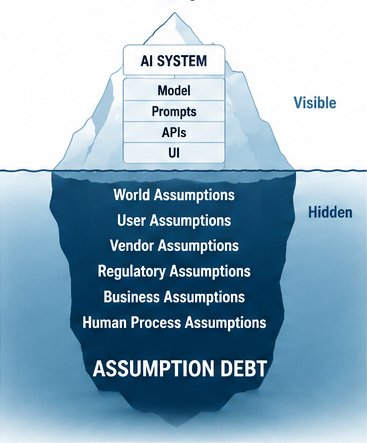
This is assumption debt. And unlike most liabilities in software systems, it does not appear on any balance sheet until it fails.
Why Is Assumption Debt More Dangerous Than Technical Debt?
Technical debt is familiar. It is the cost of shortcuts taken during development that will need to be repaid later through refactoring time, performance degradation, and brittleness under load. Most technical debt fails loudly. A system crashes. A test suite breaks. An error surfaces in a log. The signal is usually clear, if not always timely.
Assumption debt fails silently.
When an assumption becomes invalid because the external environment shifts, the system does not crash. It continues to produce outputs. Those outputs appear reasonable. They pass schema validation. They fall within expected confidence ranges. Nothing in the monitoring stack fires.
The outputs are simply wrong in a way that the monitoring stack was not designed to detect, because detecting it would require knowing that the assumption existed in the first place.
Technical debt accumulates in the codebase. Assumption debt accumulates in the gap between what the system believes about the world and what the world actually is. You cannot find it by reading the code. You can only find it by naming what the system depends on.
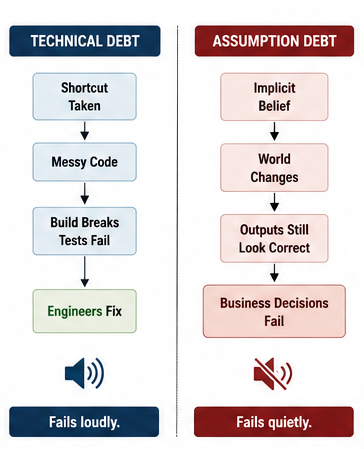
This is the core asymmetry. Technical debt is visible to engineers who read the code. Assumption debt is invisible until named. And naming it requires a discipline most AI teams have not built.
The Three Types of Assumptions
AI systems accumulate assumption debt in three distinct layers. Each layer has different failure modes, different time horizons, and different mitigation strategies.
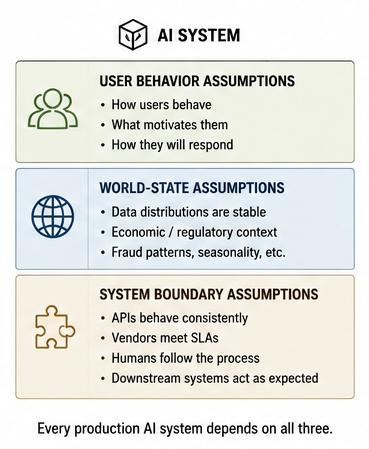
Type 1: World-State Assumptions
These are beliefs about how the external world behaves: the distributions, relationships, and dynamics that the model was trained on or calibrated against.
Examples: - "The relationship between income level and default risk that existed in our 2021 training data still holds today." - "The fraud patterns in our training data represent the fraud patterns we will encounter in production." - "The clinical contraindications encoded in our training corpus are current with present prescribing guidelines."
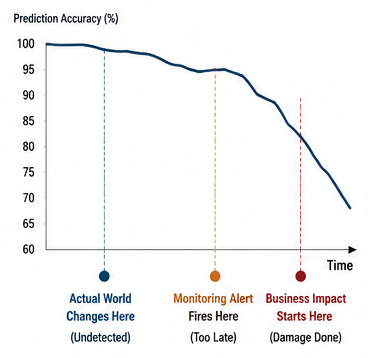
World-state assumptions are the most common source of model drift. When the world changes via economic shifts, new fraud techniques, or updated clinical guidelines, these assumptions become invalid. But they become invalid silently, because the assumption was never written down and therefore no monitoring system was built to test it.
The consequence is that drift detection systems catch the signal after damage has accumulated. An organization with explicit world-state assumptions can build leading indicators (proxies for whether the assumption still holds) rather than waiting for lagging indicators like accuracy degradation.
Type 2: User-Behavior Assumptions
These are beliefs about how users will interact with the system: what they intend, how they interpret outputs, and what actions they take in response.
Examples: - "Users asking the model a question are acting in good faith and will use the output as intended." - "Loan officers reviewing AI recommendations will treat them as one input among several, not as a final determination." - "Customers who receive an adverse action notice will understand it as a decision explanation, not a definitive statement of creditworthiness."
User-behavior assumptions are particularly dangerous because they are frequently optimistic. Systems are designed for expected users doing expected things. They are stress-tested against adversarial inputs. They are rarely stress-tested against well-intentioned users who interpret outputs in ways the system designers did not anticipate.
When user behavior deviates from the assumed model, even in benign ways, the system produces outputs that are formally correct but operationally harmful. The system is not broken. The assumption was.
Type 3: System-Boundary Assumptions
These are beliefs about how other components in the system will behave, including other models, vendor APIs, data pipelines, and human reviewers.
Examples: - "The vendor model we call via API will produce semantically consistent outputs across updates." - "The data pipeline feeding this model will maintain the same schema and null rate it had during validation." - "Human reviewers in the escalation queue will apply the review criteria in the same way across different reviewers and different time periods."
The previous post on vendor AI governance introduced governance residual risk, the irreducible unknowns that remain when you don't own the model. System-boundary assumptions are the mechanism through which governance residual risk accumulates. Every implicit assumption about vendor behavior is a governance residual risk that has not been named.
When a vendor updates their model silently, the failure is not a vendor failure. It is a system-boundary assumption failure. The assumption, "this API will behave consistently across versions", was implicit. It was not tested. And it was not escalated when it broke, because no one was monitoring for it.
How Assumption Debt Compounds
Assumption debt does not grow linearly. It compounds in two directions simultaneously.
The world changes. World-state assumptions that were valid at deployment become progressively less valid as time passes. A model deployed into a stable regulatory environment accumulates less world-state assumption debt than one deployed into a rapidly evolving market. But no environment is perfectly stable. Every month in production is a month in which the gap between the assumed world and the actual world grows.
The system evolves. Each change to the system, a prompt update, a vendor model upgrade, a schema modification in an upstream pipeline, has the potential to introduce new assumptions while invalidating existing ones. When changes are made without a systematic review of which assumptions they affect, the assumption register (to the extent one exists at all) becomes stale.
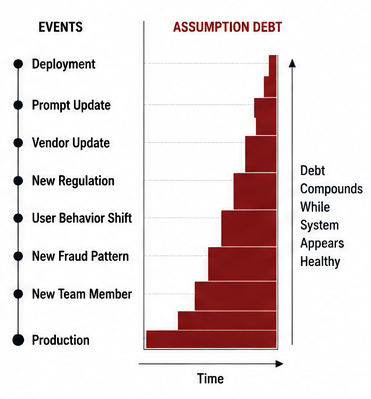
The compounding dynamic is this: a system with fifty implicit assumptions is not five times riskier than a system with ten. Risk grows non-linearly, through interactions between invalid assumptions that produce failure modes no single assumption's failure would have triggered.
Assumption debt compounds not because individual assumptions fail, but because they fail together in combinations that were never anticipated, because the assumptions were never made explicit enough to analyze their interactions.
The Assumption Register
The practical response to assumption debt is an assumption register: a living document that catalogs every significant belief the system depends on. Not every assumption deserves the same attention, the register is a triage instrument, not an exhaustive inventory. Each entry carries five fields.
Field 1: Explicit or Implicit? Is this assumption written down somewhere, in the model card, system documentation, validation report, or vendor contract? If it exists only in the heads of the people who built the system, it is implicit. The first act of governance is making it explicit.
Field 2: How would this be tested? If someone challenged this assumption, a regulator, an auditor, an internal reviewer, what evidence would you produce? An assumption that could in principle be tested but hasn't is a verification gap. An assumption that cannot even be formulated as a testable claim is a structural governance problem.
Field 3: Who is responsible for maintaining it? Assumptions degrade over time. The world-state assumption that was valid at deployment requires someone to periodically check whether it still holds. That someone needs a name, a calendar trigger, and a clear definition of what "still holds" means. Without an owner, even explicit assumptions become stale.
Field 4: Likelihood of change. How likely is this assumption to become invalid in the next six to twelve months? A world-state assumption in a rapidly evolving regulatory environment is high-likelihood. A system-boundary assumption about a stable internal data pipeline is low-likelihood. Likelihood determines monitoring frequency.
Field 5: Business impact if invalid. If this assumption breaks and goes undetected for thirty days, what is the consequence? High-impact assumptions, those that would affect regulatory compliance, customer harm, or material financial outcomes, require more frequent testing and lower detection thresholds. Low-impact assumptions can tolerate longer review cycles.
The combination of likelihood and impact produces a natural priority ordering. High-likelihood, high-impact assumptions get active monitoring and quarterly review. Low on both dimensions get annual review or acknowledgement in risk acceptance.
An example of what a populated register looks like:
| Assumption | Type | Explicit? | How Tested | Owner | Likelihood | Impact | Frequency |
|---|---|---|---|---|---|---|---|
| Income-to-default correlation reflects current economic conditions | World-state | No | Cohort comparison vs. live default rates | Model Risk Officer | High | High | Quarterly |
| Loan officers treat recommendations as advisory, not determinative | User-behavior | No | Workflow audit + review queue sampling | Product Lead | Medium | High | Semi-annual |
| Vendor model API produces semantically consistent outputs across versions | System-boundary | Partial (contract) | Behavioral regression against fixed eval set | Engineering Lead | High | Medium | Monthly |
| Internal data pipeline schema is stable | System-boundary | Yes (schema docs) | Schema diff check in CI pipeline | Data Engineering | Low | Medium | On-change |
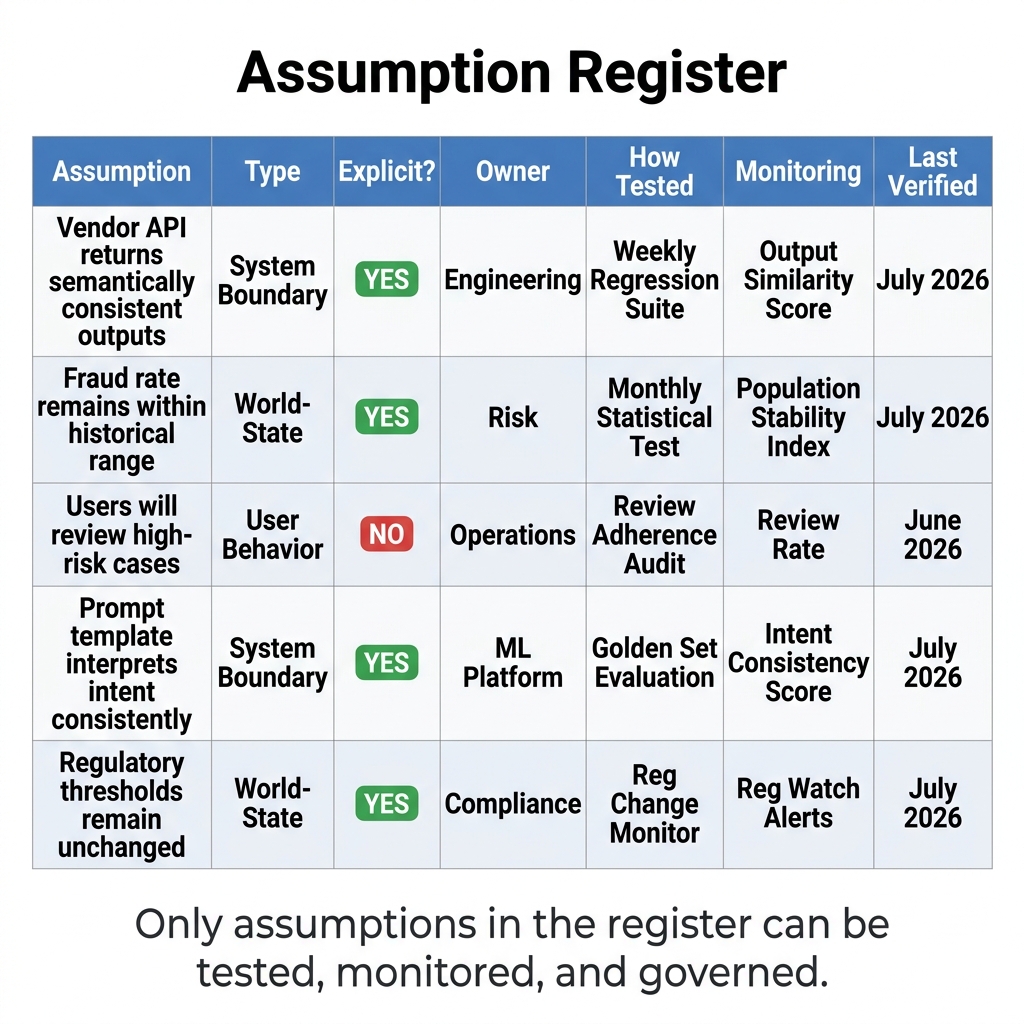
The register is not a compliance artifact. It is an operational instrument. Assumptions that appear in it are governable, they can be monitored, tested, and escalated when they break. Assumptions that do not appear cannot be monitored, because no one knows to look.
The PM's Assumption Debt Triage Matrix: 5 Assumptions to Challenge in Every Sprint Review
During sprint reviews and backlog grooming, engineering teams naturally prioritize feature velocity over unstated assumptions. The Product Manager must challenge the unspoken premises that create production liabilities.
Bring this 5-question matrix to every bi-weekly sprint triage:
| Assumption Category | The Unspoken Team Belief | The Silent Production Failure Mode | The PM's Test & Monitoring Gate |
|---|---|---|---|
| World-State (Macro & Data) |
"The relationship between customer credit score and repayment probability hasn't changed since model training." | Macroeconomic interest rate shifts cause loan defaults to surge on prime accounts while the model remains mathematically confident. | Leading Indicator: Track 30-day early-payment friction and employment changes; trigger automatic slice review quarterly. |
| User-Behavior (Operators) |
"Loan officers treat AI output as an advisory recommendation and independently verify edge cases." | Underwriters face queue pressure, experience cognitive fatigue, and rubber-stamp 98% of recommendations without reading evidence. | Dwell-Time Telemetry: Monitor review latency; flag any operator approving cases in < 10 seconds; require mandatory justification codes. |
| System-Boundary (Vendor APIs) |
"OpenAI/Anthropic's hosted API will produce semantically identical responses across monthly updates." | The vendor silently updates tokenization or reasoning weights, subtly breaking prompt parsing or JSON schema extraction. | Golden Set Regression: Run a fixed 50-example behavioral test suite against the vendor API weekly; halt deployment if outputs diverge. |
| Data Pipeline (Ingress) |
"Upstream data pipelines will maintain schema integrity and never deliver empty or corrupted fields." | An upstream third-party service deprecates an API field, feeding nulls into the model which defaults to zero-risk scores. | Ingress Invariant: Enforce strict Pydantic/JSON schema validation at API ingress; reject malformed payloads with 400 Bad Request. |
| Product Boundary (Decision Logic) |
"Our 0.65 auto-decline cutoff threshold reflects our current corporate risk tolerance." | The business strategy shifted toward growth, but the legacy cutoff silently rejects viable customers, depressing conversion. | Threshold Recalibration: Re-examine threshold calibration curves against realized business margins every 90 days. |
The Connection to the Governance Ceiling
The correlation problem post argued that explicit assumptions are testable and implicit assumptions are not, and that this distinction determines whether a model's governance mechanism is external surveillance or internally testable reasoning.
The assumption register extends that argument from the model layer to the system layer.
A model that encodes explicit causal structure has made its world-state assumptions explicit in the form of a directed graph. Those assumptions can be tested against incoming data. A correlation-based model encodes its assumptions implicitly in weights and learned associations. Those assumptions cannot be directly inspected or tested.
But even a causal model sits inside a system with user-behavior assumptions and system-boundary assumptions that are entirely external to the model. A governance program that achieves internally testable reasoning at the model layer while leaving user-behavior and system-boundary assumptions implicit has solved the harder half of the problem and neglected the easier one.
The governance ceiling of any AI system is determined by how many of its critical assumptions are explicit. A causal model with an implicit vendor dependency and undocumented user-behavior assumptions is not a governed system. It is a partially governed system with residual assumption debt that has not been priced.
Full governance requires assumption explicitness at all three layers: world-state, user-behavior, and system-boundary.
The Practical Test
The assumption debt audit has four questions. They can be run in a single working session by any team with production AI.
Question 1: What does this system believe about the world? List every claim the system's behavior depends on being true about the external environment. Income and default rates. Fraud pattern distributions. User intent. Regulatory stability. This is the world-state assumption inventory.
Question 2: What does this system believe about its users? List every claim about how users interact with the system. How they interpret outputs. What actions they take. Whether they have the context to use recommendations appropriately. This is the user-behavior assumption inventory.
Question 3: What does this system believe about its dependencies? List every claim about upstream data, vendor models, and downstream systems. Schema stability. API consistency. Reviewer behavior. This is the system-boundary assumption inventory.
Question 4: For each assumption, can you name a test? Go through every item on the three lists and ask: if this assumption became invalid tomorrow, what would be the first signal? If the answer is "we'd find out from complaints" or "we'd find out from an audit," the assumption is ungoverned.
The distance between "we'd find out from complaints" and "we'd find out from our monitoring" is not a monitoring gap. It is an assumption debt gap. The monitoring doesn't exist because the assumption was never named.
What This Changes for AI Teams
The assumption register is not another governance document to fill out before a launch. It is a diagnostic instrument that changes how teams think about risk.
It surfaces the real governance questions. Most pre-launch reviews focus on model accuracy, bias testing, and integration validation. The assumption register asks: what would have to be true about the world for this model to remain valid in twelve months? That question is rarely asked at launch. It is always relevant by month three.
It makes residual risk explicit. Every assumption that cannot be tested is a component of governance residual risk: the risk that remains after all available controls have been applied. Making that residual explicit is not an admission of weakness. It is the difference between a risk program that pretends to cover everything and one that knows precisely where it stops.
It creates a monitoring backlog. Every implicit assumption that gets made explicit becomes a candidate for a monitoring instrument. That is a backlog: a list of leading indicators that could be built to detect assumption invalidation before it propagates into output quality. Most monitoring programs are built from lagging indicators because the leading indicators require knowing what assumptions to watch. The register provides that knowledge.
It distributes accountability. An assumption with no owner is an assumption no one is watching. The register assigns ownership not just of the assumption's validity, but of the decision about what to do when it breaks. That is a governance decision, not a technical one. It belongs with a named person, not in an architecture diagram.
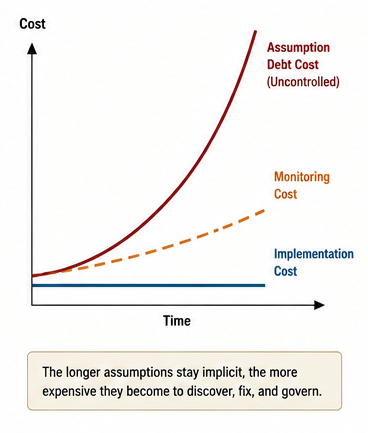
The assumption register does not prevent assumptions from becoming invalid. The world will continue to change. What it does is ensure that when assumptions break, someone finds out from their own monitoring before anyone else does, and knows exactly what to do.
The Assumption Lifecycle
An assumption register answers the static question: what does the system currently believe? But governance is not a point-in-time audit. It is a continuous operational discipline. The instrument that converts the register from a document into a process is the assumption lifecycle.
Every assumption in a governed AI system passes through a sequence of states:
Implicit → Named → Owned → Tested → Monitored → Revalidated → Retired
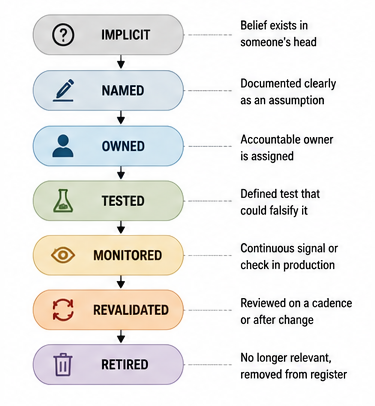
Implicit is the starting state for most assumptions. The belief exists and shapes system behavior, but it has never been articulated. It cannot be governed in this state.
Named is the first governance act. The assumption is written down in language specific enough that someone could in principle challenge it. "The model performs well" is not named. "The income-to-default correlation in our 2021 training data still reflects current underwriting risk" is named.
Owned means a named individual has accepted responsibility for the assumption's validity. Without an owner, a named assumption is still ungoverned; it has been acknowledged but not actively watched.
Tested means the assumption has been verified against current evidence at least once since deployment. The test does not need to be elaborate. It needs to be documented, with a result, a date, and the person who ran it.
Monitored means a leading indicator exists: a proxy measurement that will signal when the assumption is approaching invalidity, before it actually breaks. Not every assumption can be monitored in this sense. Those that cannot should be acknowledged as carrying higher residual risk.
Revalidated is the periodic return to the Tested state on a scheduled cadence. The frequency is determined by likelihood and impact from the register.
Retired is the appropriate end state when a system component is decommissioned, when a model is replaced, or when an assumption is superseded by a deterministic rule that no longer requires the belief to hold. Retired assumptions should remain in the register's historical record for audit purposes and future deployments.
Governance, in this framing, is not a property a system has. It is a process a team runs. The assumption lifecycle is the structure of that process: the sequence through which implicit liability becomes explicit, tested, monitored, and eventually resolved.
This maps directly onto the Architecture of Proof maturity model. Stage 2 organizations have named assumptions, sometimes. Stage 3 organizations have named and owned assumptions, systematically. Stage 4 organizations have monitored assumptions: leading indicators that fire before the governance program finds out from someone else. The lifecycle is the operational definition of what it means to move between those stages.
The Adversarial Stress-Test: Five Critical Inquiries
1. What is the strongest argument against this approach?
Maintaining an exhaustive register of hundreds of implicit assumptions across multi-agent pipelines creates administrative paralysis and documentation bloat. Engineers and product teams spend disproportionate cycles cataloging speculative beliefs rather than shipping features, turning an agile development process into a bureaucratic compliance tax.
The Practical Resolution: Focus the assumption register strictly on high-impact boundary premises. Use a calibrated 2x2 triage matrix (Likelihood of Invalidation × Consequence of Failure) to monitor only the top tier of critical world-state and system-boundary assumptions, reviewing the long tail only during annual risk audits.
2. Under what circumstances would this fail?
This framework fails when an organization experiences a "black swan" systemic shock that simultaneously invalidates dozens of correlated assumptions. If macroeconomic liquidity freezes or a fundamental platform dependency deprecates without notice, individual assumption monitors will be swamped by cascading alerts, rendering localized assumption triage useless.
The Practical Resolution: Couple individual assumption monitors with aggregate system-level circuit breakers. When multiple correlated boundary assumptions degrade simultaneously, the platform must trigger an emergency operational demotion to Tier 0 manual triage rather than attempting piecemeal assumption remediation during a crisis.
3. What would a skeptical customer, client, or colleague object to?
A skeptical executive or commercial sponsor will argue that cataloging untested assumptions creates a legal discovery hazard. In litigation or regulatory investigations, an internal register detailing known untested premises could be subpoenaed to prove that the company deployed software despite knowing its operating foundations were unverified.
The Practical Resolution: Align the assumption register with formal Model Risk Management (MRM) frameworks. Treat named assumptions as authorized operational risk tolerances with defined verification timelines, demonstrating corporate due diligence and proactive governance rather than willful negligence.
4. Which alternative deserves more consideration?
Empirical End-to-End Adversarial Chaos Engineering. Rather than cataloging theoretical assumptions in a register, continuously subject production models to automated fuzzing, synthetic out-of-distribution feature injection, and adversarial agent attacks in staging sandboxes, measuring empirical failure modes directly without cataloging philosophical beliefs.
The Practical Resolution: Use adversarial chaos testing to discover which unstated assumptions are most vulnerable to breakage. The two approaches are complementary: chaos engineering exposes the empirical cracks, while the assumption register assigns permanent human ownership, leading-indicator monitoring, and remediation protocols to prevent regressions.
5. What am I assuming that may not be true?
This architecture assumes that named human owners will maintain cognitive vigilance and actively monitor leading indicators over multi-year deployment lifecycles. In practice, when systems run smoothly for extended periods, human owners succumb to complacency, treating assumption reviews as perfunctory rubber-stamp rituals.
The Practical Resolution: Automate assumption health telemetry within engineering observability dashboards. If a scheduled assumption revalidation window lapses without verified empirical testing, the governance platform must flag an automated compliance blocker that halts production deployment pipelines until sign-off is completed.
One-Line Synthesis
AI governance is the systematic operational discipline of converting implicit system beliefs into named, monitored, and testable assumptions before environmental drift forces a catastrophic production failure.
Frequently Asked Questions
What is assumption debt in AI systems?
Assumption debt is the accumulation of untested, undocumented beliefs that an AI system's behavior depends on. Every AI system runs on beliefs about the world: specifically regarding users, data distributions, and component behaviors. When those beliefs are implicit (never written down), they cannot be tested. When they cannot be tested, they cannot be governed. Assumption debt compounds silently: the system keeps producing outputs while the premises those outputs depend on become increasingly stale.
How is assumption debt different from technical debt?
Technical debt usually fails loudly, a system crashes, a test breaks, an error surfaces. Assumption debt fails quietly. The system continues to run. The outputs continue to appear reasonable. The underlying beliefs the system depends on have shifted, but nothing signals that shift until downstream consequences accumulate. This makes assumption debt more operationally dangerous than most technical debt: it is invisible until it isn't.
What is an assumption register?
An assumption register is a living document that catalogs every significant belief an AI system depends on, along with three fields for each: whether the assumption is explicit or implicit, how it would be tested if challenged, and who is responsible for maintaining it. The register is not a compliance artifact; it is an operational instrument. Assumptions that appear in the register are governable. Assumptions that don't appear cannot be monitored, tested, or escalated when they become invalid.
How does assumption debt relate to model drift?
Model drift is the symptom. Assumption debt is the structural cause. When a model drifts, it is because a world-state assumption it depended on (such as data distributions, user behavior, or causal relationships) has become invalid. Drift detection systems catch the signal after the fact. An assumption register, combined with active assumption monitoring, is the mechanism for anticipating which assumptions are most likely to break and why.
Subscribe to the Architecture of Proof Dispatch
Rigorous, decision-forcing systems engineering and AI governance monographs for technical leaders. Delivered periodically, zero spam.