The Correlation Problem: Why Pattern-Matching AI Can't Be Governed: Only Monitored
Most enterprise AI governance programs are built on a dangerous misunderstanding of software architecture.
When a product team deploys an AI system to make credit decisions, evaluate insurance claims, or route customer disputes, leadership assumes that "governance" means wrapping the model in monitoring dashboards, tracking latency, and logging outcomes. If a metric drifts, an alert sounds. If an auditor asks what happened, engineers pull the logs. If a customer complains, a human reviews the case.
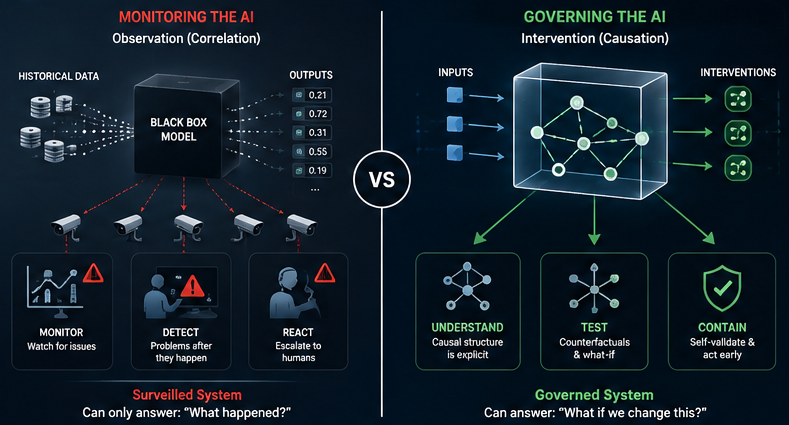
That setup is better than flying blind. But it is not governance. It is surveillance.
Surveillance is passive observation: watching what a system does after the fact and reacting when things go visibly wrong. Governance is active, predictive control: knowing in advance how the system will behave when conditions change, understanding why a specific decision was reached, and having the ability to steer the system before an error escalates into a regulatory investigation or a financial loss.
The difference between surveillance and governance comes down to a simple question:
A governed system can answer: "If we change this input, what will the output become?" A surveilled system can only answer: "Here is what the output was last time."
Nearly every correlation-based AI model in production today requires external surveillance to compensate for its inability to reason about interventions. That is the correlation problem.
The Audit Note on "Proof": In the context of the Architecture of Proof, "proof" does not refer to absolute mathematical certainty. Rather, it denotes reproducible evidence obtained through intervention-aware reasoning, the programmatic ability to demonstrate why a decision occurred and how it would respond to structural changes.
What Do Correlation-Based Models Actually Learn?
To understand the governance ceiling, you have to be precise about what a statistical model does.
A model trained on historical data learns the association between input features and output labels as those associations existed in past observations. Given enough data and the right architecture, it learns these associations with impressive fidelity. That is why models predict fraud, classify documents, score creditworthiness, and route support tickets with meaningful accuracy.
But there is a precise boundary to what historical association can tell you, and that boundary has a name in the formal literature: the difference between observation and intervention.
Observation answers: "In the past, when X was true, Y followed." Intervention answers: "If I change X right now, what will Y become?" These are structurally different questions. Correlation answers the first. It can estimate answers to the second, but those estimates are not grounded in explicit causal structure, and therefore cannot independently provide intervention-aware proof.
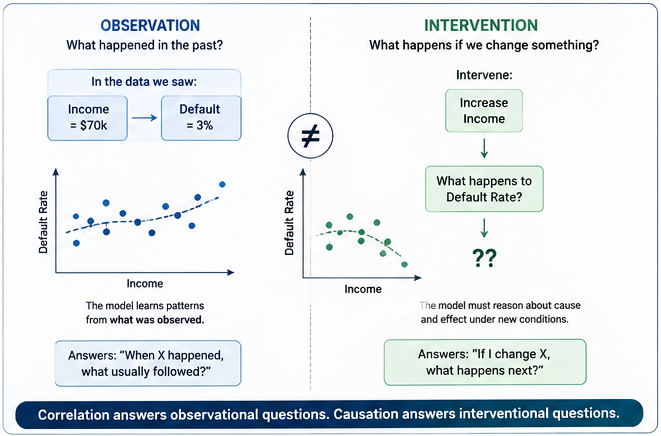
This distinction was formalized by Judea Pearl in his work on causal inference, but the practical implication for AI governance is immediate and operational: a model that can only answer observational questions cannot be steered. You can watch it. You cannot reason about what it will do next when conditions change.
Which Three Questions Expose the Governance Ceiling?
There are three governance questions that every enterprise AI deployment eventually faces. Correlation-based models can produce estimates in response to these questions, but those estimates are not grounded in explicit causal structure, which means they cannot independently support intervention-aware governance without external controls to compensate.
Question 1: If we change this policy, what will the model do?
A lender changes its underwriting policy, say, increasing the minimum income threshold. The correlation-based model was trained on historical data from before that change. The historical association between income level and default probability holds under the old policy regime, not the new one. The model has no internal mechanism to reason about the policy change. It continues generating predictions using patterns that are no longer valid.
You discover this through monitoring, by watching outcomes degrade, not through any reasoning capability in the model itself.
Question 2: Why did this specific decision happen?
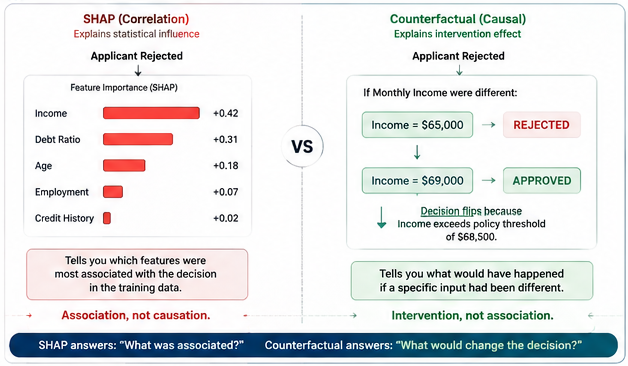
Post-hoc explainability tools like SHAP produce feature importance scores. They tell you which inputs had the highest statistical weight on the output. That is correlation, the inputs that most closely track the output in the model's learned representation.
Feature importance is not causation. A high SHAP value for a feature does not mean that feature caused the decision. It means the feature was statistically associated with the decision in the training data. SHAP explains statistical influence, which features moved with the outcome in training. Increasingly, regulated environments require reasoning that extends beyond statistical attribution to intervention-aware evidence: not which features were associated, but what would have changed the decision, and whether that change is actionable.
The Audit Note: The difference between SHAP and a causal trace is not a matter of technical sophistication. It is a distinction of what the evidence proves. SHAP says "these features moved together with this outcome in training." A causal trace says "this feature, at this value, caused this decision to flip." The first is a description of the training data. The second is intervention-aware evidence, grounded in causal structure, constrained to realistic changes, and defensible when the decision is challenged.
Question 3: Is the model still valid today?
Model drift detection works by monitoring statistical distributions over time. If the input distribution shifts beyond a threshold, an alert fires. That is again observation, watching what the inputs look like rather than understanding the model's behavior under those new conditions.
A model can pass all drift detection thresholds while being completely invalid for the current environment. The historical correlations it encoded may no longer reflect real-world causal relationships. You find out not because the model tells you, but because outcomes degrade and the monitoring system catches the signal, often weeks after the damage began.
Why Does Correlation Create an Irreducible Verification Burden?
The three questions above are not edge cases. They are the routine operational questions of any AI deployment that runs for more than a few months.
Because correlation-based models cannot answer them from the inside, every organization that deploys them must build an external verification apparatus to compensate. This is the pattern described in The Hidden Tax of Low-Trust AI: the verification spiral. Review queues, reconciliation logic, manual spot-checks, compliance audits, and escalation workflows that exist not because the business chose them, but because the system is structurally incapable of reasoning about its own validity.
The verification burden on a correlation-based model is not a product design failure. It is an architectural consequence. You are paying, in operational labor, for the reasoning capability the model does not have.
The cost is real and measurable. An organization running a correlation-based model in a regulated environment carries:
- Ongoing drift monitoring to detect when historical associations break down
- Manual review queues for decisions that produce high-confidence outputs on low-confidence grounds
- Post-hoc explainability labor when a decision is challenged and the model cannot explain itself
- Periodic retraining cycles triggered by monitoring signals rather than by any internal validity check
- Regulatory response overhead when the statistical nature of the explanation proves insufficient for the auditor
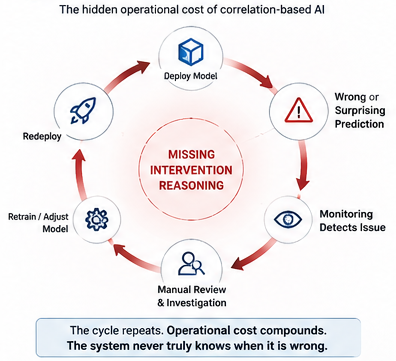
None of these costs appear in the original ROI model. All of them appear in the operating model by the time the system reaches production scale.
How Does Post-Hoc Explainability Differ from Causal Proof?
To understand the difference in practice, consider a lending decision where an applicant is rejected.
It is worth noting upfront: counterfactuals can be generated from correlation-based models too, tools like DiCE and Wachter et al. do exactly that. The critical distinction is not whether a counterfactual exists, but whether it respects the causal constraints of the real world, whether it only proposes interventions the applicant can actually make.
The Correlation-Based Explanation (SHAP):
Applicant rejected.

SHAP Feature Contribution:
- Monthly Income: +0.42
- Debt-to-Income Ratio: +0.31
- Length of Employment: +0.21
What this tells you: These features had the highest statistical weight in the model's output. It does not tell you whether changing any one of them would actually flip the decision, nor does it distinguish between features the applicant can change and features they cannot.
The Unconstrained Counterfactual (from a correlation-based model):
Applicant rejected.

Counterfactual:
- If Age decreased by 6 years AND Employment history increased by 3 years,
  the application would have been approved.
The problem: Age cannot be decreased. This counterfactual correctly identifies where the model's decision boundary sits, but proposes an intervention that is physically impossible. It tells you about the model's surface, not what the applicant can actually do.
The Causal Counterfactual (constraint-respecting):
Applicant rejected.

Causal Counterfactual (constrained to actionable interventions):
- If Monthly Income increased by $400 while existing debt remained unchanged,
  the application would have been approved.
- This intervention is feasible, financially consistent, and respects the
  directional causal relationships encoded in the model structure.
What this tells you: A decision boundary constrained to what is actually changeable. The applicant gets actionable recourse. The regulator gets a trail grounded in causal structure, not statistical boundary-seeking. That constraint is the product of having a causal graph, a model of which variables can influence which, and in what direction.
What Does AI Governance Look Like from the Inside?
This distinction produces a qualitatively different kind of system.
| Capability | Correlation Model | Causal Model |
|---|---|---|
| Answers observational questions | Yes | Yes |
| Estimates intervention outcomes | Yes (ungrounded) | Yes (grounded) |
| Supports counterfactual proof | No | Yes |
| Makes structural assumptions explicit | No | Yes |
| Produces defensible explanations | No | Yes |
| Governance mechanism | External surveillance | Internally testable reasoning |
The key phrase in that table is "internally testable reasoning." A correlation model encodes its assumptions implicitly, baked into weights and learned associations that cannot be inspected or tested directly. A causal model encodes its assumptions explicitly in a causal graph: which variables influence which, and in what direction. Explicit assumptions are testable. As new data arrives, those structural assumptions can be checked against incoming evidence. When they are violated, the system can flag structural drift before predictive accuracy collapses. That testability is the governance property, not any claim of autonomous self-awareness. This is the mechanism behind Causal Drift detection described in Stage 4 Maturity.
A correlation-based model fails silently when underlying relationships shift, remaining dependent on external outcomes monitoring. A causal system allows for testing of structural assumptions, enabling proactive detection and containment. That difference determines whether your governance program is proactive or reactive.
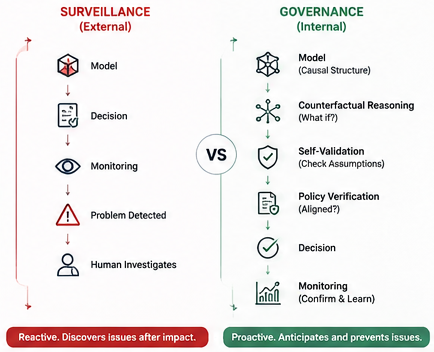
Counterfactual testing is the operational expression of this capability. When a lending model rejects an application, a causal model can answer: "If the applicant's bank statement gap had been zero days instead of forty-seven, would the decision have flipped?" That is a counterfactual test, not an estimate. It is a statement about what the system would have done under different conditions, and it is legally defensible in a way that feature importance scores are not.
Why Is Causal Structure a Hard Prerequisite for Incident Response?
The Architecture of Proof framework defines Layer 6 as Causal Diagnostics and Remediation, the capability to run 4-minute root cause analyses using causal traces and counterfactual tests. It is the incident response layer.
But Layer 6 has a prerequisite that the framework does not state explicitly: the upstream model must have been built causally for the causal trace to contain meaningful information.
A correlation-based model produces an audit log, not a causal trace. The audit log records what inputs entered, what the model's internal activations were, and what output emerged. If you replay that log, you learn what happened, you do not learn why it happened in any causal sense, and you cannot use it to answer what would have happened under different conditions.
The 4-minute RCA works because it replays a causal structure, not a data sequence. It answers: "This feature caused this decision to flip at this confidence threshold." That statement requires the model to have encoded causal relationships in the first place.
Audit trails without causal structure are forensic archaeology. You can reconstruct the sequence of events, but you cannot prove the mechanism. Causal traces let you run the experiment you didn't run. That is the difference between evidence and proof.
This is where the correlation problem intersects with governance maturity. Organizations at Stage 2 and 3, Replayable Evidence and Controlled Autonomy, may have sophisticated audit trails and escalation protocols. But if the underlying models are correlation-based, the audit trails cannot support the causal reasoning that Stage 4 requires. The governance ceiling is set not by the observability infrastructure, but by the internal structure of the model.

What Does This Mean for the AI Product Roadmap?
For AI product managers, the correlation problem reframes the governance question from a compliance checklist to an architectural decision.
The question is not "Do we have monitoring?" The question is: "Does our model have the internal structure to reason about interventions, or are we permanently dependent on external observation to catch what the model cannot tell us itself?"
This is not an argument that causal models are easy to build. Specifying a valid causal graph, the directional structure of which variables influence which, requires genuine domain expertise, and that structure can itself be wrong. Causal discovery algorithms exist to help infer structure from data, but they carry their own assumptions and fail under certain data conditions. The honest case for building causally is not that it costs less upfront. It is that the verification burden of a correlation-based model at regulated scale eventually exceeds the construction cost. The question is not whether to pay, it is when, and in what form: domain expert time during design, or operational labor compounding indefinitely in production.
The practical implication is phased:
At design time: Ask whether the domain requires answers to interventional questions. Lending, healthcare, insurance, fraud, and compliance almost always do. If the answer is yes, a correlation-based model is structurally insufficient, regardless of its accuracy on held-out data.
At build time: Require that the model's architecture encode directional relationships between variables, not just statistical associations. This is the difference between a model that learns from data and a model that learns the structure of the world from data.
At deployment time: Evaluate governance readiness not by monitoring coverage but by counterfactual capability. Can the model answer what would have happened if a specific input had been different? If not, the governance program is surveillance, not proof.
At scale: Recognize that the operational cost of a correlation-based model grows with deployment scope. Every new regulated domain, every new jurisdiction, every new audit requirement adds to the external verification burden. The causal alternative reduces that burden by moving verification capability inside the system.
The governance ceiling of a correlation-based model is not a model quality problem. It is a structural one. You cannot audit your way to causal proof. You have to build the causal structure in.
What Changes When You Shift from Surveillance to Governance?
Replacing correlation with causation is not a one-shot architectural migration. It is a design commitment that surfaces in specific, concrete decisions.
It surfaces when you decide whether a model needs to produce an explanation or a proof for a challenged decision.
It surfaces when you define what "model drift" means, whether it means the input distribution shifted or whether it means the causal relationships the model depends on have changed.
It surfaces when you scope a regulatory response, whether you are presenting statistical feature importance or a counterfactual test that demonstrates exactly why the decision was made and what would have changed it.
It surfaces when you design the escalation boundary, whether human review is triggered by a confidence threshold on a correlation-based output, or by a detected violation of a causal assumption that the model itself can identify.
In each case, the correlation-based answer is available faster, is easier to implement, and is cheaper in the short term. The causal answer is the one that holds up in an audit, under cross-examination, and at production scale when the world has changed.
Enterprise AI has spent the past decade optimizing prediction. The next decade will be defined by optimizing intervention. The systems that merely recognize patterns will continue to require ever-larger governance organizations around them. The systems that explicitly model cause and effect will increasingly absorb governance into their own architecture. The future of AI governance is not more monitoring. It is models that can reason about change before the world proves them wrong.
The PM's Causal vs. Correlation Decision Matrix: Defending High-Stakes Models in Model Risk Reviews
Product managers do not need a Ph.D. in causal inference to govern an AI product. They only need to know which structural questions to ask during sprint triage, PRD reviews, and Model Risk Management (MRM) sign-offs.
Before signing off on any production deployment in a regulated or high-stakes workflow, review these five core production vectors with engineering and data science teams:
| Production Workflow | Correlation Failure Mode (Surveillance Only) | Causal Counterfactual Required (Governance & Proof) | PM Go/No-Go Release Gate |
|---|---|---|---|
| Credit Underwriting & Lending | Rejection explanations generated via SHAP values show high weights on unchangeable or correlated features (e.g., zip code, tenure). | Actionable Recourse: Proves the minimal feasible intervention (e.g., "Pay down credit card balance by $1,200") that flips decision to approval. | NO-GO if adverse action notices cite unchangeable attributes or cannot generate feasible recourse under ECOA Regulation B. |
| Policy & Fee Schedule Changes | Model trained on historical interest rate regime predicts defaults using invalid baseline associations after prime rate hikes. | Intervention Simulation: Re-runs decision logic under simulated counterfactual rate hikes before applying to live accounts. | NO-GO if model performance cannot be tested against synthetic structural interventions prior to policy launch. |
| Fraud & Account Takeover | Blocking algorithms flag legitimate international travel because location change correlates with account takeover in historical logs. | Mechanism Attribution: Asserts whether anomaly originates from credential abuse versus benign user intent across causal graph paths. | NO-GO if false positive block rate on legitimate high-value users exceeds $0.5\%$ without explainable root cause. |
| Clinical / Claims Triage | Model deprioritizes low-income patients because lower historical healthcare spend is correlated with lower predicted severity. | Confounder Disentanglement: Explicitly models healthcare access barriers as a confounding node separate from clinical acuity. | NO-GO if protected demographic or socioeconomic status acts as an unhedged proxy for clinical need. |
| Customer Dispute Resolution | Automated refund agent uses past agent approval correlations, hallucinating credit issuance when customer uses specific keywords. | Deterministic State Invariants: Binds refund authority to explicit ledger balances and verified shipment status DAGs. | NO-GO if financial mutation thresholds rely on probabilistic confidence scores rather than verified deterministic prerequisites. |
If your team can answer these questions with demonstrable, intervention-aware evidence, you have an architecture of proof. If they can only show validation curves and feature importance charts, you have built an elaborate surveillance system carrying unhedged operational liability.
The Adversarial Stress-Test: Five Critical Inquiries
1. What is the strongest argument against this approach?
Constructing formal Structural Causal Models (SCMs) and Directed Acyclic Graphs (DAGs) requires exhaustive domain expert time, while deep neural networks and gradient-boosted trees trained on raw correlations frequently achieve superior predictive accuracy on benchmark holdouts at a fraction of the engineering setup cost.
The Practical Resolution: Adopt a hybrid causal architecture. Use high-capacity statistical models for raw representation learning and pattern recognition, but bind their operational execution to causal DAG perimeters that govern high-stakes intervention boundaries. By validating directional assumptions on key policy variables rather than attempting to graph thousands of micro-features, teams maintain high predictive power while preserving interventional explainability and adverse action compliance.
2. Under what circumstances would this fail?
Causal governance fails when the underlying causal graph is misspecified by domain experts (omitting confounding variables or inverting directional edges), or in high-dimensional unstructured domains (such as raw text or vision) where defining discrete causal variables and counterfactual bounds is mathematically intractable.
The Practical Resolution: Subject domain causal DAGs to automated statistical refutation tests (such as d-separation checks and placebo treatment refutations using libraries like DoWhy). For unstructured modalities, map embeddings into structured intermediate concept bottlenecks (e.g., extracting discrete financial metrics or clinical symptoms from text) before feeding decision logic, ensuring that interventional reasoning operates on explicit, testable variables.
3. What would a skeptical customer, client, or colleague object to?
Data science leaders will argue that modern explainability libraries (such as TreeSHAP and integrated gradients) already satisfy enterprise audit requirements, and that replacing them with counterfactual reasoning is an unnecessary theoretical luxury that complicates production inference.
The Practical Resolution: Demonstrate the legal and regulatory vulnerability of SHAP in adverse action defense. Regulators (under CFPB Circular 2022-03) explicitly reject ungrounded statistical importance scores as compliant explanations because SHAP cannot tell an applicant what actionable step would change their decision. Show data science teams that generating actionable counterfactuals directly protects the enterprise from non-compliance fines while improving customer trust.
4. Which alternative deserves more consideration?
Continuous empirical A/B testing and randomized controlled trials (RCTs) deployed at scale in production, which measure the true interventional effect of policy changes directly against live cohorts without needing explicit upfront causal graphs.
The Practical Resolution: Treat randomized experimentation as the empirical validation engine for causal DAGs rather than an alternative. While live A/B tests measure aggregate cohort reactions, they cannot explain individual high-stakes decisions or provide individual adverse action recourse. Integrating RCT telemetry into the causal graph continuously refines edge weights, combining population-level validation with individual decision traceability.
5. What am I assuming that may not be true?
This approach assumes that real-world business and economic environments exhibit stable causal mechanisms across time, whereas macroeconomic regime shifts, regulatory upheavals, and competitor innovations can alter the structural relationships between variables without warning.
The Practical Resolution: Instrument invariant causal prediction monitoring at runtime. Track the conditional independence relationships across variables in production telemetry: if an observed relationship between two nodes flips statistical significance while inputs remain normal, the system triggers a structural anomaly alarm, instantly downgrading the model from autonomous execution (Tier 4) to supervised human review (Tier 2).
One-Line Synthesis
Defensible AI governance requires causal structural models that simulate interventions and generate actionable counterfactuals before shifting production environments invalidate historical correlation patterns.
Frequently Asked Questions
What is the correlation problem in AI governance?
The correlation problem is the structural limitation of pattern-matching AI models: they learn what happened in historical data but cannot predict what would happen if you change an input or intervene in a process. Correlation-based models cannot independently support intervention-aware governance. They require external governance mechanisms to compensate for their inability to reason about interventions.
What is the difference between a correlation-based model and a causal model?
A correlation-based model identifies statistical associations between inputs and outputs in historical data. A causal model encodes the directional, interventional relationships between variables, it can answer 'what would happen if we changed X?' rather than just 'what pattern predicts Y?'. Causal models are a prerequisite for counterfactual proof.
Why can't you govern a correlation-based AI model without constant monitoring?
Because correlation-based models have no internal mechanism to reason about change. When the world shifts, new regulation, new customer behavior, new fraud pattern, the model's historical associations become invalid without warning. Governance requires knowing when and why a system's outputs are no longer trustworthy. Correlation cannot answer that question from the inside.
How does causal AI relate to Layer 6 of the Architecture of Proof?
Layer 6 (Causal Diagnostics) is the incident-response application of causal reasoning, it uses causal traces to diagnose failures after they happen. But causal traces only work if the upstream model was built causally. Correlation-based models produce audit logs, not causal traces. The correlation problem is the prerequisite: without causal structure in the model, Layer 6 has nothing meaningful to replay.
Subscribe to the Architecture of Proof Dispatch
Rigorous, decision-forcing systems engineering and AI governance monographs for technical leaders. Delivered periodically, zero spam.