Explainability vs. Traceability: The Anatomy of Forensic Debt in Enterprise AI
A Systems Engineering Blueprint for Chief Risk Officers, Principal AI Architects, and Enterprise Product Leaders
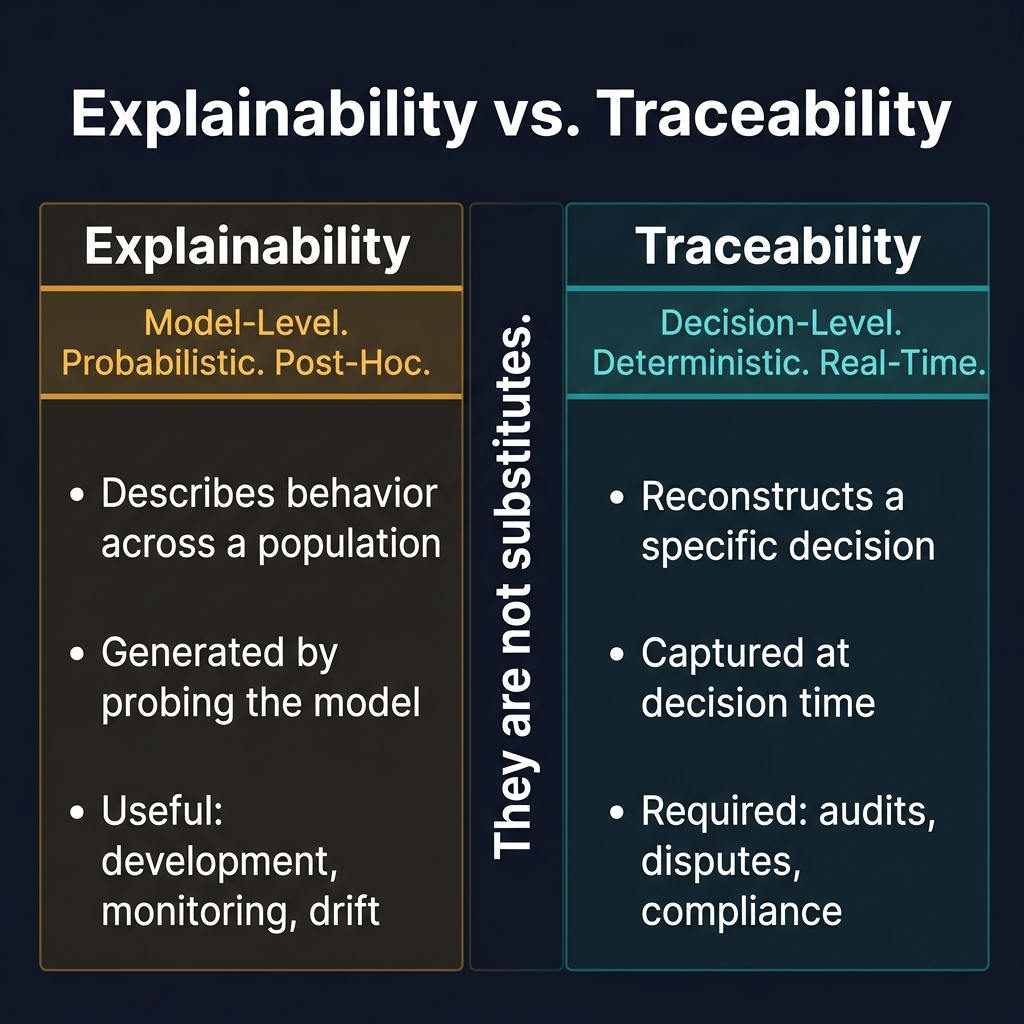
Explainability estimates how a model’s inputs relate to an output; traceability preserves the execution record of a specific decision. Neither proves that the decision was right; together, they make it possible to investigate, validate, and govern the system responsibly.
The Forensic Illusion: Why Does Feature Attribution Fail Under Audit?
The most dangerous assumption in modern AI governance is that integrating SHAP (SHapley Additive exPlanations) or LIME (Local Interpretable Model-agnostic Explanations) into an inference service satisfies the requirements of enterprise accountability.
Engineering squads frequently build elaborate monitoring dashboards displaying feature importance waterfalls. When product leaders or compliance officers ask, "Can we explain why the model rejected this applicant?", engineering points to the waterfall chart and declares the system explainable.
This is the Forensic Illusion.
Feature attribution methods were engineered for data scientists debugging model training dynamics. While essential for model development, fairness testing, and validation, post-hoc explainers were never designed to serve as standalone evidentiary records for legal defense, regulatory scrutiny, or production incident response.
| Architecture Dimension | Explainability (Model-Centric & Interpretability) | Traceability (System-Centric & Event Provenance) |
|---|---|---|
| Primary Question | What patterns and feature weights influenced the model's output? | What exact execution path, inputs, versions, and rules ran at this timestamp? |
| System Paradigm | Statistical Attribution: Approximates feature contribution via marginal permutations (KernelSHAP) or tree traversal (TreeSHAP). | Tamper-Evident Provenance: Captures an unalterable, correlated record of runtime state across the full distributed pipeline. |
| Execution Path | [Input X] → [Model f(x)] → [Output Y] with post-hoc attribution curves. |
[Input X] → [Perimeter Filter] → [RAG Context] → [Model Run] → [Human Gate] → [Output Y]. |
| Evidentiary Output | "Feature A contributed +0.14 relative to reference distribution $D_{\text{bg}}$." | Decision-Time Evidence Tuple Hash(D_7782): Versioned record of exact inputs, weights, prompts, and business rules at timestamp. |
| Regulatory Role | Helps formulate consumer-facing reason codes and test for demographic parity. | Provides tamper-evident auditability required for incident reconstruction and statutory record-keeping (EU AI Act Art. 12, FCRA). |
The fundamental limitation of relying solely on post-hoc explainers in high-stakes production environments stems from three mathematical and architectural realities:
1. Dependence on Synthetic Reference Distributions & Feature Correlation
Shapley values calculate the marginal contribution of a feature across all possible feature subsets:
$$\phi_i(v) = \sum_{S \subseteq N \setminus {i}} \frac{|S|!(|N| - |S| - 1)!}{|N|!} \left( v(S \cup {i}) - v(S) \right)$$
To evaluate $v(S)$ when features are omitted, perturbation-based explainers (such as KernelSHAP) must simulate missingness by sampling from a background reference dataset ($D_{\text{bg}}$). Consequently, the calculated explanation is not purely a function of the customer's application: it is conditional on the background distribution and baseline selected by an engineer.
When features are correlated, multiple variables carry overlapping mutual information. Altering the reference background or perturbation method may materially change the ranking of top adverse-action factors. In regulatory enforcement audits or litigation, an attribution metric whose output fluctuates based on background sampling assumptions cannot stand alone as a factual record of corporate conduct.
2. Inability to Trace Non-Model State Transitions
Modern AI systems are not isolated models; they are compound systems orchestrating deterministic rules, multi-hop vector retrievals, guardrails, and human supervisor overrides.
A SHAP chart explains only the isolated mathematical function of the neural network or gradient-boosted tree. It cannot explain whether a retrieval gateway returned stale cache, whether an upstream data pipeline truncated an account balance, or whether a human supervisor overrode a credit limit.
3. Post-Hoc Instability Under Model Retraining
If a customer disputes a transaction six months after it occurs, generating a post-hoc explanation requires re-evaluating the input against the active model.
If the model weights have been updated, fine-tuned, or rolled back, running an explainer today generates an explanation for how today's model would evaluate yesterday's input. It cannot reconstruct what actually occurred at decision time.
4. Adverse Action Compliance Requires Both Provenance and Translation
Under U.S. consumer financial protection laws (ECOA / FCRA) and CFPB Circular 2022-03, creditors using complex algorithms or AI must provide specific, accurate principal reasons for adverse decisions that reflect the factors actually considered or scored.
A post-hoc explanation run months after an event on updated model weights cannot prove which factors were active at decision time. Conversely, a raw execution trace proves which inputs and model versions were used, but cannot by itself explain complex non-linear feature interactions to a consumer.
The two capabilities are co-dependent: Traceability anchors the exact decision-time feature values, prompts, and model checkpoint, while validated explainability and scorecard mapping translate that frozen execution state into legally compliant, consumer-facing reason codes.
What Makes Up the Four-Part Evidence Architecture?
Enterprise AI accountability cannot be achieved through a single explainability library or an isolated server event log. Relying solely on model explanations creates procedural blindness; relying solely on execution traces creates substantive blindness:
A decision trace answers: "What software pipeline executed?" An explanation answers: "What factors materially drove the model's output?" Enterprise governance must also answer: "Was the action authorized, lawful, and substantively justified?"
High-consequence production systems require an integrated Four-Part Evidence Architecture:
$$\text{Enterprise Accountability} = \text{Execution Trace} + \text{Lineage} + \text{Model Explanation} + \text{Decision Justification}$$
| Evidence Layer | Core Question Answered | Primary Value & Artifacts | Primary Owner |
|---|---|---|---|
| 1. Execution Trace | What did the system do in this specific event? | Request ID, model hash, prompt template ID, retrieved chunk hashes, rule evaluations, human approvals, execution timestamp. | Platform Engineering & SRE |
| 2. Lineage & State | What data, features, and pipeline code shaped the run? | Training dataset version, feature store transform logic, model checkpoint registry, calibration reports. | Data & ML Engineering |
| 3. Explanation & Validation | What patterns drove output behavior across cohorts? | TreeSHAP/LIME feature attribution, reason-code logic, subgroup slice calibration, fairness curves. | Data Science & Model Risk |
| 4. Decision Justification | Was the action authorized, proportionate, and lawful in context? | Policy rules, statutory compliance checks, adverse-action disclosures, supervisor exception memos. | Product, Risk & Legal Stewards |
Traceability does not replace explainability, data lineage, or legal justification. Traceability is the foundational binding layer that locks the execution context so that lineage can be proven, explanations can be audited, and decisions can be justified under scrutiny.
How Does Forensic Debt Compound Across Production Systems?
When an enterprise chooses to rely on explainability in place of traceability, it incurs Forensic Debt.
| Lifecycle Stage | Operational Posture & Governance Illusion | Forensic Debt Incurred |
|---|---|---|
| Day 1: Launch | "We added SHAP dashboards; compliance obligations are satisfied." | Zero Upfront Traceability: No immutable record of exact context chunks or prompt IDs. |
| Month 6: Drift | Model retrained 3 times; vector embeddings updated 14 times. | Compounding Liability: 1.2M unlinked decisions emitted with zero historical state pinning. |
| Month 12: Subpoena | Regulators demand the exact deterministic basis for 45 adverse credit decisions. | Emergency Multiplier: Reconstructing state requires 80+ senior engineering hours and $420,000+ in forensic triage. |
Forensic Debt is the accumulated investigation liability created when decisions are emitted without an immutable record of their operating context. Like technical debt, forensic debt allows teams to ship features rapidly in the short term by skipping the engineering required to build deterministic audit pipelines.
However, unlike technical debt (which degrades code maintainability), forensic debt matures under hostile conditions:
-
A regulatory subpoena demanding evidence under the Fair Credit Reporting Act (FCRA) or EU AI Act Article 12.
-
An enterprise customer disputing an ungrounded commercial contract hallucination.
-
An active security incident where an agent executed an unauthorized financial transfer.
When forensic debt comes due, the engineering cost is catastrophic. Senior engineers, data scientists, and legal counsel spend weeks attempting to reconstruct historical database snapshots, reverse-engineer model weights, and guess which prompt templates were active at a specific timestamp.
How Do Post-Hoc and Traceable Systems Behave During a Live Incident?
To understand how Forensic Debt impacts operational reality, examine how two organizations investigate the exact same critical production incident:
The Scenario
On October 14, an autonomous financial fraud detection pipeline flags a high-volume enterprise customer’s payroll disbursement of $420,000 as money laundering, automatically freezing the account and canceling critical vendor wires. The customer threatens immediate litigation. Executive leadership demands an explanation: Why did the system flag this transaction, what exact data triggered the freeze, and did the model or the perimeter rules make the call?
Organization Alpha: Governed by Post-Hoc Explainability
Organization Alpha deployed a frontier XGBoost + LLM pipeline with a real-time SHAP explainer dashboard.
The Investigation Protocol:
-
Hour 1–4: The support team pulls up the SHAP dashboard for Transaction
#TX-9941. The dashboard displays a red bar indicating thatvelocity_7dcontributed $+0.32$ to the fraud risk score, whileaccount_tenurecontributed $-0.18$. -
Hour 5–12: Legal reviews the SHAP output. Counsel points out that the customer’s 7-day transaction velocity was well within normal historical parameters. Why did
velocity_7dspike the risk score? The data science team is summoned. -
Day 2–4: The data science team discovers that the model running in production was retrained forty-eight hours prior to the incident. The SHAP dashboard was re-computing feature attribution dynamically using the new model weights and the current month’s background reference set. When applied to
#TX-9941, the explanation is an artifact of the new model, not the one that executed the freeze. -
Week 2: SRE attempts to restore the exact model artifact and database state from October 14. They discover that while the model weights were archived, the vector database embeddings and the intermediate JSON payloads passed between the ingestion microservice and the model were not logged to prevent disk bloat.
-
Week 3 (Outcome): After 80 engineer-hours across six senior staff members, the team presents an inconclusive finding: "The model likely experienced a feature collision exacerbated by a background distribution shift." The enterprise customer terminates their account; legal settles the dispute under adverse terms.
Organization Beta: Governed by the Architecture of Proof
Organization Beta deployed the same core ML pipeline but enclosed it within an immutable decision-trace architecture as outlined in Audit Trails for AI.
The Investigation Protocol:
- Minute 1: The incident engineer queries the unique decision identifier:
aop-trace-cli get --decision-id TX-9941
- Minute 2: The system retrieves the cryptographically verified Causal Trace Package:
json
  {
    "decision_id": "TX-9941",
    "timestamp_utc": "2026-10-14T08:14:22.104Z",
    "perimeter_verification": {
      "account_authorization_check": "PASSED (entitlement_scope: WIRE_DISBURSEMENT)",
      "schema_conformance": "PASSED (schema_v2.4)",
      "double_entry_balance_check": "PASSED (debit_credit_delta: $0.00)"
    },
    "retrieval_context": {
      "cache_node_id": "redis-prod-04",
      "cache_hit_status": "STALE_CACHE_REVISE",
      "context_chunk_hash": "sha256:e3b0c44298fc1c149afbf4c8996fb92427ae41e4649b934ca495991b7852b855"
    },
    "model_execution": {
      "model_id": "fraud-classifier-xgboost",
      "model_checkpoint_sha256": "sha256:7f83b1657ff1fc53b92dc18148a1d65dfc2d4b1fa3d677284addd200126d9069",
      "inference_seed": 42,
      "raw_probability_score": 0.841
    },
    "system_rules": {
      "hard_circuit_breaker_fired": "RULE-104: VELOCITY_ANOMALY_OVERRIDE",
      "rule_input_value": 420000,
      "rule_threshold": 250000
    },
    "human_supervision": {
      "tier": "Tier 3: Autonomous Execution",
      "override_engaged": false
    }
  }
-
Minute 4 (Proximate Execution Path Isolated): The trace immediately transforms an open-ended crisis into a bounded investigation. The model did not trigger the freeze: the raw ML probability score ($0.841$) was below the autonomous action threshold ($0.90$). The account freeze was triggered deterministically by
RULE-104because an upstream cache failure atredis-prod-04returned an un-cleared batch transaction flag from seventy-two hours prior. -
Minute 15 (Investigation Bounded & Remediated): SRE isolates the cache invalidation race condition. Legal provides the customer with the verified execution-path trace within two hours of the complaint, demonstrating that the failure was an isolated cache race condition rather than an ungrounded model hallucination or discriminatory profile. The customer accepts the technical post-mortem, sees the issue isolated, and remains on the platform.
Total triage time to isolate proximate cause: 15 minutes. Forensic debt incurred: Contained.
What Belongs in a Causal Decision Trace?
To build an AI architecture capable of withstanding regulatory audits and operational crises, teams must implement the four layers of the Causal Decision Trace:
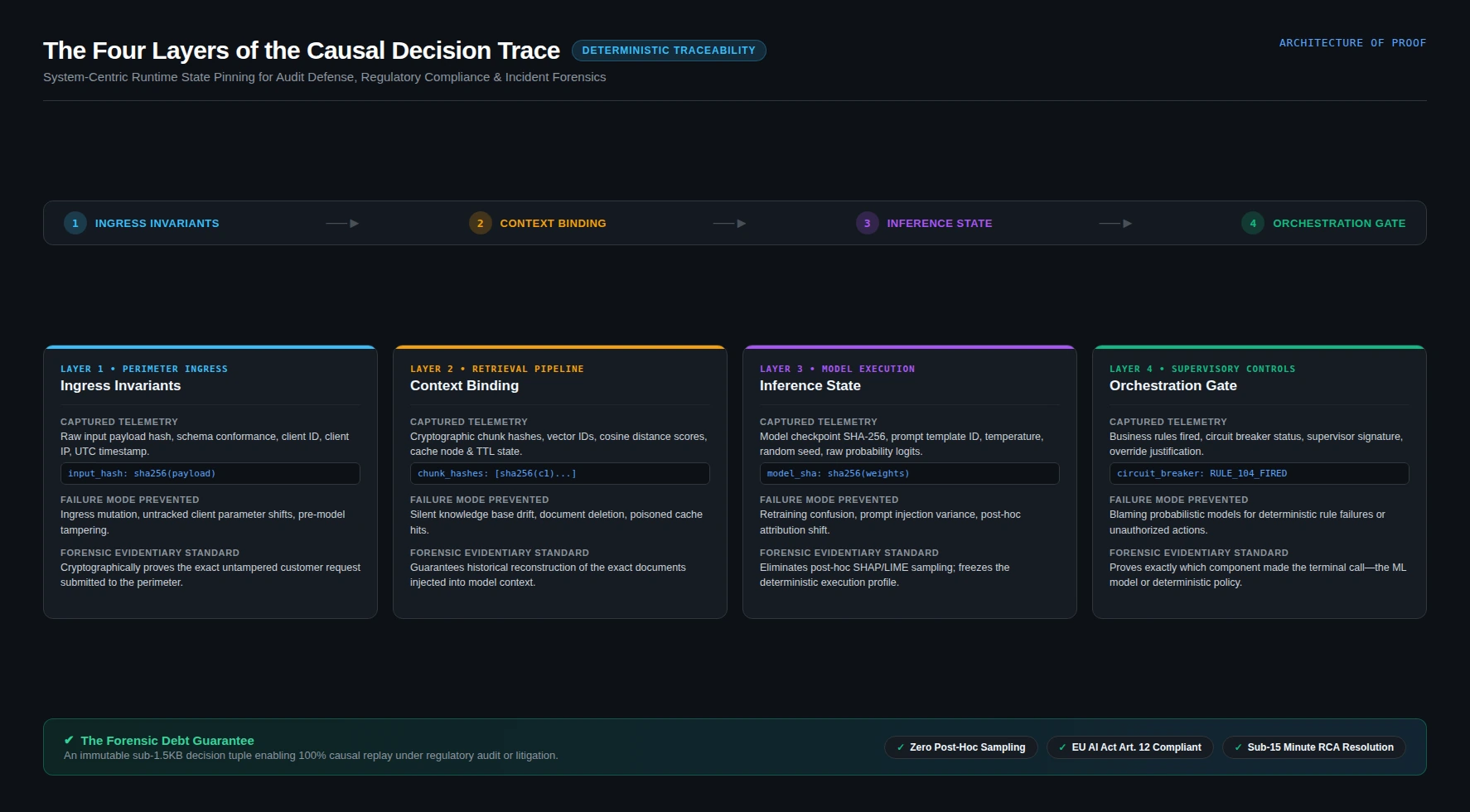
| Pipeline Layer | Telemetry Vector Captured | Primary Failure Mode Prevented | Forensic Evidentiary Standard |
|---|---|---|---|
| 1. Ingress Invariants | Raw payload SHA-256, schema grammar conformance, client ID, client IP, UTC timestamp. | Ingress payload mutation, untracked client parameter shifts, pre-model tampering. | Cryptographically proves the exact untampered customer request submitted to the perimeter. |
| 2. Context Binding | Cryptographic chunk hashes, vector IDs, cosine distance scores, cache node & TTL state. | Silent knowledge base drift, document deletion, poisoned cache hits. | Guarantees historical reconstruction of the exact documents injected into model context. |
| 3. Inference State | Model checkpoint SHA-256, prompt template ID, temperature, random seed, raw probability logits. | Retraining confusion, prompt injection variance, post-hoc attribution shift. | Eliminates post-hoc SHAP/LIME sampling; freezes the deterministic execution profile. |
| 4. Orchestration Gate | Business rules fired, circuit breaker status, supervisor signature, override justification. | Blaming probabilistic models for deterministic rule failures or unauthorized actions. | Proves exactly which component made the terminal call: the ML model or deterministic policy. |
1. Ingress Invariants
Captures the raw, untampered input state before any transformation, prompt formatting, or embedding generation occurs. Any divergence between what the customer sent and what the system processed is recorded here.
2. Retrieval & Context Binding
In RAG systems, the model's output is governed by the documents injected into its context window. A causal trace must record the cryptographic hashes of every retrieved text chunk.
If a document in the knowledge base is edited or deleted tomorrow, the trace preserves the exact historical information the model consumed at decision time.
3. Inference State Capture
Records the deterministic identity of the model itself:
-
Model artifact hash (preventing confusion across retraining runs).
-
Prompt template version ID and system instructions.
-
Inference hyperparameters (temperature, top-p, frequency penalties, random seed).
-
Raw scalar probability scores before threshold discretization.
4. Orchestration & Supervisory Contracts
Documents the complete decision topology outside the model:
-
Which deterministic business rules evaluated the model output?
-
Did any safety perimeter or unit economics ceiling trigger an intervention?
-
Was the decision routed to a human operator, and what did that operator review?
What Can Traceability Prove—and What Remains Outside Its Scope?
A frequent objection to traceability is: "Can a causal decision trace prove that an LLM's diagnostic reasoning or credit rationale was objectively correct?"
The answer is no. Claiming that software can deterministically prove the correctness of complex, subjective, or open-ended reasoning is an epistemological trap. Many consequential business decisions (such as whether a loan memo is sufficiently conservative, a customer communication is empathetic, or a legal summary captured strategic nuance) cannot be mathematically verified.
A robust governance architecture operates across Three Distinct Evidentiary Tiers:
| Evidentiary Tier | Nature of the Verification | Concrete System Elements | Evidentiary Standard Under Audit |
|---|---|---|---|
| Tier 1: Mechanically Provable | Deterministic mathematical verification. | Schema validity, arithmetic calculations, payload SHA-256 hashes, citation character-offset bounds, circuit breaker state, execution timestamps. | 100% Deterministic: The state either precisely conforms to programmatic invariants or halts immediately. |
| Tier 2: Empirically Validated | Continuous statistical verification across distributions. | Task completion rates, Calibrated Refusal Quality (CRQ), P95 latency bounds, embedding drift, token density ratios ($\ge 0.65$). | Bounded Confidence: The system operates within pre-authorized operational and safety failure envelopes. |
| Tier 3: Expert Assessed | Qualitative human judgment and domain evaluation. | Clinical diagnostic nuance, legal risk synthesis, underwriting discretion, customer tone, narrative coherence. | Admissibility & Inter-Rater Consensus: Double-blind expert review with measured agreement thresholds ($\kappa \ge 0.75$). |
The Core Architectural Insight
Traceability does not attempt to automate Tier 3 or reduce human expertise to mechanical proofs.
Instead, Traceability's critical function is to deterministically pin Tier 1 and empirically bound Tier 2, creating an uncorrupted factual foundation that makes Tier 3 expert judgment possible.
Without traceability, domain experts auditing an incident are reviewing synthetic ghost records against shifting background baselines. With traceability, they inspect the exact historical snapshot under complete forensic certainty.
Critical Architectural Boundary: A decision trace does not prove that a model's output was wise, fair, lawful, or optimal. It preserves an uncorrupted, tamper-evident record of the observed execution path: what inputs entered the perimeter, what model checkpoint ran, what context chunks were bound, which policy assertions passed or failed, and what human operator signatures authorized the final action.
How Should Product Managers Choose Between Explainability and Traceability?
Use this matrix to allocate engineering resources and architectural priorities across your product portfolio:
| Operational Scenario | Primary Requirement | Why the Alternative Fails | Architectural Mechanism |
|---|---|---|---|
| Model Feature Selection & Debugging | Explainability (SHAP, LIME) | Traceability produces raw execution logs; it cannot tell data scientists which features are noisy or correlated. | Global feature importance waterfalls; partial dependence plots. |
| Adverse Action Disclosures (ECOA / FCRA) | Co-Dependent Integration | Traceability provides frozen decision-time inputs and model versions; explainers translate complex feature interactions into consumer reason codes. | Versioned decision tuples bound to calibrated scorecard reason-code generation logic. |
| Production Incident Root Cause Analysis | Traceability | Explainers show what current model weights think; they cannot expose cache failures, upstream API bugs, or rule breaches. | Causal decision tuples indexed by transaction ID; replayable event logs. |
| Population Fairness & Bias Monitoring | Explainability | Individual decision traces are too granular to surface macro-demographic disparities across populations. | Disaggregated slice analysis; demographic parity evaluations. |
| Regulatory Audit & Incident Inquiries | Traceability | Post-hoc algorithmic approximations cannot establish the procedural facts of what actually executed. | Cryptographically signed, tamper-evident audit packages supporting EU AI Act Art. 12 obligations. |
| LLM Hallucination Mitigation | Traceability | Asking an LLM to explain why it hallucinated generates a second, sycophantic hallucination. | Context chunk offset tracking; deterministic citation validation. |
The PM's Forensic Audit Matrix: 5 Questions for Cross-Functional PRD Reviews
Before approving any PRD that deploys probabilistic scoring or generative reasoning into production workflows, the lead PM should run this forensic audit gate across Engineering, Legal, and Risk:
| Review Gate Question | Stakeholder Lead | Go / No-Go Threshold | Required PRD Artifact |
|---|---|---|---|
| 1. Is the decision payload cryptographically pinned at runtime? | Staff Platform / Data Eng | Strict Gate: Raw ingress JSON, model checkpoint hash, and prompt template ID must be indexed into a tamper-evident tuple before downstream action execution. | JSON Causal Trace schema definition and Hot Index retention SLA ($< 2$ KB payload). |
| 2. Does the feature generate adverse-action or customer disclosures? | Regulatory Counsel / Compliance | Strict Gate: If adverse action applies (ECOA, FCRA, EU AI Act), reason codes must bind to decision-time feature values, never recomputed post-hoc. | Validated mapping table from score delta/TreeSHAP output to deterministic regulatory reason codes. |
| 3. Can an on-call engineer isolate non-model failures in under 15 minutes? | SRE / DevOps Lead | Operational Gate: System must distinguish cache hits, upstream schema shifts, and rule circuit breakers from pure model scoring anomalies. | Runbook protocol specifying CLI/API query path for decision_id with sub-15-minute MTTR SLA. |
| 4. What happens when an individual requests GDPR Article 17 erasure? | Security & Privacy Officer | Compliance Gate: Audit trails must support cryptographic erasure (per-tenant/user key destruction) without invalidating the immutable ledger sequence. | Key management protocol document detailing envelope encryption and erasure mechanisms. |
| 5. Are Tier 3 qualitative evaluations bounded by deterministic Tier 1 gates? | Principal PM & Risk Lead | Architectural Gate: High-stakes actions cannot rely solely on open-ended LLM confidence scores without programmatic perimeter validation (e.g., balance delta $= 0$). | Defined boundary rules and circuit breaker specification table. |
How Is Tiered Evidence Storage Implemented in Production?
Building enterprise traceability does not require storing petabytes of raw uncompressed video or unbounded text streams in expensive transactional databases. High-performance teams implement The Tiered Evidence Storage Model:
| Evidence Tier | Data Payload Retained | Storage Posture & Latency | Lifecycle & Access Governance |
|---|---|---|---|
| 1. Hot Decision Index | Decision UUID, input hash, model artifact SHA-256, chunk hashes, rule triggers, timestamp. | Ultra-fast relational/document query store (sub-2 KB per transaction record). | Strictly access-controlled (RBAC); indexed for real-time compliance lookup and incident queries. |
| 2. Warm Evidence Store | Serialized transformed inputs, structured JSON model outputs, rule evaluations, approval signatures. | Encrypted object storage (S3/GCS) with KMS envelope encryption. | Automated lifecycle retention policies; restricted access scoped to active investigations. |
| 3. Cold Reconstruction Archive | Base model weights snapshots, prompt version control repositories, point-in-time vector embedding corpora. | Immutable, version-addressable archive storage (e.g., Glacier / cold vaults). | Retained per regulatory audit mandates; accessed only during formal depositions or forensic reconstructions. |
# The Immutable Decision Record Schema (Hot Index Layer)
class CausalTraceTuple(BaseModel):
    decision_id: UUID
    timestamp_utc: datetime
    input_hash: str              # SHA-256 of raw ingress payload
    perimeter_status: str        # e.g., "PASSED_LEDGER_RECONCILIATION"
    retrieval_chunk_hashes: List[str] # Hashes of RAG context documents
    model_manifest: ModelManifestRef  # Checkpoint SHA-256, prompt_id, seed
    raw_output_hash: str         # SHA-256 of structured model output
    rules_evaluated: List[RuleResult] # State of deterministic business logic
    supervisor_action: Optional[SupervisorSignature]
Privacy, Data Minimization & Retention Liability (EU AI Act Art. 12 & GDPR)
A logging system that indiscriminately records raw customer PII, credit card details, or medical records is not a governance asset; it is a high-value breach target and regulatory liability.
Enterprise audit architectures resolve this tension through three controls:
- Data Minimization: Retain salted hashes and structured semantic features rather than raw plaintext payloads whenever possible.
- Cryptographic Erasure: Encrypt customer-specific payload traces with dedicated per-user or per-session keys. When an individual exercises a GDPR Article 17 "Right to Erasure" or data-deletion request, destroying the encryption key renders the payload permanently unrecoverable while preserving the tamper-evident integrity of the audit ledger.
- Proportionate Retention: Logging must strictly reflect the risk tier and operational lifecycle of the system. Systems operating under EU AI Act Article 12 require event-logging capabilities appropriate to their intended purpose and post-market monitoring needs, not unbounded, indefinite hoarding of sensitive runtime telemetry.
What Are the Five Invariants of Defensible Governance?
- Explainability Supports Model Understanding; Traceability Supports Operational Accountability: Use explainability tools to validate, calibrate, and interpret your models. Use traceability infrastructure to preserve the tamper-evident execution record of production decisions.
- Never Substitute a Later Rerun for Decision-Time Records: Rerunning a model against current weights, updated context corpora, or modified reference baselines produces an ungrounded simulation. Only data pinned at decision time constitutes historical evidence.
- Capture the Full System Topology, Not Just the Model: Many consequential production failures originate outside the model: in caching layers, retrieval pipelines, business rules, and input corruption. Trace the entire computational graph.
- Anchor Explanations to Versioned, Decision-Time State: For regulatory compliance (such as ECOA adverse action), model-explanation and reason-code logic must be bound directly to the verified inputs and model checkpoint that executed the transaction.
- Architect Tiered Evidence Storage Upfront: Do not treat logging as free or unstructured. Design explicit Hot, Warm, and Cold evidence tiers with strict data minimization, cryptographic erasure, and lifecycle retention policies.
The Adversarial Stress-Test: What Could Break This Framework?
1. What is the strongest argument against this approach?
Prioritizing forensic decision traceability over explainability creates an "audit trap" where organizations capture immaculate, immutable records of catastrophic mistakes without understanding why the underlying neural network made the error. If product and ML teams dedicate their engineering budgets to distributed tracing pipelines rather than model alignment, interpretability research, and calibration testing, the system remains a dangerous black box that simply logs its failures with high precision.
The Practical Resolution: Treat explainability and traceability as co-dependent engineering tracks. Allocate telemetry budgets to capture decision-time state, while using that frozen state to feed offline interpretability harnesses, continuous calibration checks, and demographic fairness evaluations before promoting models to higher autonomy tiers.
2. Under what circumstances would this fail?
This architecture fails in high-consequence edge cases where the causal trace is technically flawless, but human reviewers lack the cognitive ability or domain context to interpret the serialized state vector during an incident. When multi-agent systems interact across dozens of asynchronous tool calls, reading a multi-megabyte JSON causal trace during an outage introduces cognitive paralysis, causing engineers to fall back on superficial intuition anyway.
The Practical Resolution: Build automated diagnostic summarizers and visualization projection tools into the incident response console. Ingest raw execution traces and compile them into visual dependency DAGs, highlighting anomalous state deltas, failed rule evaluations, and confidence drops in plain visual terms for on-call engineers.
3. What would a skeptical customer, client, or colleague object to?
A skeptical compliance officer or enterprise buyer will argue that regulators and consumers do not want raw execution hashes, seed parameters, or DAG execution graphs; they want simple, human-understandable explanations for why an adverse action occurred. Handing an aggrieved loan applicant or clinical patient a cryptographically signed execution tuple rather than an intuitive reason code will be perceived as technical obfuscation.
The Practical Resolution: Bind execution traces directly to consumer-facing scorecard logic. Use the frozen decision trace as the evidentiary anchor, and feed its verified feature values into deterministic reason-code generators (such as CFPB-compliant adverse action engines) that produce plain-language disclosures backed by verifiable mathematical proof.
4. Which alternative deserves more consideration?
Inherently Interpretable Architectures (such as Generalized Additive Models with structured interactions, or Glass-box Rule-augmented Networks) over complex black-box models with external traceability harnesses. By constraining the model architecture itself to be transparent and monotonic by design, organizations eliminate both the instability of post-hoc explainers (SHAP/LIME) and the massive operational storage overhead of full-state forensic tracing.
The Practical Resolution: Deploy inherently interpretable models (such as EBMs or constrained rule lists) as the default baseline for tabular credit scoring and actuarial underwriting. Reserve deep black-box models and comprehensive state-tracing harnesses for unstructured text, vision, and complex multi-modal domains where additive models lack sufficient discriminative power.
5. What am I assuming that may not be true?
This architecture assumes that infrastructure components (such as Redis caches, vector databases, and API gateways) can be cleanly instrumented with cryptographic tamper seals without introducing prohibitive latency penalties into real-time decision flows. In distributed architectures handling millions of requests per second, serializing and hashing full context payloads at the boundary can breach P99 latency budgets.
The Practical Resolution: Implement asynchronous trace hashing and decoupled reference stores. Compute cryptographic hashes over streaming payloads in non-blocking worker threads, or persist lightweight Merkle roots during hot-path inference while streaming heavy context blobs into asynchronous object stores.
One-Line Synthesis
Model explainability analyzes statistical behavior across populations, but decision traceability provides the immutable evidence of what a system executed in a specific transaction.
Frequently Asked Questions
Why is a post-hoc explanation like SHAP or LIME insufficient for regulatory adverse action notices?
Post-hoc explainers approximate how a model behaves across background reference distributions; they do not record what the system actually computed at execution time. Under statutes like the Equal Credit Opportunity Act (ECOA) or FCRA, adverse action disclosures must cite the actual, unalterable factors that caused an individual consumer's adverse decision. If the underlying model or reference background shifts, post-hoc explanations can emit contradictory attribution weights for the exact same transaction.
What is Forensic Debt in enterprise AI systems?
Forensic Debt is the accumulated investigation liability incurred when an organization deploys probabilistic models without immutable, decision-time execution traces. While teams save engineering time upfront by relying on off-the-shelf explainability libraries, they defer the massive operational cost of manually reconstructing disparate logs, prompt versions, and context chunks during security incidents or regulatory audits.
What constitutes a deterministic causal trace?
A causal trace is an immutable, cryptographically verifiable record captured at decision time that binds together the exact input payload, the deterministic perimeter validation status, the retrieved context chunk hashes, the model checkpoint hash and inference seed, the rules that fired, and any downstream human operator overrides into a single indexed decision tuple.
Subscribe to the Architecture of Proof Dispatch
Rigorous, decision-forcing systems engineering and AI governance monographs for technical leaders. Delivered periodically, zero spam.