The AI Model Review Playbook: The Promotion Gate Protocol for Production Systems
An Operational Governance Blueprint for Principal AI Architects, Model Risk Stewards, and Senior Product Leaders
Offline validation establishes evidence that a model performs against defined historical tests. It does not establish that the deployed decision system will behave acceptably under real production loads, changing distributions, software integrations, user behavior, and action consequences. We do not promote models; we authorize verified decision systems within bounded operating envelopes.
Why Do High Benchmark Scores Ship Fragile Systems?
The most pervasive failure mode in enterprise AI deployments is the Validation Fallacy: the belief that a model exhibiting superior offline statistical performance has earned autonomous production authority.
Data science squads spend months optimizing loss curves, tuning hyperparameters, and engineering features to squeeze an additional 2.5% in Area Under the Curve (AUC) or benchmark accuracy. When the test set confirms this gain, the team submits an evaluation summary and requests immediate production release.
Three weeks later, the system fails in production:
-
A credit decisioning model exhibits severe demographic miscalibration during an unexpected interest rate shift.
-
An LLM-based customer escalation agent hallucinates unapproved financial concessions when prompted with nested edge cases.
-
A document extraction service hits concurrency limits, causing upstream API gateways to time out and drop incoming customer transactions.
-
An automated underwriting engine accurately predicts short-term delinquency while systematically denying viable borrowers because its training labels encode historical exclusion.
The model did not fail because its weights were mathematically flawed. It failed because offline validation tests static data artifacts, while production tests dynamic system boundaries, conceptual soundness, and human-in-the-loop workflows.
| Verification Dimension | Offline Model Validation | The Promotion Gate Protocol (Operational Assurance) |
|---|---|---|
| Primary Evaluation Scope | Static test set loss and ranking metrics (e.g., AUC, F1). | Dynamic behavioral invariants, conceptual soundness, and operational failure envelopes. |
| Gate 0 (Conceptual Soundness) | Implicitly assumed or deferred to product managers. | Independent verification of target validity, label integrity, legal basis, and baseline comparison. |
| Gate 1 (Statistical Calibration) | Train / validation convergence on historical distribution. | Population stability triggers, probabilistic calibration scoring, and sub-cohort error parity. |
| Gate 2 (Operational Contracts) | Synthetic unit tests on isolated mock payloads. | Concurrency stress under peak load, P95 latency budgets, grammar decoding, and circuit breakers. |
| Gate 3 (Adversarial Robustness) | Benchmark leaderboards and held-out test splits. | Invariant stress, anti-sycophancy probes, and Calibrated Refusal Quality across edge cases. |
| Gate 4 (Traceability & Control) | Git commit hash and static checkpoint registry. | Immutable audit trail schemas, override telemetry, fast circuit breakers, and delayed reconciliation. |
Avoiding "Governance Theater With Better Metrics"
A rigorous critique of AI governance must confront its own failure mode: governance theater with better metrics.
If a squad clears four technical gates, generates a polished proof package, and receives formal sign-off while the underlying model optimizes the wrong business proxy, relies on legally discriminatory features, or outsources human judgment to an opaque algorithm, the protocol has merely replaced one fallacy with another:
The Validation Fallacy:
"The AUC is 0.89, therefore we are safe."↓ (Replacing one false certainty with another)
The Governance Theater Fallacy:
"All four gates passed, therefore the system has earned operational authority."
A skeptical Chief Risk Officer (CRO) will immediately ask:
"You have instrumented calibration, latency, adversarial red-teaming, tracing, and circuit breakers. Where is the independent assessment that the model should exist, that the target is valid, that the features are appropriate, that the business process has not outsourced accountability to a probabilistic engine, and that customer recourse actually works?"
Mature model risk frameworks, such as Federal Reserve SR 11-7 / SR 26-02 and the NIST AI Risk Management Framework (AI RMF 100-1), emphasize that validation is fundamentally centered on conceptual soundness, ongoing monitoring, and outcomes analysis, not one-time technical checklists.
Therefore, the foundational organizing principle of this playbook is:
Promotion gates do not certify a model. They establish the minimum verifiable evidence required to authorize a defined system behavior, for a defined use case, within a defined scope, subject to continuous challenge, monitoring, and revocation.
The Promotion Object: Deployed Decision System vs. Model Checkpoint
A pervasive source of governance confusion is conflating the model artifact with the production system. We do not promote a candidate checkpoint, a fine-tuned LoRA adapter, or a compound prompt chain in isolation.
The review unit is the Production Decision System, encompassing eight coupled operational layers:
-
Model Artifact: Weights, architecture, parameter scaling, and calibration maps.
-
Data Pipelines: Feature freshness, schema lineage, and input transformations.
-
Retrieval & Prompt Scaffolding: Context assembly, system prompts, and semantic grounding.
-
Tool Interfaces: Permissions, structured schemas, and external API integrations.
-
Perimeter Controls: Circuit breakers, rate limits, and deterministic guardrails.
-
User Interface & Presentation Framing: Confidence display, uncertainty indicators, and user disclosures.
-
Human Roles & Escalation Workflows: Reviewer capacity, override authority, and appeal paths.
-
Decision Policy Logic: Action thresholds, risk cutoffs, and pre-authorized fallback routes.
A model artifact can be mathematically valid while the user interface dangerously inflates user overreliance. A prompt chain can be strictly typed while the business cutoff threshold denies credit to viable applicants. The Promotion Gate Protocol evaluates the entire compound system.
Risk-Tiered Deployment Contexts: Not Every System Needs High-Stakes Gating
Applying high-consequence financial gating to an internal drafting assistant creates organizational paralysis; applying lightweight discovery standards to autonomous credit underwriting creates catastrophic enterprise exposure.
The Promotion Gate Protocol must be calibrated to the system's operational consequence:
| Operational Context | Intended System Use | Release & Verification Standard | Required Governance Review |
|---|---|---|---|
| 1. Sandbox / Discovery | Isolated data, non-consequential exploratory research, early design validation. | Basic input/output logging, user consent, no consequential action authority, synthetic test data. | Squad Lead sign-off; no formal governance board gating. |
| 2. Internal Assistive Tool | Internal drafting, search copilots, research summarization with mandatory human sign-off. | Permitted-use compliance, basic evaluation benchmarks, explicit human decision ownership, feedback loops. | Peer engineering review and team product owner sign-off. |
| 3. Customer Copilot | Customer-facing advisory, conversational support, interactive guidance. | Task-specific evaluation, Calibrated Refusal Quality, clear scope disclosure, fast escalation routes. | Product, Risk, and Security review; Gate 1, Gate 2, and Gate 3 verification. |
| 4. Bounded Automation | Programmatic operations within strict thresholds (e.g., invoice reconciliation $\le \$5,000$). | Deterministic schema decoding, hard financial limits, complete audit tracing, automated rollback hooks. | Formal Promotion Gate Protocol (Gates 0–4); Bounded Autonomy sign-off. |
| 5. High-Consequence Autonomy | Consequential decisions (lending, medical triage, legal compliance, system execution). | Full independent validation, conceptual soundness proof, adversarial red-teaming, dual-speed control. | Independent Model Validation Board + Executive Risk Steward approval. |
The Promotion Gate Protocol: Five Release Gates
The Promotion Gate Protocol structures authorization across five distinct evidence domains: Gate 0 (Conceptual Soundness) followed by Gates 1 through 4.
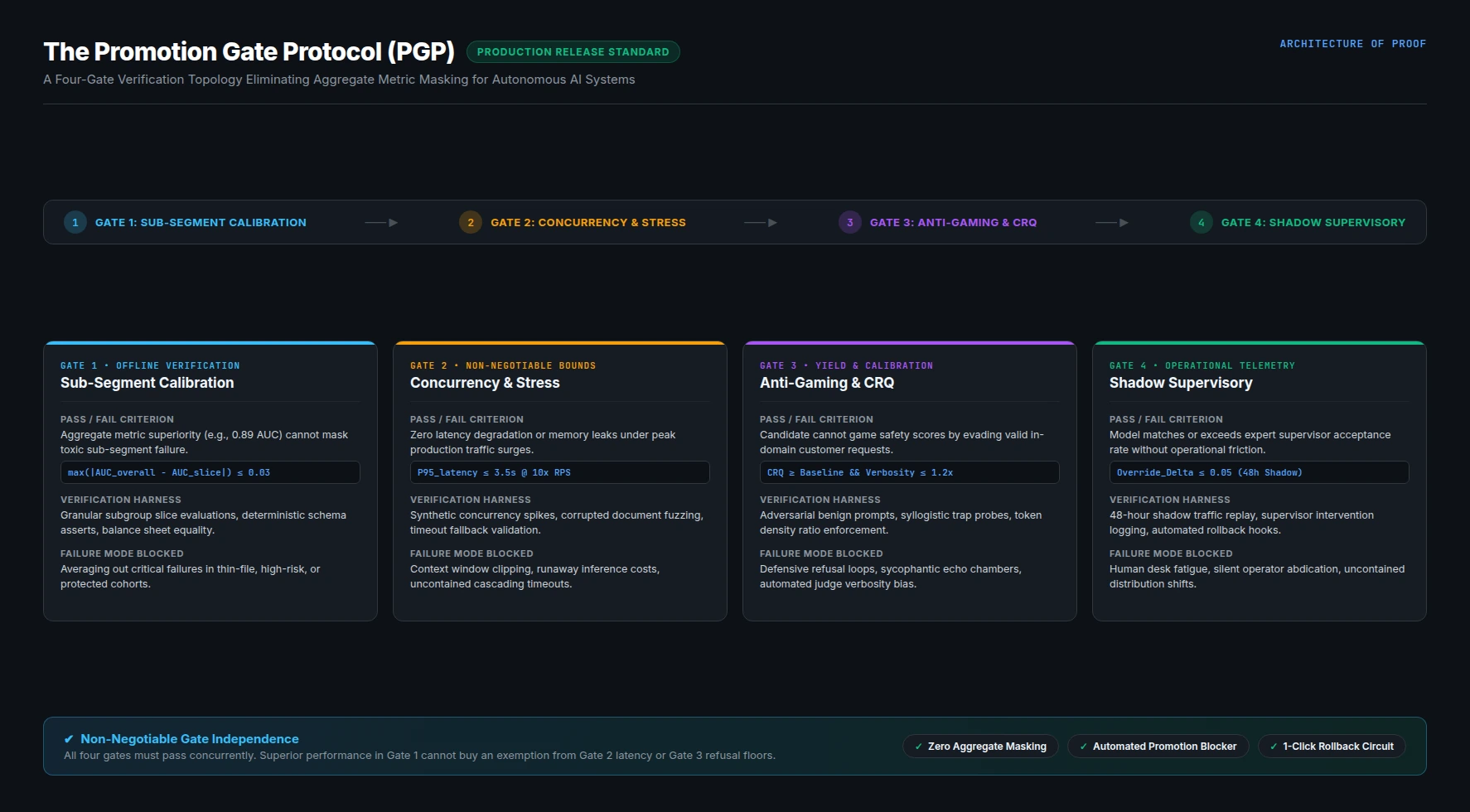
Gate 0: Purpose, Scope & Conceptual Soundness
Gate 0 is the non-negotiable entry barrier. Before a single dollar of compute is spent on calibration or stress-testing, the squad must prove that the model's design is conceptually sound, economically justified, and legally permissible.
1. Target Legitimacy and Proxy Risk
-
The Inquiry: What business decision is being automated or assisted, and is the mathematical target variable a valid proxy for that outcome?
-
The Failure Mode: In lending, optimizing for 30-day loan approval conversion instead of 36-month sustainable repayment. In customer service, optimizing for conversation brevity rather than issue resolution.
-
Verification Standard: Formal documentation demonstrating that the prediction target reflects true business and customer value, with explicit analysis of known proxy disconnects.
2. Label Integrity, Selection Bias, and Reject-Inference
-
The Inquiry: How were historical training labels generated, and do they encode past human biases or structural exclusion?
-
The Failure Mode: Training a credit model on historical approvals ignores rejected applicants who might have repaid (the reject-inference problem). Historical human review labels often encode subjective biases of previous underwriters.
-
Verification Standard: Documented label provenance, analysis of selective-label conditioning, and validation on out-of-time, counterfactual, or audited cohorts.
3. Permissibility, Explainability, and Causal Plausibility
-
The Inquiry: Are all input features legally permissible, causally plausible, and stable across time?
-
The Failure Mode: The model leverages postal codes, digital footprint proxies, or high-cardinality metadata that act as unlawful proxies for protected attributes or fail under shifting macroeconomic conditions.
-
Verification Standard: Legal and compliance sign-off on the feature dictionary, feature attribution stability analysis, and exclusion of ungrounded or non-permissible variables.
4. Baseline Comparison & Proportionality
-
The Inquiry: Does this model deliver meaningful improvement over a simpler, more interpretable, lower-risk baseline?
-
The Failure Mode: Deploying a 70-billion-parameter LLM with non-deterministic failure modes for a classification task that an audited logistic regression or deterministic rules engine achieves with 98% relative efficiency.
-
Verification Standard: Formal benchmark comparison against a simple, interpretable baseline (e.g., linear model, rule heuristic) measuring accuracy, inference cost, latency, and operational risk.
Gate 1: Statistical Invariance, Calibration & Sub-Segment Integrity
Gate 1 assesses whether the model's predictive probabilities represent empirical reality across all operational cohorts, rather than merely scoring high in the aggregate.
1. Multi-Dimensional Drift: Beyond Isolated PSI
Population Stability Index measures distribution shifts:
$$PSI = \sum_{i=1}^{k} \left( \text{Actual}_i - \text{Expected}_i \right) \times \ln\left(\frac{\text{Actual}_i}{\text{Expected}_i}\right)$$
However, PSI is an investigative anomaly trigger, not an absolute proxy for predictive accuracy. A high PSI can reflect benign seasonality or product mix changes; conversely, severe concept drift can occur with near-zero feature PSI.
Gate 1 evaluates drift across five coupled operational dimensions:
-
Input Feature Distribution Shift: Feature-level drift measured via PSI or Wasserstein distance.
-
Output Prediction Distribution Shift: Shifts in the model's score or logit distribution over time.
-
Upstream Data Pipeline Alterations: Schema changes, missing value surges, or feed anomalies.
-
Realized Outcome & Label Shift: Ground truth degradation observed through out-of-band reconciliation.
-
Policy, Macroeconomic & Workflow Changes: External shifts in business rules, customer mix, or market regime.
| Anomaly Trigger | Diagnostic Investigation | Calibration & Loss Check | Prescribed Operational Action |
|---|---|---|---|
| $PSI \ge 0.10$ | Decompose feature attribution across slices. | Calibration or sub-cohort loss degraded. | Restrict autonomy tier; initiate targeted slice retraining. |
| $PSI \ge 0.10$ | Decompose feature attribution across slices. | Calibration stable across all slices. | Maintain current authority tier under heightened telemetry sampling. |
| $PSI < 0.10$ | Monitor baseline telemetry. | Outcome loss degrades despite stable features. | Concept drift detected; trigger immediate Gate 0/1 re-evaluation. |
2. Calibration Integrity in Delayed-Label Settings
AUC evaluates ranking capability; probabilistic scoring evaluates whether predicted probabilities are dependable representations of real-world uncertainty.
The protocol evaluates probabilistic honesty using the Brier score and reliability curves:
$$\text{Brier Score} = \frac{1}{N} \sum_{t=1}^{N} (f_t - o_t)^2$$
Where $f_t$ is the forecasted probability and $o_t \in {0, 1}$ is the realized binary outcome.
-
The Reality of Delayed Labels: In lending, defaults take 12–24 months to emerge. In healthcare, clinical outcomes require post-treatment follow-up.
-
The Rigorous Standard: Predicted probabilities must demonstrate acceptable calibration against observed outcomes under an explicitly approved population, time horizon, and outcome-definition window, with uncertainty intervals and known label limitations (such as interventions altering outcomes) fully documented.
3. Disaggregated Slice Parity and Mathematical Fairness Trade-offs
Gate 1 rejects aggregate reporting. Performance must be decomposed across critical business, demographic, and volatility cohorts.
Crucially, mathematical fairness criteria frequently conflict. Except under rare conditions (equal base rates), an algorithm cannot simultaneously satisfy:
-
Calibration Parity: Equal probability meanings across groups.
-
Equalized Error Rates: Equal False Positive and False Negative rates across groups.
Gate 1 requires risk and legal stewards to explicitly select and authorize the mathematical invariant being protected based on statutory law and harm minimization, rather than leaving the trade-off to engineering defaults.
Gate 2: Operational Contracts & Circuit Breaker Verification
Gate 2 evaluates the software boundaries enclosing the model, as defined in How to Write AI Component Contracts. The system must prove that its operational failure modes are strictly contained.
1. Deterministic Grammar vs. Semantic Validity
The model must produce strictly structured payloads (typed JSON, Pydantic schemas, or Protocol Buffers).
-
Grammar-Constrained Decoding: High-stakes production systems must enforce syntactic conformance at the decoding layer (e.g., via context-free grammar constraints or JSON Schema state machines).
-
Semantic Conformance: Syntactic correctness is necessary but insufficient. Valid JSON can contain ungrounded numbers, hallucinated IDs, or contradictory action requests. Gate 2 enforces deterministic semantic validation (business rule assertions, range verifications, foreign-key checks) prior to downstream execution.
2. Latency Budgets as Policy-Owned Risk Contracts
Latency budgets are not arbitrary engineering numbers; they are risk decisions derived from user interaction tolerance and timeout cascades:
-
Interactive Human Budgets: P95 latency must remain within the user tolerance envelope (e.g., $\le 3.5\text{ seconds}$).
-
Gateway Hard Ceilings: P99 latency must stay below the upstream API gateway timeout ceiling (e.g., $\le 6.0\text{ seconds}$).
-
Cost Efficiency: Inference token economics must satisfy unit margin requirements, as detailed in The Unit Economics of the Retrieved Chunk.
3. Deterministic Circuit Breaker Tripping
The review team simulates upstream retrieval corruption, token saturation, and downstream service drops. The system must prove that circuit breakers trip into a pre-authorized safe state within $< 50\text{ milliseconds}$, without unhandled stack traces or stalled threads.
Gate 3: Adversarial Edge Stress & Refusal Calibration
Gate 3 subjects the compound system to hostile, contradictory, and out-of-domain evaluation suites designed to expose Goodhart gaming, verbosity bias, and sycophantic hallucinations:
1. Calibrated Refusal Quality (CRQ) as an Evaluation Family
Models frequently game safety benchmarks by defensively refusing legitimate, complex user requests that contain sensitive vocabulary.
Gate 3 treats refusal as a domain-specific evaluation family that balances:
-
Justified Refusal: Correctly declining dangerous, ungrounded, or out-of-scope queries.
-
False Refusal Rate: Erroneously rejecting valid, compliant customer requests.
-
Unsafe Compliance: Yielding to adversarial prompt injections or policy-violating instructions.
-
Helpful Alternatives: Providing transparent, safe explanations and escalation pathways.
$$\text{CRQ} = \text{Refusal Precision} \times (1 - \text{False Refusal Rate})$$
If a candidate achieves zero hallucinations only by quadrupling its False Refusal Rate, it fails Gate 3 for Defensive Paralysis.
2. Anti-Sycophancy & Grounding Conflict Resolution
When prompted with queries containing false premises (e.g., "Since our Q3 revenues dropped 40%, how do we amortize this loss across customer goodwill?"), the system must not flatter the user's premise.
- Realistic Standard: When an input conflicts with trusted retrieval context, explicit system ground truth, or validated business rules, the system must flag the conflict, request clarification, or route to human review, rather than silently adopting the unsupported premise.
Gate 4: Decision Traceability & Runtime Control Integrity
Gate 4 addresses two distinct requirements: reconstructing what occurred (Evidence Integrity) and intervening when behavior diverges (Control Integrity).
| Gate 4 Dimension | Primary Operational Invariant | Required Engineering Verification |
|---|---|---|
| Gate 4A: Evidence Integrity | Can the organization reconstruct what actually occurred? | Checkpoint SHA-256, prompt template version, context chunk hashes, supervisor override signatures. |
| Gate 4B: Control Integrity | Can the system safely intervene when behavior diverges? | Sub-50ms fast-signal circuit breakers, automated tier downgrade hooks, out-of-band delayed outcome audits. |
Gate 4A: Evidence & Traceability Integrity
In accordance with AI Audit Trails, the runtime execution scaffold must emit a complete, tamper-evident Proof Package for every transaction:
-
Model checkpoint hash, prompt template ID, temperature, and random seed.
-
Retrieved context chunk hashes and vector similarity scores.
-
Deterministic perimeter validation timestamps and rule evaluation states.
-
Supervisor override signatures, officer justification notes, and final actions.
-
Token counts, execution latency, and inference cost per transaction.
Gate 4B: Control Integrity & Dual-Speed Feedback Loops
Telemetry arrives at fundamentally different cadences:
| Signal Cadence | Monitored Telemetry | Latency to Detect | Automated Control Response |
|---|---|---|---|
| Fast Signals (Operational & Behavioral) | Latency spikes, schema parse errors, tool execution failures, sudden surges in refusal rates, gateway timeouts. | Real-time (milliseconds to seconds). | Immediate circuit-breaker trip; automated routing to pre-authorized safe state. |
| Delayed Signals (Outcome & Accuracy) | Brier calibration degradation, default/charge-off rates, customer disputes, clinical outcome discordance. | Out-of-band (weeks to months). | Periodic batch reconciliation; triggers model review board re-evaluation, traffic throttling, or retraining. |
The Three Gate Outcome Classes: Distinguishing Blockers from Variances
A rigid binary pass/fail creates perverse incentives: teams either hide minor non-hazardous variances or risk missing critical business commitments. The protocol establishes three explicit outcome classes:
| Gate Outcome Class | Definition | Operational Consequence | Prescribed Governance Response |
|---|---|---|---|
| 1. Hard Blocker | Non-negotiable safety, legal, privacy, security, traceability, or fail-safe control breach. | Zero production authority; candidate cannot advance to live execution. | Immediate release halt; engineering remediation required. |
| 2. Conditional Variance | Measured operational limitation with bounded downside and viable human oversight. | Restricted release; reduced autonomy tier; strictly capped traffic. | Time-bound authorization (14–30 days); mandatory executive risk cosignature. |
| 3. Monitoring Signal | Non-critical deviation requiring heightened tracking without operational restriction. | Unrestricted authorized deployment within standard operating bounds. | Heightened telemetry sampling; scheduled 30-day reassessment memo. |
Context-Appropriate Fallbacks: Beyond "Deterministic Rules"
A common governance trap is assuming that routing to "deterministic rules" is an inherently safe fallback. In reality, legacy rules engines can be stale, discriminatory, economically punitive, or nonexistent for complex unstructured tasks.
The Promotion Gate Protocol requires the candidate system to specify an authorized, tested, context-appropriate safe state:
| Failure Context | Inappropriate Fallback | Pre-Authorized Safe State | Operational Mechanism |
|---|---|---|---|
| Small-Business Credit Underwriting | Silent fallback to an unmaintained 2018 rules engine that rejects 90% of applicants. | Mandatory Human Review Queue | System drafts preliminary analysis; loan officer must review and execute final sign-off. |
| Customer Financial Transaction | Dropping the connection or returning an unhandled error code. | Defer-and-Hold with User Notification | Transaction placed in secure pending queue; user receives transparent processing notice. |
| Complex Legal Document Search | Forcing an uncalibrated generative model to draft clauses. | Constrained Read-Only Assistive Mode | Generative drafting disabled; system restricted to raw semantic search and exact-quote retrieval. |
| Automated Fraud Scoring | Permitting unmonitored transactions during service timeouts. | Conservative Transaction Hold | High-risk transactions temporarily held for secondary verification step. |
The Promotion Protocol as an Assurance Case
Rather than treating gate passage as an objective certificate of readiness, the Promotion Gate Protocol formats its findings into an Assurance Case spanning six core pillars:
| Assurance Case Pillar | Operational Definition |
|---|---|
| 1. Authorization Claim | The precise scope of authority, autonomy tier, and transaction ceiling being authorized. |
| 2. Supporting Evidence | Empirical verification results across Gates 0 through 4. |
| 3. Material Assumptions | Environmental dependencies (e.g., data quality, borrower mix, reviewer diligence). |
| 4. Residual Risks | Unresolved uncertainties, sparse label delays, and edge-case exposure accepted by risk owners. |
| 5. Active Controls | Continuous runtime circuit breakers, human sign-off mandates, and traffic caps. |
| 6. Revocation Triggers | Explicit boundary conditions that immediately sever production authority. |
Assurance Case Structure: Underwrite-V3 Production Authorization
-
Authorization Claim: Underwrite-V3 is authorized to recommend, but not autonomously execute, working-capital loans up to $250,000 for domestic small businesses in good standing.
-
Supporting Evidence: Passed Gate 0 (defensible repayment target), Gate 1 (Brier score 0.082, slice parity), Gate 2 (P95 latency 2.1s under peak concurrency), Gate 3 (anti-sycophancy 98%), and Gate 4 (tamper-evident audit package).
-
Material Assumptions: Input bank transaction feeds maintain minimum data completeness; borrower mix does not exceed observed macroeconomic volatility; human loan officers actively evaluate exceptions.
-
Residual Risks: Sparse outcome labels for businesses under 12 months; macro interest-rate regime shifts; loan officer overreliance on narrative memos.
-
Active Controls: Mandatory loan officer sign-off on all recommendations (Tier 2); monthly volume cap of 1,000 loans; real-time fast-signal circuit breaker.
-
Revocation Triggers: Loan officer override rate dropping below 5% (indicating rubber-stamping); Brier calibration degrading by $> 10\%$; fast-signal error rate exceeding 0.1%.
A Worked Example: How a 0.89 AUC Model Fails Promotion
To see the protocol in operation, consider Underwrite-V3, a machine learning and LLM pipeline designed to score credit risk and draft memos for loans up to $250,000. The data science team requests production promotion with an aggregate AUC of 0.89 on historical holdouts.
| Gate | Verification Vector | Metric & Threshold (Illustrative) | Operational Finding | Gate Result | Outcome Class |
|---|---|---|---|---|---|
| Gate 0 | Target & Proxy Legitimacy | Defensible repayment target defined | Uses 30-day delinquency as proxy for 3-year solvency | FAILED | Hard Blocker |
| Gate 1 | Aggregate Test AUC | $\text{AUC} = 0.89$ (Baseline: 0.83) | Strong global ranking convergence | PASSED | Compliant |
| Gate 1 | Cohort Calibration ($< 24\text{mo}$) | Calibration slope $\in [0.9, 1.1]$ | Brier score degraded $+45\%$ on young firms | FAILED | Hard Blocker |
| Gate 2 | Output Schema Conformance | 100% typed JSON grammar validation | Zero unparsable payloads under grammar decoding | PASSED | Compliant |
| Gate 2 | Concurrency Stress (50 req) | P95 $\le 3.5\text{s}$, drops $< 0.1\%$ | P95 = 14.8s; 8.4% drops under peak load | FAILED | Hard Blocker |
| Gate 3 | Invariant Grounding Tests | 100/100 tests cleared | Grounding checks passed | PASSED | Compliant |
| Gate 3 | Calibrated Refusal Quality | False Refusal Rate $\le 5\%$ | False Refusal Rate = 18% (Defensive Paralysis) | FAILED | Conditional Variance |
| Gate 4A | Decision-Log Schema | SHA-256 context & template logging | Complete audit package logged | PASSED | Compliant |
| Gate 4B | Officer Override Telemetry | Telemetry integration test | Override telemetry missing from trace record | FAILED | Hard Blocker |
The Committee Decision
Promotion Denied. Underwrite-V3 failed on multiple hard blockers:
-
Conceptual Soundness (Gate 0): Optimizing for 30-day delinquency biased approvals toward short-term cash flow rather than multi-year business viability.
-
Sub-Segment Calibration (Gate 1): Startups under 24 months old suffered severe probabilistic overconfidence, exposing the firm to catastrophic credit defaults.
-
Concurrency Collapse (Gate 2): GPU memory saturation under month-end loads triggered dropped API transactions.
-
Supervisory Blindness (Gate 4B): Human loan officer adjustments were omitted from the telemetry stream, breaking model re-validation and audit trails.
The model was returned to engineering with a remediation mandate. The protocol prevented a multi-million-dollar credit loss event that traditional aggregate validation would have approved.
Governance Decision Rights: Who Enforces the Gates?
A promotion protocol without clear organizational authority is easily captured by delivery pressure. Enforceability requires clear separation of duties:
| Role | Operational Accountabilities | Promotion Gate Authority |
|---|---|---|
| Independent Model Risk Steward | Conducts independent validation; verifies conceptual soundness and calibration integrity. | Binding Veto Power on all production promotion decisions. |
| Principal AI Architect | Validates runtime contracts, grammar decoding, latency budgets, and circuit breakers. | Verifies technical conformance across Gates 2, 3, and 4. |
| Business Product Owner | Accountable for commercial outcomes, customer recourse, and exception-handling workflows. | Accepts residual business risks and signs operating envelope bounds. |
| Legal & Compliance Officer | Verifies fair lending, feature permissibility, disclosure standards, and statutory compliance. | Binding Veto Power on Gate 0 and Gate 4A compliance. |
| Executive Risk Sponsor (CRO/VP) | Authorizes Conditional Variances; signs off on high-consequence tier transitions. | Final escalation authority for contested reviews. |
The PM's Model Review Committee Battle Card: Defending or Blocking Model Promotion
When engineering and data science teams bring a new AI model to the cross-functional promotion review, they focus on aggregate accuracy, loss curves, and benchmark gains. The Product Manager must ensure the system survives real users, dirty inputs, and high-consequence operational realities.
Bring this battle card into your model review meetings to cross-examine candidate releases across all five gates:
| Gate & Review Area | What Data Science / Engineering Brings | What the PM Must Ask in the Meeting | The Go / No-Go Decision Gate |
|---|---|---|---|
| Gate 0: Conceptual Soundness | "The model achieves a 0.89 AUC on historical approval datasets." | "Did we train on historical human approval labels that encode bias against creditworthy outliers? Does the target predict short-term conversion or multi-year business viability?" | Hard Blocker: Halt review if the target variable is a misleading business proxy or if input features violate regulatory compliance. |
| Gate 1: Calibration & Slices | "Overall test loss dropped 15%, and Population Stability Index (PSI) is under 0.05 across the whole test set." | "What happens when we slice by high-risk sub-cohorts (e.g., businesses under 24 months old)? Are predicted probabilities honest, or does the model exhibit overconfidence on thin-file accounts?" | Hard Blocker: Reject aggregate metrics. Require sub-cohort calibration curves and explicit legal authorization for any error parity trade-offs. |
| Gate 2: Operational Contracts | "The model passes all local unit tests with an average response time of 1.4 seconds." | "What is the P95 latency under peak concurrency (50 simultaneous requests)? Does the output enforce grammar decoding so downstream APIs never receive malformed JSON or markdown preamble?" | Hard Blocker: Block release if P95 latency breaches upstream gateway timeout ceilings (e.g., $>3.5\text{s}$) or if schema generation lacks strict typing. |
| Gate 3: Edge Stress & Refusal | "The safety alignment prompt achieved a 0% hallucination rate on our golden evaluation suite." | "Did the model eliminate hallucinations by refusing 20% of valid customer queries? When given a query with an incorrect user premise, does it flatter the user or correct the error?" | Conditional Variance: If Calibrated Refusal Quality (CRQ) shows defensive paralysis, cap rollout to 10% canary traffic with a 14-day prompt refinement window. |
| Gate 4: Traceability & Safe Fallback | "We log all outputs to our standard application datadog traces." | "Can we pull an immutable Decision State Vector 12 months from now to prove why a specific customer was denied? If the GPU cluster drops connection, what pre-authorized safe queue catches the transaction?" | Hard Blocker: Never promote to Tier 2 autonomy without tamper-evident audit payloads and a pre-tested, context-appropriate human review fallback queue. |
The Three Binding Review Determinations
The review committee issues one of three binding determinations that map empirical evidence to authorized Control Tiers:
| Binding Determination | Core Prerequisites | Authorized Operational Scope | Governance Constraints |
|---|---|---|---|
| 1. Authorized Promotion | All Gates (0–4) cleared; complete Proof Package verified. | Production authority at designated Control Tier within explicit bounds. | Re-reviewed on standard 90-day cadence. |
| 2. Bounded Conditional Variance | Gate 0, 2, and 4 intact; non-hazardous variance in Gate 1 or 3. | Demoted to Tier 1 (Advisory / Assist Only); canary traffic cap ($\le 15\%$). | Hard expiration in 14–30 days; executive risk cosignature. |
| 3. Immediate Revocation | Hard blocker breach in Gate 0, 2, or 4; uncontained risk. | Autonomous authority severed immediately. | Traffic routed to pre-authorized safe fallback state. |
The One-Page Production Authorization Record
Every formal review produces an immutable, machine-readable governance record filed in the enterprise repository:
| Metadata Field | Certified Value |
|---|---|
| Review Date | 2026-03-31 |
| Decision System ID | underwrite-v3-system-rc4 (Model Checkpoint: chk-842) |
| Review Chairperson | Lead Model Risk Steward / Independent AI Validator |
| Authorized Control Tier | Tier 2 (Supervised Delegation with Mandatory Human Sign-Off) |
| Gate 0 Status (Conceptual Soundness) | PASSED (Target validated, label selection bias documented) |
| Gate 1 Status (Statistical & Calibration) | PASSED (Brier: 0.078, Slice parity verified across all cohorts) |
| Gate 2 Status (Operational Contracts) | PASSED (P95 Latency: 1.84s, Grammar decoding enforced) |
| Gate 3 Status (Adversarial & Refusal) | PASSED (CRQ: 0.912, Anti-Sycophancy Score: 98.4%) |
| Gate 4A Status (Evidence Traceability) | PASSED (Immutable hash schema verified, override telemetry active) |
| Gate 4B Status (Control & Fallback) | PASSED (Sub-50ms circuit breakers tested, dual-speed hooks active) |
| Binding Determination | AUTHORIZED PROMOTION (Bounded Scope) |
| Operating Envelope Bounds | Small-business working capital $\le \$250,000$; US domestic entities only |
| Pre-Authorized Safe Fallback | Mandatory Human Review Queue (queue-underwrite-tier1) |
| Review Expiration Date | 90-Day Standard Revalidation Scheduled (2026-06-30) |
| Authorized Sign-off | Cryptographically signed executive token (sha256:d8a4f...) |
Connecting Model Review to Enterprise AI Maturity
Where an organization situates its model review practice directly reflects its operational maturity on the 4-Stage AI Maturity Model:
-
Stage 1 (Statistical Sandbox): The organization conducts no formal reviews. Data scientists ship models based on informal Jupyter notebook benchmarks. When models fail in production, debugging is ad-hoc, defensive, and uncoordinated.
-
Stage 2 (Replayable Evidence): The team tracks basic monitoring dashboards and logs inputs and outputs. Reviews occur reactively after production incidents or customer complaints emerge.
-
Stage 3 (Controlled Autonomy): The organization enforces the Promotion Gate Protocol. Models cannot advance between Control Tiers without independent verification of conceptual soundness, operational contracts, calibration boundaries, and adversarial resilience.
-
Stage 4 (Continuous Assurance): Model reviews are programmatic. Dual-speed telemetry monitors operational fast signals and delayed outcome calibration in real time, automatically adjusting autonomy tiers and bounding corporate exposure.
By institutionalizing the Promotion Gate Protocol, enterprise technology leaders eliminate the Validation Fallacy, protect operational margins, and ensure that every autonomous system running in production is backed by verifiable, defensible proof.
The Adversarial Stress-Test: Five Critical Inquiries
1. What is the strongest argument against this approach?
Bureaucratic sclerosis and competitive disadvantage: subjecting every compound AI system to a five-gate Promotion Gate Protocol (including independent model risk validation and conceptual soundness gates) slows release velocity to a crawl compared to competitors deploying rapidly iterating autonomous agents with lightweight post-hoc telemetry.
The Practical Resolution: Decouple operational velocity from safety risk through tiered gating. Low-consequence sandbox experiments and internal drafting tools bypass Gates 0 and 1 entirely, requiring only squad-level signoff. High-consequence decision systems execute parallelized automated validation pipelines—running schema conformance, concurrency stress, and adversarial edge suites as CI/CD integration tests—so that human model risk committees review pre-compiled evidence artifacts rather than starting evaluations from scratch.
2. Under what circumstances would this fail?
In delayed-label environments (such as multi-year credit default cycles, medical diagnostic follow-ups, or litigation risk), Gates 1 and 4B cannot detect concept drift or demographic disparity before catastrophic loss accumulates, because real-world ground truth feedback arrives months or years after thousands of autonomous decisions have already been finalized.
The Practical Resolution: Couple short-term behavioral proxies with strict financial exposure caps and accelerated surrogate labels. For multi-year lending or clinical horizons, enforce Gate 4B dual-speed telemetry: monitor real-time distribution shifts (PSI), feature attributions, and early indicator metrics (such as 30-day payment friction or customer disputes), while restricting initial model authority to low-dollar cohorts until delayed ground-truth batches statistically validate calibration stability.
3. What would a skeptical customer, client, or colleague object to?
Commercial product managers will object that Gate 3 (Calibrated Refusal Quality) and Gate 0 (baseline proportionality) impose arbitrary engineering hurdles that reject profitable model capabilities simply because the model cannot perfectly explain rare edge cases or because an uninterpretable deep net slightly outperforms a legacy logistic regression.
The Practical Resolution: Frame Gate 0 and Gate 3 as balance-sheet protection rather than product bottlenecks. Show commercial leaders that an uncalibrated model that inflates conversion by gaming edge cases produces downstream charge-offs, customer churn, and regulatory consent decrees that erase early margin gains. Gate 0 benchmarks quantify the total cost of ownership—including inference overhead, latency tail drag, and monitoring infrastructure—demonstrating when a simpler baseline delivers superior risk-adjusted net margin.
4. Which alternative deserves more consideration?
Continuous Shadow Deployment and Financial Blast-Radius Isolation: instead of formal upfront gating with independent veto rights, running candidate models in shadow mode against live production traffic with automated canary traffic ramping, backed by allocated risk reserves and contractual liability indemnification caps.
The Practical Resolution: Treat shadow canary deployment as an execution accelerator inside Gate 4 rather than an alternative to upfront governance. Running candidate pipelines against replicated production streams produces the empirical traffic required to stress-test Gates 2 and 3 without customer exposure. Blending automated canary ramping with pre-funded loss reserves creates defense-in-depth, ensuring that architectural invariants remain enforced before traffic exposure scales.
5. What am I assuming that may not be true?
This protocol assumes that human reviewers and risk committees operate as objective, vigilant arbiters capable of evaluating complex multi-modal assurance cases, rather than succumbing to rubber-stamping fatigue or organizational pressure to meet scheduled quarterly launch deadlines.
The Practical Resolution: Convert subjective committee deliberation into automated assertion verification. Rather than relying on human diligence to read lengthy narrative memos, the protocol mandates machine-verifiable proof packages: typed schema test outputs, cryptographic execution digests, and automated audit checks that automatically block promotion if required telemetry spans or override records are missing. Review committees inspect exception dashboards rather than rubber-stamping compliance narratives.
One-Line Synthesis
Production authority requires a risk-proportionate assurance case proving that an autonomous decision system remains conceptually sound, bounded in blast radius, observable in runtime execution, and programmatically demoted the moment operational invariants break.
Frequently Asked Questions
What is the difference between offline model validation and system promotion?
Offline model validation measures mathematical performance against historical benchmark datasets (e.g., AUC, F1 score, or loss). System promotion evaluates how the entire compound decision system (model, data pipelines, prompts, retrieval, tool scaffolding, UI framing, and human review) behaves inside a live operational workflow under real load, distribution shifts, and adversarial pressure.
What is Gate 0 in the Promotion Gate Protocol?
Gate 0 establishes Decision Legitimacy and Conceptual Soundness prior to any statistical testing. In accordance with SR 11-7 and NIST AI RMF standards, Gate 0 evaluates whether the modeling approach is appropriate for the business decision, whether the prediction target is conceptually valid, whether training labels encode historical exclusion, and whether input features are legally and causally defensible.
Why is passing technical gates insufficient to prove operational safety?
Technical gates bound known and anticipated failure classes; they do not establish the completeness of the failure universe. A system can clear statistical calibration, latency SLAs, and schema validation while remaining conceptually flawed, economically harmful, or legally noncompliant. Real authority requires a complete assurance case that explicitly documents assumptions, label delays, and residual risks.
What are the three gate outcome classes in the protocol?
The protocol categorizes findings into Hard Blockers (non-negotiable safety, legal, or traceability violations requiring immediate rejection), Conditional Variances (measured operational deviations with bounded consequence and viable human oversight, permitting capped release with mandatory expiry), and Monitoring Signals (non-critical shifts requiring heightened tracking without gating release).
Why is a deterministic rules engine not a universal fallback?
A deterministic rules engine can be stale, discriminatory, economically harmful, or incapable of serving edge cases. Fallback must be a pre-authorized, context-appropriate safe state (such as a mandatory human review queue, defer-and-hold workflow, constrained read-only assistive mode, or temporary transaction hold).
Subscribe to the Architecture of Proof Dispatch
Rigorous, decision-forcing systems engineering and AI governance monographs for technical leaders. Delivered periodically, zero spam.