How to Write AI Component Contracts: A Practical Guide | AI Governance
This post is part of the AI Accountability Architecture pillar.
Writing an AI component contract is not an abstract compliance exercise. It is the architectural discipline that separates systems that can be debugged from systems that must be completely rolled back during an outage.
When a production system produces an anomalous outcome, the diagnostic inquiry must isolate the failing layer immediately: did the deterministic rules admit an invalid payload, did the statistical model misclassify an outlier, did an operator override a correct prediction, or did the orchestration router time out? Without contracts, that question triggers cross-functional blame. With contracts, it produces immediate technical findings.
This guide provides an engineering blueprint for authoring machine-testable contracts across rules, models, and humans.
What Makes an AI Component Contract Defensible?
A contract is not an implementation specification. A specification describes internal mechanics; a contract defines verifiable behavioral bounds and how compliance is measured at runtime.
Effective component contracts require three operational properties:
- Testable: Evaluated against concrete telemetry rather than subjective intent. Stating that "the model should perform well" is an aspiration; mandating that "the model must maintain an AUC $\ge 0.82$ on weekly held-out production distributions" is a testable contract.
- Specific: Bound to an individual executing component and its explicit failure envelopes. A contract applying generically to "the pipeline" diffuses responsibility and prevents automated gating.
- Owned: Assigned to a single operational owner with authority to deploy hotfixes or sign off on variances. Unowned contracts degrade into dead documentation.
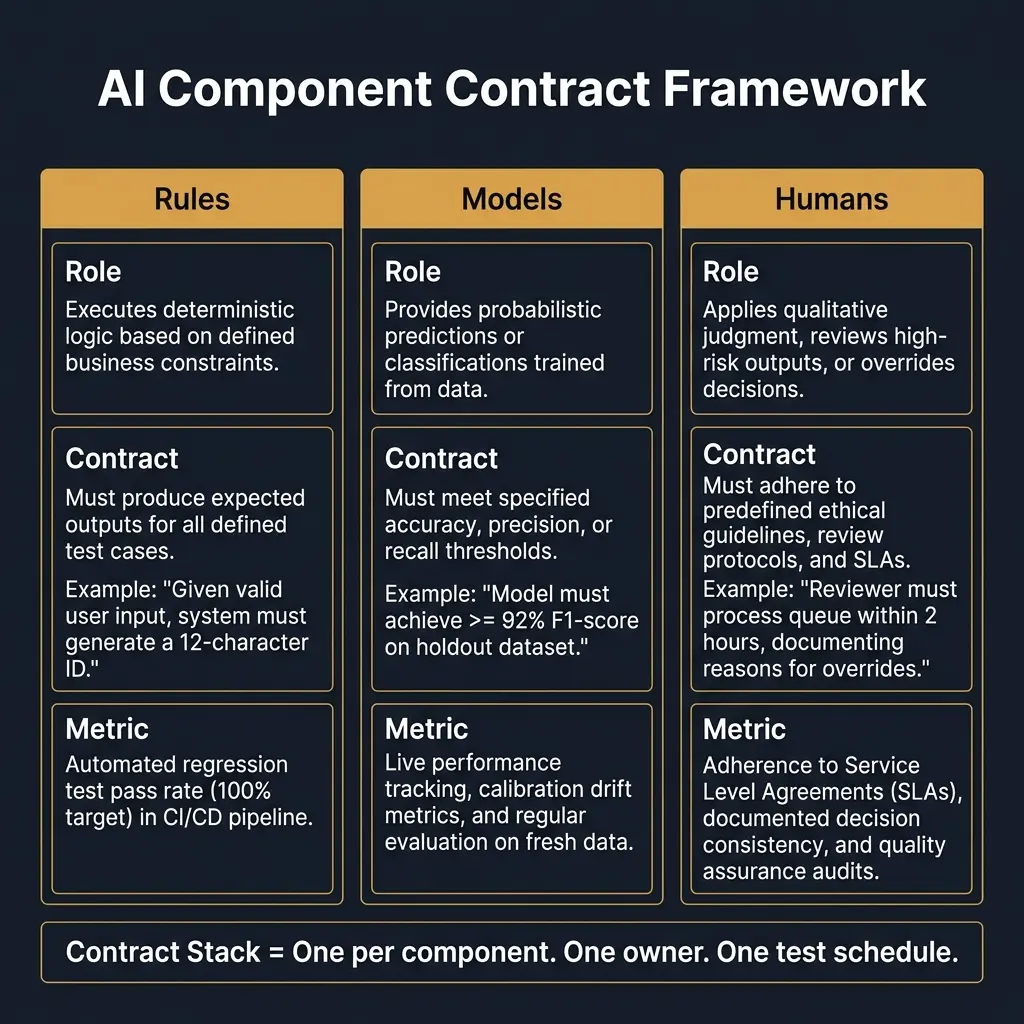
How Do You Write Contracts for Deterministic Rules?
Because rules execute deterministic logic, their contracts enforce binary invariants: the condition either held or breached, and the action either executed or failed.
The Contract Archetype:
"Given input condition $[X]$, rule $[R]$ must always execute $[Action]$. This rule must process $100\%$ of traffic meeting condition $[X]$, with zero unlogged bypasses. Breaches must emit priority alerts within $[Z]$ seconds."
Production Examples: * Credit Eligibility Gate: "Any commercial loan applicant operating under 12 months in business must be rejected prior to model invocation. This rule must execute on $100\%$ of incoming applications; violations must trigger an immediate CI/CD telemetry exception." * Sanctions & Compliance Filter: "Transactions originating from entities on active regulatory watchlists must be blocked prior to feature enrichment. Zero bypasses permitted; violations dispatch an immediate P1 alert to compliance engineering." * Autonomy Routing Circuit Breaker: "Transactions where model confidence drops below 0.65 must route to Tier 0 human review rather than executing automated disbursement. Routing anomalies must be flagged as blocking audit events."
Testing a rules contract requires verifying three properties in production: Traffic Coverage (proving that 100% of candidate payloads pass through the rule check without uninstrumented side-doors), Cross-Channel Consistency (ensuring identical execution across web, mobile, and third-party API gateways), and Bypass Detection (actively asserting that downstream components reject any payload lacking the upstream rule engine's cryptographic signature).
How Do You Write Contracts for Probabilistic Models?
Because models are non-deterministic, model contracts cannot enforce identical outputs on every invocation. Instead, they govern statistical performance envelopes, calibration floors, and distributional drift thresholds.
The Contract Archetype:
"Given normalized input vectors in $[Scope]$, model $[M]$ must maintain $[Performance Floor]$ on $[Evaluation Dataset]$ measured at $[Cadence]$. Inferences outside $[Scope]$ are prohibited. Breaches in $[Drift Metric]$ trigger automated autonomy demotion."
Production Examples: * Credit Risk Classifier: "Given normalized consumer lending inputs, the risk scoring model must maintain an AUC $\ge 0.74$ on rolling 30-day production samples. Operations outside the prime consumer segment are prohibited; Population Stability Index ($PSI > 0.20$) on credit bureau features triggers an automated downgrade to human review." * Real-Time Fraud Scorer: "The transaction fraud model must maintain a false positive rate $\le 1.2\%$ over any 7-day observation window. If false positive rate exceeds $1.8\%$, automated account blocking must downgrade to SMS two-factor verification until recalibrated." * Document Extraction Engine: "The entity extraction model must achieve $\ge 96\%$ token precision on core commercial invoice fields. Extractions below $0.90$ confidence must be routed to human annotator queues without generating downstream ERP mutations."
Validating a model contract requires continuous runtime instrumentation: tracking discriminative power on fresh production telemetry (rather than static training partitions), probability calibration (verifying that a predicted 90% risk score aligns with empirical default rates), segment-level divergence (detecting whether performance drops severely in specific geographic or demographic cohorts), and population boundary integrity (verifying that the model is never called on feature distributions for which it was not certified).
How Do You Write Contracts for Human Reviewers?
Human-in-the-loop governance often assumes that human reviewers naturally provide safety. In production, unmonitored human review produces vigilance fatigue, inconsistent exceptions, and unlogged liability. Human contracts formalize human review as a structured system component.
The Contract Archetype:
"When triggered by $[Escalation Event]$, human reviewer in role $[R]$ must execute $[Action]$ within $[SLA]$. Overrides must be justified using $[Reason Code Taxonomy]$ with attached evidentiary documentation. Override distributions are audited at $[Frequency]$."
Production Examples: * Underwriter Adjudication: "When an application is escalated for manual underwriting, the assigned credit officer must render a disposition within 4 business hours. Overriding a model recommendation requires selecting an authorized reason code and attaching audited financial statements. Unjustified overrides halt pipeline processing." * Fraud Investigation Queue: "Tier 2 fraud alerts require analyst acknowledgment within 30 minutes and final resolution within 2 hours. Dispositions lacking standardized forensic tags are automatically rejected by the workflow engine as compliance exceptions." * Model Governance Board: "The model risk committee must adjudicate any automated drift alert within 5 business days, issuing either an operating recertification, a mandatory retraining ticket with an SLA, or an order to suspend autonomous execution."
Monitoring human contracts requires evaluating taxonomy compliance (tracking the percentage of overrides with valid documentary evidence), SLA latency (measuring median and P99 queue wait times to detect backlog choke points), and directional bias (analyzing whether specific reviewers systematically approve or reject cases at rates that diverge from peer baselines).
How Do You Assemble and Enforce the Full Contract Stack?
Individual component contracts combine into an end-to-end contract stack governing the entire transactional workflow. When an outcome fails in production, the contract stack eliminates forensic ambiguity: the incident is immediately mapped to the specific component whose runtime metric breached its agreed boundary.
The PM's AI Component Contract Checklist: Authoring Contracts in Sprint PRD Reviews
Before approving any AI feature specification or promotion to production, product managers must ensure that every participating layer has a signed, machine-testable contract with explicit Go/No-Go release gates:
| Workflow Component | Execution Scope & Role | Machine-Testable Contract Invariant | Operational Owner & Alert SLA | PM Go/No-Go Release Gate |
|---|---|---|---|---|
| Deterministic Input Rules | Validate inbound payload schemas and enforce statutory eligibility before model invocation. | $100\%$ of traffic meeting precondition $X$ intercepted; zero unlogged bypasses; P99 latency $<15\text{ms}$. | Compliance Engineering (P1 alert emitted within 30 seconds of bypass) |
NO-GO if any request can reach the model without passing cryptographic schema assertions. |
| Probabilistic ML Model | Generate candidate predictions or extraction vectors on in-distribution features. | AUC $\ge 0.74$, $PSI < 0.20$, and Brier score $< 0.12$ over rolling 30-day production windows. | ML Engineering (Automated autonomy downgrade upon drift breach) |
NO-GO if model lacks a hard Population Stability Index ($PSI$) circuit breaker. |
| Orchestration Router | Route low-confidence inferences ($<0.70$) to fallback logic or human queues. | Dispatch $100\%$ of uncertain states to reviewer queues within 200ms; zero silent fails. | Platform SRE (Alert if queue latency exceeds 5 minutes) |
NO-GO if unhandled model errors or timeouts default to automated execution. |
| Human Reviewer / Operator | Adjudicate edge cases and model overrides under cognitive SLA. | Disposition rendered within 4h SLA; 100% of overrides tagged with valid reason code taxonomy. | Operations Lead (Weekly supervisory audit of override distributions) |
NO-GO if reviewers can override model output without providing auditable documentary evidence. |
| Database State Committer | Execute consequential DB mutations, financial transfers, or patient record updates. | Verify state freshness, authority limits, and idempotency locks before committing mutations. | Core Backend Engineering (Immediate rollback if state lock fails) |
NO-GO if state updates lack compensation/reversal logic or audit log lineage. |
The Adversarial Stress-Test: Five Critical Inquiries
To ensure component contracting withstands engineering skepticism and operational stress, we subject this framework to five decision-forcing inquiries:
1. What is the strongest argument against this approach?
- Contract Brittleness & Velocity Degradation: Formalizing component contracts introduces rigid schema constraints that penalize rapid model iteration. If every minor prompt adjustment, context pruning tweak, or threshold update requires cross-functional contract re-certification across legal, compliance, and engineering teams, the organization loses the agility that justifies deploying modern AI.
- The Practical Resolution: Enforce tiered contract governance based on change blast-radius. Internal prompt tuning and feature tweaks within existing performance envelopes require only automated CI/CD assertion passes. Formal cross-functional re-signing is reserved exclusively for shifts in statutory boundaries, autonomy tier promotions, or SLA widenings.
2. Under what circumstances would this fail?
This architecture collapses when component contracts incentivize local metric optimization at the expense of systemic health (Goodhart’s Law):
- If an ML team's contract heavily penalizes false positives, engineers tune the model to reject ambiguous cases, artificially dumping massive volume onto human review queues.
- If human reviewer contracts strictly penalize queue latency (4-hour resolution SLA), fatigued reviewers approve cases without inspection to clear their backlog, technically satisfying their local contract while introducing catastrophic underwriting defaults.
3. What would a skeptical customer, client, or colleague object to?
- "Writing deterministic contracts for non-deterministic models is fundamentally contradictory. Static metrics like AUC or precision on historical holdout sets offer zero safety guarantees on non-stationary production distributions, making the contract an expensive legal fiction."
- The Resolution: Contracts do not claim that a model is infallible; they define the precise failure boundaries under which the model is permitted to operate autonomously. When non-stationary distributions trigger drift alerts ($PSI > 0.20$), the contract acts as an automated circuit breaker, revoking autonomy before damage compounds.
4. Which alternative deserves more consideration?
- Self-Tuning Anomaly Detection with Dynamic Breakers: Instead of maintaining static, manually specified component contracts and SLAs, deploy self-tuning statistical process control (SPC) monitors. These dynamic baselines adapt to seasonal fluctuations automatically, throttling traffic and adjusting routing thresholds without requiring manual contract renegotiation.
5. What am I assuming that may not be true?
- Operational Enforcement Capacity: Component owners possess the active telemetry and engineering bandwidth to monitor contracts in real time rather than filing them as compliance paperwork.
- Failure Decoupling: Failures can always be isolated to a single component breach, when in reality subtle cross-component feedback loops frequently induce shared failure.
- Organizational Incentives: Teams are willing to establish transparent component contracts that clearly attribute failure to their own microservice during incident postmortems.
One-Line Synthesis
AI component contracts replace retrospective debate with deterministic forensics by binding rules, models, and humans to machine-verifiable operational invariants.
Related in this pillar
-
AI Accountability Architecture: The full framework for designing accountable AI systems.
-
Composite Accountability: How to assign contracts across rules, models, and humans in a composite system.
-
AI Audit Trails: How to instrument your system so contracts can be verified with evidence.
Frequently Asked Questions
What is an AI component contract?
An AI component contract is a testable statement that defines what correct behavior looks like for a specific part of an AI system: a rule, a model, or a human reviewer. It specifies what the component must do, what it must not do, and how compliance is measured.
How do you write a model contract for an AI system?
A model contract specifies the performance conditions under which the model is permitted to operate: the inputs it expects, the outputs it must produce, the accuracy threshold it must maintain, and the drift conditions that trigger a review. It is testable in production, not just in testing.
Why do AI component contracts matter?
Without contracts, AI postmortems are debates. With contracts, they are findings. A contract tells you, before an incident, what 'working correctly' looks like, ensuring that when something breaks, you can identify which contract was violated rather than arguing about whose interpretation of acceptable performance was right.
Subscribe to the Architecture of Proof Dispatch
Rigorous, decision-forcing systems engineering and AI governance monographs for technical leaders. Delivered periodically, zero spam.