Five AI Governance Failures That Weren't Model Problems: RACI Design, Operating Model Gaps, and Accountability Architecture
When an AI system fails in production, the immediate corporate reflex is to blame the model.
The data science team is summoned. The prompt engineers are interrogated. The weights are re-analyzed for distribution drift. The executive assumption is always the same: the machine made a bad prediction; fix the machine.
In practice, this diagnosis is almost always wrong.
Postmortems across commercial banking, healthcare triage, insurance underwriting, and automated logistics demonstrate an uncomfortable reality: the vast majority of consequential AI failures are not model failures at all.
They are failures of governance architecture: breakdowns in the composite harness surrounding the model. They happen because rules were silently bypassed in auxiliary channels, routing logic dispatched edge cases to the wrong system, human overrides accumulated into systemic regulatory non-compliance, circuit breakers existed only as slide-deck aspirations, or audit logs failed to record what the system knew at decision time.
A high-accuracy model wrapped in an unmonitored, unaccountable operating model is not an enterprise asset. It is an unhedged operational liability.
Which Five Governance Failures Break Systems When the Model Is Accurate?
| Failure Mode | Operational Pathology | System Vulnerability |
|---|---|---|
| 1. The Channel Bypass | Rules enforced in primary UI, bypassed in secondary APIs. | Direct execution endpoints circumvent compliance guardrails. |
| 2. The Routing Error | Orchestration logic silently misclassifies edge cases. | Flawed pre-model heuristics route unvetted payloads to autonomous models. |
| 3. Override Accumulation | Unanalyzed human operator overrides create systemic bias. | Discretionary adjustments compound into statutory regulatory breaches. |
| 4. Missing Breakers | Gradual statistical or distribution drift operates without downgrade. | Technical uptime masks severe domain and calibration failures. |
| 5. Audit Trail Gaps | Logging output scores without capturing inputs, prompt, and context. | Inability to forensically reconstruct past high-stakes decisions. |
1. The Channel Bypass
-
The Pathology: An organization rigorously engineers deterministic compliance rules into its primary web portal. Months later, a mobile app update, a partner REST API, or an internal bulk-processing script is deployed. The new pipeline invokes the model directly, bypassing the rule engine or calling a deprecated configuration.
-
Why It Goes Undetected: Dashboard telemetry from the primary channel looks pristine. Violation rates appear at near zero. Because nobody owns cross-channel consistency audits, transactions violating statutory limits flow through secondary pipes unnoticed for months.
-
The Governance Fix: Every business rule and compliance guardrail must be deployed as a decoupled policy microservice or Policy-as-Code contract. A model must never have a public execution endpoint that bypasses the perimeter verification gate. Cross-channel invariant reconciliation must run on automated daily schedules.
2. The Routing Error
-
The Pathology: In composite architectures, an orchestration router examines incoming payloads to determine which model, rule set, or human queue should process the case. An engineer writes a naive routing heuristic that fails on boundary conditions (e.g., treating a missing income field as zero rather than null). Unqualified transactions are silently routed to an auto-approval model meant only for prime borrowers.
-
Why It Goes Undetected: The auto-approval model operates with mathematical perfection on the data it receives. It approves the loans because the inputs it was fed indicated high confidence. The error occurred before the model ever ran.
-
The Governance Fix: Routing logic is not "glue code": it is a Tier 1 governed architectural component. Orchestration routers require explicit interface contracts, unit tests against pathological edge distributions, and weekly reconciliation comparing actual routing paths against statutory routing rules.
3. The Override Accumulation Drift
-
The Pathology: To satisfy human-in-the-loop mandates, human reviewers are granted override authority over model recommendations. Under pressure to meet throughput quotas, operators begin overriding specific marginal scores. Over six months, these individually justifiable overrides accumulate into a statistically skewed distribution: approving applicants from specific demographic profiles at 3x the baseline rate.
-
Why It Goes Undetected: Aggregated executive dashboards only show total volume and high-level approval percentages. Because each override was executed by an authorized employee, no operational alarms sound. The failure only surfaces when a regulatory audit uncovers severe disparate impact.
-
The Governance Fix: Human overrides are not discretionary subjective choices; they are production data signals. The governance operating model must analyze override patterns weekly by operator ID, demographic segment, and reason code. If an individual reviewer's override distribution deviates by more than $2\sigma$ from cohort norms, an automatic peer-review gate must be enforced.
4. The Missing Circuit Breaker
-
The Pathology: A credit scoring or claim-adjudication model begins experiencing subtle covariate shift due to changing macroeconomic interest rates. The error rate rises gradually: from 2.1% to 3.8% over twelve weeks. Because no single transaction triggers an infrastructure exception, the system continues running at full autonomous velocity until quarterly default metrics reveal catastrophic loss.
-
Why It Goes Undetected: The team has observability dashboards, but they monitor technical health (latency, CPU, 200 OK responses) rather than statistical and financial boundary constraints.
-
The Governance Fix: Hard-coded Circuit Breakers that automatically downgrade a system's autonomy tier (e.g., reverting from Tier 2 auto-execution to Tier 0 human pre-clearance) the moment calibration curves, false-positive ratios, or human override frequencies breach predefined limits.
5. The Audit Trail Gap
- The Pathology: A state regulator or general counsel demands full reconstruction of an automated decision made eight months prior. The engineering team inspects the database and discovers:
-
The database recorded the model's confidence score (0.84), but discarded the raw retrieved context chunks.
-
The model weights were retrained and unpinned, meaning the current inference endpoint cannot reproduce historical outputs.
-
The prompt template had been modified three times in Git without linking commits to decision IDs.
-
Why It Goes Undetected: Engineers logged standard application logs into Datadog or CloudWatch. They mistook ephemeral infrastructure logging for immutable forensic state capture.
-
The Governance Fix: Deploying a Black Box Recorder that serializes the complete Decision State Vector (DSV): including content-addressed hashes of raw inputs, prompts, retrieved context, and model weights: committing the record synchronously to immutable, append-only storage before returning execution results to production.
How Does the Three-Layer Operating Model Translate Policy into Code?
Closing these failure modes requires moving beyond static PDF policies into a running Operating Model.
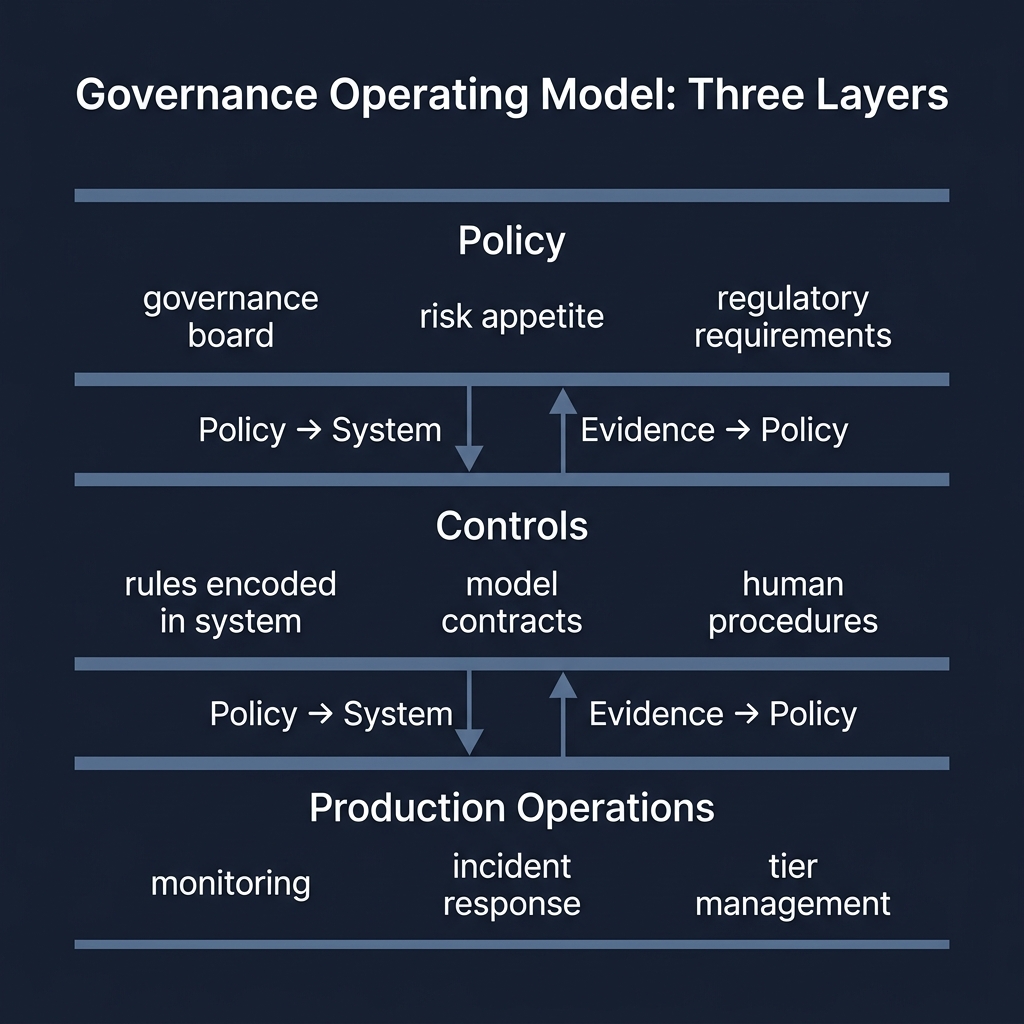
A complete AI governance operating model operates across three interconnected layers:
| Operating Layer | Core Focus | Engineering Translation & Artifacts |
|---|---|---|
| 1. Policy Layer | Risk appetite, statutory mandates, and board boundaries. | Formal regulatory standards translated into concrete system specifications. |
| 2. Controls Layer | Deterministic guardrails, component contracts, and circuit breakers. | Machine-enforceable rules engines and automated autonomy tier bounds. |
| 3. Production Operations | Continuous telemetry, incident response, and forensic audit capture. | Real-time invariant monitoring and bidirectional feedback to policy. |
Layer 1: Policy (The Mandate)
The policy layer articulates what the enterprise permits, tolerates, and forbids. It synthesizes regulatory statutes (e.g., EU AI Act, Fair Housing Act, SEC disclosures), fiduciary risk appetite, and brand safety boundaries.
- The Common Flaw: Policy is written in abstract aspirational prose ("Models must be unbiased") that offers zero engineering utility.
Layer 2: Controls (The Engineering Translation)
The controls layer translates abstract policy into measurable, machine-enforceable specifications:
-
Component Contracts: Defining maximum allowable error rates, latency fences, and input invariant schemas for every microservice.
-
Deterministic Guardrails: Hard-coded rule engines positioned around models that veto illegal outputs regardless of model confidence.
-
Circuit Breakers: Programmatic downgrade pathways embedded directly into deployment infrastructure.
Layer 3: Production Operations (The Feedback Loop)
Production operations generate the empirical proof of whether controls are holding: real-time telemetry, autonomy tier reviews, incident postmortems, and audit evidence assembly.
- The Non-Negotiable Principle: Evidence must flow bidirectionally. If production anomalies, edge-case overrides, and incident replays do not actively revise and update Layer 1 policies, the organization is engaging in Governance Theater: maintaining clean documents while production drifts uncontrolled.
Who Owns What in the AI Governance RACI Matrix?
Accountability cannot be distributed democratically across an organization. When an entire committee is vaguely responsible for AI safety, nobody is accountable.
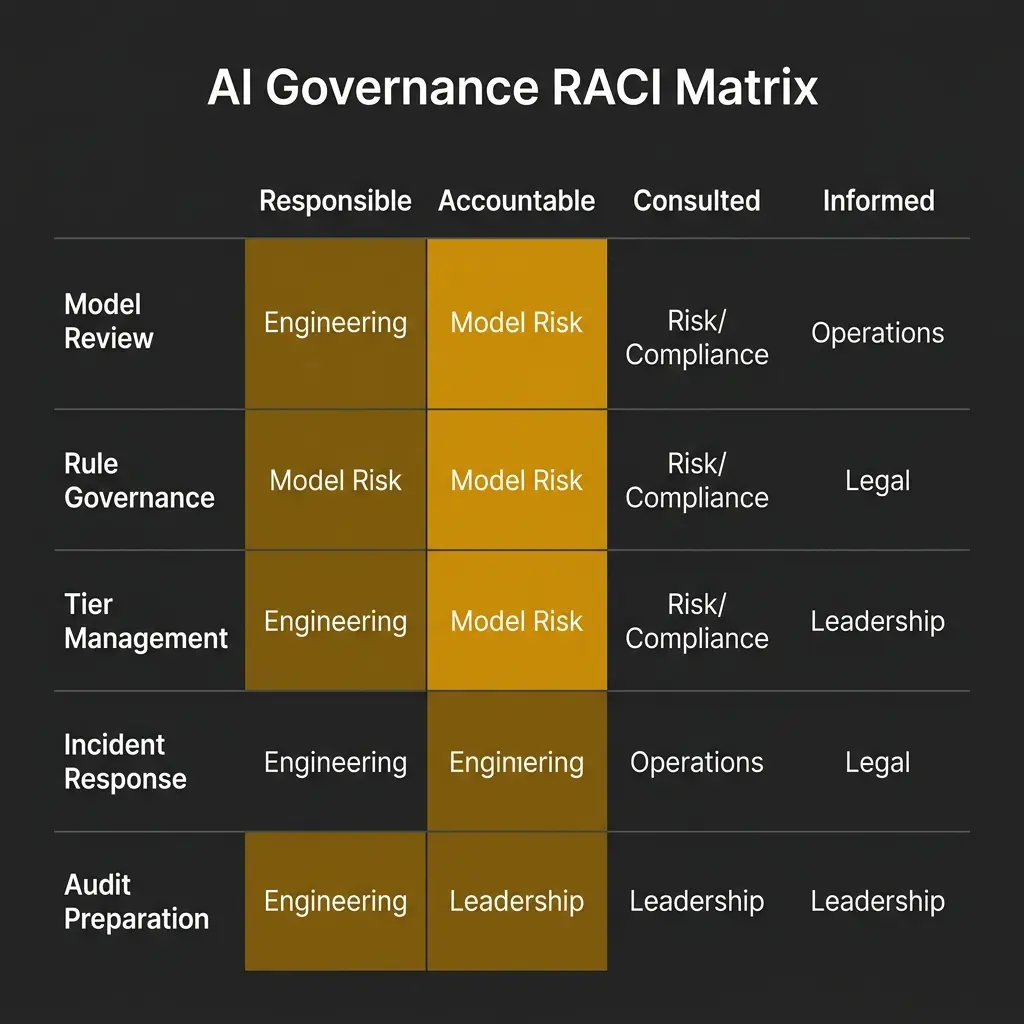
The Governance RACI assigns unambiguous ownership across five non-negotiable operational activities:
| Activity | Responsible | Accountable | Consulted | Informed |
|---|---|---|---|---|
| 1. Model Review & Validation | Model Risk / Data Science | Chief Risk Officer | ML Engineering, Product | Operations, Compliance |
| 2. Rule Governance & Invariants | Compliance & Systems Engineering | Head of Compliance | Legal, Product | ML Engineering, Leadership |
| 3. Autonomy Tier Transitions | Product Lead & AI Architect | CPO / VP Engineering | Risk Management, ML Governance | Executive Committee |
| 4. Incident Golden Hour Response | SRE Incident Commander | Staff AI Systems Architect | General Counsel | Executive Board |
| 5. Audit Trail & Forensics | Data & Security Engineering | General Counsel / GC | Model Risk, External Audit | Regulators, Leadership |
The PM's AI Governance Diagnostic: 5 Red-Flag Checks for Sprint & Post-Mortem Reviews
Product managers can use this diagnostic matrix in sprint reviews and post-mortems to catch organizational seam failures before they cause customer or regulatory harm:
| Failure Mode Vulnerability | Standup / Review Red-Flag Signal | Immediate Engineering Check | Accountable Owner (RACI) |
|---|---|---|---|
| 1. Channel Bypass | "We shipped the partner API faster by pointing straight to the inference cluster." | Verify whether the endpoint enforces the centralized Policy-as-Code filter or bypasses business invariants. | Head of Compliance & Systems Eng |
| 2. Routing Error | "High-value cases are hitting the auto-approval pipeline without review." | Run synthetic regression edge tests on missing/null fields and router boundary heuristics. | Lead Systems Architect |
| 3. Override Accumulation | "Operator queue throughput doubled, but no override reasons were logged." | Query reviewer override distributions; flag operators with $> 2\sigma$ divergence from cohort baselines. | Operations Lead & Chief Risk Officer |
| 4. Missing Circuit Breakers | "Latency and HTTP 200s look green, but support reports anomalous decisions." | Check statistical error envelopes, false-positive ratios, and automated autonomy tier downgrade paths. | Staff AI Systems Architect |
| 5. Audit Trail Gaps | "We logged the prompt and output score, but the retrieved chunks were truncated." | Verify whether Decision State Vectors (DSVs) synchronously pin chunk hashes and model checkpoints prior to output emission. | General Counsel & Data Platform Eng |
Activity 1: Model Review & Performance Contracts
-
The Structural Rule: The team that trained the model must never serve as the Accountable party for approving its production readiness. Self-certification creates an irreconcilable conflict of interest.
-
Responsible: Model Risk Management or an independent Data Science audit unit.
-
Accountable: Chief Risk Officer or Head of Model Risk.
-
Cadence: Quarterly for high-consequence systems; immediately upon drift-threshold alerts or major regulatory amendments.
Activity 2: Rule Governance & Policy Translation
Rules change faster than models. Tax codes update; AML sanctions lists expand daily; underwriting thresholds shift.
-
Responsible: Risk & Compliance (authoring the formal logic) co-partnered with Systems Engineering (implementing deterministic test suites).
-
Accountable: Head of Compliance.
-
Requirement: Every rule modification must undergo version-controlled regression testing against historical decision datasets before production release.
Activity 3: Autonomy Tier Transitions
Promoting an AI component from Tier 0 (Suggest Only) to Tier 1 (Sandbox) or Tier 2 (Autonomous with Breakers) is an architectural and fiduciary event, not an engineering sprint task.
- Responsible: Product Lead and Lead Systems Architect.
- Accountable: Chief Product Officer or VP of Engineering.
- Standard: Tier promotions require documented empirical evidence of zero-defect performance across held-out datasets and tested circuit breakers.
Activity 4: Incident Response & Golden Hour Execution
When an anomaly breaches containment boundaries, the incident response protocol must operate like a flight emergency crew.
- Responsible: On-Call SRE Incident Commander and Technical Product Manager.
- Accountable: Staff AI Systems Architect.
- Mandate: Enforce the 60-minute Golden Hour: Auto-containment at $T+15$, Replay verification at $T+45$, and Causal fix at $T+60$.
Activity 5: Audit Readiness & Forensic Evidence Custody
Preparing verifiable proof for regulatory examinations, discovery proceedings, or independent oversight audits.
- Responsible: Data Platform & Security Engineering.
- Accountable: General Counsel and Chief Compliance Officer.
- Standard: 100% of decisions in high-stakes tiers must have a cryptographically verifiable Decision State Vector retrievable within four hours of request.
How Do Teams Move From Static Policy to Operational Execution?
How does an enterprise operationalize this framework without grinding product development to a halt? By embedding governance into the engineering cadence:
1. Weekly Operational Telemetry Review (30 Minutes)
- Product Managers and ML Leads inspect aggregate calibration, override outlier rates, and circuit-breaker telemetry.
- Flagged items: Any reviewer with $>2\sigma$ override deviation or any model operating within 10% of a circuit-breaker trip fence.
2. Monthly Governance Change Gate
- Formal review of proposed Autonomy Tier promotions.
- Audit of Policy-as-Code test suites to verify that secondary APIs and legacy channels maintain 100% parity with primary channels.
3. Quarterly Adversarial Game Days
- Simulated failure injections into staging: synthetic out-of-distribution payloads, simulated vector index corruptions, and intentional circuit-breaker trip verification.
- Random selection of five historical decisions from production to test whether the engineering team can achieve bit-level reconstruction in under 60 minutes.
The Adversarial Stress-Test: What Could Break This Operating Model?
1. What is the strongest argument against this approach?
Enforcing a rigorous cross-functional operating model and formal RACI gating creates severe organizational drag. Engineering velocity slows down because every model deployment, routing change, or tier promotion requires consensus from risk officers, legal counsel, and compliance teams, paralyzing product iteration in hyper-competitive markets.
The Practical Resolution: Automate governance gates within standard CI/CD pipelines using Policy-as-Code contracts. Replace slow human committee reviews with automated pre-merge test harnesses that verify cross-channel invariant parity, routing heuristics, and schema validations in minutes, escalating to human risk committees only for formal tier promotions.
2. Under what circumstances would this fail?
This framework fails under organizational shadow development and unmonitored endpoint proliferation. If business units spin up independent cloud accounts, bypass centralized API gateways, or connect third-party AI agents directly to core production databases without logging Decision State Vectors, the formal RACI matrix becomes purely ceremonial fiction.
The Practical Resolution: Implement zero-trust network perimeters and database authentication controls that reject any production state mutation lacking a cryptographically signed execution token from the centralized policy gateway.
3. What would a skeptical customer, client, or colleague object to?
A skeptical engineering manager or product lead will object that monitoring human overrides and treating them as statistical anomalies destroys human operational autonomy and insults professional domain judgment, turning experienced underwriters or clinicians into micro-managed subordinates.
The Practical Resolution: Frame override analytics as an architectural feedback loop rather than punitive employee surveillance. When operator override clusters deviate from model baselines, treat the divergence as valuable production signal that either reveals model blindspots requiring retraining or exposes ambiguous policy guidelines needing clarification.
4. Which alternative deserves more consideration?
Autonomous Self-Healing Agent Architectures with runtime reflection loops. Rather than relying on rigid human RACI matrices and hardcoded circuit breakers, deploy meta-evaluator supervisor models that continuously inspect live inference streams, dynamically detect channel bypasses or routing errors, and autonomously patch policy enforcement rules at runtime.
The Practical Resolution: Confine self-healing supervisor models to Tier 1 non-consequential sandboxes. In regulated financial, healthcare, or employment applications, statutory liability requires named human accountability and deterministic fail-safes that cannot be delegated to another non-deterministic model layer.
5. What am I assuming that may not be true?
This architecture assumes that cross-functional stakeholders (compliance, legal, data science, and platform engineering) share a common definition of acceptable risk and will collaborate constructively. In reality, departmental incentives are frequently diametrically opposed: product teams optimize for throughput, while compliance teams optimize for zero-risk paralysis.
The Practical Resolution: Establish explicit, quantitative invariant error budgets signed by executive leadership before system launch. When risk thresholds and error budgets are tied directly to corporate balance sheets, discussions transition from political posturing to objective telemetry monitoring.
One-Line Synthesis
AI governance is an architectural contract enforced by code, measured by continuous telemetry, and owned by named individuals before an operational incident occurs.
Frequently Asked Questions
Why do AI systems fail in production when models are accurate?
Because accuracy evaluates the statistical model in isolation. Production AI failures predominantly occur in the composite systems engineering and organizational seams around the model: channel rule bypasses, unmonitored orchestration routing errors, unanalyzed human override drift, missing circuit breakers, and audit trail gaps.
What is an AI Governance Operating Model?
An AI governance operating model is the operational structure connecting three distinct layers: Policy (risk appetite and regulatory constraints), Controls (deterministic rules, model contracts, and verification procedures), and Production Operations (telemetry, incident response, tier management, and audit prep) with a mandatory bidirectional feedback loop.
How does a RACI matrix prevent AI governance failures?
A RACI matrix assigns explicit operational ownership across Engineering, Model Risk, Compliance, and Operations for the five core activities: model review, rule governance, autonomy tier transitions, incident escalation, and audit readiness: ensuring accountability never falls through departmental cracks.
Subscribe to the Architecture of Proof Dispatch
Rigorous, decision-forcing systems engineering and AI governance monographs for technical leaders. Delivered periodically, zero spam.