The Case for Shared Intelligence Services: How Product Teams Build Compounding AI
Why Building AI Feature-by-Feature Fails, and How Reusable Capability Contracts Create Enterprise Leverage
The platform functions as an accelerator, not an approval committee.
Executive Summary
When software organizations accelerate their AI delivery, product leaders often default to squad-level autonomy: the search squad builds bespoke extraction prompts, onboarding scripts custom agent loops, and finance creates its own document parsing pipelines. Each team solves prompting, error handling, and validation in complete isolation.
In the initial quarters, this appears to deliver extraordinary velocity. Demos ship in weeks. Features launch ahead of schedule.
Then the systemic reality of uncoordinated probabilistic software sets in:
- Duplicated scaffolding: Chronic engineering waste. Squads independently burn quarters re-solving extraction, validation, rate-limiting, and cost controls, recreating commoditized plumbing instead of differentiating product workflows.
- Inconsistent trust perimeters: Acute catastrophic risk. Autonomous squads implement discretionary privacy, scrubbing, and authority controls, leaving enterprise compliance and security exposed to whichever team takes the shortest path.
- Cascading brittleness: Operational attrition. Upstream model updates and real-world distribution shifts silently degrade isolated features with no shared regression harness to catch capability regressions before users do.
- Zero compounding leverage: Strategic terminal loss. Disconnected implementations discard production traces and human corrections—leaving the enterprise with dozens of isolated implementations instead of an accumulating, governable capability.
The core challenge in enterprise AI is preventing probabilistic workflows from fragmenting into disconnected, non-governable product implementations that fail to compound institutional value.
The answer is not to centralize all AI development. It is to centralize the capabilities that make AI observable, governable, reusable, and economically viable—while leaving product innovation, workflow design, and business outcome accountability squarely with product squads.
A Shared Intelligence Service is a versioned, observable, governed reasoning capability that multiple product surfaces can invoke through an explicit contract. This distinguishes it from a prompt library or a generic model gateway. Durable enterprise advantage comes from building and operating these services at scale: bounded orchestration, explicit capability contracts, continuous evaluation, and institutional learning.
The First-Principles Divergence: Why Feature Silos Work in Traditional Software but Break in AI
The defining playbook of modern software delivery has been radical decentralization: autonomous squads owning their domain, their stack, and their release cadence. Two-pizza teams build their own microservices, choose their own dependencies, and ship without cross-team coordination. Conway's Law was turned from an organizational tax into an operational strategy.
While autonomous silos carry well-known distributed-systems debt in traditional software—schema drift, redundant data pipelines, and integration complexity—the underlying system mechanics remain deterministic: code paths are inspectable, interfaces are typed, and runtime failures produce stack traces rooted in specific commits or dependency diffs.
When organizations apply this same siloed playbook to probabilistic AI products, the failure mode changes from static architectural debt to active operational blindness.
In deterministic software, feature silos duplicate engineering effort—a coordination cost that manifests as static integration debt. In probabilistic AI products, feature silos create dark data and lost adjudication: production failures and operator corrections that are not captured in a governed, domain-aligned evaluation corpus expire into unrecoverable noise, preventing institutional learning from ever compounding.
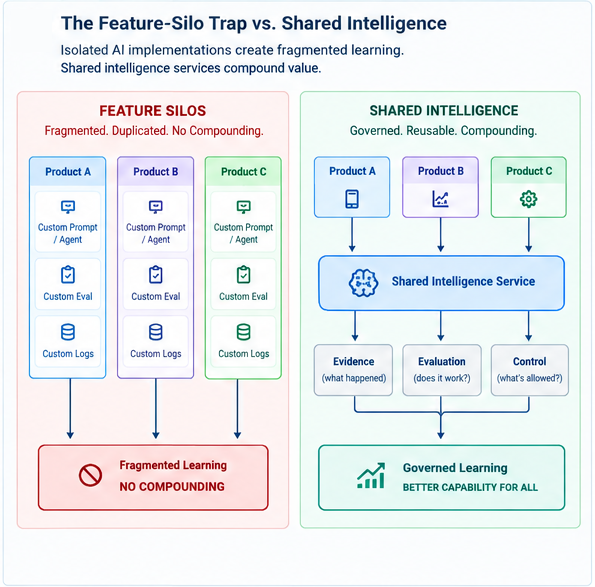
There are five first-principles reasons why squad-level autonomy fractures in probabilistic systems:
1. Change Observability vs. Silent Behavioral Drift
In deterministic software, behavior is anchored to explicit code, configuration, and runtime environments. When behavior changes, the root cause is traceable through changelogs, dependency updates, or environmental diffs. In probabilistic systems, behavior also depends on foundation model checkpoint revisions, sampling temperatures, retrieved context shifts, tool schema interpretations, and live distribution drift. Provider release notes may announce a model upgrade or API refinement, but they cannot predict how that change alters confidence calibration, reasoning edge cases, or false-positive rates on an enterprise's specific task distribution.
In a siloed architecture, each squad monitors its own product surface through high-level operational metrics: error rates, user drop-offs, and latency percentiles. These are lagging, conflated indicators. They detect degradation only after users experience failure, and they present the issue as a localized feature defect ("invoicing discrepancy rate rose 3%") rather than an underlying capability regression ("entity boundary extraction degraded after last week's model checkpoint shift"). Diagnosing root cause requires disentangling the AI model's behavioral shift from concurrent UI releases, upstream database changes, and normal seasonal variance.
Standardizing application performance monitoring (APM) via tools like OpenTelemetry or Datadog captures raw latency, token counts, and HTTP errors across silos—but telemetry is not semantic evaluation. A standard distributed trace records that a prompt was sent and an answer returned; it cannot determine whether an extracted numerical threshold violated a regulatory boundary.
Shared capability-level regression monitoring provides four capabilities that siloed product monitoring structurally cannot:
Pre-production detection. The shared capability maintains a versioned golden evaluation suite. Fast contract, invariant, and critical-case checks run continuously in CI; comprehensive regression suites execute on capability release candidates, while canary deployments isolate behavior under live traffic. Regressions are caught against historical domain benchmarks before reaching customer-facing surfaces.
Cross-product pattern detection. A subtle, distributed regression—such as a 2% accuracy degradation on complex nested tables spread across twelve internal workflows—remains buried under the statistical noise threshold of any single product dashboard. Aggregated at the shared capability layer, that distributed degradation surfaces as a statistically significant signal pointing to a single root cause.
Principled boundary coverage, not user-reported gaps. Product teams inevitably optimize for what users encounter and report. A shared domain evaluation suite is intentionally curated to cover historical failure modes, contractual edge cases, adversarial inputs, and low-frequency regulatory conditions that live users may not trigger for months—the exact scenarios where silent degradation creates catastrophic exposure.
Capability health isolated from product health. A product squad observing a drop in workflow completion cannot easily isolate whether the cause is a confusing UI redesign, a payment gateway timeout, or an AI extraction regression. Capability-level regression evaluation isolates the reasoning component independently, confirming behavioral integrity before it is conflated with product-level variables.
2. Bounded Test Coverage vs. Uncharted Input Space
Deterministic code operates within bounded type systems and explicit conditional logic. An engineering squad can write deterministic unit tests targeting high branch coverage. Probabilistic systems consume natural language, noisy OCR, and multimodal inputs across an effectively infinite input space. A squad-level prompt evaluation suite samples only a minuscule, often unrepresentative fragment of the inputs the system will encounter in live operations. When squads build in silos, every production failure prompts an ad-hoc local prompt patch, trapping the fix within that isolated squad.
In a shared capability architecture, the primary advantage is governed routability across shared semantic domains. When an edge-case failure occurs, it generates a structured evidence artifact with an established pipeline into a domain-specific evaluation corpus. However, cross-squad pooling cannot be applied indiscriminately. Pushing edge cases from a loose, recall-oriented legal search squad into a strict, precision-oriented invoice reconciliation suite causes evaluation bloat and conflicting acceptance criteria. A governed platform prevents this through strict domain affinity matching: validated failure cases route only to the capabilities and evaluation suites sharing identical semantic objectives.
3. Predictable Execution Cost vs. Structural Inference Waste
In traditional services, marginal compute cost per request is negligible and predictable. AI workloads introduce acute, variable expenses: input and output tokens, reasoning tiers, multi-step retries, tool execution cycles, context window inflation, and latency requirements all govern the unit economics of every transaction.
In large enterprises, central IT often governs model selection by providing an approved vendor list. But centralizing vendor access is not the same as coordinating inference economics. Siloed architectures inevitably produce structural waste:
Absence of task-complexity routing. When squads invoke models directly, simple classification tasks and multi-hop analytical reasoning queries often traverse the same high-cost frontier model endpoint. Silos lack the dynamic routing fabric necessary to classify task complexity and dispatch low-stakes requests to smaller, highly optimized models.
Inability to leverage structured prompt caching. Frontier model prompt caching requires bit-for-bit identical prefix matching across requests. Independent squads authoring bespoke system prompts and ad-hoc schemas achieve near-zero cache reuse. Conversely, shared intelligence services standardize input schemas and stable system prefixes across consuming applications, converting cache potential into predictable latency and cost reductions.
Fragmented cost attribution. When AI invocations are distributed across disparate squad logging setups, engineering leadership cannot accurately tie token expenditure to specific customer tiers, business processes, or operational outcomes, obscuring unit economic viability.
Blocked distillation pathways. The most dramatic economic optimization—distilling high-volume reasoning tasks into smaller, fine-tuned open weights—requires thousands of high-quality, verified production input/output pairs. Siloed squads processing moderate request volumes never individually accumulate the verified dataset density required to train and benchmark specialized models.
4. Internal Stack Traces vs. External Proof Requirements
When deterministic software faults, the runtime yields an exact stack trace mapping to a file, line number, and memory state. Probabilistic models produce syntactically plausible statistical completions without native auditability detailing why an output was generated or which retrieval chunks directly justified a claim. In consequential workflows, operational proof must be engineered externally through explicit Evidence, Decision, and Authority Contracts.
The failure in a siloed architecture is not that squads refuse to log data. Most dump raw API payloads into passive log archives. The failure lies in semantic inconsistency and lack of evidentiary standardization:
- Squad A stores raw completions as unstructured text in an application database.
- Squad B logs JSON payloads without recording chunk hashes or retrieval timestamps.
- Squad C records model outputs but drops the operator override rationale.
A regulatory examination or compliance audit across these surfaces becomes an expensive forensic reconstruction across incompatible data structures. Furthermore, systemic biases or correlated confidence miscalibrations cannot be systematically detected across the enterprise because the evidentiary records lack structural equivalence.
A shared intelligence service enforces an immutable, standardized evidence schema at the capability boundary. Every product consuming the service automatically emits cryptographically chained, structurally comparable evidence artifacts, enabling unified compliance verification across all operational surfaces.
5. Code Reuse (DRY) vs. Compounding Institutional Learning
In deterministic software, code reuse (Don't Repeat Yourself, or DRY) is primarily an engineering efficiency mechanism: Squad A sharing an authentication library with Squad B saves developer hours, but the code does not become mathematically more accurate, cheaper to run, or more defensible over time. The productivity gain is linear: saving $N$ squads from writing redundant code.
In AI systems, capability reuse is the primary engine of non-linear compounding. It does not merely prevent duplicate prompt authoring—it activates four compounding flywheels across the enterprise simultaneously:
1. Learning Compounding (Statistical Mass & Curated Long Tail): In machine learning, indiscriminate data accumulation yields sub-linear or logarithmic returns: the ten-thousandth standard invoice provides virtually zero incremental value over the first thousand. Compounding occurs specifically in curating the long tail of rare, high-consequence failure modes. Siloed squads rarely encounter enough long-tail exceptions to characterize the distribution, leaving every product vulnerable to recurring edge-case failures. Capability reuse aggregates verified production traces into a shared golden corpus, crossing the statistical threshold required to train, evaluate, and benchmark domain-specific models.
2. Immunization Compounding (Enterprise Defense): When Product A discovers an adversarial prompt injection, a subtle schema perturbation, or a hallucinated regulatory threshold, a new deterministic verification invariant is committed to the shared capability contract. Instantly, all products consuming that capability are immunized against that failure mode before they ever encounter it in live production. One squad's near-miss becomes enterprise-wide defense.
3. Economic Compounding (Inference Arbitrage & Distillation): Ten isolated squads authoring bespoke prompts achieve near-zero prompt prefix cache reuse and pay full retail rates for frontier models. A shared capability standardizes input schemas and system prefixes, unlocking high-hit-rate prompt caching, enabling dynamic task-complexity routing, and accumulating the verified dataset density required to distill expensive tasks into low-cost private open weights.
4. Compliance Compounding (Audit Velocity & Pre-Certified Proof): In regulated domains (OCC/SR 11-7, HIPAA, FedRAMP), auditing ten siloed AI implementations requires ten separate, multi-month governance reviews across incompatible logs. A shared intelligence service standardizes the evidence schema, confidence calibration thresholds, and cryptographic audit ledger once. Consuming products inherit pre-certified compliance, reducing regulatory review cycles from quarters to zero.
Why does uncoordinated development break this compounding mechanism?
- Raw logs persist, but unadjudicated context perishes: Dumping raw prompt payloads into passive log archives creates dark data. If an operator overrides an automated decision without a structured reason code and outcome linkage, that operational intelligence is permanently lost. Six months later, an engineer examining raw payloads cannot retroactively deduce whether the model failed or the human made a discretionary business exception.
- Adjudicated human signal is scarce and perishable: Production override events—moments where an authorized human actively corrects an AI decision—are the single most information-dense signal at the frontier of model capability. Trapping these events inside local squad logs wastes the essential raw material required to fuel the four compounding flywheels.
| Architectural Dimension | Traditional Deterministic Software | Probabilistic AI Products | Why the Feature Silo Fails in AI |
|---|---|---|---|
| Change Observability | Behavior governed by explicit code and config; runtime failures yield traceable stack traces. | Behavior shifts dynamically across model checkpoints, prompts, retrieved context, and live data distributions. | Isolated product metrics detect degradation only after users are impacted; APM logs lack semantic evaluation. |
| Verification Scope | Compilers, typed interfaces, and deterministic unit tests achieve high branch coverage. | Input space is open-ended; local prompt test suites cover an unrepresentative fraction of live distributions. | Silos patch edge cases locally; failure modes never route into domain-wide regression suites. |
| Operational Economics | Predictable, near-zero marginal execution cost per request. | Dynamic token spend, reasoning tiers, tool execution overhead, and context window inflation. | Uncoordinated prompts prevent prefix caching; fragmented volume blocks cost-effective model distillation. |
| Failure Diagnosis | Runtime stack traces pinpoint deterministic lines of failure. | Plausible statistical completions provide no internal audit trail; proof must be engineered externally. | Incompatible logging schemas create un-auditable dark data and fragmented regulatory liability. |
| Compounding Value | Code reuse saves engineering hours (linear productivity gain). | Capability reuse compounds curated edge cases, confidence calibration, and domain distillation (non-linear). | Silos let high-value human corrections expire into unclassified, unusable log dumps. |
The Two Planes: Execution and Learning
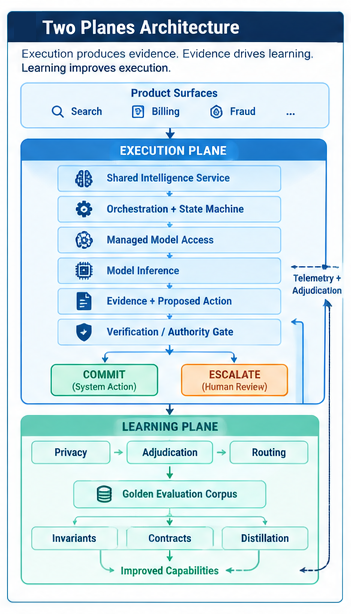
A mature shared intelligence platform operates across two distinct planes, not merely a five-level stack.
flowchart TD
    subgraph EP["EXECUTION PLANE (Serves Product Requests Downward)"]
        direction TB
        PS["Product Surface"]
        SIS["Shared Intelligence Service"]
        MMA["Managed Model Access"]
        MI["Model Inference<br/>(Evidence + Proposed Action)"]
        VG{"Verification Gate<br/>(Transition, Authority, Policy)"}
        Commit["Staged Commit"]
        Escalate["Escalate to Human<br/>(Operator Review & Override)"]

        PS -->|"Invokes Capability Contract"| SIS
        SIS -->|"Executes via Orchestration & State Machine"| MMA
        MMA -->|"Routes to Optimal Inference Backend"| MI
        MI --> VG
        VG -->|"Pass"| Commit
        VG -->|"Fail"| Escalate
    end

    TAP["Telemetry & Adjudication Pipeline<br/>(Upward Feedback Bridge)"]
    Commit --> TAP
    Escalate --> TAP

    subgraph LP["LEARNING PLANE (Improves Capabilities Upward)"]
        direction TB
        GLP["Governed Learning Pipeline<br/>(Privacy Filter → Classification → Scope Routing)"]
        GEC[("Governed Evaluation Corpus<br/>(Golden Sets & Failure Libraries)")]
        HI["Hardened Invariants<br/>(Pre-Commit & Merge Gates)"]
        RCC["Revised Capability Contracts<br/>(Semantic Versioning)"]
        DMW["Distilled Model Weights<br/>(Lower Latency & Unit Cost)"]

        GLP --> GEC
        GEC --> HI
        GEC --> RCC
        GEC --> DMW
    end

    TAP --> GLP
    HI -.->|"Pre-Commit Gates"| VG
    RCC -.->|"Updated Contracts"| SIS
    DMW -.->|"Optimized Inference"| MMA
The execution plane serves product requests. The learning plane converts production evidence into improved capabilities. The telemetry bridge between them is not a secondary concern—it is what makes the architecture compound.
The Strategic Moat: Verified Organizational Learning, Not Shared Infrastructure
Most product roadmaps misallocate engineering capital by treating infrastructure as the finish line. Infrastructure—model gateways, orchestration tooling, vector stores, and out-of-band LLM evaluation dashboards—is necessary but rapidly commoditizing. A competitor can replicate a routing gateway, copy a service interface, or adopt an open-source evaluation framework like Promptfoo or DeepEval over a weekend.
Furthermore, the enterprise AI tooling market has flooded with hosted, API-first evaluation and observability platforms (Braintrust, Galileo, Arize Phoenix, Patronus AI). These tools capture traces passively and compute post-hoc quality metrics in third-party clouds. But passive telemetry is not an enterprise control plane. Passive observability tells you how your system failed after the downstream damage has already occurred.
What cannot be replicated off-the-shelf is the accumulation of verified organizational learning embedded in an active, inline control plane:
| Layer | Core Capabilities & Components | Defensibility & Strategic Advantage |
|---|---|---|
| 1. Commodity Intelligence (Accessible Utility) |
• Hosted completion APIs from major providers • Universal language reasoning, general generation |
Low / Ephemeral. Available to competitors through broadly accessible commercial APIs. Provides temporary advantages in cost, latency, or specialization, but no durable structural defensibility. |
| 2. Infrastructure & Eval Scaffolding (Table Stakes) |
• Model access gateways, token governance, basic observability • Commodity orchestrators and off-the-shelf vector stores • Hosted prompt playgrounds and out-of-band eval dashboards (Braintrust, Galileo, Arize, Promptfoo) |
Low. Necessary operational foundation, but easily replicated via open-source or commercial off-the-shelf tooling. Passive post-hoc metrics offer zero inline execution authority. |
| 3. Verified Organizational Learning (The Durable Advantage) |
• Adjudicated production traces & domain-specific failure distributions • Curated Golden Evaluation Corpus with outcome-linked labels • Embedded workflow integrations, policy bindings, authority rules • Institutional memory: context graphs, reviewed corrections, trust records |
High & Compounding. Requires years of governed production operation to accumulate. Defensibility scales with operational tenure and verified production volume. |
The defensible layer is not shared infrastructure or hosted evaluation dashboards by itself. It is the verified organizational learning embedded in an inline architectural triad: On-Premise/Private-VPC Deployment, a Cryptographic Audit Ledger, and Real-Time Inline TCP Interception.
The Defensible Architectural Triad: Operating Posture over Passive Telemetry
To provide genuine governance in regulated enterprise environments (HIPAA, FedRAMP, OCC/SR 11-7), the platform cannot be a passive SaaS analytics dashboard. While commercial eval platforms increasingly offer enterprise VPC connections or data-residency clauses, their fundamental architectural posture remains out-of-band and asynchronous: they ingest traces after the fact to score quality metrics in background queues.
Genuine enterprise control requires a synchronous, inline operational posture—anchored in an architectural triad designed for immediate enforcement rather than retrospective analysis:
- On-Premise / Private-VPC Air-Gapped Deployment: Regulated data, internal reasoning context, and institutional failure traces remain strictly within the customer's security boundary, guaranteeing that zero evidentiary tokens egress to external multi-tenant infrastructure.
- Cryptographic Audit Ledger: Every input anchor, state-transition check, verifier jury score, and committed mutation is timestamped and cryptographically chained into an immutable, tamper-evident log, providing mathematically verifiable proof of operational history for regulators.
- Real-Time Inline Interception (The Kill-Switch): Sitting synchronously in the execution and state-commit path (at the network and proxy boundary). Operating under sub-millisecond overhead constraints, the platform does not merely log non-compliance—it acts as an active circuit breaker, deterministically arresting unauthorized or unverified agent transitions before they commit irreversible side effects to production databases.
An inline execution gate introduces a tradeoff that must be stated explicitly: any synchronous control plane component that can block a transaction can also become a single point of failure that blocks every transaction. The architecture addresses this through active-active redundancy, sub-millisecond circuit breakers that fail-open to human review queues rather than fail-closed to hard stops, and strict separation of the blocking path (authority and policy verification) from the enrichment path (evidence logging and trace collection). Failing open is intentional: the platform's failure mode is mandatory human review, not enterprise-wide AI outage.
Operationalizing this inline posture requires structuring capabilities across five progressive maturity levels—beginning with basic model decoupling and culminating in governed institutional learning.
Level 1 — Managed Model Access: Decoupling Capability from Supplier
The objective of Level 1 is to separate the application's intelligence dependency from the underlying model supplier.
An application should depend on an enterprise capability contract, not on a specific model supplier.
A capability contract decouples application code from vendor-specific APIs, but it does not make model substitution behaviorally free. Swapping an underlying model checkpoint inevitably alters reasoning nuance, confidence calibration, and long-tail error distributions. The platform layer abstracts the interface and routing mechanics, but the enterprise still owns behavioral compatibility evaluation, regression testing against historical task distributions, and risk-managed rollout policies before any traffic shifts.
In a mature architecture, product teams specify an internal capability requirement (e.g., structured-entity-extraction with p95 latency < 400ms and cost ceiling $0.002). The Model Access Layer resolves that requirement dynamically:
flowchart TD
    APP["Application Surface"]

    subgraph MAL["Enterprise Model Access Layer"]
        direction TB
        GATE["Request Normalization & Policy Enforcement<br/>• Evaluates SLA, cost budget, context length, and modality<br/>• Injects unique trace ID, records provenance, and enforces tenant PII redaction"]

        ROUTER{"Dynamic Task-Complexity Router"}

        T1["Cheap Commodity Tier<br/>(Flash / Haiku / Local 8B)"]
        T2["Balanced Production Tier<br/>(Mid-Weight Production Models)"]
        T3["Deep Reasoning Tier<br/>(Frontier Reasoning Models)"]

        GATE --> ROUTER
        ROUTER -->|"Low Complexity / High Volume"| T1
        ROUTER -->|"Standard Task Workflows"| T2
        ROUTER -->|"Multi-Hop Analytical Reasoning"| T3
    end

    APP -->|"Invokes Capability Requirement"| GATE

    subgraph BACKENDS["Inference Backends (With Circuit Breakers & Outage Fallback)"]
        direction LR
        PA["Provider A"]
        PB["Provider B"]
        IW["Internal Weights<br/>(Private VPC / On-Prem)"]
    end

    T1 --> BACKENDS
    T2 --> BACKENDS
    T3 --> BACKENDS
This abstraction protects the enterprise across six operational vectors:
- Model deprecation: Upstream vendors sunset checkpoints on short notice.
- Provider cost changes: When an alternative provider reduces pricing significantly, the enterprise captures the margin across all products without changing application code.
- Latency hedging: Real-time routing directs bursty traffic away from degraded regions.
- Outage resiliency: If a provider suffers global degradation, traffic fails over seamlessly.
- Data residency compliance: Requests containing sovereign data are routed deterministically to local or on-premise inference endpoints.
- Token accounting: Spend is attributed directly to specific product features, customer tiers, and cost centers.
Level 2 — Bounded Orchestration: The State-Transition Gate
Level 1 provides access to compute. Level 2 determines what that compute is permitted to do—and what constitutes a valid state change.
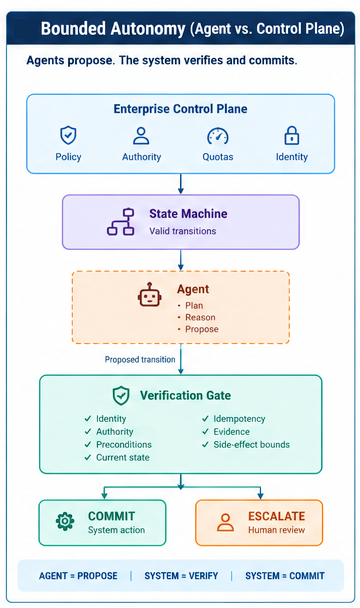
The architectural principle is Bounded Autonomy: probabilistic agents operate inside deterministic state machines, governed by an enterprise control plane.
flowchart TD
    ECP["Enterprise Control Plane<br/>(Policy, Quotas, Permissions)"]
    SM["State Machine<br/>(Enforces Valid Transitions)"]
    AGENT["Agent (Probabilistic)<br/>(Planning & Draft Generation)"]

    ECP --> SM
    SM -->|"Allowed Actions"| AGENT

    subgraph TVL["Transition Validation Layer (At Commit Time)"]
        direction TB
        V1["• Actor & Tenant Verified"]
        V2["• Target Resource Checked"]
        V3["• Authority Tier Confirmed"]
        V4["• Preconditions Met"]
        V5["• Concurrency & Current State Validated"]
        V6["• Idempotency Key Confirmed"]
        V7["• Expected Side Effects Bounded"]
        V8["• Evidence Sufficiency Assessed"]
    end

    AGENT -->|"Proposed State Transition"| TVL

    COMMIT["Staged Commit<br/>(With Rollback or Preview)"]
    ESC["Escalate to Human<br/>(Audit Bundle + Low-TTC Context)"]

    TVL -->|"Pass"| COMMIT
    TVL -->|"Fail"| ESC
The verification gate is not merely output validation. It validates the proposed state transition against current state at commit time: actor, target, authority, preconditions, concurrency, idempotency, expected side effects, and evidence sufficiency.
The Operating Principle
- Model: "Here is my best probabilistic assessment of this insurance claim, with proposed settlement payout X."
- Transition Validation Layer: "Does payout X fall within the user's authority tier? Do the line items match the underlying evidence? Has the target record changed since context assembly? Has this payout already been triggered? Has the fraud invariant passed? If all pass, commit idempotently. If not, escalate with the full context bundle."
A proposed action can be well-evidenced and policy-compliant yet still invalid if the target state changed after planning; validation must occur against current state at commit time, backed by strict idempotency keys to prevent duplicate external side effects. Where the risk profile allows, introduce a simulation or staging path before commit, making recovery explicit and enabling effect preview before irreversible actions.
Level 3 — Shared Intelligence Services: Don't Let Every Squad Reinvent Reasoning
The most damaging waste in AI engineering occurs when product squads repeatedly rediscover how to solve the same foundational domain reasoning problems.
Consider three squads in a fintech enterprise:
- The Invoicing Squad needs to extract vendor names, line items, and tax identifiers from scanned PDFs.
- The Fraud Squad needs to extract merchant names, locations, and transaction entities from dispute emails.
- The Procurement Squad needs to extract entities from vendor contracts and master service agreements.
In isolation, each squad writes bespoke system prompts, tests multiple models, invents custom regex fallbacks, and builds disjointed error handling. In a mature architecture, the enterprise builds a shared capability.
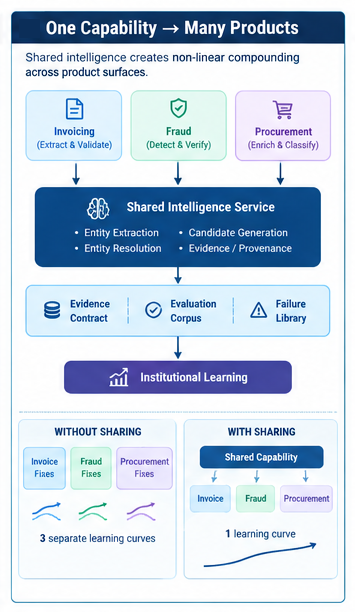
Note that a shared capability should be composable, not monolithic. A complete entity resolution workflow involves distinct sub-capabilities—document fact extraction, entity candidate generation, entity resolution, and canonical record mutation—each with its own contract and authority boundary. A fact extraction service may return candidate claims; a resolution service may return ranked candidates; a mutation service may require deterministic match thresholds or explicit human approval. This prevents shared services from becoming new AI monoliths.
When to Share: The Capability Decision Framework
Centralizing too early is just as fatal as fragmenting into silos. If an enterprise forces every speculative prompt experiment into a shared platform, the platform becomes an administrative bottleneck, producing rigid, lowest-common-denominator abstractions that stifle product velocity.
Promoting an AI capability from a local product feature to a Shared Intelligence Service should be governed by a rigorous decision rubric:
| Evaluation Dimension | Centralize into a Shared Capability | Keep Local to Product Squad |
|---|---|---|
| Semantic Overlap | Multiple products solve structurally identical or adjacent reasoning tasks (e.g., entity extraction from legal documents across invoicing, procurement, and onboarding). | Task semantics and input formats are unique to a single product workflow with no cross-organizational equivalent. |
| Verification & Compliance | The capability requires rigorous proof perimeters: immutable audit trails, standardized evidence schemas, or legal/regulatory compliance. | Low-stakes, internal, or discretionary completions where informal verification suffices. |
| Blast Radius of Drift | Silent behavioral drift carries acute operational, financial, or regulatory liability across multiple business surfaces. | Local degradation impacts only isolated feature engagement without cascading cross-system side effects. |
| Statistical Scale | Combined organizational volume generates sufficient trace volume to justify versioned golden datasets and model distillation pipelines. | Sparse or sporadic request volume where the engineering overhead of three-plane contracts exceeds inference cost savings. |
| Outcome Observability | Consuming workflows yield explicit, adjudicable downstream feedback (e.g., human corrections, operator overrides, settlement audits). | Downstream user interaction provides no structured signal of factual correctness or decision quality. |
| Frontier Model Absorption Risk | Reasoning task is domain-specific, consequential, multi-party, or requires institutional memory that foundational models cannot acquire from pre-training. | Reasoning task is a general capability (summarization, classification, basic extraction) that upcoming frontier model checkpoints will absorb into base capability within 12–18 months. |
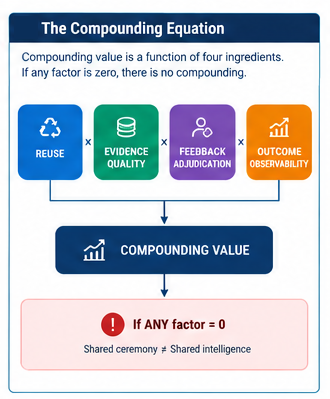
Compounding value is not guaranteed by centralization alone. Compounding is a function: Reuse × Evidence Quality × Feedback Adjudication × Outcome Observability. If any factor is zero, centralization builds shared ceremony rather than shared intelligence.
The Capability Cannibalization Risk: When the Model Absorbs Your Service
This decision rubric carries a specific operational reality: the appropriate architectural decision for a general reasoning task (such as classifying support tickets into standard categories or generic table summarization) often shifts from "build shared service" to "call frontier model directly" within 12 to 18 months. When frontier model checkpoints absorb capabilities natively, custom prompt pipelines and bespoke parsing logic become technical debt rather than defensibility.
Monitoring frontier capability absorption is a mandatory input to the annual capability portfolio review. A shared service that wraps a reasoning task now handled natively and robustly by the base model is not an enterprise moat—it is maintenance overhead. Engineering leaders must actively deprecate and decommission shared intelligence services when upstream model improvements render bespoke orchestration redundant.
The Intelligence Service Contract: Three Planes
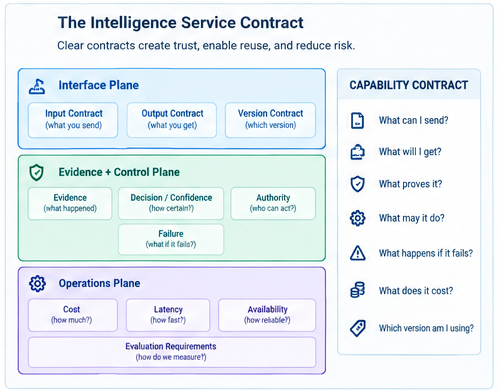
Every shared capability must be governed by an Intelligence Service Contract organized across three planes:
Interface Plane — defines the capability boundary:
| Contract | Purpose | Requirement |
|---|---|---|
| Input Contract | Boundary Definition | Strictly defines allowed payload types, multimodal parameters, context bounds, and schema constraints. |
| Output Contract | Deterministic Target | Guarantees strongly-typed data structures (e.g., Pydantic / Zod / Protobuf schemas). |
| Version Contract | Immutability | Backward compatibility guaranteed; behavioral modifications must pass regression tests before deployment. |
Evidence and Control Plane — defines what the capability knows and what it may do:
| Contract | Purpose | Requirement |
|---|---|---|
| Evidence Contract | The Proof Requirement | Every extracted assertion or synthesized answer must include source-location anchors, retrieval timestamps, and content hashes where tamper evidence or reproducibility is required. A hash proves integrity and reproducibility—not that the content is accurate or sufficient. |
| Evidence and Decision Contract | Calibrated Threshold | Defines the calibrated evidence and decision thresholds required to return an executable result rather than an indeterminate result. Evidence signals incorporate retrieval grounding density, citation completeness, schema compliance, and independent verifier consensus. A capability may return: result, evidence, uncertainties, unsupported claims, validation checks, authority required, and recommended next action. |
| Authority Contract | Execution Boundaries | Defines whether the capability is authorized to autonomously commit a mutation or trigger a side-effect, versus merely proposing a draft. Explicitly separates "the model says this is correct" from "the system is authorized to act on this conclusion." |
| Failure Contract | Graceful Degradation | Codifies behavior when confidence or authority is breached: partial payload return, deterministic fallback, or structured escalation. |
Operations Plane — defines the operational envelope:
| Contract | Purpose | Requirement |
|---|---|---|
| Cost Contract | Unit-Economic Stability | Fixes maximum token spend and inference budgets per transaction tier. |
| Latency & Availability SLA | Reliability Target | Defines p95 latency budgets, error rate ceilings, and fallback behavior on degradation. |
| Evaluation Requirements | Release Governance | Specifies the evaluation class, minimum dataset coverage, and threshold conditions for each release gate. |
When capabilities are wrapped in explicit contracts across all three planes, the organization learns once and distributes that learning everywhere.
Contract Synthesis vs. The Bootstrapping Inversion
A tempting engineering fantasy is "auto-contract synthesis"—the idea that an inline gateway can passively observe production traces and automatically derive semantic contracts and dependency graphs.
In practice, this collides with a structural reality:
Sitting in the network path captures raw payloads, but semantic dependencies do not automatically materialize from network traffic.
Traditional APM tools (Datadog, Dynatrace) already provide topological dependency graphs (Service A → Service B). But enterprise AI governance requires semantic dependencies: knowing that Mortgage Squad's underwriting workflow depends on Reasoning Property Y (source-attribution consistency) of Extraction Service Z.
Attempting to infer this automatically creates two unworkable traps:
- The Inferred Path Paradox: Inferring semantic dependencies requires observing historical failures, edge-case regressions, and user disputes traced back to underlying reasoning properties. In regulated environments (OCC/SR 11-7, HIPAA, FedRAMP), asking a Chief Risk Officer to allow production failures to accumulate so that a governance system can learn its contracts is a self-undermining proposition. You cannot sell a failure-prevention system that requires production failure to bootstrap.
- Declared Path Rot: The opposite approach—asking product squads to manually declare and maintain exhaustive semantic contracts in documentation—invariably fails. Discretionary declarations decay the moment release deadlines press. Manual contracts rot unless tied directly to a hard, automated forcing function: a cryptographically verified CI merge gate or deployment blocker.
The platform resolves this bootstrapping inversion by refusing to rely on generic, passive contract synthesis or unverified developer wikis. Instead, it bridges the cold start through a two-step discipline:
- Explicit Semantic Scoping: Contract declaration is scoped strictly to high-compliance, consequential workflows where interface and authority parameters are already legally or architecturally mandated.
- Synthetic Pre-Flight Contract Probing: Rather than waiting for real-world production failures to expose missing dependency edges, the platform deploys synthetic red-teaming engines to probe declared contracts against simulated consumer workflows. By generating adversarial variations and boundary permutations before release, synthetic probing discovers unstated assumptions and latent semantic dependencies prior to live traffic.
The resulting semantic dependency graph is not left as passive documentation; it is cryptographically signed, versioned, and anchored in the platform's audit ledger, turning declared and probed contracts into active, machine-enforceable merge gates and runtime boundaries.
The Vertical SaaS Alternative: When Not to Build
Before committing engineering capital to build an internal shared capability, evaluate whether a specialized vertical SaaS vendor has already accumulated the governed corpus and fine-tuned edge-case coverage your enterprise cannot match. For many standardized functional reasoning tasks—legal contract review (Harvey), accounts-payable invoice extraction (Rossum, Vic.ai), clinical documentation (Abridge), or enterprise search (Glean)—specialized vendors process millions of domain transactions across hundreds of enterprise clients. Their distillation flywheels compound across an entire industry, creating domain-specific accuracy and edge-case resilience that single-enterprise datasets struggle to equal.
The build-versus-buy decision reduces to a precise architectural question: Does your workflow, data residency boundary, proprietary context graph, or regulatory authority requirement demand controls that a vertical vendor cannot contractually or architecturally satisfy? If the task relies strictly on public domain mechanics without proprietary organizational context or sensitive jurisdictional isolation, building an internal shared intelligence service is the wrong investment. Buy the vertical solution; reserve internal platform engineering for capabilities that embed proprietary institutional memory and private audit perimeters.
Level 4 — Evaluation: What Cannot Be Evaluated Cannot Be Shipped
In probabilistic software, passing a handful of test prompts guarantees nothing about production behavior.
Without continuous regression evaluation, any prompt modification, model upgrade, or context adjustment is an unquantified risk.
Evaluation must cover four distinct classes—not just output quality:
| Evaluation Class | What It Measures |
|---|---|
| Task Quality | Extraction accuracy, classification fidelity, answer quality across the production input distribution. |
| Evidence Quality | Citation completeness, grounding density, provenance, source freshness, and reproducibility. |
| Control Integrity | Authority enforcement, policy compliance, refusal behavior, escalation correctness. |
| Operations | Cost per transaction, latency distributions, availability, retry behavior, throughput under load. |
A capability can score well on task quality while failing on control integrity — for example, by generating accurate answers that it is not authorized to commit autonomously. The Architecture of Proof framing evaluates whether the system acted correctly and permissibly, not merely whether the model generated a good answer.
What the Shared Golden Dataset Actually Contains
The shared golden dataset is not executed in full on every deployment. It is a governed, versioned source from which risk-tiered evaluation slices are selected. The critical slice protects every push; the full suite runs for material changes, scheduled regression reviews, and incident-driven validation.
A shared golden dataset is a versioned, governed collection of (input, expected_output, metadata) tuples maintained at the capability layer — not at individual product level. Its composition across five categories is what gives it coverage that no single squad's test suite can match:
| Category | Contents | Source |
|---|---|---|
| Baseline correctness | Representative, standard inputs that must always produce correct outputs | Hand-curated at capability launch |
| Historical production failures | Real edge cases from any consuming product that cleared the governance pipeline | Production escalations, human overrides |
| Adversarial perturbations | Synthetic variants: injected typos, reordered clauses, format shifts, prompt injection attempts | Synthetic data engine |
| Scope boundary cases | Inputs near the capability's declared limit where the correct behavior is an indeterminate result, not a confident wrong answer | Capability steward + red team |
| High-stakes anchors | Cases where prior failures caused compliance, financial, or legal exposure and must never regress | Incident post-mortems |
Each entry carries structured metadata: source product, collection date, failure category, adjudication record, risk tier, and privacy classification (PII redacted or synthetically replaced before the entry is admitted). The metadata is what makes the dataset governable — without it, the corpus is a pile of examples with no traceability.
The cross-product property is the structural advantage: a boundary failure discovered in the invoicing squad automatically becomes an evaluation candidate for the procurement squad consuming the same extraction capability, once it clears governance review. In a siloed architecture, that failure stays in the invoicing squad's Slack thread.
“Common” Does Not Mean “Identical”: Core Suite vs. Product Overlay
A common mistake in platform design is swinging between two unworkable extremes: having no shared evaluation (every squad learns privately) or forcing one monolithic, universal test suite (the platform ignores product-specific consequences).
The correct architecture decouples the capability baseline from product-specific acceptance criteria:
flowchart TD
    subgraph SCS["Shared Capability Suite (Core Baseline)"]
        direction TB
        B1["Organization-Wide Extraction Invariants"]
        B2["Cross-Product Historical Failure Library"]
        B3["Security, Policy & Authority Assertions"]
        B4["Boundary & Abstention Cases"]
    end

    subgraph PSO["Product-Specific Overlays (Workflow Acceptance)"]
        direction TB
        subgraph INV["Invoicing Workflow"]
            I1["Vendor Invoice Layout Formats"]
            I2["Line-Item Reconciliation Tolerances"]
        end
        subgraph FRD["Fraud Dispute Workflow"]
            F1["Disputed Merchant Entity Matching"]
            F2["Strict False-Positive Bounds"]
        end
        subgraph PRC["Procurement Workflow"]
            P1["Master Service Agreement Clauses"]
            P2["Corporate Compliance Taxonomy Tags"]
        end
        subgraph THRESH["Custom Acceptance"]
            T1["Product-Specific Risk Thresholds"]
        end
    end

    SCS -->|"Verifies Capability Correctness & Permissibility"| PSO
    PSO -->|"Verifies Operational Risk Appropriateness"| PROD["Production Deployment Clearance"]
The shared suite verifies that the reasoning capability behaves correctly and permissibly. The product overlay verifies that it is appropriate for that specific workflow's operational risk.
Does This Increase Deployment Time and Cost?
Yes — honestly. Running LLM-based evaluation against hundreds or thousands of examples adds latency and token expense to a release pipeline. Two paths make this manageable:
The Fast Path (Every Commit or Pull Request)
Runs in seconds on every change with minimal compute. This layer does not rely on expensive or slow LLM-as-judge calls; standard open-source runners (like Promptfoo or CI test harnesses) can execute these deterministic assertions locally without hosted SaaS dependencies:
- Output schema validation and strong-typing checks (Pydantic / Zod / Protobuf).
- Contract backward compatibility and interface diffs.
- Deterministic policy and authority-boundary assertions.
- Citation and evidence-format verification.
- A small, fast canonical evaluation slice covering known critical failure paths.
- Cost, token, and latency smoke tests.
This fast path is necessary hygiene, but it is table stakes. The durable defensibility of the platform lies in the full regression suite, runtime enforcement, and how it handles invariant verification.
Epistemic Circularity and the Legal Deposition Asymmetry
As organizations attempt to scale evaluation, the common temptation is to rely on LLMs to mine behavioral invariants (e.g., "must never contradict extracted payment terms," "must cite verified medical records") and score test passes automatically.
In high-stakes enterprise systems, unconstrained LLM-driven invariant mining introduces two severe systemic perils:
Epistemic Circularity: Using an LLM to evaluate the correctness of an LLM creates an illusion of verification. When the mining model and the evaluated model share training corpora, vendor origins, or alignment biases, the verifier fails in the exact same edge cases as the target.
When both models share common blind spots, the evaluator does not verify correctness—it certifies its own shared hallucinations. This circularity is particularly pernicious because it produces high statistical confidence scores right up until catastrophic failure in production.
This leads directly to the Legal and Deposition Asymmetry:
In regulated industries (governed by OCC SR 11-7, HIPAA, FedRAMP, or Basel III), supervisory regimes like SR 11-7 impose affirmative, ongoing model validation duties. Operating an unmonitored AI capability is not a safe harbor—it is an explicit regulatory deficiency subject to supervisory findings and remediation orders.
However, the legal exposure changes character when automated evaluation is introduced recklessly:
- An acknowledged capability boundary with human compensating controls (e.g., admitting that a model cannot verify loan eligibility thresholds, and therefore restricting its authority tier to require mandatory human officer sign-off) represents standard, defensible risk management.
- A cryptographically signed, timestamped, false invariant converts that boundary into documented, bad-faith failure of diligence.
In a regulatory deposition or litigation:
"Did your enterprise mathematically seal, sign, and commit an invariant attesting that this AI capability complies with regulatory fair-lending rules, when in fact your automated LLM evaluator shared the exact same blind spot and hallucinated the pass condition?"
A signed certificate of compliance that is factually false destroys the enterprise's legal posture. It transforms an engineering boundary into documented institutional negligence, proving that the enterprise constructed an illusion of governance rather than actual controls.
The Three Invariant Defense Standards: Bounding Precision, Not Recall
To prevent epistemic circularity and deposition liability, the platform enforces three strict architectural rules before any candidate invariant can become an active release gate:
- Human-Adjudicated Ground Truth: Candidate invariant validity cannot be certified by another prompt loop. Invariants must be calibrated against historical incident datasets where ground truth has been verified by human domain specialists.
- Multi-Vendor Jurying & Lineage Stratification: Verification must enforce lineage diversity. An invariant evaluating an Anthropic model must be juried by independent models from differing model families (e.g., Google, OpenAI, or specialized open weights) to ensure shared training alignments do not conceal errors.
- False-Confidence Rate Tracking in the Audit Ledger: The platform must track the false-confidence rate—how often a candidate invariant passed while the underlying real-world workflow actually failed—not merely its generic hit rate. Every approved invariant is written to the cryptographic audit ledger with its verified confidence score, vendor jury breakdown, and model lineage hash.
Crucial Architectural Boundary: The Three Defense Standards bound the precision (validity) of approved invariants; they do not guarantee recall (completeness).
Multi-vendor jurying ensures that surviving candidate invariants are trustworthy. It does not prevent omission blindness—scenarios where all candidate models share a blind spot broad enough that a critical failure invariant is never proposed in the first place. A jury of frontier models trained on structurally similar web-scale corpora, fine-tuned with comparable RLHF alignment paradigms, and subject to similar capability cutoffs will often converge on identical blind spots. They can produce unanimous, hallucinated passes on the exact failure modes where frontier models collectively underperform. The remedy is not a larger jury of LLMs; it is human threat modeling against the enterprise's specific task distribution, domain-specific red-team adversarials, and post-mortem retrospectives that originate completely outside model lineages. Automated invariant mining can only ever serve as an accelerator for candidate generation—never as an autonomous surrogate for human oversight.
The Full Path (Material Release Candidates)
Triggered when a change materially alters model behavior:
- Foundation model or checkpoint replacement.
- System prompt or reasoning chain modifications.
- Retrieval, context-graph, or embedding model changes.
- Tool definitions, orchestrator dependencies, or authority policy updates.
- Changes to the evaluators themselves.
The full path executes the complete golden dataset, adversarial perturbations, boundary cases, and comparisons against the active production baseline.
Offline Golden Evals vs. Online Production Evaluation
Offline golden-set evaluation cannot anticipate every production reality. A candidate can pass the full suite and still degrade in production due to live distribution shifts, new document formats, tool timeouts, or retrieval index staleness.
Therefore, pre-deployment evaluation is coupled with online production verification:
- The Golden Suite asks: "Does this candidate behave correctly and permissibly on known, governed cases?"
- Online Production Evaluation asks: "Is this capability continuing to behave acceptably under live conditions?"
Production rollouts use shadow evaluation, canary traffic slicing, sampled human oversight, and automated rollback triggers when live drift exceeds tolerance thresholds.
Risk-tiered release gates govern deployment based on capability risk profile:
| Risk Tier | Representative Capabilities | Regression Policy & Release Gate |
|---|---|---|
| Low-Risk Capability | Internal search summarization, draft generation, exploratory queries | • Regression below threshold triggers warning + canary deployment. • Experiment and rollback plan required; reduced authority tier. |
| Medium-Risk Capability | Document entity extraction, classification, workflow routing | • Regression below threshold triggers increased human review queue + shadow mode. • A/B validation required before full traffic promotion. |
| High-Risk Capability | Financial record mutation, compliance screening, autonomous decisions | • Any statistically and operationally meaningful regression immediately blocks deployment. • Explicit dual sign-off required from product owner and domain capability steward. |
A statistically meaningful regression is capability-specific: what constitutes a blocking threshold depends on sample size, confidence intervals, task distribution, and business impact — not a universal fixed percentage.
Level 5 — Institutional Learning: The Governed Compounding Flywheel
Level 5 is where the entire investment converts into compounding organizational advantage.
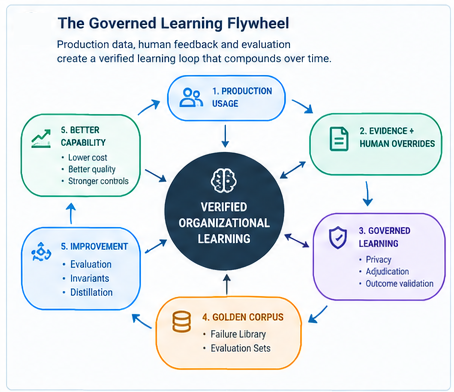
When product squads operate in silos, production experience remains locked in transient logs. When squads consume shared capabilities, production observations flow into the learning plane—but only after appropriate governance. Production failures and reviewed overrides do not immediately alter the golden dataset; they become evaluation candidates and enter the shared suite only after privacy filtering, classification, adjudication, and outcome validation.
The Governed Learning Pipeline
Not every production transaction is useful training data. Noisy labels, user mistakes, policy violations, sensitive data, adversarial inputs, and biased outcomes can poison a learning corpus. The learning pipeline must be governed:
flowchart TD
    PROD["Production Usage + Human Overrides + Supervisor Corrections"]

    FILT["Privacy & Retention Filter<br/>(PII, Data Residency, Retention Policy)"]

    CLASS{"Correction Classification & Outcome Validation<br/>(Was the human override a genuine error correction or an exception?)"}

    REV["Dataset Review<br/>(Bias, Contradiction, Adversarial Content Screening)"]

    ROUTER{"Learning Scope Routing"}

    subgraph SCOPES["Learning Scopes"]
        direction TB
        PL["Product-Local<br/>(Feature-Specific Edge Cases)"]
        DS["Domain-Shared<br/>(Cluster Reasoning Patterns)"]
        ES["Enterprise-Shared<br/>(Global Invariants & Auth)"]
        PR["Prohibited<br/>(Tenant-Restricted IP / Purged)"]
    end

    CORPUS[("Governed Evaluation Corpus<br/>(Golden Datasets + Failure Library)")]

    subgraph COMPOUND["Compounding Outputs"]
        direction TB
        INV["Invariant Hardening<br/>(Human Ground Truth + Vendor Jury → Signed Ledger)"]
        CON["Contract Revision<br/>(Cryptographically Bound to Merge Gates)"]
        DIS["Distillation Pipeline<br/>(Candidates → Evaluation Gate → Redeployment)"]
    end

    PROD --> FILT
    FILT --> CLASS
    CLASS -->|"Verified Correction"| REV
    CLASS -->|"Discretionary Exception"| PR
    REV --> ROUTER

    ROUTER --> PL
    ROUTER --> DS
    ROUTER --> ES
    ROUTER --> PR

    PL --> CORPUS
    DS --> CORPUS
    ES --> CORPUS

    CORPUS --> INV
    CORPUS --> CON
    CORPUS --> DIS
The Feedback Vacuum: When the Learning Pipeline Starves
In practice, the most common Level 5 failure mode is behavioral rather than architectural: the learning pipeline starves because human operators under production pressure click "override" to clear their queues, not to teach an AI system. When an operator override carries no structured categorization—no error classification, no corrected ground-truth payload, and no linkage to the final business outcome—it represents noise rather than actionable training signal. A learning pipeline fed unclassified operator overrides does not compound institutional intelligence; it accumulates labeled noise.
Three structural controls prevent pipeline starvation:
- Constrained Override Taxonomies: Override interfaces must require a mandatory selection from a constrained reason-code taxonomy (e.g., incorrect entity boundary, missing contextual modifier, unsupported policy assertion, hallucinated constraint) before committing. Free-text notes generate unstructured sentiment; structured reason codes generate classifiable datasets.
- Downstream Outcome Anchoring: For consequential capabilities, the platform defers dataset labeling until an objective downstream outcome is observable—a disputed transaction is settled, an insurance claim is adjudicated by underwriting, or an invoice clears audit reconciliation. Anchoring labels to verified downstream outcomes bypasses operator queue fatigue and provides unambiguous ground truth.
- Override Rate Monitoring as a Leading Indicator: A rising human override rate is the earliest empirical signal of distribution drift or prompt degradation. The platform treats override rate velocity as a Tier-1 operational metric, triggering automated regression reviews and invariant audits long before end users report visible service failure.
The Four Learning Scopes
A common governance failure is assuming every cleared observation enters a single monolithic enterprise corpus. In reality, organizational boundaries, tenant isolation, and relevance require routing validated observations into distinct learning scopes:
- Product-Local: Workflow-specific anomalies, UI edge cases, or specialized client exceptions that do not generalize beyond the origin feature. They enrich product-specific acceptance overlays, not shared baselines.
- Domain-Shared: Reasoning patterns, entity variations, or failure modes common across a specific business cluster (e.g., all invoicing, billing, and procurement document processing).
- Enterprise-Shared: Foundational invariants, universal policy and authority violations, security guardrail failures, or cross-cutting extraction primitives that apply organization-wide.
- Prohibited: Context containing tenant-restricted IP, proprietary counterparty negotiations, or non-retainable data that must be purged after resolution and excluded from all persistent training and evaluation assets.
Not every observation should become a training artifact. Some learning belongs in policy code, routing logic, validation rules, evaluation sets, and workflow configuration—not in model weights.
A critical operating principle: do not bake changing policy or authorization logic into model weights when it belongs in the control plane. Model distillation is one path for institutional learning to compound; it is not the only path, and it is the wrong path for capabilities that require explicit, auditable authority boundaries. Furthermore, the distillation pipeline must preserve the boundary between domain task knowledge and restricted institutional knowledge: shared learning must be reusable at the capability level without making one tenant's protected context, proprietary rationale, or sensitive payloads available to another.
Candidate invariants identified in this pipeline follow this exact discipline: rather than being synthesized directly into model weights, they are verified against human-adjudicated ground truth, juried across independent model lineages under Level 4 defense standards, and cryptographically signed into the audit ledger as deterministic pre-commit and runtime gates.
Illustrative Economics: The Distillation Flywheel
For high-volume, low-ambiguity workloads where distillation is appropriate, the compounding potential is significant. Real-world returns depend on task complexity, training overhead, hosting, traffic distribution, quality degradation tolerance, and evaluation requirements—but the structural dynamic is consistent:
- Bootstrap with frontier reasoning to establish baseline accuracy and generate a high-quality seed corpus.
- Harvest governed artifacts: verified input/output examples, tool traces, evidence anchors, and human-validated outcome labels—filtered through the learning pipeline above.
- Distill into specialized weights: fine-tune an open-weights model on verified enterprise-specific artifacts.
- Deploy at materially lower unit cost: the specialized model handles the majority of standard traffic at dramatically lower latency and token expense.
- Reinvest the savings: freed capital bootstraps the next tier of reasoning capabilities.
Organizations without shared capabilities never accumulate the critical mass of governed, verified data to execute this flywheel.
Platform vs. Bottleneck: The Operating Model That Makes This Work
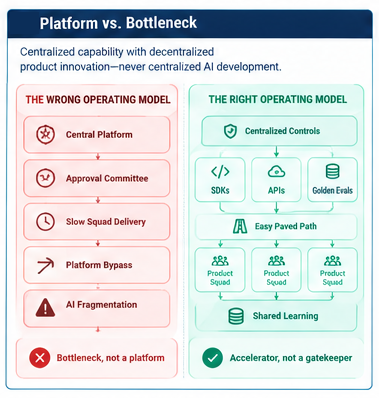
The most common failure mode of enterprise platform initiatives is organizational sclerosis:
flowchart LR
    A["Centralized Architecture<br/>(Rigid Shared Bureaucracy)"] -->|Produces| B["Centralized Bottleneck<br/>(Release Gridlock)"]
    B -->|Forces| C["Squads Route Around It<br/>(Shadow AI Silos & Lost Governance)"]
To succeed, the platform must be designed so that the paved path is easier than bypassing it:
The objective is centralized capability with decentralized product innovation—never centralized AI development.
Build Cost Realism: When Platform Headcount Exceeds Token Savings
Building and maintaining a Shared Intelligence Service platform represents a significant capital investment. Before committing to a dedicated platform organization, engineering leadership must evaluate the true carrying costs against actual economic benefits:
| Cost Element | Annual Estimate (USD) | Operating Profile & Scope |
|---|---|---|
| Central Platform Engineers | $400,000 – $800,000 | 2–4 senior systems and ML infrastructure engineers owning gateway routing, SDKs, CI/CD harnesses, and ledger persistence. |
| Domain Capability Stewards | $200,000 – $400,000 | 1–2 domain specialists or senior engineers per capability cluster (part-time in general product areas; dedicated in regulated domains). |
| Evaluation & Replay Compute | $25,000 – $75,000 | LLM-as-judge calls, shadow traffic replay, adversarial red-teaming, and continuous golden regression test execution. |
| Economic Hurdle | Net Positive Value | Combined token/duplication savings + verified incident avoidance + defensible regulatory auditability must exceed annual platform run rate. |
If an enterprise has fewer than five product squads actively building AI workflows, or if aggregate volume across all reasoning tasks is under 500,000 transactions per month, funding a full tripartite platform team is premature. In early stages, the appropriate scope is a Minimum Viable Stack: a centralized model routing gateway, a single designated technical steward, and a versioned golden regression harness. A full dedicated platform organization becomes economically defensible only when multiple squads are independently building duplicate, unmonitored reasoning pipelines that create acute compliance liability or runaway API expenditure.
The Federated Three-Tier Operating Model
To prevent the platform from collapsing into an administrative bottleneck, ownership must be distributed across three distinct tiers rather than split into an unworkable central-versus-local binary:
| Operating Tier | Primary Focus | Core Responsibilities & Scope | Ownership Boundary |
|---|---|---|---|
| 1. Platform Control Plane | Reusable Controls & Enterprise Infrastructure | • Model gateway routing, fallbacks, and cost arbitrage • Universal schema tooling, contract compilers, and SDK distribution • Evaluation infrastructure, CI/CD harnesses, and regression pipelines • Telemetry collection, audit persistence, and trace portability • Tenant isolation, rate limiting, and global budget caps |
Central Platform Team owns reusable controls, infrastructure uptime, and platform compliance. |
| 2. Domain Capability Plane | Semantic Meaning & Capability Boundaries | • Owns the semantic definitions, schemas, and limits of the reasoning task • Curates the core Golden Evaluation Suite and domain failure libraries • Manages versioned capability contracts (Interface, Control, Operations) • Evaluates candidate models, prompts, and distillations for the domain • Decides capability deprecation, evolution, and scope boundaries |
Domain Capability Stewards own semantic correctness, capability contracts, and evaluation baselines. |
| 3. Product Workflow Plane | Workflow Design & Consequential Outcomes | • End-user experience, prompt experimentation, and business workflow design • Workflow-specific acceptance overlays and custom risk tolerances • Human escalation UI, operator intervention, and low-TTC audit bundles • Contributes edge cases, classified overrides, and failure traces upward • Consequential accountability for business decisions and user outcomes |
Product Squads own workflow integration, user experience, and consequential business outcomes. |
The platform owns reusable controls and infrastructure. Domain capability owners own the semantic meaning and limits of the reasoning service. The product squad owns workflow design and consequential outcomes.
This tripartite division prevents the platform from becoming an accountability vacuum. The central platform team cannot determine whether an entity extraction service is appropriate for an autonomous $500k invoice reconciliation flow; that consequential judgment belongs to the product team. Likewise, individual product squads should not independently define what constitutes valid extraction evidence or maintain redundant golden eval corpora; that belongs to the domain capability steward.
Blast-Radius Containment: Preventing the Shared Monolith
A centralized capability layer that lacks rigorous isolation becomes an enterprise single point of failure. If an update to a shared service introduces latent reasoning drift or an outage, it risks taking down every consuming product simultaneously.
A resilient architecture enforces five structural blast-radius controls:
- Semantic Version Pinning: Consuming products pin to explicit contract versions (e.g.,
v2.4.1). Shared service updates—whether prompt refinements, context graph revisions, or model tier migrations—are never pushed forcefully to live consumer workflows without explicit version opt-in. - Canary Slicing & Progressive Promotion: Capability releases follow a strict promotion ladder: offline golden evaluation → shadow traffic replay → 1% canary slicing → tenant-gated release. Automated rollback triggers halt promotion if latency, schema validation failure, or verifier consensus drifts beyond baseline thresholds.
- Graceful Fallback & Circuit Breaking: If a shared service or underlying model provider degrades, the client SDK immediately invokes the capability's Failure Contract: falling back to cached historical outputs, deterministic rule-based heuristics, or human review queues without crashing the consuming product surface.
- Tenant & Budget Isolation: Strict per-tenant rate limits and hard token spend ceilings ensure that an unconstrained agent loop or traffic spike in Product A cannot exhaust enterprise API quotas or degrade latency for Product B.
- Contract Backward-Compatibility Gating: CI pipelines execute automated contract diffing and regression assertions against historical payloads. Any breaking change to input, output, or evidence schemas requires a major version bump, ensuring zero silent breakage across dependent squads.
The platform team provides self-service SDKs, governed sandboxes, and an explicit operational mandate: centralized controls for production and high-risk use cases, with radical autonomy for local experimentation in sandbox environments. When a product squad invents a novel reasoning flow that proves reliable in production, that flow gets factored into a shared capability for the rest of the organization.
Implementation Path: From Minimum Viable Stack to Compounding Platform
Building toward shared intelligence services does not require a year-long moratorium on product delivery, nor does it require standing up a massive platform apparatus on day one. For a 50-to-200 person engineering organization, attempting to implement all three planes, four evaluation classes, and three operating tiers simultaneously is a recipe for platform paralysis.
The objective of day-one adoption is not architectural completeness. It is establishing a single governed capability boundary where learning can begin compounding immediately.
The Minimum Viable Stack (Day 1 for Mid-Market Teams)
Before building multi-tiered platform teams or running multi-model evaluation juries, a pragmatic engineering team should implement the minimum viable triad:
- One Contract Plane (Interface + Authority Boundary): Enforce strict strongly-typed input/output schemas (using Pydantic, Zod, or Protobuf) and an explicit Authority Contract (
can_commit: falsevs.can_propose: true). Do not engineer complex dynamic SLA or token-arbitrage contracts until transaction volume warrants it. - One Core Evaluation Class (Task Quality + Schema Regression): Implement lightweight pre-merge assertion suites using free, open-source CI test runners (such as Promptfoo). Pair these with an initial 50-example Golden Dataset representing high-frequency production tasks and historical failure edge cases.
- One Federated Capability Steward: Avoid standing up an isolated, dedicated platform committee. Instead, designate a senior engineer embedded within the highest-volume consumer squad (e.g., billing extraction or document search) to serve as part-time steward of the capability contract, ensuring the paved path solves immediate operational pain points rather than abstract architectural ideals.
Once this initial boundary stabilizes, the enterprise expands through the phased promotion path below:
Phase 1: Establish Managed Access
- Conduct an enterprise AI audit: inventory every endpoint, API credential, and open-weights instance across all engineering squads.
- Inventory every production AI capability, not merely every model endpoint: Identify which business workflows depend on probabilistic inference, what evidence they produce, what authority they exercise, and what happens when they fail.
- Route all model egress through a centralized gateway without restricting squad experimentation. Provide managed access with unified budget caps, automated PII scrubbing, and global token telemetry.
- Indicative timing: smaller organizations may complete this in several weeks; regulated enterprises should plan for a longer adoption cycle.
Phase 2: Standardize the First Capabilities
- Identify the two most frequently duplicated reasoning tasks across products (typically Contextual Extraction/Normalization and Evidence Verification/Grounding).
- Package these workflows as Shared Intelligence Services with explicit three-plane contracts.
- Provide drop-in client SDKs. Make the shared service easier to use than rebuilding from scratch. Subsidize adoption through reduced token budgets for squads using shared capabilities.
Phase 3: Close the Institutional Learning Loop
- Connect production escalation queues and supervisor review telemetry directly to the shared evaluation corpus—through the governed learning pipeline.
- Establish the evaluation harness across all four evaluation classes for each shared capability.
- For high-volume, low-ambiguity capabilities where distillation is appropriate and governance is established, initiate model distillation pipelines to permanently reduce unit costs.
The Strategic Scorecard
Evaluate your current organizational architecture against the maturity curve:
| Capability Dimension | Stage 1: Feature-Siloed AI | Stage 2: Managed Infrastructure | Stage 3: Compounding Proof Platform |
|---|---|---|---|
| Intelligence Coupling | Feature code calls vendor APIs directly. | Centralized API gateway with manual routing. | Dynamic SLA/cost routing; capabilities invoked through explicit contracts. |
| Orchestration | Unbounded agent loops; zero safety invariants. | Ad-hoc output filters. | Bounded autonomy: agent proposals validated by transition gate before commit. |
| Capability Reuse | Every squad writes bespoke prompt libraries. | Shared prompt repository or wiki. | Versioned, governed intelligence services with three-plane contracts. |
| Evaluation & Release | Informal "vibe checks" before release. | Periodic offline batch tests. | Four-class evaluation covering quality, evidence, control integrity, and operations; risk-tiered release gates. |
| Institutional Learning | Locked in transient logs. | Ad-hoc retrospectives. | Governed learning pipeline from production evidence to evaluation corpus to contract revision and distillation. |
| Operating Model | Autonomous squad silos with discretionary, uncoordinated controls. | Central standards with uneven adoption; platform team risks becoming an approval gatekeeper. | Federated three-tier model: platform owns controls and infrastructure; domain teams own reasoning contracts and limits; squads own workflow design. |
| Accountability Distribution | Diffuse; no clear owner for probabilistic errors. | Platform team takes on too much, creating an accountability vacuum. | Tripartite accountability: platform owns reusable controls; domain owners own semantic contracts; product squads own consequential business outcomes. |
One-Line Synthesis
Models generate possibilities. Shared Intelligence Services turn those possibilities into governed capabilities—and an enterprise platform that retains evidence, evaluates behavior, enforces authority, and learns from production turns those capabilities into compounding strategic advantage.
Related Reading
- Three Decisions Before You Commit to an AI Platform Budget — How product leaders evaluate sequencing, buy vs. build boundaries, and CFO financial models.
- AI Platform as Product Strategy: When to Centralize, When to Federate, and What to Protect — The organizational blueprint and three-tier operating model separating platform controls from domain contracts.
- Control Planes: The Missing Layer in AI Product Strategy — Why copilots generate suggestions, but control planes decide what actually happens.
- Composite AI Architectures: Orchestrating Rules, Models, and Humans — Building high-fidelity decision flows across deterministic and probabilistic systems.
- The AI Roadmap That Can't Be Shipped — Why conventional release trains collapse under probabilistic drift.
- How to Write AI Component Contracts — Defining rigid verification perimeters and proof artifacts between AI components.
- Context Graphs as the Product Moat — Why accumulated, verified state outperforms raw inference capability in enterprise software.
The ideas in this post are my own — they emerged from questions I asked while learning applied AI concepts and putting them to work in my job and my projects. The prose was developed with AI assistance.
Frequently Asked Questions
What is a Shared Intelligence Service?
A Shared Intelligence Service is a versioned, observable, governed reasoning capability that multiple product surfaces can invoke through an explicit contract. This distinguishes it from a prompt library or a generic model gateway.
Why is building AI feature-by-feature a flawed strategy?
Directly wiring individual product features to isolated prompt pipelines produces duplicated scaffolding, unmanaged unit economics, and zero organizational learning. The enterprise accumulates isolated implementations rather than compounding an institutional AI capability.
What is an Intelligence Service Contract?
An Intelligence Service Contract governs a shared enterprise reasoning capability across three planes: the Interface Plane (Input, Output, Version), the Evidence and Control Plane (Evidence, Decision, Authority, Failure), and the Operations Plane (Cost, Latency, Availability, Evaluation). Together these planes ensure predictable behavior, inspectable evidence, enforceable authority, and continuous improvement.
How does bounded autonomy differ from replacing agents with state machines?
Bounded autonomy does not eliminate probabilistic agent loops; it nests them inside deterministic state machines governed by an enterprise control plane. The agent proposes state transitions probabilistically, but execution is gated by a transition validation layer that checks actor, authority, preconditions, and expected side effects before any commit.
Download the Architecture of Proof Checklist
Ready to implement? Get the definitive checklist for building verifiable AI systems.