Control Planes: The Missing Layer in AI Product Strategy
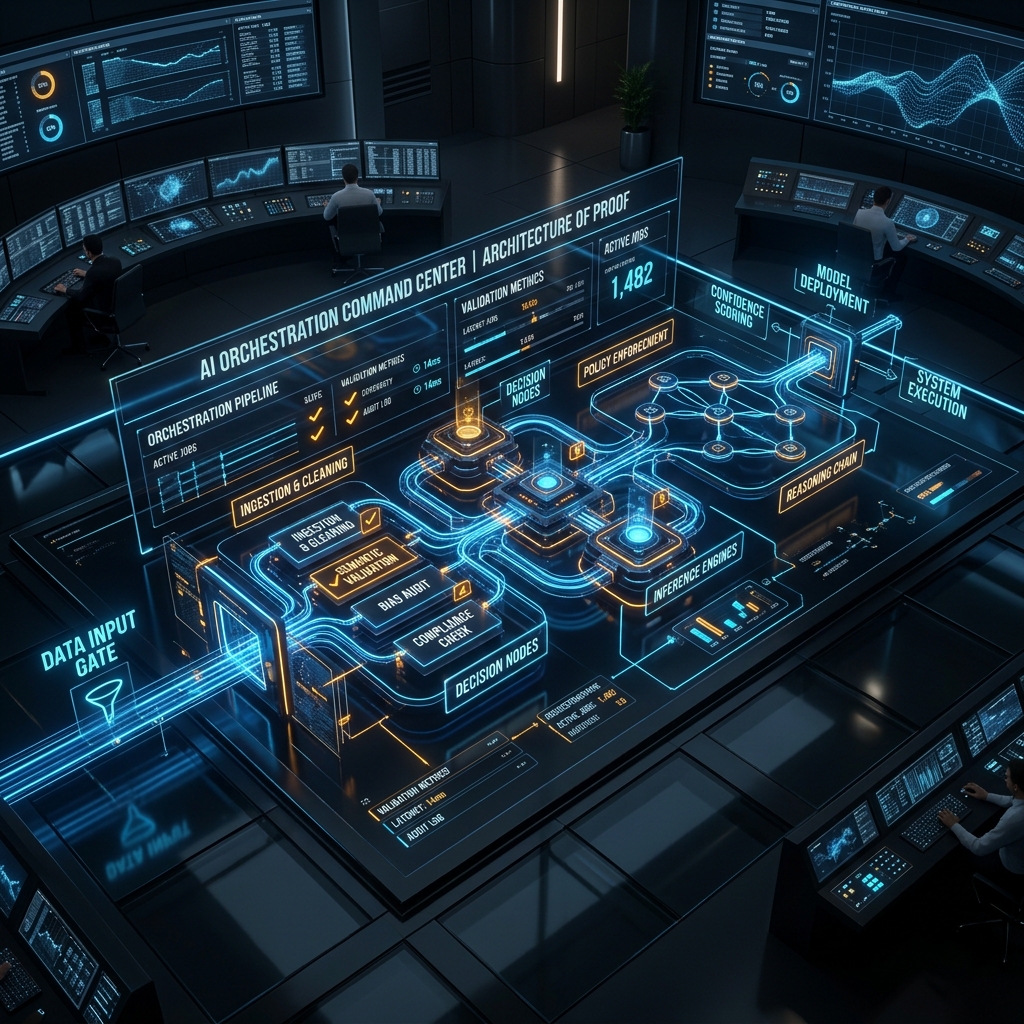
In these early years of AI, most teams think they’re building products. In reality, they’re building UIs wrapped around models. That distinction only becomes obvious when the system has to make a decision that actually matters.
Copilots don’t decide. They suggest. Control planes decide what actually happens.
The Core Idea
Models are a plug-in. Product is much larger than that.
There should be a layer within the product that determines:
- when to trust the model
- when to override it
- and what happens when it gets things wrong
That layer is what I’d call the control plane.
Copilots generate suggestions. Control planes turn suggestions into outcomes.
Why This Matters Now
Traditional software didn’t need control planes because it was deterministic by default. This is no longer true with AI.
The core component of the system—the model—is probabilistic. And that changes everything.
Determinism doesn’t disappear. It just moves up the stack.
So the real work is no longer just to build the model. It becomes: how do you contain and manage uncertainty at the system level?
You’re no longer building features. You’re building a system that behaves reliably under uncertainty.
Why Is Accurate Behavior a System Design Problem?
Most AI teams spend too much time optimizing the wrong layer. They focus on:
- better prompts
- more data
- fine-tuning
- RAG pipelines
All useful, but not sufficient.
Teams need to keep in mind that even the best models will:
- hallucinate
- miss edge cases
- behave inconsistently under load
That’s not a model failure. That’s expected behavior.
And this is the key point most teams miss:
Accuracy is a model property. Reliability is a system property.
Introducing the Missing Layer: Control Planes
A control plane is the deterministic layer around the model that defines system behavior. It decides:
- when the model is allowed to act
- how outputs are validated
- what happens when confidence breaks
It imposes structure on something that is inherently unstructured.
graph TD
    subgraph Control_Plane [The Control Plane]
        IG[Input Gates: Validate & Constrain]
        OF[Output Filters: Rule & Policy Enforcement]
        Audit[(Audit Layer: Immutable Traceability)]
        Fallback{Fallback Logic: Confidence Router}
    end

    Input([Unstructured Input]) --> IG
    IG -- Constrained Schema --> Model((Probabilistic Model))
    Model -- Candidate Suggestion --> OF
    OF -- Policy Passed --> Audit
    OF -- Uncertainty / Policy Violation --> Fallback
    Audit --> Outcome([Verified Production Outcome])
    Fallback -- Human Review / Deterministic Rule --> Outcome

    style Control_Plane fill:#f9f9f9,stroke:#333,stroke-dasharray: 5 5
    style Model fill:#e1f5fe,stroke:#01579b
    style Outcome fill:#e8f5e9,stroke:#2e7d32
At a minimum, the control plane includes:
- Input gates: Validate and constrain what enters the model
- Output filters: Enforce business rules and prevent invalid states
- Audit layer: Track and explain every decision
- Fallback logic: Route to humans or deterministic systems when needed
This is not a "guardrail" system:
Guardrails react to model behavior. Control planes define system behavior.
The Audit Note: A control plane’s effectiveness is measured by its negative predictive power—the deterministic ability to intercept, validate, and isolate invalid model suggestions before they trigger state mutations or downstream liability.
Why Control Planes Matter in High-Stakes Systems
In regulated systems, model errors are liability. A single failure here isn’t abstract. It could show up as:
- a denied claim that shouldn’t have been denied
- a flagged transaction that shouldn’t have been flagged
- an identity decision that can’t be undone
These are system failures with real consequences. Even though they don’t fail often—when they do, they fail expensively.
Case in Point: Healthcare Prior Authorization
Take prior authorization—high-volume, high-friction, high-risk.
Workflow Without a Control Plane
Patient data goes into an LLM and a decision comes out. Most of the time it works. But when it doesn’t, it’s not a small error:
- a denial that should have been approved
- an approval that violates policy
The result is rework, delays, potential legal exposure, or worse. This is where most AI copilots sit today: they assist the workflow, but they don’t own it.
Workflow With a Control Plane
Now the system changes:
- inputs are validated before reaching the model
- outputs are checked against policy rules
- every decision is logged and auditable
- uncertain cases are routed to fallback paths
You don’t eliminate errors. You bound them. And more importantly, you make them:
- visible
- explainable
- recoverable
That’s what production reliability actually looks like.
Control planes don’t remove failure. They make failure manageable.
What This Means for AI Product Managers
1. Designing Systems, Not Model Outputs
- Wrong framing: "Our model is 95% accurate."
- Better framing: "Our system produces reliable outcomes under uncertainty."
2. Control Points Matter More Than Features
It’s easy to focus on better prompts, better models, and more data sources. But the real leverage comes from:
- where you validate inputs
- where you enforce constraints
- where you route failures
That’s where system behavior is actually shaped.
3. Failure Is Not an Edge Case
In AI systems, failure is guaranteed. So the question is not: "How do we avoid failure?"
It is: "What happens when failure shows up in production?"
If you don’t design for that explicitly, users will experience it for you.
4. Value Moves Away from Tokens to Guaranteed Outcomes
If your product is priced around model usage, you’re exposed to commoditization. Control planes shift the value:
- from compute
- to guaranteed system behavior
Because customers don’t pay for predictions. They pay for outcomes they can trust.
| Dimension | Model-Centric Approach | Control Plane Architecture |
|---|---|---|
| Primary Metric | Benchmark Accuracy (e.g., 95%) | Bounded System Reliability (100% contained) |
| Primary Focus | Prompts, RAG, and fine-tuning | Input validation, schema enforcement, and fallback paths |
| Role of the LLM | Autonomous decision engine | Probabilistic candidate generator |
| Failure Mode | Unhandled hallucination / liability event | Deterministic routing to fallback or human review |
| Value Capture | Compute & token consumption (commodity) | Verified workflow outcomes (durable moat) |
The Deeper Insight: The Control Plane as a Strategic Moat
The control plane is not just a technical layer. It is the strategic control center of the system. Whoever owns it owns:
- decision logic
- auditability
- integration into workflows
- and eventually, economic value
Copilots plug into systems. Control planes are the system navigators.
The Production Gut Check
If you’re building an AI product, ask:
- Do we validate inputs before the model runs?
- Can we verify outputs systematically?
- Do we have fallback paths when confidence drops?
- Can we explain any decision after the fact?
If not, you don’t really have a control plane yet. You just have a model wrapped in a product surface.
The Contrarian Take: Who Decides When the Model Matters?
Most AI teams are optimizing the wrong layer. They focus too much on model quality, speed, and benchmarks.
Helpful, but ignoring the larger picture. You also need to focus on: Who decides when the model is allowed to matter?
That’s the control plane. Copilots are tools. Control planes decide the system.
One-Line Synthesis
AI doesn’t remove the need for determinism—it relocates it from the model to the system. Models suggest possibilities; control planes decide what becomes real.
The ideas in this post are my own — they emerged from questions I asked while learning applied AI concepts and putting them to work in my job and my projects. The prose was developed with AI assistance.
Frequently Asked Questions
What is an AI control plane?
An AI control plane is the deterministic architectural layer surrounding a probabilistic model that governs system behavior. It validates inputs, enforces business rules on outputs, logs auditable decision traces, and routes low-confidence predictions to fallback logic or human oversight.
How does a control plane differ from an AI guardrail?
Guardrails reactively monitor model outputs for toxicity or policy violations. Control planes proactively define system behavior: determining when a model is permitted to execute, enforcing hard schema constraints, orchestrating state transitions, and managing deterministic fallbacks.
Why is accuracy a model property while reliability is a system property?
Model accuracy measures statistical correctness over an evaluation dataset, which will inevitably degrade on edge cases and drift. System reliability is the end-to-end guarantee that unhandled errors, hallucinations, and failures cannot propagate into unverified production actions.
How do control planes prevent commodity pricing erosion in AI products?
When AI products price around raw model access or token usage, they face rapid commoditization as underlying models become cheaper. Control planes capture durable economic value by guaranteeing verified business outcomes and managing compliance liability.
Download the Architecture of Proof Checklist
Ready to implement? Get the definitive checklist for building verifiable AI systems.