Regulated AI Implementation: Governance Frameworks for Lending, Fraud, Healthcare, and Claims | AI Governance
Regulated industries are where the Architecture of Proof matters most, and where generic AI governance frameworks fail most visibly.
The reason is individual-level accountability. In lending, the question is not "does the model have acceptable overall accuracy?" It is "why was this specific applicant declined?" In fraud detection, it is not "what is the false positive rate?" It is "why was this specific customer blocked, and was that decision defensible?"
The frameworks that work for optimizing recommendation systems, ranking algorithms, and forecasting models do not answer those questions. The Architecture of Proof is designed to.
This pillar covers the specific governance requirements for six regulated implementation domains: lending, fraud detection, healthcare, insurance claims, underwriting, and customer support.
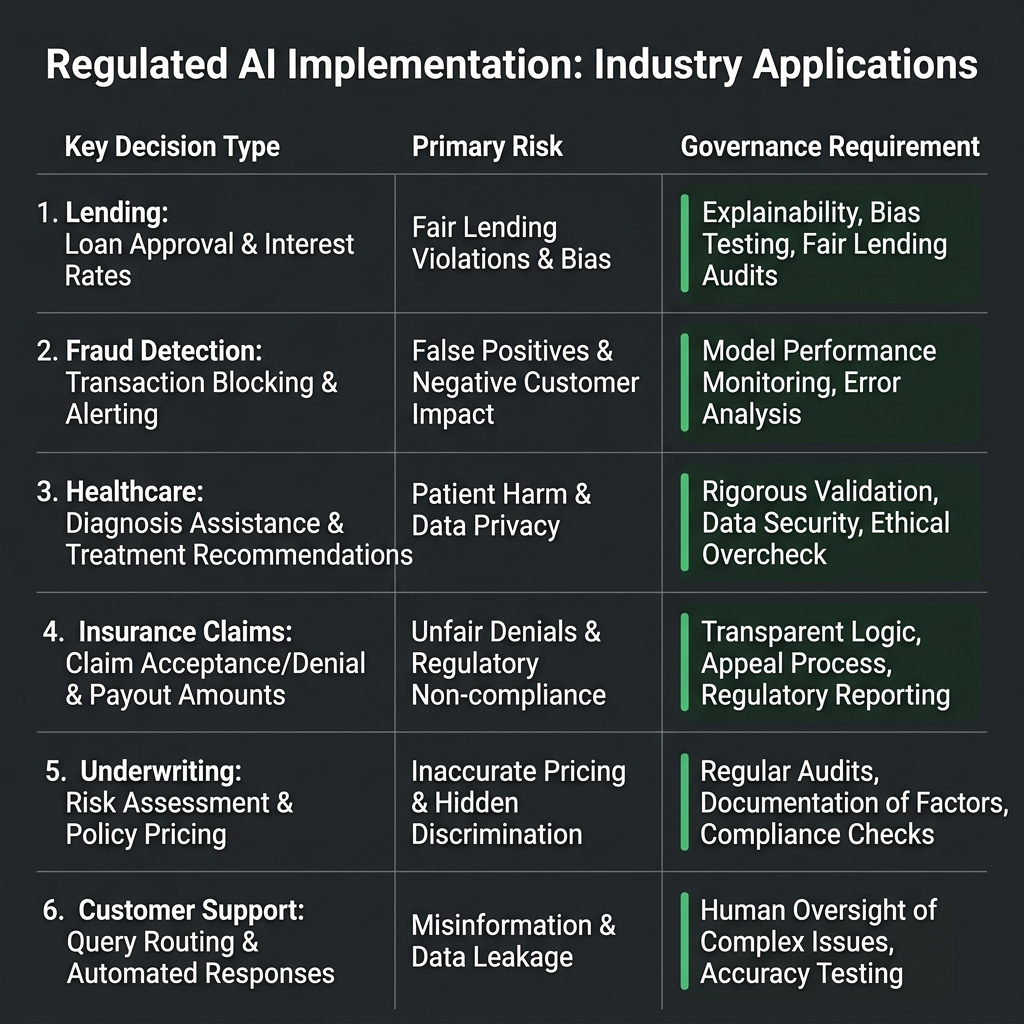
What Separates Regulated AI Implementation From Standard Deployments?
Three structural mandates distinguish regulated implementation from standard machine learning deployments:
- Individual-Level Explainability: Generic frameworks measure aggregate performance (macro F1, demographic parity, area under curve). Statutory regulators enforce individual-level rights: why this specific loan was rejected, why this particular healthcare claim was denied, or why a specific fraud block occurred.
- Pre-Inference Adverse Action Defensibility: Under regulations like the Equal Credit Opportunity Act (ECOA) or Fair Credit Reporting Act (FCRA), institutions must produce immutable adverse action reason codes derived from pre-decision feature attribution rather than post-hoc synthetic explanations.
- Continuous Audit Readiness: Compliance examinations require bit-level replayability within hours. Systems must log model checkpoints, frozen prompt contexts, retrieved document vectors, and operator override journals to reconstruct any historic decision on demand.
How Does Governance Architecture Map Across Regulated Verticals?
Across regulated verticals, successful implementation requires decoupling deterministic compliance invariants from probabilistic inference engines:
| Regulated Domain | Statutory & Legal Constraint | Deterministic Rule Boundary | Auditable Evidence Artifact | Autonomous Containment Trigger |
|---|---|---|---|---|
| Commercial & Consumer Lending | ECOA, FCRA, Fair Lending Act, CFPB Circular 2022-03. | Minimum time-in-business and bankruptcy eligibility filters run outside the model. | Replayable TreeSHAP reason-code vectors linked to credit bureau payload hashes. | Disparate impact four-fifths ratio breach ($< 0.80$) across protected demographic groups. |
| High-Volume Fraud Detection | Electronic Fund Transfer Act (Reg E), consumer banking protection. | Hard transaction blocks restricted to deterministic sanctions lists; step-up challenges used for models. | Cryptographic decision trace capturing device telemetry, velocity rules, and model scores. | False positive rate exceeding $5\%$ of legitimate transaction volume within 1-hour window. |
| Clinical Decision Support | FDA SaMD requirements, HIPAA, state medical board standards. | Clinical contraindications and maximum dosage limits hardcoded in rules engines. | Clinician dwell time, visual citation bounding boxes, and mandatory override reason codes. | Statistical shift in clinician override frequency exceeding $3\sigma$ from baseline. |
| Insurance Claims Adjudication | State Unfair Claims Settlement Practices Acts, NAIC model acts. | Policy exclusions and coverage limits parsed via deterministic contract state machines. | Immutable claims ledger mapping denied line items to explicit policy clause citations. | Claims processing latency approaching statutory response deadline envelopes. |
| Property & Casualty Underwriting | State insurance commissioner actuarial standards. | Statutory territory exclusions and non-insurable property characteristics. | Actuarially validated risk scorecards preserving historical model versions for 7 years. | Distributional loss-cost variance diverging from approved actuarial rate filings. |
| Customer Dispute Operations | CFPB UDAAP provisions, accessibility standards, Reg E. | Immediate mandatory human escalation for discrimination or financial hardship claims. | Complete conversational transcript, sentiment trace, and operator escalation handoff receipt. | Sentiment degradation or repeat agent loop detection triggering automated agent suspension. |
The Regulated AI Launch Gate: 5 Questions for Product & Model Risk Reviews
Before releasing any automated decisioning or generative feature in a regulated workflow, the product manager and model risk officer must sign off on this 5-point gate:
| Review Dimension | Sprint / Release Review Question | Statutory Risk if Failed | Required Evidence Artifact for Sign-off |
|---|---|---|---|
| 1. Individual Adverse Action | Are adverse action reason codes derived from frozen decision-time inputs or post-hoc estimates? | ECOA/FCRA non-compliance, regulatory consent decrees, and class-action litigation. | Mathematical scorecard or EBM contribution mapping verified in staging. |
| 2. Deterministic Eligibility Fences | Do statutory eligibility criteria (sanctions, age, bankruptcy) execute strictly outside model scoring? | Unauthorized approvals, BSA/AML non-compliance, and enforcement penalties. | Architecture diagram and unit tests proving zero bypass paths to model inference. |
| 3. Bit-Level Replay SLA | Can an engineer query a single transaction ID and reproduce its exact execution state in $< 60$ minutes? | Failure to satisfy state supervisory audit subpoenas or discovery demands. | End-to-end replay test log with cryptographic input/checkpoint verification. |
| 4. Human Override Tracking | Does the system analyze operator override rates weekly by reviewer ID and demographic cohort? | Unmonitored disparate impact drift and subjective human bias accumulation. | Automated override distribution report with automated alert tripwires at $2\sigma$. |
| 5. Autonomous Circuit Breakers | Will the system automatically downgrade autonomy tiers if false positive rates breach 5%? | Runaway operational losses, systemic customer account lockouts, and severe churn. | Programmatic circuit breaker runbook and automated staging failure injection test. |
The Adversarial Stress-Test: What Could Break Regulated AI Implementations?
1. What is the strongest argument against this approach?
Enforcing deterministic rule perimeters, TreeSHAP reason-code logging, and bit-level replayability increases transaction latency and compute infrastructure expenses by 30% to 50%. Critics argue that hyper-regulated architectures slow down product release velocity and put institutions at a disadvantage against agile fintech competitors deploying unconstrained frontier models.
The Practical Resolution: Unconstrained AI deployments accumulate massive statutory liability. In regulated verticals, a single unexplainable adverse action lawsuit, CFPB consent decree, or HIPAA violation carries eight-figure penalties and existential regulatory sanctions. Decoupling deterministic rules from probabilistic scoring ensures that high-volume routine decisions execute at low latency while high-liability edge cases remain fully defensible under examination.
2. Under what circumstances would this fail?
This architecture fails when feature pipelines drift or third-party data providers modify their upstream schema without warning. If an external credit bureau or medical coding service alters a categorical definition, the underlying model will output valid scores based on misaligned inputs, silently corrupting adverse action codes or clinical recommendations.
The Practical Resolution: Implement strict schema validation and distribution assertion tripwires at the data ingestion boundary. If input data distributions, categorical frequencies, or null-value percentages breach pre-configured statistical tolerance bands, the system immediately trips a circuit breaker, halting automated scoring and falling back to conservative, manual review queues.
3. What would a skeptical customer, client, or colleague object to?
Compliance officers and risk committees will object that post-hoc explainability algorithms like SHAP or LIME are mathematical approximations that can be manipulated by feature collinearity, failing to provide true legal certainty in court.
The Practical Resolution: Adopt Explainable Boosting Machines (EBMs) or generalized additive models (GAMs) for credit and underwriting decision paths where absolute statutory explainability is mandated. Confine deep neural networks strictly to unstructured perception tasks (e.g., OCR, fraud feature extraction), while feeding tabular decision logic into glass-box models with mathematically exact, non-approximated feature contributions.
4. Which alternative deserves more consideration?
Rather than deploying probabilistic machine learning models in high-consequence decision flows, an institution could retain 100% deterministic rules engines and expert scorecards, using LLMs solely for administrative drafting and internal workflow automation.
The Practical Resolution: Purely rule-based systems suffer from combinatorial explosion, high maintenance drag, and poor predictive discrimination on non-linear risk surfaces. The hybrid composite architecture provides the optimal solution: let deterministic engines enforce rigid statutory perimeters and eligibility floors, while using calibrated probabilistic models within that bounded envelope to optimize risk tiering.
5. What am I assuming that may not be true?
This framework assumes that regulatory agencies will accept algorithmic decision traces and automated reason-code generators as equivalent to traditional actuarial or underwriter documentation.
The Practical Resolution: Pre-brief state regulators and supervisory examiners before deploying autonomous decision pipelines. Present the complete Architecture of Proof—including golden validation eval sets, immutable audit schemas, and deterministic circuit breakers—as an auditable model risk governance dossier, securing affirmative supervisory alignment ahead of production launch.
One-Line Synthesis
Regulated AI implementation requires deterministic safety invariants, immutable decision traces, and bit-level replayability to withstand statutory and regulatory examination.
Related Reading Across the Architecture of Proof
- Composite AI Architectures: Orchestrating rules, models, and humans in high-liability decision flows.
- AI Audit Trails: Designing the immutable, replayable evidence chain that regulatory bodies require.
- Control Tiers for AI-Enabled Processes: Structuring autonomy levels and escalation thresholds for high-stakes workflows.
- The AI Incident Golden Hour: Operating response protocols under statutory reporting deadlines.
Frequently Asked Questions
What makes AI implementation in regulated industries different?
In regulated industries, AI decisions must be explainable to specific individuals, defensible under regulatory scrutiny, and auditable on demand. Generic AI governance frameworks, designed for optimization, are not sufficient. Regulated implementation requires decision traceability, individual-level explainability, and evidence that every decision was made within policy.
How do you implement AI governance in lending?
Lending AI governance requires separating deterministic eligibility rules from probabilistic model scoring, building adverse action reason code generation into the decision path, and building a replayable audit trail that can reconstruct any individual credit decision and the inputs that produced it.
What AI governance is required for fraud detection systems?
Fraud AI governance requires managing the false positive rate as a first-class metric, designing circuit breakers that downgrade from hard blocks to challenges when the error rate rises, and maintaining decision traces that can respond to customer disputes and regulatory inquiries about specific blocking decisions.
Subscribe to the Architecture of Proof Dispatch
Rigorous, decision-forcing systems engineering and AI governance monographs for technical leaders. Delivered periodically, zero spam.