The AI Governance Playbook: From Pilots to Proven Systems | AI Governance
This post is part of the Governance Operating Model pillar.
For senior leaders, AI is no longer a technical experiment; it is a core operational risk and a strategic opportunity. The companies that win the next decade won't be those with the "best" models, but those with the most Proven Systems.
This playbook provides the framework for moving beyond the black box and building an AI strategy that survives the scrutiny of regulators, auditors, and production reality.
1. The Strategy: AI Maturity Model
Maturity is defined by Promotion Gates, not model count. You earn autonomy by providing evidence of control.
The first step is knowing where you stand on the AI Maturity Model. Most organizations stall at Stage 2 (Governed but Manual) because they lack the technical layers to reach Stage 3 (Integrated Proof).
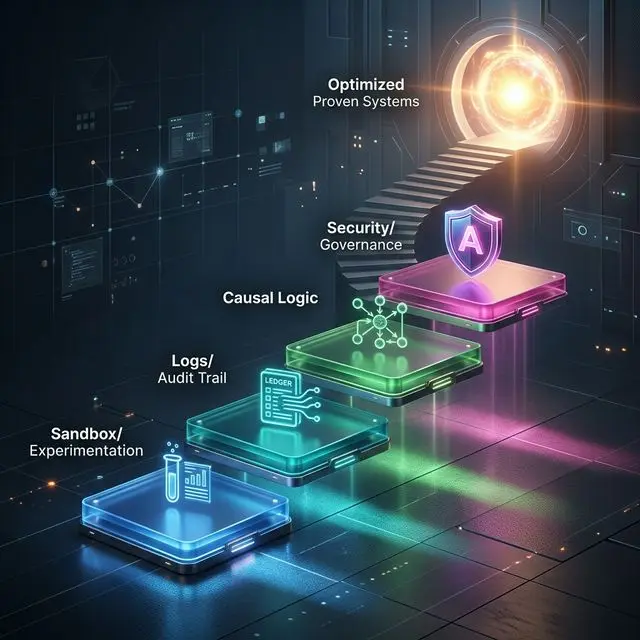
| Stage | Name | Proof Gate |
|---|---|---|
| 1 | Ad-hoc | Sandbox only (No production action) |
| 2 | Governed | Signed SOPs (Human-led review) |
| 3 | Integrated | 30 days of replayability |
| 4 | Optimized | Causal traces + 4-min diagnosis |
2. The Architecture: Control Tiers & Escalation
Autonomy is a dial, not a switch. Your architecture must support dynamic downgrades when shift happens.
You shouldn't grant "Full Autonomy" to a probabilistic model on day one. Use Control Tiers to manage risk:
- Tier 2 (Recommend): AI proposes, human approves.
- Tier 3 (Autonomous): AI acts, system logs evidence.
- Tier 4 (Full): AI acts with auto-escalation on drift.
When the system detects an anomaly, Escalation Protocols must auto-downgrade the tier to ensure safety.
3. The Evidence: Audit Trails & Replayability
'Explainability' is a UX feature for users; 'Replayability' is a governance requirement for the Board.
A senior leader must be able to ask: "What did the system know at 2:14 PM last Tuesday when it made this decision?" If you can't replay that decision exactly, your governance has a gap. Decision logs are the "flight recorders" of your AI business.
4. The Response: The Golden Hour
Incidents are leadership opportunities. How you respond in the first 60 minutes defines your regulatory reputation.
A mature leader expects failure and builds for it. The AI Incident Golden Hour protocol ensures that containment happens in 15 minutes and root cause is identified in 60. This is how you turn a $720k fraud loss into a $72k contained event.
5. The Outcome: Risk-Adjusted ROI
The ultimate metric is: (Risk Reduction $) - (Proof Cost $) = Defensible ROI.
Stop measuring success by "engineer hours saved." Start measuring by:
- Margin Lift: Realized through safely scaled autonomy in high-stakes segments.
- Audit Readiness: Zero-finding readiness for board and regulatory reviews.
- Incident MTTR: Resolution in minutes (Causal) rather than hours (Manual).
Summary: Your AI Moat
The Architecture of Proof isn't just about technical idealism. It's your unfair advantage. While your competitors are stuck in "pilot purgatory," you will be shipping systems that are as defensible as they are intelligent.
Junior PMs ship models. Senior Directors ship Proven Systems.
Key Pillars in the Series
- The AI Maturity Model: Know your stage.
- Control Tiers: Manage your autonomy.
- Audit Trails: Prove your logic.
- Causal Traces: Resolve in minutes.
- Incident Response: Survive the Golden Hour.
Frequently Asked Questions
How do I move from AI pilots to proven systems?
Transitioning requires building the 'Architecture of Proof'—the structural layers of visibility and control that allow AI to survive audits and production failures.
What is the ROI of AI governance for leadership?
Leadership ROI is found in 'Risk-Adjusted Margin'—the ability to scale autonomous systems safely, reducing incident costs by up to 90% and ensuring Board-level defensibility.
Download the Architecture of Proof Checklist
Ready to implement? Get the definitive checklist for building verifiable AI systems.