The AI Product Risk Stack: Where Uncertainty Acquires Authority
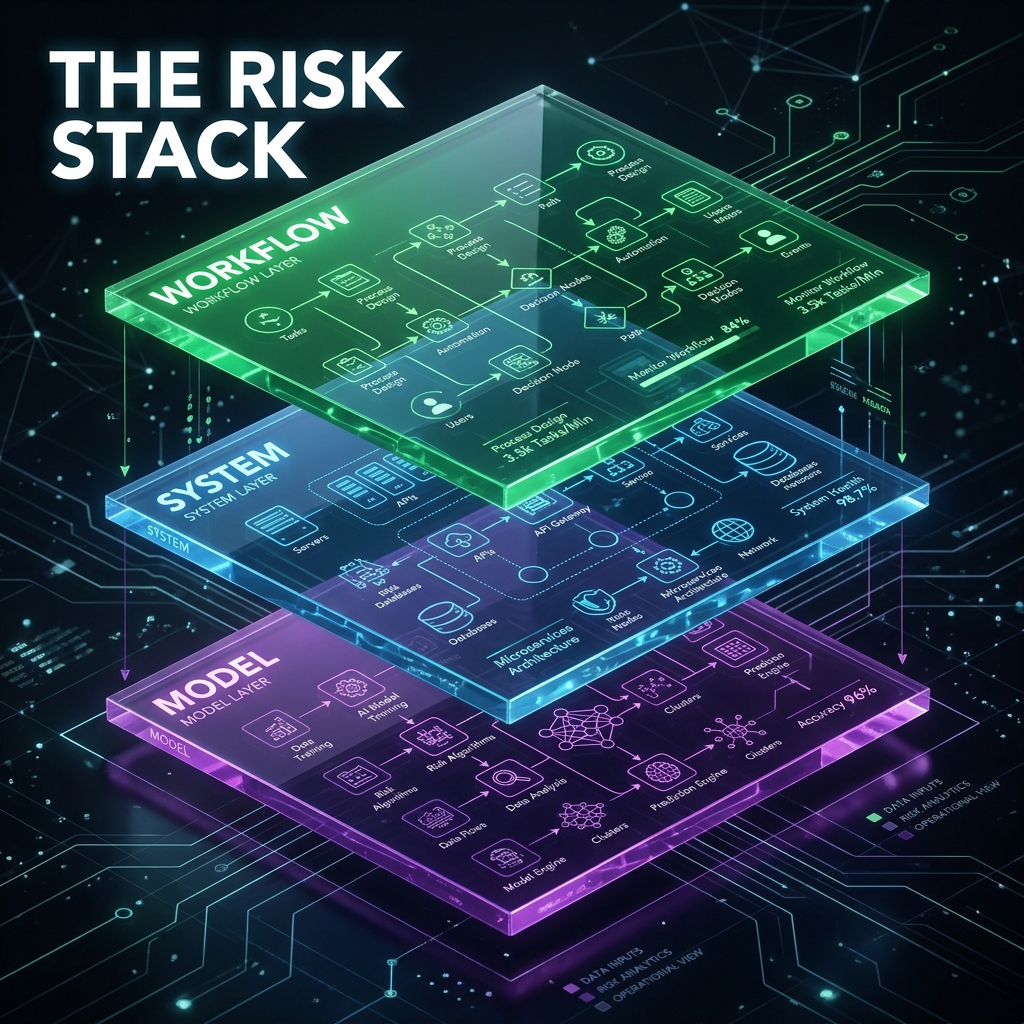
One of the most persistent errors in AI product development is the assumption that product risk begins and ends with model accuracy.
Teams obsess over benchmark evaluations, prompt tuning, fine-tuning datasets, and hallucination rates. They treat every system breakdown as a model failure and assume that every step forward in statistical performance translates directly into product reliability.
It does not.
Users, customers, and regulatory auditors do not experience "model error" in the abstract. They experience consequences: a legitimate medical claim is rejected, an unauthorized wire transfer clears, a patient receives contradictory clinical advice, or an enterprise customer's private data leaks into a public vector store.
The central question in an AI product is not how often the model is wrong. It is where a model error becomes an uncontained real-world outcome.
A model can hallucinate wildly within an isolated sandbox and cause zero harm. Conversely, a foundation model with 99.5% benchmark accuracy can trigger an enterprise disaster if the surrounding product permits that remaining 0.5% uncertainty to execute uncontained actions in production.
Risk is not a static property of weights and embeddings. Risk is a state transition: the exact moment where probabilistic uncertainty acquires the authority to mutate production state.
The Three Risk Boundaries
To design effective control planes, product architects must decompose AI risk across three analytical boundaries. These are not independent runtime compartments or a strict sequential pipeline. They are analytical boundaries with continuous cross-layer dependencies and feedback loops:
graph LR
    subgraph Boundaries [Analytical Risk Boundaries]
        M[<b>Model Capability</b><br/>Statistical Engine & Calibration]
        S[<b>System Propagation</b><br/>Transport, Isolation, & Data Boundaries]
        W[<b>Workflow Consequence</b><br/>Authority, Policy, & State Mutation]
    end

    M <--> S
    S <--> W
    W -.->|Evidence & Incident Feedback| M

    style M fill:#f8f9fa,stroke:#dc3545,stroke-width:2px
    style S fill:#f8f9fa,stroke:#0d6efd,stroke-width:2px
    style W fill:#f8f9fa,stroke:#198754,stroke-width:2px
These layers are analytical boundaries, not independent defenses. Risk frequently emerges from their shared assumptions, and a control is only useful if it relies on evidence sufficiently independent from the component it evaluates.
1. Model Capability Boundary
- The Core Question: Can the statistical engine produce a sufficiently reliable output for this domain?
- Primary Failure Modes: Hallucination, semantic confabulation, out-of-distribution drift, uncalibrated confidence scores, and systematic segment bias.
- Organizational Owner: Applied AI Research and Data Science.
Model risk is the capability boundary. Mitigations at this tier—domain-specific fine-tuning, retrieval-augmented generation (RAG), and prompt engineering—raise baseline capability.
However, model optimization creates an asymptotic trap: driving benchmark accuracy from 92% to 97% requires exponential compute and labeling resources, yet leaves the downstream product vulnerable to the remaining 3% of failures. Furthermore, model confidence is frequently miscalibrated: a model can produce incorrect assertions with high statistical confidence on out-of-distribution inputs.
2. System Propagation Boundary
- The Core Question: Can we reliably transport, isolate, observe, and constrain the output and its supporting context?
- Primary Failure Modes: Latency spikes, tool execution escape, session context corruption, vector database poisoning, stale retrieval caches, and tenant boundary cross-contamination.
- Organizational Owner: Platform Engineering, DevOps, and Infrastructure Security.
System risk governs how the model interacts with the operating environment. A model may generate an accurate query, but if the execution agent lacks schema isolation, that query can lock production database tables or exhaust connection pools.
Controls at this boundary include infrastructure mechanics and data-boundary protections: * Tenant-Aware Retrieval: Strict namespace isolation preventing cross-tenant document indexing. * Authorization-Aware Context: Evaluating access-control lists (ACLs) at query time rather than index time. * Data Boundary Controls: Enforcing data residency, provider zero-retention agreements, and deletion propagation across semantic caches. * Execution Sandboxing: Ephemeral containerization for untrusted code or tool execution.
3. Workflow Consequence Boundary
- The Core Question: What happens when the output is incorrect, ambiguous, or executed against production systems?
- Primary Failure Modes: Unbounded autonomous execution, compliance breaches, unverified adverse determinations, escalation queue starvation, and cognitive automation bias.
- Organizational Owner: Product Management, Domain Architecture, and Governance Operations.
Workflow risk is where business consequence occurs. This boundary governs whether an inference is permitted to mutate system state: approving a loan, issuing a prescription, rejecting an insurance claim, or initiating a payment.
The workflow is the decisive operational control point because it determines whether probabilistic output can mutate business state. That makes workflow design central to accountability, even when contractual or legal responsibility is distributed across multiple parties.
When an autonomous system commits a catastrophic error, legal responsibility may be contested across vendors, integrators, and software providers. However, operational accountability rests with the deploying organization's workflow—the exact control plane that accepted probabilistic tokens and converted them into an authorized execution.
The Consequence Calculus: A Vocabulary for Stakeholder Alignment
AI risk decisions require a shared vocabulary across three boundary owners who rarely speak the same language: data scientists calibrating model accuracy, platform engineers designing propagation controls, and product managers setting deployment authority. The Consequence Calculus provides that vocabulary—not a formula that resolves risk, but a set of terms that forces each stakeholder to make their uncertainty explicit before a deployment decision is made:
$$\text{Expected Risk} \approx \sum_i P(E_i \mid C) \times \text{Impact}_i \times \text{Blast Radius}_i \times \text{Detectability}_i \times (1 - \text{Recoverability}_i)$$
Be precise about what this formula does and does not do. At least three of the five terms—Impact, Blast Radius under tail scenarios, and Detectability for systematic failures—are not empirically known before deployment. They are frequently contested even after an incident. The formula's value is not that it computes a number. Its value is that it prevents deployment conversations from collapsing into a single metric (usually model accuracy) and forces each term to be owned explicitly by someone who will be accountable for it.
The final judgment still requires the deploying organization to establish its risk tolerance—a threshold the framework cannot set for you.
graph LR
    subgraph Calculus [Risk Vocabulary — Stakeholder Alignment]
        P["<b>P(E|C)</b><br/>Contextual Failure Rate<br/><i>Owner: Data Science</i>"]
        I["<b>Impact</b><br/>Severity per Event<br/><i>Owner: Domain / Legal</i>"]
        B["<b>Blast Radius</b><br/>Scope Before Containment<br/><i>Owner: Platform Eng</i>"]
        D["<b>Detectability</b><br/>Containment Latency<br/><i>Owner: Ops / SRE</i>"]
        R["<b>Recoverability</b><br/>Friction to Unwind<br/><i>Owner: Product / Legal</i>"]
    end

    P & I & B & D & R --> Engine{Stakeholder Alignment}
    Engine --> Output[<b>Shared Risk Position</b>]

    style Engine fill:#fff3cd,stroke:#ffc107,stroke-width:2px
    style Output fill:#f8d7da,stroke:#dc3545,stroke-width:2px
- Contextual Probability ($P(E_i \mid C)$): The failure rate of the model conditioned on operating context $C$. Error rates are rarely uniform; they spike on complex edge cases, non-standard dialects, or novel document layouts. For systematic segment-dependent failures, this term is estimated from evaluation data that may not represent the true deployment distribution.
- Unit Impact ($\text{Impact}_i$): The severity of a single uncontained failure. Impact across different harm types—regulatory penalty, patient harm, reputational damage—does not share a common unit. Stakeholders must make the commensurability assumption explicit rather than letting it hide inside a multiplication.
- Blast Radius ($\text{Blast Radius}_i$): The volume of entities exposed before containment engages. Note that high-blast-radius failures are often also low-detectability—the same conditions that amplify scope (batch pipelines, overnight processing) also delay discovery. The two terms are correlated, which the multiplicative form obscures.
- Detectability Factor ($\text{Detectability}_i$): The speed of anomaly discovery and containment latency ($\Delta t$). Fast detection infrastructure helps for anomalous failures with a clear signature. It does not help against slow-burn, statistically camouflaged failures—systematic bias, subtly miscalibrated confidence—where outputs remain schema-valid and internally plausible. The Detectability term implicitly assumes failures announce themselves; this assumption breaks for precisely the failure class most likely to escape containment at scale.
- Recoverability ($1 - \text{Recoverability}_i$): The friction required to restore pre-decision state. A database update may be technically reversible but legally, reputationally, or operationally difficult to unwind. Recoverability is not a scalar; it varies by harm type, jurisdiction, and elapsed time.
The Spectrum of Consequence: A Practical Comparison
- Assisted Diagnostic Coding (Low Bounded Risk): An AI assistant extracts ICD-10 codes from clinical notes and drafts a suggested submission for a certified medical coder.
- Unit Impact: Low and bounded under explicit professional review. While drafts can introduce subtle anchoring bias or review latency, the coder must actively confirm the code.
- Blast Radius: 1 claim.
- Detectability: Immediate (reviewed in-flight).
- Recoverability: High (one click to reject or modify).
-
Net Product Risk: Low and manageable.
-
Autonomous Adverse Claim Determination (Critical High Risk): An autonomous microservice ingests claims and directly transmits formal denial notices to policyholders and regulatory bodies.
- Unit Impact: Severe (regulatory sanctions, mandatory appeal penalties, patient harm).
- Blast Radius: 25,000 claims per execution cycle.
- Detectability: Low (often undetected until external appeals are filed).
- Recoverability: Extremely difficult (formal denials trigger statutory timelines and legal disputes).
- Net Product Risk: Commercially unacceptable without strict authority ceilings and explicit risk transfer.
Control-Tiered Operating Profiles
Teams often assume that AI maturity requires moving steadily toward full autonomy. This is an architectural error. Organizations may rationally choose to operate in an assistive or bounded mode indefinitely.
Furthermore, autonomy is not a single linear ladder. "Agentic" is an orchestration characteristic—a multi-step reasoning loop—not an inherently higher authority level. A complex multi-step research agent running in a read-only sandbox has low consequence, whereas a single-step API call executing a $10M payment has catastrophic consequence.
Architectures must map systems across separate operational axes: Authority, Consequence, Reversibility, and Orchestration Complexity:
| Operational Mode | Authority Tier | Consequence & Reversibility | Orchestration Complexity | Required Control Plane & Verification Invariants |
|---|---|---|---|---|
| 1. Assistive Mode | Suggest (Interactive Copilot) |
Low Reversible |
Single-step / interactive | Provenance tracing, citation verification, input sanitization, interaction logging. |
| 2. Bounded Automation | Bounded Commit (Automated Micro-Actions) |
Moderate Compensatable |
Single-step / batch | Deterministic policy-as-code checks, strict value caps, automated rollback triggers. |
| 3. Decision Support | Suggest & Guide (Expert-in-the-Loop) |
High Difficult to reverse |
Multi-step reasoning | Independent primary evidence display, blinded human review, calibration tracking. |
| 4. Consequential Execution | Consequential Execute (Autonomous State Mutation) |
Critical Irreversible |
Single-step or closed-loop | Independent multi-channel verification, dual-key authorization, tamper-evident execution records. |
A policy gate cannot prove that an empirical claim is factually true; it establishes defined structural invariants and prevents unsupported or inadmissible actions.
Product teams must distinguish between four verification properties. In practice they do not compose cleanly, and the entanglement is worst in exactly the high-consequence domains where this framework matters most:
- Factual Correctness: Whether an extracted premise reflects ground truth. A policy engine cannot verify this independently; it evaluates rules against inputs it receives, not against the world.
- Evidence Sufficiency: Whether the required primary sources exist, are uncorrupted, and are fresh. Sufficiency cannot be verified by re-examining the same document the model processed—true sufficiency requires an independent retrieval path.
- Policy Compliance: Whether the proposed action satisfies deterministic business rules. This is the only property a deterministic policy engine can actually establish without ambiguity.
- Decision Appropriateness: Whether the action fits contextual norms and organizational discretion. This requires judgment that neither the model nor the policy engine can supply.
The honest constraint: in any domain where the AI-processed document is the primary source of evidence, Factual Correctness and Evidence Sufficiency collapse into the same judgment call. A claims workflow that feeds the model's extracted summary into its policy validator is not performing independent verification—it is performing consistency checking within a single evidence chain. Independent verification requires a separate evidence-gathering process, which is frequently prohibitively expensive for moderate-risk cases. That is precisely where the temptation to use policy compliance as a proxy for factual correctness is strongest. Recognizing this as a design constraint—rather than a gap to be patched later—is the first step toward an honest risk position.
The Five Control Verbs
Effective control planes do not rely on generic "filters." They deploy targeted mechanisms categorized across five functional verbs:
graph TD
    subgraph Verbs [The Five Control Verbs]
        V1[<b>Prevent</b><br/>Input Boundary & Auth]
        V2[<b>Detect</b><br/>Entropy, Latency, & Drift]
        V3[<b>Contain</b><br/>Blast Radius & Rate Limits]
        V4[<b>Recover</b><br/>Rollback & Compensation]
        V5[<b>Explain</b><br/>Tamper-Evident Records]
    end

    V1 --> V2 --> V3 --> V4 --> V5

    style V1 fill:#e8f4f8,stroke:#0288d1,stroke-width:2px
    style V2 fill:#fff8e1,stroke:#ffa000,stroke-width:2px
    style V3 fill:#ffebee,stroke:#d32f2f,stroke-width:2px
    style V4 fill:#e8f5e9,stroke:#388e3c,stroke-width:2px
    style V5 fill:#f3e5f5,stroke:#7b1fa2,stroke-width:2px
- Prevent: Block inadmissible inputs before inference. Strip ambient authority, isolate untrusted tokens, enforce tenant isolation at retrieval time, and reject requests lacking validated credentials.
- Detect: Monitor operational telemetry during and immediately following inference. Track token logit dispersion, semantic entropy, schema non-conformance, and retrieval staleness.
- Contain: Enforce strict operational blast-radius limits. Throttle autonomous state mutations per hour, restrict maximum transaction amounts, and sandbox execution tools.
- Recover: Provide automated compensating mechanisms. Design database mutations with explicit reversal pathways, automated ledger adjustments, and customer dispute escalation routes.
- Explain: Record tamper-evident execution records. Capture context hashes, model identifiers, policy versions, and authorization proofs for forensic reconstruction.
Where Workflow Containment Breaks Down
A resilient control plane must be engineered with explicit awareness of its failure modes:
1. The Correlated Failure Problem (Shared Source of Truth)
Multi-layered containment fails when all layers depend on the same corrupted evidence. If an upstream ingestion pipeline truncates a medical attachment, the model makes an invalid clinical inference based on the truncated text, the automated policy engine evaluates the same truncated text and passes, and the human reviewer sees only the truncated summary. All four verification steps succeed according to their local definitions while the overall decision is wrong.
Adding more control points at the same evidence layer does not help. Independent evidence requires architectural investment that organizations routinely defer because it is expensive for precisely the moderate-risk cases where correlated failure is most likely to occur undetected:
- Separate extraction paths: Run a second, independent extraction against primary source documents on a pipeline with no shared state or model intermediate outputs.
- Document completeness checks at the boundary: Validate structural integrity, minimum size thresholds, and attachment completeness before any document enters the inference pipeline. Reject truncated or corrupted inputs before the model sees them.
- Source-level attestation for consequential decisions: Above a defined consequence threshold, require that a human reviewer inspect the original primary document—not the AI-generated summary of it.
- Sampled out-of-band reconciliation: Periodically compare decisions made from AI-processed evidence against decisions a separate reviewer makes from primary sources alone. Track divergence rate as a monitoring metric.
2. Systematic and Segment-Dependent Bias
Workflow controls designed for random, distributed errors are structurally weak against systematic segment bias. When a model consistently misclassifies a demographic cohort, document type, or rare clinical condition, the outputs remain schema-valid and internally plausible. Standard anomaly detectors do not fire. The Detectability term in the Consequence Calculus implicitly assumes failures announce themselves—systematic bias violates this assumption, and fast monitoring infrastructure provides no protection against it.
The mitigation requires answering design questions the framework cannot resolve generically. Organizations that treat these as post-deployment analytics rather than pre-deployment gates will discover segment bias through an external complaint or a regulatory finding:
- Define segments before deployment. Which demographic, linguistic, and case-type subgroups will be monitored? Against what baseline? The definition of a "segment" is a governance decision, not a technical one.
- Select a fairness definition and document its tradeoffs explicitly. Demographic parity, equalized odds, and within-group calibration are mathematically incompatible when base rates differ across groups. The organization must choose one, accept the implied shortfalls of the others, and document that choice as a governance record.
- Require disparity monitoring to be a blocking deployment gate, not a dashboard that someone checks quarterly. A disparity threshold that triggers a mandatory review—and suspends the relevant decision pipeline until resolved—is a materially different posture than a threshold that generates an alert.
3. Reviewer Degradation and Accountability Theater
When an AI system operates at high perceived accuracy, human reviewers experience progressive cognitive anchoring: they stop inspecting primary evidence and begin ratifying model recommendations. The audit trail records human approval faithfully. That makes accountability theater harder to detect, not easier.
Blinded review—requiring reviewers to commit an independent judgment before seeing the model's output—is the right structural mitigation for Tier 3 and 4 decisions. The legitimate objection is that applied universally at volume, it restores the economic inversion problem. This tradeoff must be resolved concretely rather than assumed away:
- Apply blinded protocols selectively by consequence tier, not universally. Full blinded review applies at Consequential Execution. Sampling-based audits apply at Bounded Automation. Assistive Mode requires neither.
- Measure reviewer calibration over time, not just presence. Track override rates, post-review error rates surfaced by appeals or retrospective audit, and reviewer agreement with gold-standard judgments. A reviewer whose override rate has dropped near zero over six months is not providing meaningful oversight—that is an operational signal requiring intervention regardless of throughput.
- Run periodic synthetic audit challenges. Inject known-incorrect AI recommendations into the review queue at a documented rate and measure detection. This is the only operational method to verify that human review is genuine rather than nominal. The synthetic challenge rate and detection outcomes should be reported as a governance metric alongside standard operational KPIs.
4. The Inability to Safely Fail Closed
Halting execution when uncertainty spikes is not universally safe. In emergency triage, late-stage fraud spikes, or real-time market operations, halting creates immediate harm that may exceed the harm from an uncertain AI decision. A conservative default for fraud detection that is too permissive during a spike lets fraud through; too restrictive, it blocks legitimate high-value transactions at the moment when volume is highest and review capacity is already strained.
Designing a genuinely safe degraded mode is often as difficult as the original design problem. The framework cannot resolve it generically. The following questions must be answered before go-live—not after the first incident requiring an emergency response:
- What is the consequence of each degraded-mode option for this specific domain? For claims, "route to human review" is the instinctive conservative default. If review queue capacity is 200 cases per day and a distribution spike generates 2,000, that default creates a backlog that produces its own harm through delayed determinations.
- Is there a pre-authorized rule-based fallback that a domain expert has reviewed and validated? If yes, version-control it, test it in simulation against historical spike scenarios, and document the conditions under which it activates. If no, that absence is a deployment risk that must be escalated, not deferred.
- Set an explicit throughput throttle for degraded mode, not a general policy of "slow down." A specific cap on autonomous execution volume during degraded conditions—with automatic escalation if that cap is reached—is a design decision, not an operational response.
5. Economic Inversion
An AI system can be architecturally sound yet commercially non-viable if containment costs exceed automation value:
$$\text{Net Automation Value} = \text{Avoided Work} - \text{Review Cost} - \text{Control Cost} - \text{Expected Failure Cost}$$
The structural danger is that control costs are typically estimated before the control plane is built, when estimates are least reliable. Independent evidence verification, blinded review infrastructure, tamper-evident logging, and out-of-band reconciliation pipelines consistently cost 2–3× initial estimates once implemented correctly. This means the Net Automation Value gate is usually evaluated with the worst numbers at the moment when the go/no-go decision is being made.
An economically honest design process treats control cost as a range, not a point estimate, and evaluates the deployment decision against the high end of that range. If the automation fails to generate positive Net Automation Value when control costs reach the upper bound of reasonable estimates, it is not economically viable under necessary safety constraints—and should not be deployed at that authority tier.
The Product Architect's Operational Checklist
Before authorizing an AI product for production deployment, product leaders and systems architects must audit seven operational metrics:
- State Mutation Boundary: What exact line of code converts a probabilistic completion into an authoritative database write or external API call?
- Independent Evidence Coverage: What percentage of consequential decisions are validated against evidence channels independent of the primary inference pipeline?
- Containment Latency ($\Delta t$): What is the maximum time elapsed between an anomalous inference event and automated authority reduction or kill-switch activation?
- Effective Recoverability: What is the mean time to recovery (MTTR) and financial friction required to unwind false-positive mutations?
- Economic Viability Threshold: Does the product maintain positive Net Automation Value if human escalation rates double during distribution shift?
- Reviewer Quality Metrics: Does the platform measure active evidence inspection and disagreement quality, rather than relying on human presence as accountability theater?
- Tamper-Evident Reconstruction: Can an auditor reassemble the exact prompt, source context checksums, active policy version, and authorization tokens for a decision made twelve months ago?
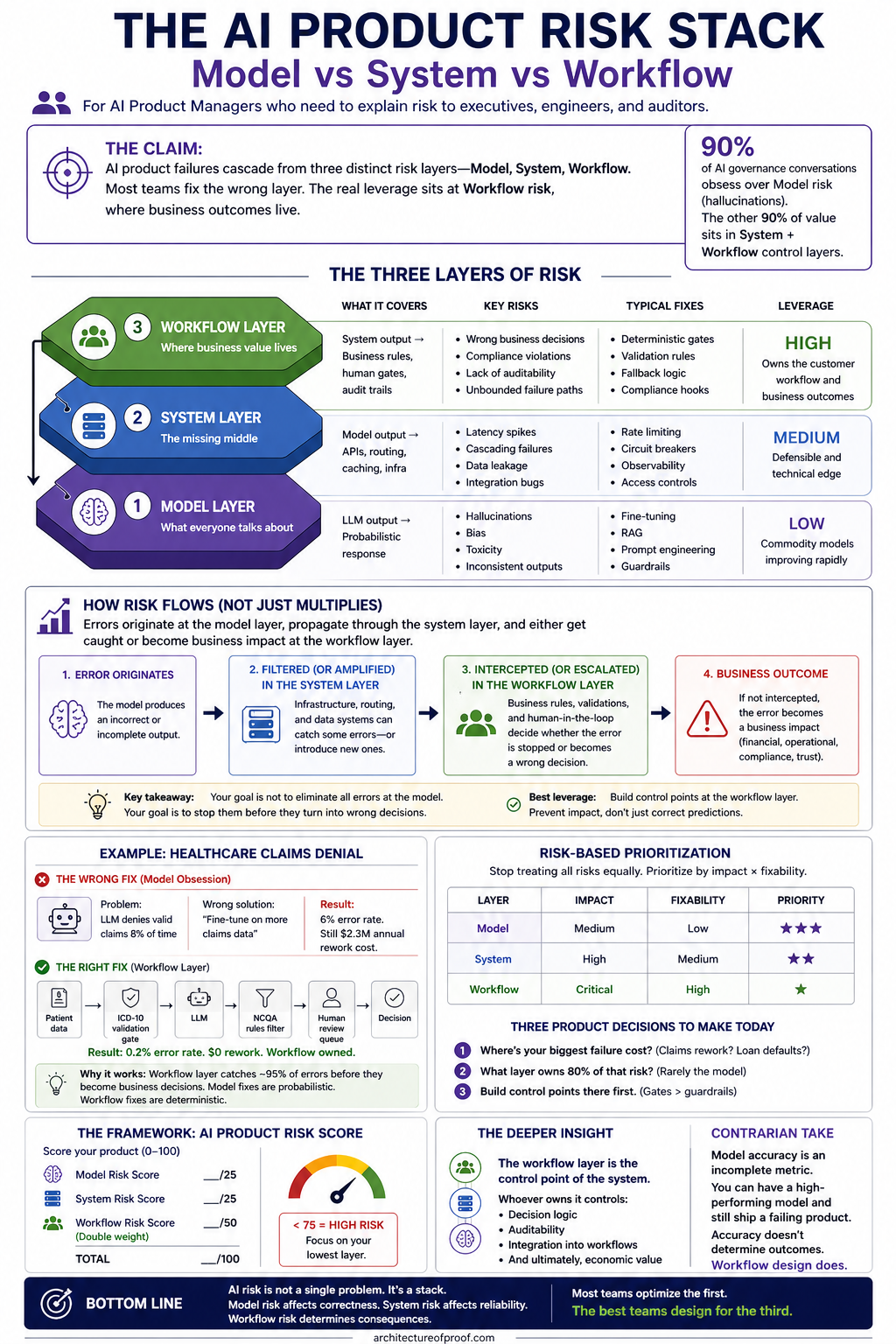
Full Resource Map
The AI Product Risk Stack is an operational framework spanning statistical, infrastructure, and workflow control planes. Below is the high-fidelity visual map for architectural reviews and governance audits.
Click to expand the full resolution map
One-Line Synthesis
A model creates capability, but the product determines authority. AI risk is governed not by model accuracy alone, but by the independence of the evidence, the scope of the authority, the speed of containment, and the recoverability of the resulting state change.
The ideas in this post are my own — they emerged from questions I asked while learning applied AI concepts and putting them to work in my job and my projects. The prose was developed with AI assistance.
Frequently Asked Questions
What is the AI Product Risk Stack?
The AI Product Risk Stack is an architectural framework that decomposes AI risk into three analytical boundaries: Model Capability, System Propagation, and Workflow Consequence. Rather than treating risk as a property of model accuracy alone, it focuses on the control points where probabilistic uncertainty is granted authority to execute state changes.
Why is model accuracy insufficient for determining product safety?
A model error is not inherently a product failure. The product determines whether that error becomes consequential. A 1% error rate in an internal drafting tool carries bounded consequence, whereas an uncontained 0.1% error rate in an automated claims adjudication pipeline can create severe regulatory sanctions, patient harm, and operational liability.
How does the workflow layer relate to enterprise liability?
The workflow is the decisive operational control point because it determines whether a probabilistic completion can mutate business state. That makes workflow design central to enterprise accountability, even when contractual and legal liability is distributed across vendors, integrators, and deploying entities.
Why doesn't a policy-as-code gate prove that a decision is correct?
A policy engine evaluates structural invariants and business rules against provided data. It can enforce compliance, but it cannot verify factual correctness if the underlying model extracted invalid premises. Verifying factual correctness requires independent evidence and out-of-band validation.
What is the Net Automation Value threshold?
Net Automation Value equals Avoided Work minus Review Cost, Control Cost, and Expected Failure Cost. An AI control plane fails commercially if the operational burden of verification, human escalation, and containment exceeds the economic value of the automation.
Download the Architecture of Proof Checklist
Ready to implement? Get the definitive checklist for building verifiable AI systems.