OpenAI Teardown: ChatGPT as Platform vs. Product Surface: The Control Point Dilemma
A Product Strategy & Systems Architecture Teardown for AI Product Leaders, Principal Systems Architects, and Technology Strategists
The strategic battleground of enterprise AI centers on the conversation interface rather than raw parameter counts. Whoever controls the interface controls the user's intent, the context window, and the routing authority to every downstream tool, API, and transaction.
Why Does Interface Control Outweigh Foundation Model Weights?
For the first eighteen months of the generative AI deployment wave, industry attention focused on frontier foundation model scaling: pre-training compute clusters, GPU cluster interconnects, and benchmark leaderboards (such as MMLU, GSM8K, and HumanEval). The prevailing venture thesis held that the organization training the largest, most capable model would capture the entire value chain.
That thesis has collapsed under empirical market reality.
Foundation model capabilities are experiencing rapid commoditization:
-
Open-weights models (such as Llama, DeepSeek, and Mistral) regularly achieve 95%+ relative performance parity with proprietary frontier checkpoints within three to six months of release.
-
Algorithmic distillation, post-training reasoning enhancements, and quantized execution allow lightweight models ($8\text{B}$ to $70\text{B}$ parameters) to execute specialized tasks at 1/50th the inference cost of monolithic frontier models.
-
Enterprise buyers increasingly treat raw inference endpoints as fungible utility commodities, aggressively routing queries across multi-model gateways based purely on spot latency and token pricing.
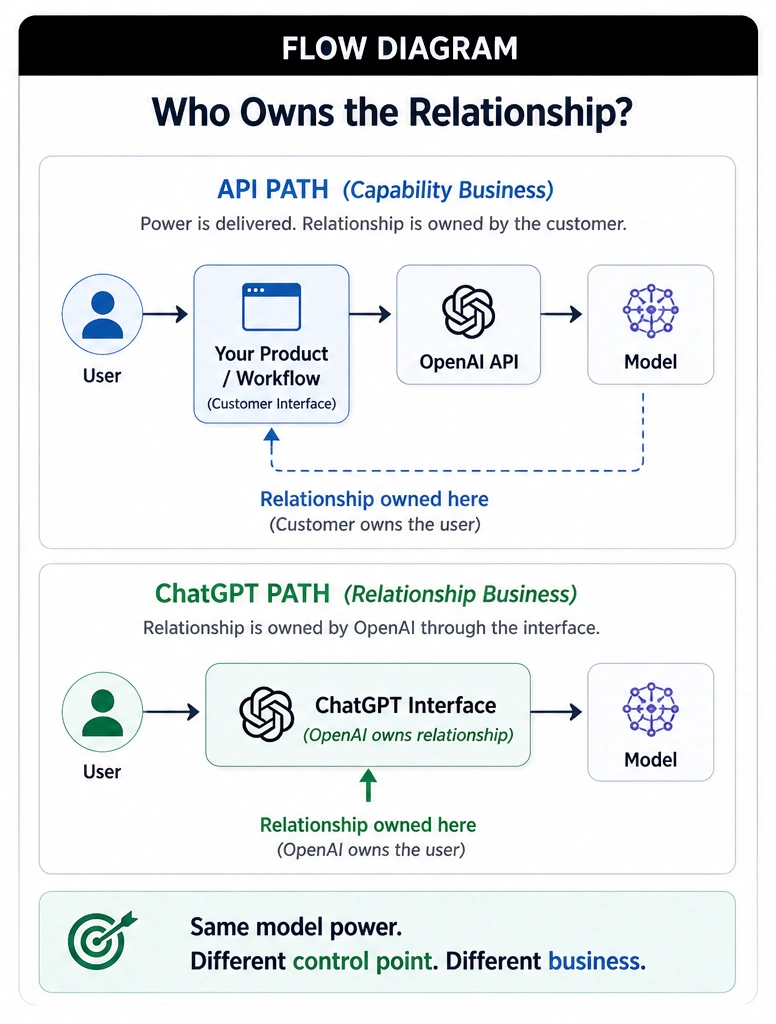
OpenAI recognized early that selling raw model access via an API is a capability business subject to structural margin compression. In a capability business, customers purchase building blocks: tokens per second, batch throughput, and parameter scale. The buyer is an engineering team that views the model provider as an upstream vendor to be negotiated down, abstracted away, or replaced with self-hosted open-weights infrastructure.
In contrast, ChatGPT is a relationship business.
| Strategic Dimension | The API (Capability Business) | ChatGPT (Relationship & Interface Business) |
|---|---|---|
| Primary Buyer | Software Engineers, MLOps Leads, Enterprise IT | Knowledge Workers, End Users, Prosumers, Enterprise Teams |
| Purchased Asset | Ephemeral token inference and API throughput | Habit, accumulated context, workflow orchestration, and trust |
| Switching Costs | Extremely low (wrapper code swap, LiteLLM gateway routing) | High (stored memory, custom GPT library, chat history, muscle memory) |
| Economic Moat | Temporary benchmark delta (3–6 months) | Habitual default, intent interception, and ecosystem distribution |
| Value Capture Point | Variable compute cost per million tokens | Recurring SaaS subscription ($20–$200/mo) + transactional tool tax |
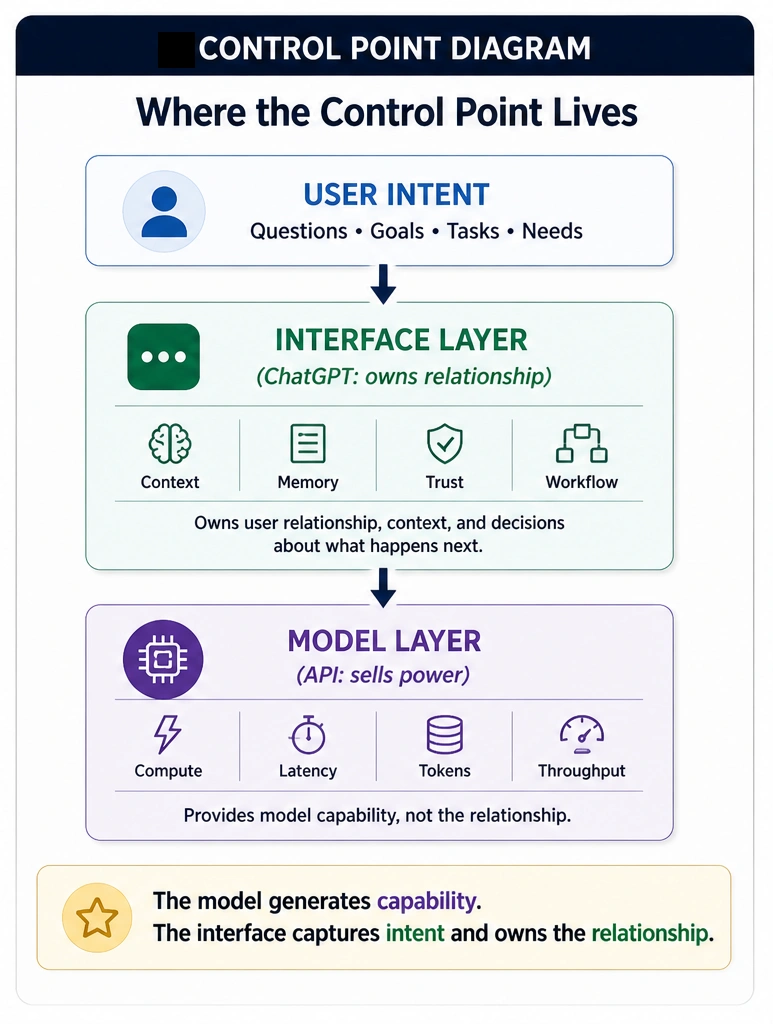
Whoever owns the interface captures the intent vector before the user opens a browser, initiates a database query, or triggers an enterprise workflow. Once an interface captures user habituation, it becomes the supervisory router for downstream digital workflows.
Why Is the Tension Between Product Surface and Platform an Architecture of Fragility?
The central architectural tension within ChatGPT is that OpenAI is attempting to build two fundamentally conflicting systems inside a single product boundary:
-
A Clean Product Surface: A high-speed, intuitive, and trustworthy personal cognitive assistant optimized for minimal cognitive friction, high coherence, and predictable conversational safety.
-
An Extensible Multi-Sided Platform: An open ecosystem (Custom GPTs, Actions, Search, Code Interpreter, Memory, Voice, and Shopping) optimized for third-party developer extensibility, transaction routing, and commercial monetization.
These two models operate on contradictory software and economic invariants:
| Architectural Property | Product Surface Invariant | Multi-Sided Platform Invariant |
|---|---|---|
| Latency Budget | P95 $< 1.2\text{s}$ to first token; seamless streaming. | Multi-second multi-turn tool calling, external API handshake, web crawl delays ($3.0\text{s}$ to $15.0\text{s}$). |
| Determinism & Trust | Predictable, calibrated tone; zero unexpected side effects. | Non-deterministic third-party tool execution; opaque API payload failures. |
| Context Assembly | Compact, high-precision system prompt and conversation history. | Bloated context window containing dynamic OpenAPI tool schemas, memory injections, and retrieval noise. |
| Monetization Model | Transparent, aligned subscription fee ($20/\text{month}$). | Commercial marketplace routing, sponsored placements, and affiliate transaction takes. |
The Neutrality Tax and Cognitive Fatigue
When a user treats ChatGPT as a thinking partner, they assume the system operates with epistemic neutrality: that its answers reflect the most accurate, unvarnished synthesis of facts available.
The moment ChatGPT transitions into a commercial platform, it incurs the Neutrality Tax. If an assistant recommends a specific SaaS accounting package, airline flight, or insurance policy, the user must evaluate a secondary incentive question:
"Is ChatGPT recommending this tool because it is mathematically and operationally optimal for my problem, or because the third-party developer pays OpenAI a higher transaction fee?"
Furthermore, platform sprawl creates severe cognitive fatigue. In 2023, ChatGPT was a clean text input. Today, the user is confronted with a dense matrix of choices: model pickers (GPT-4o, o1, o3-mini), web search toggles, deep research modes, custom canvas windows, voice interfaces, and custom GPT directories. When a product expands its platform scope faster than its interface abstraction layer can simplify, the product becomes more capable while feeling significantly less reliable.
How Does ChatGPT Map to the Architecture of Proof Control Tiers?
To evaluate the operational safety and enterprise readiness of ChatGPT, we map its subsystem capabilities across the Architecture of Proof Control Tiers:
| AoP Control Tier | System Boundary | ChatGPT Architectural Implementation | Failure Envelope & Risk Exposure |
|---|---|---|---|
| Tier 0: Observe & Suggest | Model drafts text, brainstorms, and summarizes; human retains 100% action ownership. | Core Conversational Surface. Direct generation of code snippets, essays, and conceptual answers. | Plausible hallucinations, sycophantic agreement, and confident omissions. Fully contained because the system has zero execution hooks. |
| Tier 1: Act in Sandbox | Bounded, non-destructive execution within isolated software containers; automated rollback. | Advanced Data Analysis (Code Interpreter). Ephemeral Firecracker / gVisor microVMs executing sandboxed Python code. | Memory exhaustion, infinite loops, and data transformation errors. Container isolation prevents host system compromise. |
| Tier 2: Act with Breakers | Autonomous execution of external actions (API webhooks, live browsing, third-party transactions). | Custom Actions & Agentic Web Search. Function-calling routines that dispatch HTTP REST payloads to external endpoints. | Severe Vulnerability. Indirect prompt injection, broken parameter schemas, unmonitored financial transactions, and silent timeout cascading. |
| Tier 3: Human-Only Air-Gap | Consequential legal, clinical, and financial commitments legally reserved for certified humans. | Explicit System Boundaries. OpenAI terms of service explicitly disclaim professional liability for statutory compliance. | Regulatory sanction, fiduciary breach, and uninsurable tort liability if users deploy raw model outputs into autonomous production decisions. |
| Execution Pathway | Orchestration Layer | Runtime Environment | Output & State Mutation |
|---|---|---|---|
| Tier 0: Direct LLM Route | Intent Routing Classifier | Multi-tenant transformer cluster | Streaming token response (zero external state mutation) |
| Tier 1: Sandboxed VM Route | Code Interpreter Dispatch | Ephemeral gVisor / Firecracker microVM | Generated charts, processed files, CSV downloads |
| Tier 2: Action Gateway Route | Function-Calling API Handler | External third-party REST webhook | Mutated external state (emails, DB commits, purchases) |
The fundamental architectural vulnerability of ChatGPT resides in Tier 2. In consumer software, popping up a modal that asks the user to authorize external tool integration passes the safety burden to the user. In an enterprise environment, this represents an acute governance risk: users approve permissions without understanding whether the retrieved context contains prompt injection payloads that force unauthorized data exfiltration.
What Are the True Unit Economics of Generalist Reasoning Versus Tool Chaining?
The economics of ChatGPT present a structural challenge: fixed subscription revenue versus open-ended variable inference cost curves.
When a user pays $\$20/\text{month}$ for ChatGPT Plus, OpenAI captures a predictable, linear revenue stream. However, the inference cost incurred by that user varies across three orders of magnitude depending on feature engagement:
$$\text{Session Cost} = \sum_{t=1}^{T} \left( C_{\text{prefill}} \cdot N_{\text{context}} + C_{\text{gen}} \cdot N_{\text{output}} + C_{\text{tool}} + C_{\text{search}} \right)$$
| Usage Tier | Operational Interaction Pattern | Estimated Monthly Inference Cost | Contribution Margin |
|---|---|---|---|
| Casual Prosumer | 5 short text queries/day; zero code execution; lightweight prompts. | $\$1.80 / \text{month}$ | $+91\%$ (Highly Profitable) |
| Active Developer | 30 coding sessions/day; frequent multi-file context uploads; code interpreter. | $\$18.50 / \text{month}$ | $+7.5\%$ (Breakeven) |
| Deep Reasoning & Agentic User | 15 multi-step chain-of-thought runs (o1/o3-mini); continuous web search & python analysis. | $\$65.00 – \$140.00 / \text{month}$ | $-225\%\text{ to }-600\%$ (Deeply Negative) |
This dynamic creates the Heavy-User Subsidy Trap: OpenAI's most active power users: those who run deep reasoning models, execute long Python scripts, and chain multiple external tools: generate negative unit margins under flat-rate subscription models.
To preserve solvency as agentic capabilities mature, OpenAI must execute one of three architectural maneuvers:
-
Enforce Hard Rate Ceilings: Strict daily limits on reasoning tokens and external tool calls, restricting power users.
-
Shift to Metered Usage: Transitioning prosumers to variable credit billing (similar to cloud utility computing), eliminating the consumer comfort of the flat subscription.
-
Monetize the Ecosystem Gateway: Levying a platform distribution fee on third-party developers, turning ChatGPT into an App Store marketplace.
The PM's Conversational Interface Control Gate: 5 Questions for Product & Platform Reviews
To evaluate whether a conversational interface product builds defensible enterprise custody or exposes users to unhedged non-deterministic risk, bring this checklist to PRD reviews:
| Control Vector | Architectural Inspection Check | Red Flag Condition (Interface Vulnerability) | PM Mandate & Action |
|---|---|---|---|
| 1. Tool Schema Isolation | Does the gateway dynamically inject only relevant tool definitions per turn? | System prompt inflates with 50+ third-party OpenAPI schemas, degrading context quality. | Implement two-stage semantic tool dispatch; inject at most 3 relevant tool schemas per turn. |
| 2. Indirect Injection Defense | Are external web search results and uploaded files parsed through a sanitizing AST sandbox? | Model executes untrusted instructions found inside web pages or uploaded documents. | Quarantine external retrieval into read-only sandboxes; strip raw control tokens before model ingestion. |
| 3. Epistemic Neutrality | Are tool recommendations and citations decoupled from commercial monetization incentives? | System biases recommendations toward sponsored vendor tools (Neutrality Tax). | Separate organic reasoning from sponsored placements; label commercial actions explicitly. |
| 4. Heavy-User Margin Protection | Are recursive reasoning and tool-calling loops constrained by dynamic compute budgets? | Power users execute unlimited multi-hop reasoning loops on flat-rate subscription tiers. | Enforce per-session compute circuit breakers; meter reasoning tokens above baseline thresholds. |
| 5. Admissible Execution Proof | Does external tool calling emit signed receipts detailing exact payloads and human sign-offs? | Actions execute via silent API calls without a cryptographically verifiable execution log. | Mandate Decision State Vector emission for all Tier 2 external state mutations. |
How Does a Generic Chatbot Compare to the Enterprise Proof Standard?
| Dimension | Consumer ChatGPT Architecture | Enterprise Architecture of Proof Standard |
|---|---|---|
| Execution State | Non-deterministic, probabilistic stream | Immutable, deterministic Decision State Vector (DSV) |
| Tool Orchestration | Probabilistic function calling with modal confirmation | Formally verified API contracts with automated circuit breakers |
| Auditability | Ephemeral browser chat history | Tamper-evident, cryptographically pinned execution ledger |
| Grounding Perimeter | Broad web search synthesis without coordinate proofs | Pinpoint source coordinate mapping with negative-evidence refusal |
| Liability Boundary | Disclaimed by vendor; 100% absorbed by end user | Bounded operating envelopes mapped to explicit Control Tiers |
The Adversarial Stress-Test: What Could Break OpenAI's Interface Moat?
To determine whether OpenAI's interface strategy is durable or fragile, we subject the ChatGPT platform thesis to five decision-forcing inquiries:
1. What is the strongest argument against this approach?
The Objection: Conversation is an ephemeral application layer, not an operating system. The strongest argument against OpenAI owning the primary digital interface is that native operating systems and hardware incumbents hold insurmountable architectural advantages. Apple (via Apple Intelligence on iOS and macOS), Google (via Android and Chrome), and Microsoft (via Windows kernel integration) sit beneath the application layer. An OS vendor possesses direct, sub-millisecond access to screen pixels, active memory, biometric telemetry, local filesystems, and cross-application clipboards. When an OS vendor integrates an on-device, zero-latency small language model into the keyboard, notifications, and system search, 80% of routine user intent is resolved locally before the user considers opening a browser tab. Standalone cloud conversational interfaces risk becoming an unnecessary, high-latency intermediate hop.
The Practical Resolution: Standalone conversational interfaces survive OS encroachment by evolving into enterprise systems of record and cross-cloud collaboration planes rather than remaining personal device assistants. While Apple and Microsoft control local device interactions, enterprise work requires multi-platform context graphs, federated tenant permissions, and neutral cloud-to-cloud tool execution that proprietary OS vendors cannot easily unify without antitrust scrutiny. The interface defensibility shifts from consumer mobile queries to multi-user enterprise knowledge orchestration.
2. Under what circumstances would this fail?
The Failure Mechanism: The platform collapses under context contamination, tool saturation, and indirect prompt injection. As users accumulate persistent memory, custom system instructions, and dozens of third-party tool connections, the effective context window degrades. Irrelevant memory fragments inject subtle hallucinations, and competing tool definitions trigger non-deterministic function routing errors. Crucially, the moment an agentic model reads untrusted external data (such as web pages, emails, or uploaded PDFs), hidden prompt injections can hijack the execution context, exfiltrating private user data to attacker-controlled endpoints.
The Practical Resolution: Isolate memory retrieval and tool schemas using two-stage deterministic routing: a lightweight intent classifier dynamically injects only the specific tool schema required for the immediate turn, keeping system prompts compact. To neutralize indirect prompt injection, all external data retrieval must execute in an isolated, read-only untrusted sandbox that strips control tokens and parses content through deterministic AST validators before passing sanitized facts to the reasoning model.
3. What would a skeptical customer, client, or colleague object to?
The Skeptical Pushback: Enterprise engineering leaders and compliance officers will object that building core operational workflows on an unpinned, non-deterministic cloud endpoint is an unacceptable business risk. OpenAI continuously recalibrates, fine-tunes, and safety-patches production models without backward-compatible regression guarantees: a prompt chain that functions on Tuesday can experience calibration collapse or refusal spikes on Friday. Furthermore, Custom GPTs offer zero verifiable execution lineage, disclaim all statutory liability, and route sensitive data across multi-tenant GPU clusters.
The Practical Resolution: Provide enterprise customers with cryptographically pinned model checkpoint versions guaranteed against unannounced alignment drift for 12 months. Replace open-ended chat sessions with structured execution envelopes that log version-pinned prompt hashes, retrieval chunk coordinates, model seeds, and deterministic schema outputs, delivering admissible audit trails that satisfy SOC 2, HIPAA, and regulatory non-repudiation standards.
4. Which alternative deserves more consideration?
The Counter-Architecture: Unbundled, Domain-Specific Scaffolding with Tactile High-Density Interfaces. The tech industry assumes that a single generalist conversational portal will swallow all knowledge work. The superior enterprise architecture is unbundled domain scaffolding: specialized systems of record that wrap compact, task-specific models inside deterministic state machines and domain-native interfaces. Software engineers prefer IDE-native AST integrations (e.g., Cursor); legal teams require Bates-stamped discovery platforms (e.g., Harvey); financial analysts demand tabular spreadsheet models. High-density tactile ergonomics consistently outperform a blank conversational chat box for complex work.
The Practical Resolution: Rather than forcing all knowledge workflows into a generic conversational window, deploy composite architectures where generalist reasoning models operate as background orchestrators powering domain-native, tactile UI components (diff editors, interactive DAG canvases, and live data grids). Conversational text is reserved strictly for intent clarification, while operational work execution happens within high-density structured visual surfaces.
5. What am I assuming that may not be true?
The Latent Vulnerability: We assume that conversational chat is the permanent paradigm for AI interaction, and that generalist frontier models will perpetually outperform specialized composite systems. In reality, conversational prose is high-latency, ambiguous, and cognitively exhausting. The future may belong to ambient, multi-agent background orchestration where software detects intent from user actions, drafts diffs asynchronously, and requests a single binary approval click, bypassing conversational dialogue entirely.
The Practical Resolution: Design interaction architectures around ambient intent interception and passive proposal generation rather than multi-turn conversational turn-taking. Instrument client applications to detect workflow friction, generate background state mutations backed by deterministic proof receipts, and surface structured validation cards to the operator, slashing cognitive fatigue and token consumption simultaneously.
What Is the Core Architecture Invariant?
Conversational AI defensibility compounds through user interface habituation, proprietary accumulated context, and governed execution perimeters anchored to systems of record.
Frequently Asked Questions
Why is the conversation interface the true strategic control point in generative AI?
Because raw foundation model weights are rapidly commoditizing through open-source weights and algorithmic distillation. The conversation interface captures user intent, accumulates multi-session context, governs tool orchestration, and acts as the gatekeeper for third-party commerce and software execution.
What is the difference between OpenAI's API business and the ChatGPT product surface?
The API is a capability business selling raw compute and token throughput to developers who embed intelligence into their own software. ChatGPT is a relationship business that monetizes habituation, context retention, and user trust within an active product surface.
What is the Neutrality Tax in consumer AI interfaces?
The Neutrality Tax is the erosion of user trust that occurs when an AI assistant monetizes via sponsored search results, affiliate tool routing, or commerce commissions, forcing the user to question whether an answer was generated for objective accuracy or corporate revenue.
How does ChatGPT map to the Architecture of Proof Control Tiers?
ChatGPT operates safely across Tier 0 (Observe & Suggest) and Tier 1 (Sandboxed Code Interpreter), but experiences severe failure modes in Tier 2 (Autonomous Web & Tool Calling) where non-deterministic routing, prompt injection, and missing circuit breakers create unhedged operational risk.
Why could operating system integration displace standalone conversational chatbots?
Native OS platforms like Apple Intelligence and Windows have kernel-level access to screen state, cross-application context, and on-device hardware sensors. If an operating system executes local, zero-latency cognitive assistance, standalone cloud web chat becomes an unnecessary intermediate hop.
Subscribe to the Architecture of Proof Dispatch
Rigorous, decision-forcing systems engineering and AI governance monographs for technical leaders. Delivered periodically, zero spam.