Risk Allocation as a Product Responsibility: The Forensic Audit

Why Do Production AI Defects Surface Multiple Layers Upstream?
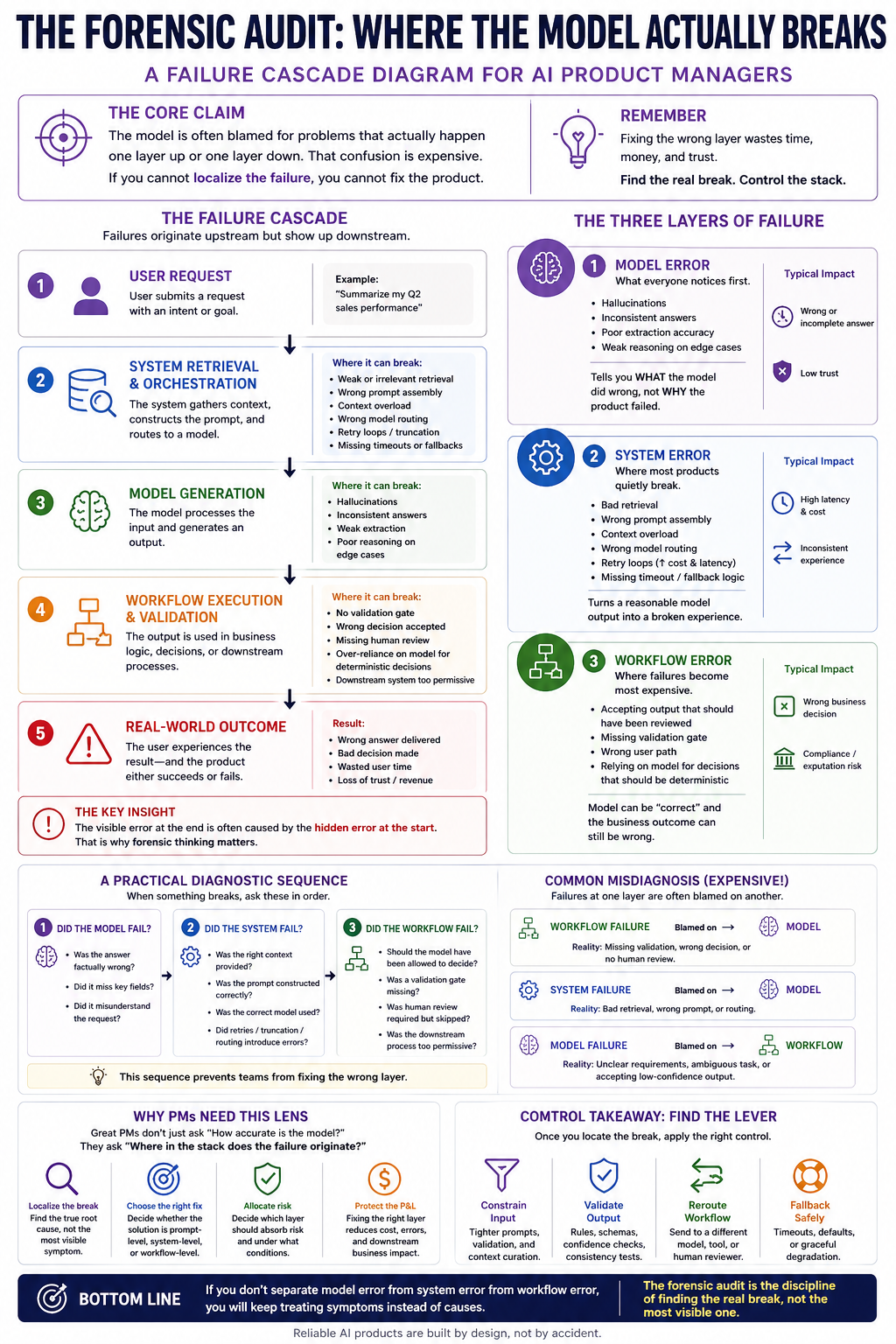
Production AI failures rarely stem from a single catastrophic model hallucination. They emerge from an unmonitored chain of minor breakdowns that compound across three architectural strata: the model layer, the orchestration fabric, and the surrounding business workflow. By the time a defect surfaces in the user interface, the root cause sits multiple layers upstream.
Diagnosing the failure layer correctly determines whether engineering capital resolves the underlying systemic risk or merely patches a symptom.
Who Decides Where the AI System Is Permitted to Fail?
Engineering teams routinely blame foundation models for vulnerabilities originating one layer above or one layer below the inference call. That diagnostic confusion carries severe financial and operational costs: squads burn quarters tweaking prompts when the retrieval pipeline is delivering corrupted chunks, swap foundation models when API routing heuristics are misconfigured, or redesign entire interfaces when the product simply lacks deterministic schema validation.
Architecture determines how the system is built. Product determines where the system is permitted to fail.
How Is Risk Distributed Across the Three-Tier AI Stack?
AI product failures distribute across three distinct architectural strata:
| Risk Stack Layer | Primary Failure Manifestation | Operational Root Cause | Architectural Containment Strategy |
|---|---|---|---|
| Model Error | Factual hallucinations, reasoning lapses on domain edge cases, inconsistent format compliance. | Transformer statistical distribution limits, token context compression, stochastic temperature variance. | Bounded temperature sampling, task-specific fine-tunes, structured output decoders. |
| System Error | Truncated retrieval context, malformed prompt assembly, retry storms, runaway API latencies. | Vector database retrieval noise, fragile API gateway logic, missing timeout and fallback state machines. | Strict input schema validation, deterministic retry ceilings, circuit-breaker fallback routers. |
| Workflow Error | Plausible hallucinations committed to production databases, unverified business actions, compliance breaches. | Overly permissive acceptance logic, absence of human-in-the-loop gates, unhedged operational liability. | Cryptographic authority gates, AST policy verifiers, deterministic state-transition interlocks. |
A foundation model can generate a statistically valid, syntactically flawless completion, and the enterprise product can still suffer catastrophic failure.
How Do Minor Retrieval Glitches Cascade Into High-Liability Failures?
Failures in probabilistic software compound across layer boundaries:
graph TD
    A[User Request / Upstream Trigger] --> B[System: Weak Retrieval / Corrupted Context]
    B --> C[Model: Plausible but Incomplete Inference]
    C --> D[Workflow: Accepted without Deterministic Verification]
    D --> E[Outcome: Visible Production Defect & Liability Event]

    style B fill:#fff3e0,stroke:#ff9800
    style C fill:#fff3e0,stroke:#ff9800
    style D fill:#fff3e0,stroke:#ff9800
    style E fill:#ffebee,stroke:#f44336,stroke-width:2px
The visible failure appears at the terminal node, yet the root cause sits at the initial retrieval or prompt assembly boundary. Without disciplined forensic localization, teams inevitably patch the symptom at the terminal interface rather than repairing the structural break.
How Do Product Teams Execute the Three-Phase Forensic Triage?
When a production defect occurs, product managers must execute a disciplined three-phase forensic triage:
| Diagnostic Phase | Forensic Investigation Query | Systemic Root-Cause Indicator | Immediate Remediation Action |
|---|---|---|---|
| Phase 1: Model Audit | Did the model hallucinate, misinterpret instructions, or fail reasoning bounds? | Output contradicts provided context or violates basic domain logic. | Adjust temperature, refine system instructions, or escalate model capability tier. |
| Phase 2: System Audit | Was the context window flooded, retrieval noisy, or prompt concatenation corrupted? | Semantic retrieval chunks contain irrelevant noise or exceed optimal token density. | Optimize chunking strategies, filter rerankers, and enforce strict token budgets. |
| Phase 3: Workflow Audit | Should a probabilistic model have been granted decision authority over this state transition? | An autonomous state mutation occurred without deterministic policy validation. | Insert deterministic validation gates, enforce schema checks, or mandate human review. |
The PM's Forensic Incident Triage Checklist: 5 Questions for Cross-Functional Post-Mortems
When an AI production failure occurs, the lead PM should run this forensic protocol before engineering touches prompts or weights:
| Diagnostic Layer | Post-Mortem Inquiry | False Culprit (Symptom) | Mandatory Architectural Remediation |
|---|---|---|---|
| 1. Ingress & Schema | Did the client payload pass strict schema validation and token budgets before inference? | "The model hallucinated bad formatting." | Add strict Pydantic parsing and schema rejection at the API gateway. |
| 2. Retrieval & Context | Was context window flooded with low-relevance chunks or outdated database records? | "The model gave wrong domain facts." | Enforce minimum cosine similarity thresholds ($> 0.72$) and semantic rerankers. |
| 3. Inference Bounds | Did the model contradict verified retrieval context or hallucinate beyond provided sources? | "We need a larger foundation model." | Clamp temperature, tighten system instructions, and add deterministic citation span verifiers. |
| 4. Workflow Interlocks | Did an autonomous state mutation commit to the database without deterministic policy checks? | "The agent made an unauthorized transaction." | Implement hard Policy-as-Code gates and circuit breakers outside model control. |
| 5. Observability Trace | Can SRE reconstruct the exact payload, prompt template ID, and retrieval hashes via trace_id? |
"We can't reproduce what happened yesterday." | Enforce OpenTelemetry distributed trace propagation across all gateway and database spans. |
Executing triage in this sequence prevents teams from misallocating scarce engineering bandwidth to prompt adjustments when the surrounding system demands deterministic validation.
How Should Governance Intensity Align With Failure Cost?
Operational reliability does not require making every layer foolproof. It requires aligning governance intensity with decision consequence. We map the layers of the risk stack across two operational vectors: Determinism (predictability of execution) and Failure Cost (severity of downstream consequence).
quadrantChart
    title Risk Allocation & Control Strategy
    x-axis Low Determinism --> High Determinism
    y-axis Low Failure Cost --> High Failure Cost
    quadrant-1 High Control Needed
    quadrant-2 Safeguards & Monitoring
    quadrant-3 Low Risk Zone
    quadrant-4 Process Efficiency
    Base Model Inference: [0.2, 0.8]
    System Routing: [0.5, 0.5]
    Workflow Logic: [0.9, 0.9]
Navigating Control Boundaries
As a product capability moves toward the top-right quadrant, reliance on probabilistic inference must decrease in favor of deterministic controls:
| Matrix Quadrant | Operating Profile | Architectural Governance Mandate | Concrete Technical Defense |
|---|---|---|---|
| Workflow Logic (Top-Right) | High Determinism, High Failure Cost | Absolute deterministic enforcement; zero unverified probabilistic state commits permitted. | Pydantic contracts, AST parsers, immutable ledger logging. |
| Base Model Inference (Top-Left) | Low Determinism, High Failure Cost | Rigorous containment; probabilistic completions treated as unverified candidate proposals. | Multi-agent critique juries, semantic anomaly monitors, confidence thresholds. |
| System Routing (Center) | Moderate Determinism, Moderate Cost | Orchestration resilience; graceful degradation under external API latency or provider outages. | Circuit breakers, exponential backoffs, fallback heuristic engines. |
| Low Risk Utilities (Bottom-Left) | Low Determinism, Low Failure Cost | Operational efficiency; lightweight telemetry without blocking downstream workflows. | Asynchronous batch logging, passive cohort sampling. |
How Does the Risk Allocation Strategy Map Guide Architectural Reviews?
The forensic audit functions as both a tactical debugging protocol and a long-term architecture roadmap. To evaluate feature boundaries during architectural reviews, product teams use the visual Risk Allocation Strategy Map below:
Click to expand the full resolution strategy map
The Adversarial Stress-Test: What Could Break the Forensic Audit Protocol?
To stress-test the forensic risk allocation framework against real-world engineering and organizational failure, we address five critical inquiries:
1. What is the strongest argument against this approach?
The Objection: Decomposing every AI defect into a multi-layered forensic audit introduces significant operational overhead and analysis paralysis. Fast-moving product teams under pressure to ship competitive generative features will bypass rigid postmortem protocols in favor of rapid, heuristic prompt tweaks that resolve 80% of visible user complaints immediately.
The Practical Resolution: Establish a tiered incident classification threshold. Low-impact cosmetic defects (such as conversational phrasing or minor UI formatting) bypass the full forensic audit and resolve via fast-track prompt iteration. The complete multi-layer forensic audit is mandated exclusively for high-consequence incidents: data corruption, financial transaction errors, compliance breaches, or recurring P99 latency spikes. This concentrates diagnostic rigor where operational liability resides.
2. Under what circumstances would this fail?
The Failure Mechanism: The forensic audit breaks down when system observability is fragmented across disjointed logging stacks. If the vector retrieval pipeline logs to Datadog, the LLM gateway logs to a vendor cloud, and the business application records state transitions in a relational database without a shared correlation ID, engineering teams cannot reconstruct the end-to-end execution trace, rendering forensic layer localization impossible.
The Practical Resolution: Enforce distributed trace propagation at the gateway layer using OpenTelemetry standards. Every inbound user request generates an immutable trace_id that is injected into retrieval chunk headers, prompt metadata envelopes, model inference payloads, and downstream database transaction records. Postmortem tooling automatically stitches these disparate logs into a unified forensic timeline.
3. What would a skeptical customer, client, or colleague object to?
The Skeptical Pushback: Enterprise customers and internal legal counsel will argue that allocating risk across internal technical layers is an internal engineering abstraction that does nothing to shield them from third-party regulatory liability or breach of contract when an AI system hallucinates a binding commitment.
The Practical Resolution: The internal risk allocation framework directly underpins external contractual warranties. By proving that probabilistic model outputs are strictly quarantined from production databases by deterministic workflow gates, the enterprise can offer legally enforceable Service Level Agreements (SLAs) backed by tamper-evident audit logs that demonstrate compliance to insurers and regulators.
4. Which alternative deserves more consideration?
The Counter-Architecture: End-to-End Model Fine-Tuning with RLHF. Instead of engineering complex deterministic system scaffolding, routing cascades, and multi-layer validation checks, invest capital entirely into fine-tuning a proprietary foundation model on thousands of curated domain-specific examples until the model natively avoids hallucination and respects operational boundaries.
The Practical Resolution: Even extensively fine-tuned models remain probabilistic engines susceptible to catastrophic forgetting, distribution shift, and adversarial jailbreaks. Fine-tuning improves average-case performance but provides zero deterministic guarantees. The production standard combines fine-tuning for domain fluency with deterministic external workflow gates for non-negotiable legal and financial invariants.
5. What am I assuming that may not be true?
The Latent Vulnerability: We assume that engineering teams can cleanly distinguish between a "model error" and a "system error" in complex agentic pipelines where multi-hop reasoning loops dynamically alter downstream prompt assembly.
The Practical Resolution: Implement formal component contracts between the orchestration harness and the model. Define explicit quantitative boundaries: if the retrieval layer delivers context with cosine similarity below 0.72, any resulting hallucination is classified as a System Error; if retrieval passes validation yet the completion contradicts the provided context, it is classified as a Model Error. Measurable contract thresholds replace subjective debate with objective categorization.
One-Line Synthesis
Enterprise AI reliability compounds when engineering organizations stop treating failures as isolated model defects and allocate operational risk across deterministic input boundaries, orchestration safeguards, and legally enforceable workflow contracts.
Subscribe to the Architecture of Proof Dispatch
Rigorous, decision-forcing systems engineering and AI governance monographs for technical leaders. Delivered periodically, zero spam.