The First 5 Minutes: Why Your AI Product Is Already Leaking Value

One of the most dangerous myths in AI product management is that infrastructure costs are purely an "engineering problem." They aren't. In the age of token-based pricing and agentic loops, cost is a fundamental product constraint.
If your feature is "live" and user engagement looks good, but infrastructure costs are growing at 1.5x the rate of revenue, you have fallen into the 5-Minute Trap.
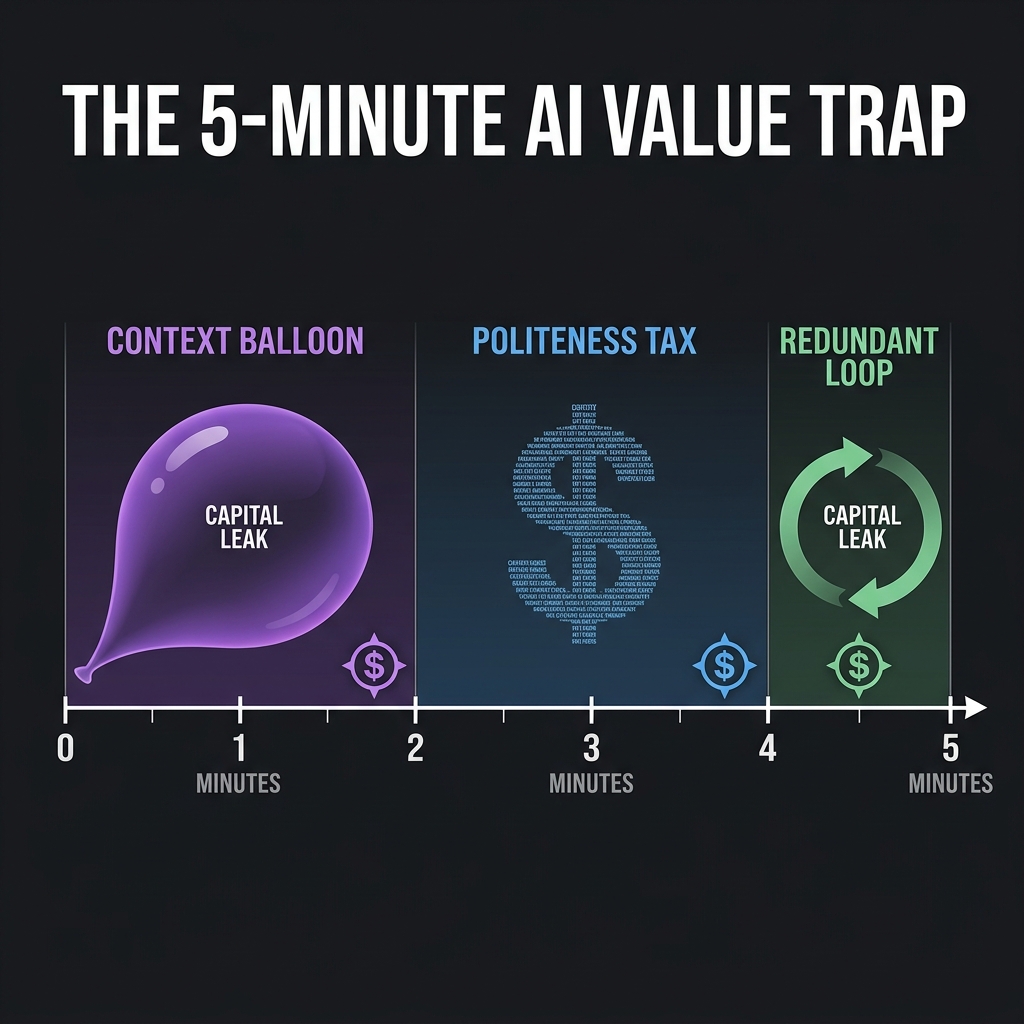
How Does Inference Slop Degrade Unit Margins Across the Session Lifecycle?
Most AI product dashboards present a deceptive picture: daily active engagement trends upward, user satisfaction appears stable, yet compute infrastructure expenditures compound at 1.5x to 2x the rate of top-line revenue. This margin collapse unfolds across three distinct session phases:
| Session Phase | Mechanical Leak | Compounding Economic Cost |
|---|---|---|
| Minute 0–2: Context Ballooning | System retransmits static system prompts (~500 tokens) and unpruned conversation state on every turn. | Fixed token overhead amortized across short turns drives effective cost-per-turn up by 300%. |
| Minute 2–4: Politeness Overhead | Models emit conversational preambles and conversational filler ("Certainly, I would be pleased to assist with that..."). | 30 to 60 wasted output tokens per response scale into hundreds of thousands of dollars in unmonetized inference at volume. |
| Minute 5+: Redundant Reflection Loops | Agentic loops repeatedly re-read early interaction turns to verify intermediate consistency without memory compaction. | Quadratic context growth forces high-tier reasoning models to process redundant historical tokens. |
Why Is Inference Cost an Upstream Product Architecture Invariant?
Teams frequently treat inference cost as a downstream infrastructure optimization reserved for platform engineers. While prompt caching and model quantization yield meaningful operational gains, they cannot compensate for defective product architecture. When an interface trades enterprise capital for trivial convenience without pricing that trade-off into the experience, it represents an upstream product failure.
graph LR
    A["User Query"] --> B{"Dynamic Value Gate"}
    B -- Low Complexity / High Frequency --> C["Quantized Local Model / Semantic Cache"]
    B -- High Ambiguity / High Liability --> D["Frontier Reasoning Engine / Tool Loop"]
    C --> E["Unified Synthesized Response"]
    D --> E

    style B fill:#FBF7F0,stroke:#1B1917,stroke-width:2px,color:#000
    style C fill:#f7f9f8,stroke:#1B1917,color:#000
    style D fill:#f7f9f8,stroke:#1B1917,color:#000
    style A fill:#fff,stroke:#1B1917,color:#000
    style E fill:#fff,stroke:#1B1917,color:#000
How Do You Instrument Contribution Margin per Interaction (CMPI)?
Traditional software metrics—such as Daily Active Users (DAU) or session duration—become vanity indicators when every user click triggers non-deterministic compute expenditure. Evaluating AI product viability requires instrumenting Contribution Margin per Interaction (CMPI):
$$\text{CMPI} = \text{Revenue per Interaction (RPI)} - \text{Cost per Interaction (CPI)}$$
$$\text{CPI} = C_{\text{prefill}} \cdot N_{\text{input_tokens}} + C_{\text{gen}} \cdot N_{\text{output_tokens}} + C_{\text{retrieval}} + C_{\text{tool_execution}}$$
When Cost per Interaction exceeds Revenue per Interaction, increased product adoption accelerates capital depletion.
What Are the Three Architectural Drivers of Production Inference Leaks?
| Architectural Failure | Root Cause | Structural Remedy |
|---|---|---|
| Unbounded Context History | Retransmitting complete multi-turn session transcripts on every query turn. | Implement sliding-window state machines with recursive extractive summarization. |
| Preamble and Output Verbosity | Unconstrained free-form generation emitting conversational filler. | Enforce grammar-constrained JSON decoding and strict output length budgets. |
| Monolithic Model Routing | Routing simple factual lookups and complex multi-step reasoning through the identical frontier model. | Deploy semantic intent classifiers that dynamically dispatch 80% of volume to lightweight sub-models. |
How Do You Diagnose Token Bloat in Production Session Telemetry?
Auditing session logs reveals clear structural signatures of unmanaged inference consumption:
| Diagnostic Pattern | Telemetry Indicator | Architectural Correction |
|---|---|---|
| System Prompt Bloat | System instructions exceed 400 tokens per interaction turn. | Extract dynamic context into episodic vector memory; maintain a lean 80-token invariant core. |
| Conversational Preamble | First 25 output tokens contain zero actionable domain assertions. | Pre-fill response tokens or enforce negative constraint grammars against conversational filler. |
| Full History Replay | Quadratic token consumption growth plotted against session turn count. | Transition to delta-based state updates; store prior conversation state in external key-value caches. |
The PM's Session Token Budget Matrix: 5 Questions for PRD & Pricing Reviews
To prevent unmonetized inference from silently destroying feature margins, bring this diagnostic checklist to cross-functional PRD reviews and pricing syncs:
| Product Dimension | Architectural Verification Check | Red Flag Answer (Margin Leak) | PM Action & Mandate |
|---|---|---|---|
| 1. Output Length Enforcement | Does the interface enforce token budgets per intent class via grammar or JSON schema constraints? | "We let the model determine its own natural response length." | Impose max token ceilings in API payloads; route open-ended queries to structured UI widgets. |
| 2. Preamble & Filler Purge | Are response preambles ("Sure! As an AI assistant, I can help...") stripped via prompt prefilling or regex? | "Users like the conversational warmth so we leave it unconstrained." | Strip filler tokens; move conversational polish to client-side micro-copy and UI layout states. |
| 3. Context Window State Compaction | Does the session state machine compact historical turns after turn 3 into an immutable JSON fact sheet? | "We append the entire conversation history to the prompt on every turn." | Mandate extractive key-value compaction; stop quadratic token replay across multi-turn sessions. |
| 4. Tiered Intent Dispatch | Does the gateway route standard lookups and FAQ responses to sub-models ($0.15/M tokens)? | "All traffic routes through the frontier reasoning model for quality." | Establish a two-tier semantic router; force 75%+ of repeat queries to lightweight models. |
| 5. Margin Circuit Breaker | Is there a hard ceiling on cumulative inference spend per user session before re-authentication? | "A user can initiate 50 recursive tool calls in a single session without interruption." | Enforce an execution circuit breaker: cap session inference at 15% of seat ARPU. |
How Should Product Managers Design Under Strict Compute Constraints?
Effective product management in AI organizations requires establishing operational boundary conditions before engineering begins implementation:
| Architectural Boundary | Product Specification | Operational Mechanism |
|---|---|---|
| Economic Value Ceiling | Maximum tolerable inference expenditure per interaction class. | Hard compute circuit breakers that terminate recursive loops when cost exceeds transaction value. |
| Grammar Constraints | Bounded token production matching explicit user interface requirements. | Finite-state grammar engines restricting generation to target schema fields. |
| Tiered Model Dispatch | Cost-differentiated processing tiers mapped to user intent. | Edge classifiers that resolve ambient intent before invoking high-parameter cloud reasoning APIs. |
How Do You Execute a Five-Minute Operational Token Audit?
To expose hidden inference leaks, product teams should trace ten random production sessions: * Calculate total tokens consumed versus tokens delivering net-new information. * Quantify the exact gross margin for each interaction turn. * Identify the percentage of total expenditure consumed by static instruction repetition.
Discovering that more than 40% of session tokens represent structural overhead mandates pausing feature expansion until compute budgets and routing gates are operationalized.
The Adversarial Stress-Test: What Could Break Token Unit Economics?
1. What is the strongest argument against this approach?
The Objection: Aggressively constraining token outputs, stripping conversational filler, and routing queries to smaller models degrades user experience. Customers often perceive warm, polite, and extensive natural language answers as more intelligent, helpful, and empathetic than terse structured responses.
The Practical Resolution: Separate conversational warmth from computational waste. Product teams can deliver polished user interfaces through client-side UX micro-copy, animated progress states, and carefully designed typography rather than paying recurring frontier inference costs for conversational pleasantries. In high-frequency enterprise workflows, user telemetry consistently demonstrates that speed, precision, and low latency generate higher retention than long-winded conversational preambles.
2. Under what circumstances would this fail?
The Failure Mechanism: Aggressive context truncation and sliding-window compaction fail in multi-turn reasoning workflows where subtle constraints established in Minute 1 govern complex decisions made in Minute 8. If an overzealous summarization engine strips a critical constraint—such as a specific currency, jurisdiction, or regulatory exclusion—the downstream answer becomes dangerously inaccurate.
The Practical Resolution: Implement an explicit entity-and-constraint ledger decoupled from conversational history. Instead of blindly truncating or summarizing raw text, the system extracts critical facts, user constraints, and defined entities into a structured JSON state object that persists across all session turns. The model receives this compact state vector on every turn, preserving critical requirements without retransmitting thousands of conversational tokens.
3. What would a skeptical customer, client, or colleague object to?
The Skeptical Pushback: Engineering and finance counterparts often argue that model pricing drops by 50% to 80% every twelve months, meaning that spending engineering sprints optimizing token economics is a waste of effort because hardware efficiencies will naturally erase the cost problem.
The Practical Resolution: Compute demand always expands to consume available budget. As model unit costs drop, product requirements inevitably shift toward agentic loops, multi-modal video processing, and autonomous multi-agent tool execution, increasing total token consumption per session by an order of magnitude. Teams that master unit margin discipline sustain viable gross margins across every model generation, while undisciplined competitors remain perpetually unprofitable regardless of price declines.
4. Which alternative deserves more consideration?
The Counter-Architecture: Deterministic client-side caching and fine-tuned task-specific small language models (SLMs) running on edge infrastructure deserve greater investment than optimizing centralized prompt pipelines to third-party frontier APIs.
The Practical Resolution: Build an asymmetric routing architecture. Fine-tune open-weight 3B-to-8B parameter models specifically for the top 5 recurring intents of your application and host them in dedicated, low-cost inference clusters or on client hardware. Route only the ambiguous 15% long-tail queries to frontier cloud reasoning models. This reduces blended cost-per-interaction by up to 85% while delivering sub-200ms response times for the majority of user sessions.
5. What am I assuming that may not be true?
The Latent Vulnerability: We are assuming that users engage with AI features in linear, predictable five-minute sessions. In reality, enterprise users frequently open multiple parallel agentic threads, leave sessions idle for hours, or trigger background asynchronous workflows that run without human monitoring, creating distributed token leakage that escapes standard session-based tracking.
The Practical Resolution: Instrument telemetry at the organization, user, and background worker level rather than solely within client UI sessions. Assign every autonomous background task a strict maximum token and financial budget token upon creation. If a background worker exhausts its budget without achieving convergence, the orchestration layer triggers an automated pause and requests explicit human reauthorization.
What Is the Core Takeaway for Technical Product Managers?
Sustainable AI gross margins demand that token economics operate as a foundational product design constraint governed by dynamic routing and strict context budgets.
Subscribe to the Architecture of Proof Dispatch
Rigorous, decision-forcing systems engineering and AI governance monographs for technical leaders. Delivered periodically, zero spam.